



Algae Products Market Size, Key Companies, Company Market Share, Production Volume, Consumption Trends, Pricing Analysis, Export & Import Dynamics, Competitive Positioning, and Demand Forecast
Food and beverage specialist Vidyesh Swar puts the algae products market at USD 6.47 billion in 2026, with the market expected to reach USD 11.53 billion by 2035 at a CAGR of 6.64%. Major algae products market companies such as Earthrise Nutritional, Cellana Inc., Algatechnologies are responding to changing consumer demand across segments including type, source, form, application, region.
Source: https://www.precedenceresearch.com/algae-products-market
 Get a Sample
 Table Of Content


What is the Algae Products Market Size?
The global algae products market size accounted for USD 6.06 billion in 2025 and is predicted to increase from USD 6.47 billion in 2026 to approximately USD 11.53 billion by 2035, expanding at a CAGR of 6.64% from 2026 to 2035. The algae products market is experiencing steady growth, driven by rising demand for natural ingredients, sustainable nutrition solutions, and innovative bio-based applications across the food, cosmetics, and industrial sectors.

Market Highlights
- The North America led the algae products market with a dominant market share in the 2025.
- The Asia Pacific is expected to grow at the fastest CAGR between 2026 and 2035.
- By type, the hydrocolloids segment captured the highest market share in 2025.
- By type, the astaxanthin segment is expected to expand at the highest CAGR from 2026 to 2035.
- By source, the brown algae segment held a dominant market share in 2025.
- By source, the blue–green algae segment is growing at the fastest CAGR between 2026 and 2035.
- By form, the solid segment contributed the largest market share in 2025.
- By form, the liquid segment is expected to grow at the fastest CAGR from 2026 to 2035.
- By application, the food and beverages segment held the major market share in 2025.
- By application, the personal care segment is expected to grow at the highest CAGR between 2026 and 2035.
Biomanufacturing: The Next Frontier in Sustainable Materials and Products
An increase in demand for sustainable ingredients and the transition to bio-based alternatives have sparked interest in products made from algae across the food and beverage and non-food sectors. Their potential versatility and low environmental footprint are driving the further acceleration of algae adoption.
The algae products market encompasses a wide range of microalgae and macroalgae, including nutraceuticals, functional foods, biofuels, pigments, and cosmetic actives. The benefits of algae products include nutrient density, renewable sourcing, and scalable growing potential. The algae products market continues to grow due to rising clean-label preferences, technological advancements in photo-bioreactors, and expanding applications of bio-products in pharmaceuticals and aquaculture. Companies are investing in strain optimization to increase productivity and efficient harvesting, cultivating higher-value products such as omega-3s, carotenoids, and hydrocolloids to improve economic viability and reduce production costs.
How AI Is Transforming Biotechnology and Bio-Based Industries
AI is speeding up research and development and scaling of algae products, from start-ups using machine learning to control cultivation, to firms using predictive models to optimize biomass and quality. For example, Pond Technologies announced plans to use AI to maximize light, nutrients, and carbon dioxide in 2025, which illustrates its intent to commercialize it and become part of the algae space. Academic review papers noted monitoring with AI, predictive maintenance and strain optimization as AI enablers for cost reductions and efficiency, and scalability.
Designers and culture are bringing attention to algae and new uses. Iris van Herpens living, bioluminescent dress recently caught attention for biology crossing into technology. New algae biotechs are harnessing AI, carbon capture, and automated bioprocessing in creative climate-tech start-ups while using carbon emissions from the environment to produce high-value proteins and ingredients and are therefore moving quickly on commercial pilots. In sum, we are seeing a fast-moving, technology-led transition to a global, algae-efficient, sustainable sector.
Algae Products Market Outlook
- Market Overview: Increasing consumer demand for natural ingredients, sustainably produced biomaterials and enriched supplements is helping to gain a foothold for algae-based products in mainstream applications. An increasing uptake in food and cosmetic products, bio fertilizers and biofuels, is reinforcing global sustainability objectives, which have been encouraged by environmental regulatory agencies.
- Global Growth: Countries that are prioritizing renewable feed stocks such as the U.S. Department of Energys algae bioenergy projects and EU-funded circular-bio-economy are bolstering international production capacity, inviting shared production among countries, and driving large-scale cultivation of algae.
- Research and Development: Government-funded programs focused on biotechnology and university centers that study algae are continuing to improve on strain engineering, photobioreactors to produce algae more effectively, and extraction processes allowing for pigment, protein, and bioactive production and quality at a lower cost.
- Sustainability Movement: The global push toward low-carbon solutions in agriculture, food and packaging, and energy is also increasing demand for bioplastics, bio fertilizers, and biofuels developed from algae. The demand movement is justified by global sustainability policies focused on reducing carbon emissions and incremental incentives for investments in green innovations.
- Expanded Use in Nutraceutical: Health-focused consumption in conjunction with regulatory approvals around DHA omega-3, antioxidants, and protein products made from algae, is also leading to a wider use of algae in fortified and functional food and wellness products. Growth in nutraceuticals is now further penetrating markets across regions.
Market Scope
| Report Coverage | Details |
| Market Size in 2025 | USD 6.06 Billion |
| Market Size in 2026 | USD 6.47 Billion |
| Market Size by 2035 | USD 11.53 Billion |
| Market Growth Rate from 2026 to 2035 | CAGR of 6.64% |
| Dominating Region | North America |
| Fastest Growing Region | Asia Pacific |
| Base Year | 2025 |
| Forecast Period | 2026 to 2035 |
| Segments Covered | Type, Source, Form, Application, and Region |
| Regions Covered | North America, Europe, Asia-Pacific, Latin America, and Middle East & Africa |
Algae Products Market Segmental Insights
Type Insights
Why Did Hydrocolloids Dominate the Algae Products Market in 2025?
The algae products market was led by hydrocolloids, which accounted for a large share in 2025 due to their widespread use across multiple industries. Hydrocolloids possess strong functional properties, including gelling, thickening, and stabilizing capabilities, and they are supported by well established regulatory frameworks in major markets. Their presence in the food and beverage sector as stabilizers for dairy alternatives, processed meat, plant based beverages and bakery formulations continues to drive demand in global supply chains. Growing utilization in pharmaceutical coatings, personal care emulsions and industrial applications such as textile printing is further strengthening the dominance of hydrocolloids derived from algae such as carrageenan and alginate.
Astaxanthin is set to see notable growth in the algae products market in the forecasted period, driven by consumer demand for high potency antioxidants, cleaner ingredients and ease of blending in premium formulations. Increasing interest in skin health, natural pigments and bioavailable nutrients is accelerating the use of algae derived astaxanthin in wellness, cosmetics and nutraceutical segments. The compound is widely incorporated into anti aging skincare, sports nutrition products and cardiovascular health supplements because of its strong oxidative stress resistance. Manufacturers are also increasing the use of microalgae based astaxanthin in functional beverages and soft gel nutraceuticals, expanding its presence in high value product categories.
Spirulina is also notably contributing to growth in the market for algae products as it supports functional nutrition, specialized ingredients and eco friendly formulations. Its growing acceptance as a dietary supplement in wellness beverages, protein powders and diet focused categories is expanding its applicability while reinforcing algal innovation in natural and sustainable products. Spirulinas rich protein profile, essential amino acids and natural blue pigment phycocyanin make it a preferred ingredient in fortified foods, natural colorant applications and plant based nutrition solutions.
Source Insights
Which Source Segment Dominates the Algae Products Sector?
Brown algae registered its dominance over the algae products sector in 2025, given their relative abundance in nature (especially coastal areas) and their high value in extracts such as alginates and fucoidan. Its established presence in food processing, pharmaceutical applications and industrial offerings reinforces its dominant share across manufacturing supply chains globally. Brown algae are widely used to produce alginate for thickening, stabilizing and film-forming functions in dairy items, confectionery, textile printing and wound dressings. Fucoidan, derived from brown algae is also gaining attention in clinical research and nutraceuticals for its potential anti-inflammatory and immune-supporting properties. In addition, industries including agriculture, wastewater treatment and biodegradable packaging are increasingly integrating brown algae extracts into their formulations, further supporting the segment market leadership.
Blue-green algae is set to be the fastest-growing segment in the market during the forecast period, as consumers seek nutrient- and protein-dense, naturally antioxidant ingredients. The broadening utilization of blue-green algae in functional foods, beverages and nutraceuticals, as well as consumer preference for clean and plant-friendly inputs, drives this segments rapid growth rate. Microalgae strains such as Spirulina and Aphanizomenon flos aquae are becoming widely used for their high protein content, phycocyanin pigments and natural vitamin profile. Food and beverage companies are incorporating blue green algae into ready-to-drink wellness beverages, protein-enriched snacks and sports nutrition powders to meet rising demand for plant-based performance ingredients. The segment is also gaining strength in the cosmetics sector, where blue green algae extracts are used in formulations targeting skin barrier support and antioxidant protection.
Red and green algae contribute to notable growth in the algae products market by offering unique bioactive molecules and pigment compounds used in specialty food ingredients, wellness formulations and cosmetic products. Their evolving contributions to a more sustainable product development model and their relevance in marine-derived nutrition inform the depth and innovation potential of the overarching market. Red algae are a primary source of carrageenan and agar, which are widely used as gelling and stabilizing agents in dairy alternatives, confectionery and microbiological culture media. Green algae species, including Chlorella and Ulva, supply chlorophyll, minerals and natural antioxidants for dietary supplements and functional food blends. Cosmetic manufacturers are increasingly adopting red and green algae extracts for hydrating, brightening and anti-pollution skincare formulations, reinforcing their importance in high-value personal care applications.
Form Insights
Why Is the Solid Form Leading the Market for Algae Products?
Solid form algae products dominated the market for algae products, mainly due to shelf life, ease of transport and incorporation into dosages, in addition to a variety of options such as tablets, capsules, polysaccharide powder and feed additives. In fact, for manufacturers, solid formats maintain stability and offer greater accuracy in dosing. As such, solid products, nutraceuticals, animal nutrition and functional food formulations are a great fit. Solid formats also allow controlled release and blending with other actives, making them suitable for multisupplement formulations and fortified foods. Their compatibility with large-scale contract manufacturing and standardized packaging formats further strengthens adoption across global supply chains.
Liquid form algae products are set to grow rapidly in the market during 2024 because they offer higher bioavailability and are easier to incorporate into beverages, shots, cosmetics and liquid supplements. With their uptake advancing, consumer acceptance grows with more and more convenience items available at retail, for example algae algae-based serums, smoothies or performance drinks, which will positively impact the growth of algae-based beverages as water extraction technologies improve. Liquid formulations also support rapid absorption and flexible dosing, which aligns well with sports nutrition, beauty from within and clinical nutrition applications. Innovations in cold extraction, microencapsulation and emulsion stability are further enabling manufacturers to maintain color, nutrient integrity and flavor in liquid algae products.
Application Insights
Why Did the Food & Beverages Lead the Application Segment in the Algae Products Market During 2025?
Food & beverages lead the algae products market as algae products and ingredients are widely recognized in food applications as natural colorants, thickening agents, antioxidants, and nutrient enhancers. In addition, the growing use of algae in plant-based foods, dairy alternatives, bakery products, and health drinks further strengthens the food & beverage sectors position in the algae products market. Manufacturers favor algae ingredients because they can be used in clean-label applications, enhance nutritional value, and offer desirable textural properties, in line with changing consumer preferences.
Personal care is set to be the fastest-growing application segment in the algae products sector, driven by algaes strong bioactive profile, including antioxidants, vitamins, and polysaccharides that moisturize the skin. Personal care products rely on these properties in the development of anti-aging creams and serums, hair care products, and sun protection products. With rising demand for natural beauty products made with marine ingredients and safer alternatives to synthetic ingredients, algae has become a leader in premium skincare products.
Nutraceutical and dietary supplements rely on algaes high protein, chlorophyll, and micronutrient content, which together can potentially support immunity and metabolic function. Feed applications use algae as a sustainable source of protein and pigment for aquaculture and livestock. Pharmaceutical applications are increasing as algae-derived compounds are increasingly recognized for their therapeutic properties. Chemical products and renewable biofuel applications are currently under study, with algae as a biodegradable material or renewable bioenergy source.
Algae Products Market Regional Insights
Why Did North America Dominate the Algae Products Market in 2025?
North America dominated the algae products market in 2025 due to significant biotechnology capacity, increasing demand for natural colorants, and the strengthening applications of algal ingredients in nutraceutical and functional foods. Innovation centers in both the U.S. and Canada are paving the way for further advancements in algal cultivation, bioprocessing, and large-scale production of high-value compounds. As the sustainable feedstock landscape is further encouraged by regulatory support and consumer trends align with a clean-label surge, the market opportunity expands. Furthermore, North Americas ability to rapidly translate lab-scale innovations into commercial manufacturing enables the region to stay ahead in product diversification and industrial uptake across the food, cosmetics, and bio-industrial product areas.
U.S. Algae Products Market Trends
The United States is the chief country in terms of R&D ecosystems, early industrial adoption, and large capital investments for algae-based food ingredients, biofuels, and cosmetics. U.S. universities and biotech clusters are also forward-thinking, actively supporting strain improvement, photo-bioreactors, and the scalable growth of algal cultivation systems, positioning the U.S. as the primary development hub for alternative algae product innovations.
Why Is the Asia Pacific Region Experiencing the Fastest Growth of the Algae Products Market?
The Asia Pacific region is rapidly growing, driven by demand for plant-derived nutrients, marine-derived products, and uses of algae in pharmaceuticals, personal care products, and aquaculture. Countries in the region are strengthening domestic algae farming, as their climates and coastlines are suitable for large-scale cultivation. Growing health-conscious consumer groups, especially in East and Southeast Asia, continue to drive robust acceptability of algae-based supplements and natural pigments.
Government encouragement to extract a sustainable source of biomass to reduce reliance on traditional raw materials is also driving growth. Growing investment in food and biotech start-ups, coupled with a lower-cost cost scalable production environment, positions the region as the most significant global acceleration point for next-generation algae-based functional ingredients.
China Algae Products Market Trends
China is the leader in the region, with advanced algae-farming infrastructure, strong government support for marine-derived biotechnology, and diversified industrial uses such as functional foods, aquaculture feed, and pharmaceuticals. With an established manufacturing business and an emphasis on pursuing new commercial opportunities for advanced algae strains and high-purity extracts, industrial support can accelerate the commercialization of new products.
How Has Europes Entry Into the Algae Products Fared for Countries in the Region?
Europes growth trajectory is steady, supported by strong sustainability regulations, a growing focus on bio-based alternatives, and increasing acceptance of algae ingredients in the food, nutraceuticals, and personal care markets. The circular bioeconomy agenda has encouraged producers to transition to renewable feedstocks, attracting more corporate interest in algae-derived proteins, omega-3 oils, and specialty polymers. European research institutes are among the most innovative in developing new growth platforms and actionable methodologies for the extraction of high-quality algal extracts. In general, the regions policy-driven innovation environment ensures European economies have a viable growth trajectory.
Germany Algae Products Market Trends
Germany is a notable contributor with strong research activity and a high level of adoption of algae-derived nutrients, cosmetics, and biodegradable products. Its universities and biotechnology companies are developing precision cultivation methods and integrated biorefinery approaches to produce high-integrity algae extracts for health, wellness, and personal care, as well as for sustainable industrial applications.
Why Is the Middle East & Africa Region Accelerating the Use of Algae Products?
The Middle East & Africa region is progressively shaping up as interest builds in the sustainable production of biomass and alternative nutrient sources for arid regions where viable land and or water are available. Programs to cultivate algae are gaining momentum because they require less freshwater than regular crops, thereby lending themselves to innovative desert-based hubs. The emerging potential of this region can also be supported by abundant sunlight, coastal opportunities and pilot facilities developing scalable photo-bioreactor and open pond systems.
Research centers in countries such as the United Arab Emirates, Saudi Arabia and South Africa are testing integrated algae production models that pair renewable energy with nutrient recovery to improve yield consistency. Governments and industrial partners are also exploring algae cultivation for aquafeed, biofertilizers and specialty ingredients as part of long-term food security and circular economy initiatives. The region, while in the exploratory phase, continues to move steadily forward as infrastructure, research partnerships and commercialization pathways slowly expand.
UAE Algae Product Market Trend
The UAE has been advancing algal biotechnology through renewable energy and desert farming programs, as well as sustainable food (SAF) investment opportunities. There are a number of pilot projects helping to produce algae-based protein, bioactive, and aquaculture feeds, based on strong research capabilities and high solar intensity, making it plausible to optimise the economic potential of year-round cultivation efficiencies, a great opportunity.
Algae Products Market Value Chain
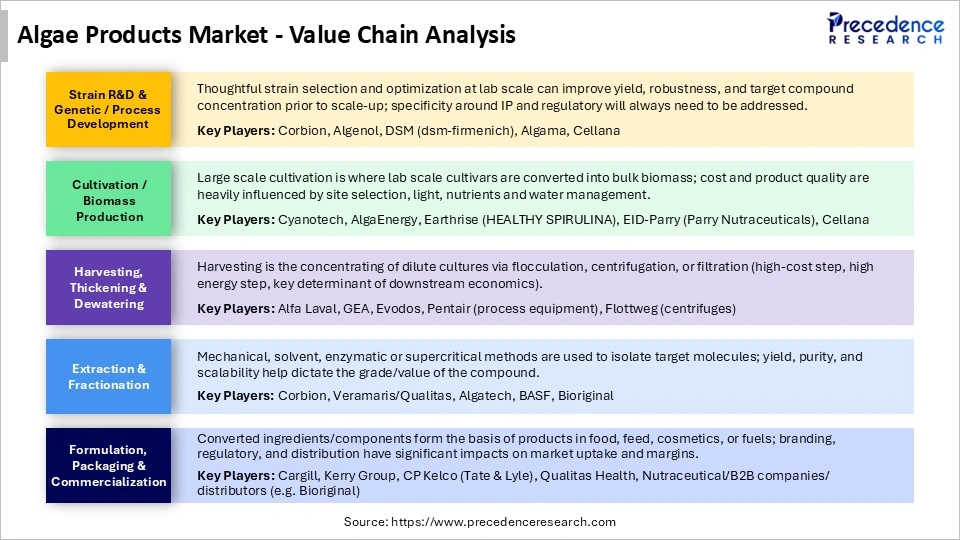
Algae Product Market Companies
- Euglena Co.: Produces a range of algae-based products, including dietary supplements like Yaeyama Chlorella and Euglena Gracilis Powder
- Algae Systems LLC: Produces items such as lipids, carotenoids, algal protein, and ingredients for food, feed, and pharmaceuticals.
- Cyanotech Corporation: BioAstin Hawaiian Astaxanthin and Hawaiian Spirulina Pacifica produced from two microalgal species.
- Cargill, Incorporated: Carrageenan (a texturizer from red seaweed) and algal DHA oil (an omega-3 supplement from microalgae)
- Algenol Biofuels Inc: Produces algae-based products, including biofuels like ethanol, as well as ingredients for personal care, food, and industrial applications.
- Corbion: Algae-based products: AlgaPrim DHA for animal nutrition and AlgaVia ingredients for human food products and dietary supplements.
- Algatechnologies: AstaPure astaxanthin, a potent antioxidant derived from Haematococcus pluvialis microalgae.
- Cellana Inc: EPA Omega-3 oils, algae-based ink, and animal/biofuel feedstocks from marine microalgae, using their ALDU system.
Exclusive Insights
The algae-products market is likely to grow steadily as industries look for cleaner ingredients, climate-neutral materials, and high-value bioactive compounds. Analysts pointed out that advancements in cultivation systems, strain selection, and extraction strategies contributed to improved commercial viability. There will remain issues such as elevated operational costs, inconsistent biomass quality, and regulatory hurdles for food- and/or health-grade products.
While challenging, companies can capitalize on the growing demand for plant-based proteins, natural pigments, omega supplements, and biodegradable alternatives. There are also combination trends of integrated bio refineries, circular production using CO2 or wastewater, and branded food or cosmetic products that would enhance longer-term growth trends.
Latest Investments Powering Algae Production
- In July 2025, Australian biotechnology company, Provectus Algae, secured $12.6 million in combined Series A and grant funding to scale production of SurfNTurf, Provectus Algaes innovative feed supplement.(Source: https://www.startuphub.ai)
Recent Developments
- In October 2025, SIG and Nutrition from Water (NXW) launched a global partnership to create algae-based protein beverages with advanced aseptic packaging, aiming to address malnutrition in underserved economies.(Source: https://www.sig.biz)
- In July 2025, Corbion secured regulatory approvals from Chinas GACC for its algae-derived omega-3 DHA products (AlgaPrim DHA and AlgaVi DHA) in both human and animal nutrition markets.(Source: https://www.globenewswire.com)
- In September 2025, GNT unveiled algae-based Exberry Carotenes using Dunaliella salina to produce natural yellow food coloring in liquid, powder, and oil-soluble forms, suited for a variety of food applications.(Source: https://www.foodbusinessmea.com)
Algae Product Market Segments Covered in the Report
By Type
- Spirulina
- Chlorella
- Astaxanthin
- Beta Carotene
- Hydrocolloids (Agar, Alginates, and Carrageenans)
By Source
- Brown Algae
- Blue-green Algae
- Red Algae
- Green Algae
By Form
- Solid
- Liquid
By Application
- Food & Beverages
- Nutraceuticals & Dietary Supplements
- Personal Care
- Feed
- Pharmaceuticals
- Chemicals
- Fuel
By Region
- North America
- Europe
- Asia Pacific
- Latin America
- Middle East & Africa
For inquiries regarding discounts, bulk purchases, or customization requests, please contact us at sales@precedenceresearch.com
Frequently Asked Questions
Tags





Ask For Sample
No cookie-cutter, only authentic analysis – take the 1st step to become a Precedence Research client
 Get a Sample




 sales@precedenceresearch.com
 Schedule a Meeting
