



MiFi Market Size, Key Companies, Company Market Share, User Adoption, Technology Deployment, Revenue Growth, Competitive Positioning, and Demand Forecast
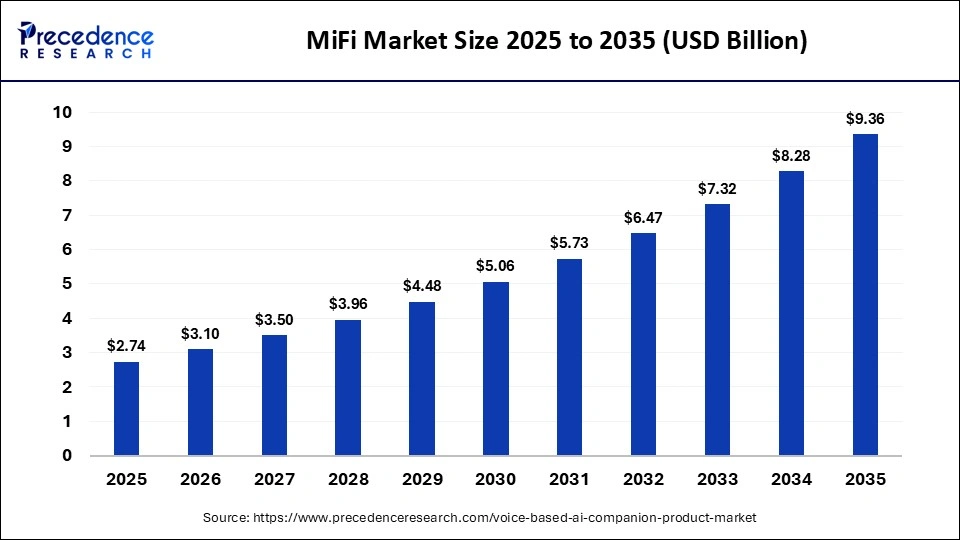
ICT industry specialist Shivani Zoting estimates the MiFi market at USD 3.10 billion in 2026, with continued technology adoption expected to take the market to USD 9.36 billion by 2035 at a CAGR of 13.07%. Leading MiFi market providers such as Inseego Corp, ZTE Corporation, Novatel Wireless, are expanding their capabilities across segments including by technology, by product type, by end-use application, by connectivity type, by subscription model.
Source: https://www.precedenceresearch.com/mifi-market
 Get a Sample
 Table Of Content


What is the MiFi Market Size?
The global MiFi market size accounted for USD 2.74 billion in 2025 and is predicted to increase from USD 3.10 billion in 2026 to approximately USD 9.36 billion by 2035, expanding at a CAGR of 13.07% from 2026 to 2035. The MiFi market is driven by rising online connectivity demand, remote work, digital services, and mobile internet usage.
Market Highlights
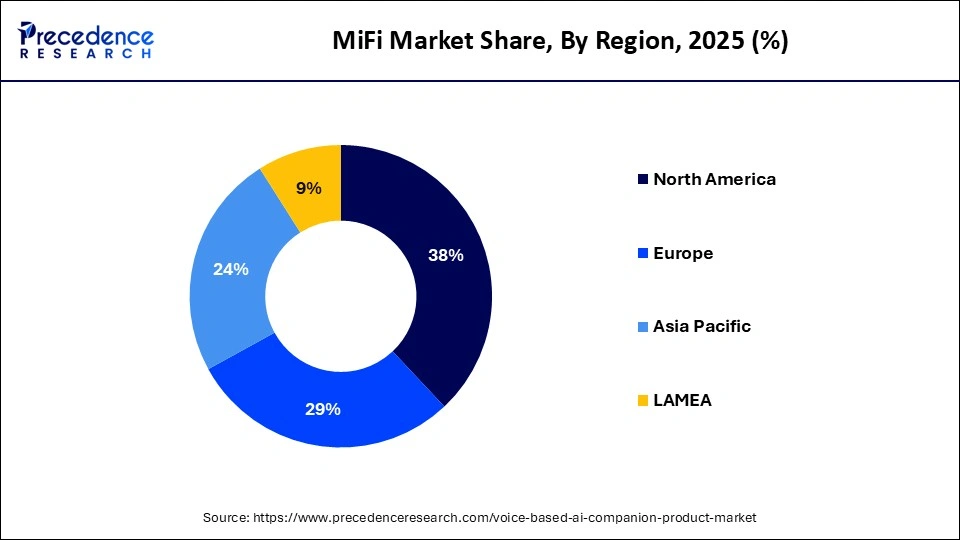
- North America dominated the market, holding the largest market share of 38% in 2025.
- The Asia Pacific is expected to grow at the fastest CAGR between 2026 and 2035.
- By technology, the LTE MIFI devices segment held the biggest market share of 60% in 2025.
- By technology, the 5G MiFi devices segment is growing at a remarkable CAGR between 2026 and 2035.
- By product type, the portable MiFi hotspots segment captured the largest market share of 55% in 2025.
- By product type, the embedded MiFi modules segment is expanding at a notable CAGR between 2026 and 2035.
- By end-use application, the consumer & home use segment contributed the biggest market share of 48% in 2025.
- By end-use application, the IoT & M2M connectivity segment is expected to grow at a remarkable CAGR between 2026 and 2035.
- By connectivity type, the standalone MiFi devices segment accounted for the highest share of 50% in 2025.
- By connectivity type, the connected MiFi with data plans is poised to grow at a remarkable CAGR between 2026 and 2035.
- By subscription model, the postpaid/contract subscriptions segment held the largest share of 55% in 2025.
- By subscription model, the enterprise data plans segment is expected to expand at a strong CAGR between 2026 and 2035.
Redefining Connectivity on the Move: How Innovation Is Transforming the MiFi Market
The global MiFi market includes portable mobile Wi-Fi hotspot devices allowing users to go anywhere with access to broadband internet by connecting to cellular networks like 3G, 4G/LTE, and, more recently, 5G. These small gadgets form a safe local Wi-Fi network that enables various smartphones, laptops, tablets, and IoT devices to be linked to it at the same time. As battery efficiency, device miniaturization, and network speeds advance, MiFi devices are changing their role from mere connectivity devices into mandatory digital facilitating devices to support contemporary mobile lives and businesses.
The growth of 4G and 5G networks and network infrastructure is considerably enhancing the speed of connections, the latency, and the reliability, thus making MiFi solutions more appealing both personally and professionally. The remote and hybrid work patterns, online education, and cloud-based services, which have been viewed worldwide, have further increased adoption. The increasing smartphone penetration, the spread of connected devices, frequent traveling, and the necessity to have access to the internet in underserved or transient settings are all growing demands. Businesses are also using MiFi to support the mobility of their workforce and backup network/contract applications, altogether to help them maintain growth in the market.
Key AI Integrations in the MiFi Market Propelling Growth
The AI implementation in the MiFi market is transforming portable connectivity devices into intelligent networking solutions that actively manage performance, security, and user experience rather than functioning as passive access points. AI-enabled MiFi devices increasingly rely on machine learning models to analyze real-time traffic patterns, user behavior, and network conditions, allowing them to dynamically schedule bandwidth, prioritize latency-sensitive applications, and allocate resources more efficiently across connected devices.
AI-driven network selection is a critical capability, particularly in multi-network environments. MiFi devices can continuously evaluate signal strength, congestion levels, and historical performance data to automatically switch between available cellular bands or operators, ensuring more stable connections and reduced service interruptions. This adaptive behavior improves throughput consistency for applications such as video conferencing, cloud access, and remote work scenarios.
Security enhancement is another central area of AI deployment. Embedded AI systems enable real-time threat detection by monitoring traffic anomalies, identifying unusual access patterns, and recognizing potential intrusion attempts. Automated response mechanisms allow MiFi devices to isolate suspicious connections, enforce adaptive authentication rules, and update security parameters without user intervention, strengthening protection against unauthorized access and data misuse.
MiFi Market Outlook
- Industry Growth Overview: The MiFi market is on a steady growth as more people are seeking the high-speed internet connection portable market. The further development of remote work, mobile data, and the implementation of 5G further increase the pace of market growth.
- Global Expansion: It is a growing market worldwide with good adoption in North America, Europe, and the Asia-Pacific. The emerging economies are also contributing to the growth by enhancing cellular infrastructure and growth in mobile penetration.
- Major Investors: The firms that have invested in the market are Huawei, Netgear, ZTE, Inseego, and TP-Link. These players are concerned with product innovation, the use of 5G-enabled devices, and strategic collaboration with telecom operators.
- Startup Ecosystem: Startups such as Skyroam, GlocalMe, and Keepgo are innovating on cloud-based connectivity and global data plans. Such companies are also focusing on travelers, SMEs, and remote workers using flexible MiFi plans.
Market Scope
| Report Coverage | Details |
| Market Size in 2025 | USD 2.74 Billion |
| Market Size in 2026 | USD 3.10 Billion |
| Market Size by 2035 | USD 9.36 Billion |
| Market Growth Rate from 2026 to 2035 | CAGR of 13.07% |
| Dominating Region | North America |
| Fastest Growing Region | Asia Pacific |
| Base Year | 2025 |
| Forecast Period | 2026 to 2035 |
| Segments Covered | Technology, Product Type, End-Use Application, Connectivity Type, Subscription Model, and Region |
| Regions Covered | North America, Europe, Asia-Pacific, Latin America, and Middle East & Africa |
Segment Insights
Technology Insights
Why Did the 4G/LTE MiFi Devices Segment Hold a 60% Share in the MiFi Market during 2025?
4G/LTE MiFi Devices: In 2025, this segment commanded a 60% market share in the MiFi market because it is widely used, affordable, and has been known to perform reliably in the network. LTE is still widely used in both developed and developing areas and has guaranteed people in semi-urban and rural regions to have coverage all the time. Customers and businesses still favored 4G MiFi gadgets since they offer decent speeds to support daily tasks like video streaming, remote work, online learning, and simple enterprise connections at a lower price when compared to the expensive 5G hardware. Telecom operators are keen to offer 4G MiFi devices through data plans, which strengthens their leadership.
5G MiFi Devices: This segment is expected to grow at a notable CAGR between 28 and 32% in the upcoming years because of the speedy global 5G network deployment and rising demand for ultra-high-speed connectivity. The devices are much faster in data, with reduced latency and larger bandwidth than LTE, and are suitable to support applications that incur high bandwidth rates like cloud computing, video conferencing in high definition, online games, and enterprise-level remote operations. Due to the active promotion of 5G services offered by telecom operators in the form of premium tariffs and subsidized equipment, the segment showed good momentum.
Product Type Insights
Why Did the Portable MiFi Hotspots Segment Hold a 55% Share in 2025?
Portable MiFi Hotspots: This segment dominated the market for MiFi, taking up an approximately 55% share in 2025 due to the flexibility, ease-of-use, and suitability with mobile lifestyles. They are compact-sized gadgets that can deliver instant wireless hot spots anywhere, hence becoming extremely popular among travelers, remote offices, students, and small businesses. The rising pattern of work-anywhere and the gradual rise in use of mobile internet connections greatly enhanced the demand for portable MiFi devices. Their low cost relative to the fixed broadband installations and the fact that they require fast deployment in case of an emergency or temporary installation strengthened their leadership in the product type segment.
Embedded MiFi Modules: These modules are set to grow at a CAGR between 16% and 18% during the forecasted period between 2026 and 2035, with the growing popularity of the integration of wireless connectivity in consumer electronics, workplace equipment, and connected cars. They can be directly integrated into devices like laptops, tablets, smart kiosks, POS, and industrial machines and still allow a seamless, always-on connection to the internet without having to connect to any external hotspots. The increase in the demand for IoT-based solutions, intelligent production, and digitalization by businesses allowed them to expand. Embedded MiFi devices have been discovered to be more secure, simpler to install, and to provide nonstop connection, and have therefore been attractive to mission-critical devices.
End-Use Application Insights
Why Did Consumer & Home Use Lead the MiFi Market in 2025?
Consumer & Home Use: The segment had a 48% market share during 2025, with growing demand in MiFi and high-speed internet connectivity beyond the normal fixed broadband networks. Remote employment, distance learning, entertainment, and smart home apps greatly encouraged the dependence of the household on a good wireless network. MiFi was an alternative to fiber or DSL connections, which were easy to install in areas with small fixed-line networks. The MiFi devices were also used by consumers as backup connectivity systems whenever there was a network outage. The increasing use of numerous interlinked devices in every home also contributed to the requirement to have convenient and portable connectivity solutions.
IoT & M2M Connectivity: The segment is set to grow at a rate between 20 and 24% during the forecasted period and has enormous growth prospects in the coming years because of swift digitalization in industries. Machine-to-machine communication, MiFi-enabled connectedness, is crucial to the widespread implementation of machine-to-machine communication in smart cities, M2M logistics tracking, industrial automation, healthcare monitoring, and connected transportation. Companies are moving towards wireless networks as a way of facilitating real-time data communication and remote surveillance on the distributed assets. The availability of 5G networks also makes MiFi solutions more attractive to IoT applications because it provides low latency and greater density in device coverage.
Connectivity Type Insights
Why Did the Standalone MiFi Devices Segment Hold a 50% Share in 2025?
Standalone MiFi Devices: The segment made up 50% of the market for MiFi devices in 2025 because of being independent of bundled service contracts and network providers. These gadgets give the user the option to select their favorite telecommunications operator as well as the data plan, and they are more flexible and cost-efficient. Mifi systems used independently, MiFi devices are especially common among traveling people, freelancers, and small enterprises that need a versatile solution to connectivity in various locations. They are very easy to replace, highly compatible with SIM cards, and are offered at various price points, so they were well adopted. Retail and e-commerce outlets were popular in selling standalone MiFi devices in the developing markets, which enhanced the level of sales.
Connected MiFi with Data Plans: The segment is set to grow with an 18-21% CAGR during the forecasted period and is set to have high growth. The services include MiFi gadgets along with prepaid or postpaid data services, which will streamline the process for consumers and businesses to buy. Bundled solutions are low-priced and provide a hassle-free connection from the time of purchase. This model is especially desirable to first-time users, small businesses, and enterprises that have multiple devices. Telecom operators enjoy the benefits of recurring revenue streams, and the customers have guaranteed billing and technical support. The emergence of 5G also enhanced the existing growth as operators developed high-quality bundled packages that had increased data available and value-added services.
Subscription Model Insights
Why Did the Postpaid/Contract Subscriptions Segment Lead the MiFi Industry in 2025?
Postpaid/Contract Subscriptions: This segment dominated the industry for MiFi with a 55% share in 2025, as they are trustworthy, have a higher data cap, and are cost-effective to individuals who require them in the long run. Postpaid interests companies and large data users more, as it offers them predictable billing and priority network access, along with services such as financing their devices and customer support. Faster 5G subscriptions are also supported by postpaid subscriptions, which are appealing to professional and business use. The rising necessity to use MiFi at home to work and for enterprise connectivity also strengthened the demand for contract-based subscriptions and ensured the leadership of the segment in the market.
Enterprise Data Plans: This segment is projected to grow at a significant CAGR over the forecast period and is expected to see a growth rate between 19 and 22% during the forecasted period between 2026 and 2035. Companies in industries like IT, logistics, healthcare, shopping, and construction are becoming more frequent users of MiFi devices to facilitate operations in the field, staff working outside the office, and ad hoc locations. The features of enterprise data plans include centralized data management, improved security, increased data limits, and scalable connections, making them a perfect tool to be used by organizations. More demand is also stirred through the implementation of cloud-based applications, IoT, and digitally based collaboration tools.
Region Insights
How Big is the North America MiFi Market Size?
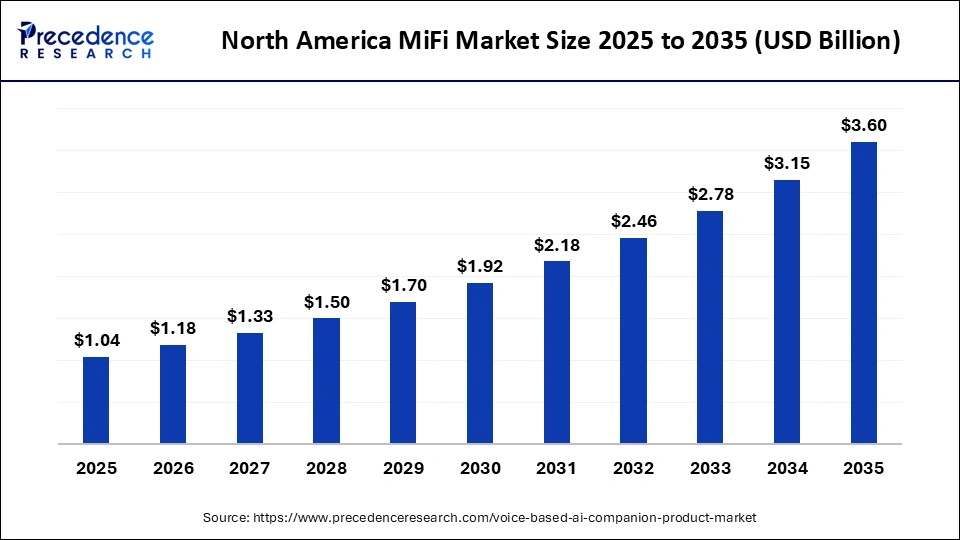
The North America MiFi market size is estimated at USD 104 billion in 2025 and is projected to reach approximately USD 3.60 billion by 2035, with a 13.22% CAGR from 2026 to 2035.
Why Did North America Lead the Global MiFi Market in 2025?
In 2025, North America was the largest MiFi market with a 38% share, driven by well-developed digital infrastructure, high mobile data consumption, and early adoption of advanced connectivity technologies. Strong reliance on mobile broadband across both consumer and enterprise users has positioned MiFi devices as an essential component of everyday connectivity rather than a supplementary solution.
Major investments in 5G infrastructure, particularly in the United States and Canada, are accelerating MiFi uptake by delivering higher throughput, lower latency, and more consistent network performance. Expansion of 5G coverage across urban centers, transport corridors, and business districts has increased demand for MiFi devices that are 5G-compatible and capable of supporting a high number of simultaneous device connections without service degradation.
What is the Size of the U.S. MiFi Market?
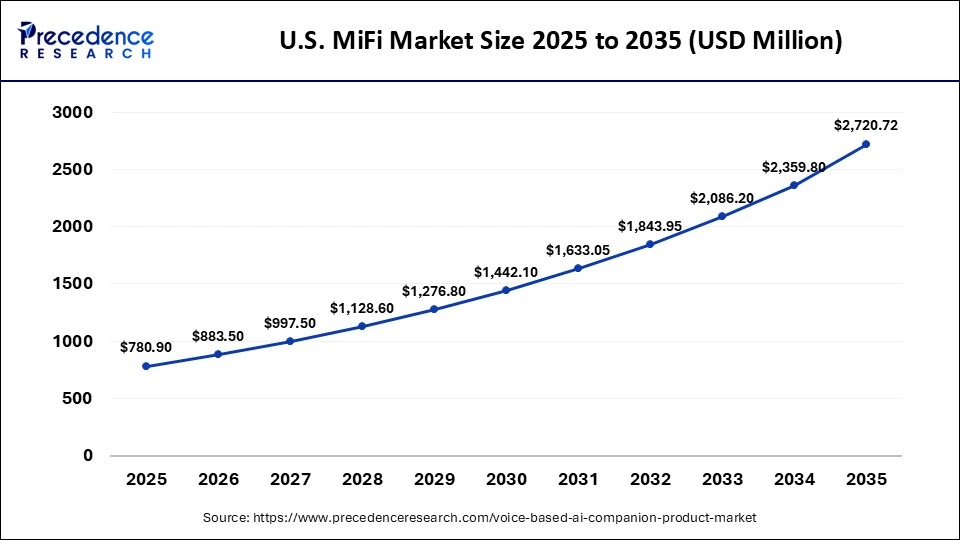
The U.S. MiFi market size is calculated at USD 780.90 million in 2025 and is expected to reach nearly USD 2,720.72 million in 2035, accelerating at a strong CAGR of 13.29% between 2026 and 2035.
U.S MiFi Market Analysis
The U.S. is the biggest MiFi market contributor in the North American region due to the proliferation of a variety of smart devices in individual packs and the increasing reliance on constant connectivity. MiFi routers are used by consumers and businesses in more applications, such as commuting, remote working, field services, disaster recovery, and emergency response. The adoption is supported by the need of the country to have a highly mobile workforce and the high demand to have secure on-the-go internet access. The existence of large technology centers, telecommunications companies, and chipset makers has increased the pace of innovation in the design of MiFi devices, battery life, and 5G capability.
Why Is Asia Pacific Undergoing the Fastest Growth in the MiFi Market?
The Asia Pacific region is experiencing the fastest growth in the global MiFi market and holds a 24-27% market share, driven by rapid urbanization, accelerating smartphone adoption, and expanding mobile broadband coverage. Mobile data consumption is rising sharply across the region as digital payments, online education platforms, video streaming, and e-commerce become embedded in daily economic activity, increasing the need for reliable and portable internet access.
Large-scale deployment of 4G and 5G networks across China, India, South Korea, and Southeast Asian markets is significantly improving network availability, latency, and throughput. These improvements directly support demand for MiFi devices, particularly in high-mobility use cases such as commuting professionals, small businesses, students, and temporary work sites where fixed broadband access is limited or unreliable.
Demographic and economic factors further strengthen adoption. The region's large population base, expanding middle-income segment, and improving affordability of MiFi hardware and data plans are lowering entry barriers for both individual and enterprise users. Price-sensitive consumers increasingly view MiFi devices as a flexible alternative to fixed-line connections, especially in dense urban centers and fast-growing peri-urban areas.
China MiFi Market Trends
China controls the Asia Pacific market with a robust manufacturing ecosystem and the worldwide telecom technology. There are large MiFi device companies in the country (Huawei, ZTE, and TP-Link) that will be at the cutting edge of 4G and 5G. These firms manufacture high-performance MiFi devices having superior features, speeds, and connectivity, serving both local and global markets. The low-cost production capacity that China has allows it to offer competitive prices, and, therefore, Chinese MiFi devices have become very desirable, especially in the emerging economies that are highly price-sensitive. Also, large-scale domestic 5G deployment and robust government backing with regard to digital infrastructure contribute to demand.
Why Is the European MiFi Market Experiencing Notable Growth?
The European MiFi market is registering sustainable growth due to the rising need for flexible and secure internet connectivity across both consumer and enterprise segments. The sustained shift toward remote and hybrid work models, coupled with frequent cross-border business travel within the region, has increased reliance on portable broadband devices that provide consistent and location-independent connectivity.
High regulatory emphasis on data protection and privacy plays a decisive role in shaping usage behavior. Strict compliance requirements under Europe's data protection and cybersecurity frameworks make public Wi-Fi networks less attractive for both individuals and organizations. As a result, personal and enterprise-grade MiFi devices are increasingly preferred as controlled and secure alternatives that reduce exposure to data interception, unauthorized access, and network vulnerabilities.
Enterprise adoption is particularly strong among mobile professionals, consulting firms, logistics operators, and small and medium-sized businesses that require secure connectivity outside fixed office environments. MiFi devices are also widely used as backup connectivity solutions to support business continuity during network disruptions or temporary site deployments.
UK MiFi Market Trends
The UK MiFi market is on the rise because of the rise in the mobility of mobile workers, high 5G coverage, and the need to have uninterrupted internet services. Companies are placing MiFi gadgets for remote workers, field workers, and as a backup connection to maintain business continuity. The smart device and cloud-based services penetration has increased dependency on portable Wi-Fi services. The growing 5G coverage in the UK by the three largest operators (EE, Vodafone, and O2) is pushing to use higher-speed and reduced-latency MiFi routers.
Why Is the MEA MiFi Market Gaining Momentum?
The Middle East and Africa market is driven by the rising need to have the internet in areas that have little or no fixed broadband networks. MiFi gadgets can be used to offer an effective and credible means of delivering internet services in rural and underserved regions. The development of 4G and 5G networks, especially in the Gulf countries, is enhancing the quality of the network and making the use of portable Wi-Fi solutions more acceptable. The demand is fuelled by the increasing activities in the mobile workforce, oil and gas activities, tourism, and smart city projects. South Africa MiFi is becoming increasingly used in education, healthcare, and small businesses as a result of increased smartphone adoption and digital inclusion programs.
Why Is the Latin American MiFi Market Emerging Rapidly?
The Latin American MiFi market is driven by the expanding availability of mobile broadband services and a strong demand for affordable internet access across urban and semi-urban areas. Wider deployment of 4G networks, alongside a gradual transition toward 5G in major cities, is improving mobile internet reliability, coverage consistency, and data speeds, which directly supports the adoption of portable connectivity solutions.
Rising smartphone penetration and the growing use of digital services such as online banking, digital payments, online education platforms, and e-commerce are reinforcing the need for always-on, flexible internet access. MiFi devices address connectivity gaps in areas with limited fixed-line infrastructure, enabling users to maintain stable access across multiple devices without dependence on wired networks.
Usage is particularly strong among travelers, remote workers, small businesses, and field-based enterprises that require backup connectivity or temporary network access. MiFi devices are commonly used to ensure business continuity during network outages, support mobile workforces, and provide secure connections for short-term operational needs.
MiFi Market Companies
- Inseego Corp
- Huawei Technologies Co
- ZTE Corporation
- NETGEAR, Inc.
- Samsung Electronics Co., Ltd.
- Novatel Wireless
- Alcatel-Lucent (Nokia)
- TP-Link Technologies Co., Ltd.
- D-Link Corporation
- Sierra Wireless
- Franklin Wireless Corp.
- TCL Communication (Alcatel)
- Verizon Communications Inc.
- AT&T Inc.
- Telstra Group Limited
Recent Developments
- In December 2025, Inseego Corp., a provider of 5G and intelligent IoT device-to-cloud solutions, announced its new and next-generation MiFi X PRO 5G mobile hotspot, in collaboration with Telstra. The gadget provided the speed of 5G connectivity over the largest 5G network in Australia and was enhanced with Wi-Fi 6 performance and all-day battery life.(Source: https://www.pipelinepub.com)
- In June 2025, SITA released SITA Mobile WIFI (MIFI), a mobile Wi-Fi service that will improve connectivity to airports, airlines, and ground handlers. The service offered fast, flexible, and secure wireless services.(Source: https://www.airport-technology.com)
Segments Covered in the Report
By Technology
- 4G/LTE MiFi Devices
- 5G MiFi Devices
- 3G MiFi Devices
By Product Type
- Portable MiFi Hotspots
- Embedded MiFi Modules
- Fixed/Router-Style MiFi Devices
By End-Use Application
- Consumer & Home Use
- Enterprise & SMB Use
- Travel & Hospitality
- Education & E-Learning
- Government & Public Sector
- IoT & M2M Connectivity
By Connectivity Type
- Standalone MiFi Devices
- Smartphone Tethering (supported MiFi mode)
- Connected MiFi with Data Plans
By Subscription Model
- Prepaid/Pay-as-You-Go Plans
- Postpaid/Contract Subscriptions
- Enterprise Data Plans
By Region
- North America
- Europe
- Asia-Pacific
- Latin America
- Middle East and Africa
For inquiries regarding discounts, bulk purchases, or customization requests, please contact us at sales@precedenceresearch.com
Frequently Asked Questions
Tags





Ask For Sample
No cookie-cutter, only authentic analysis – take the 1st step to become a Precedence Research client
 Get a Sample




 sales@precedenceresearch.com
 Schedule a Meeting
