



Model Inference Optimization Tools Market Trends, Companies, Revenue / Sales Performance, Subscriber Growth, Pricing Strategies, Cloud Adoption, Infrastructure Expansion, Competitive Landscape, and Industry Outlook
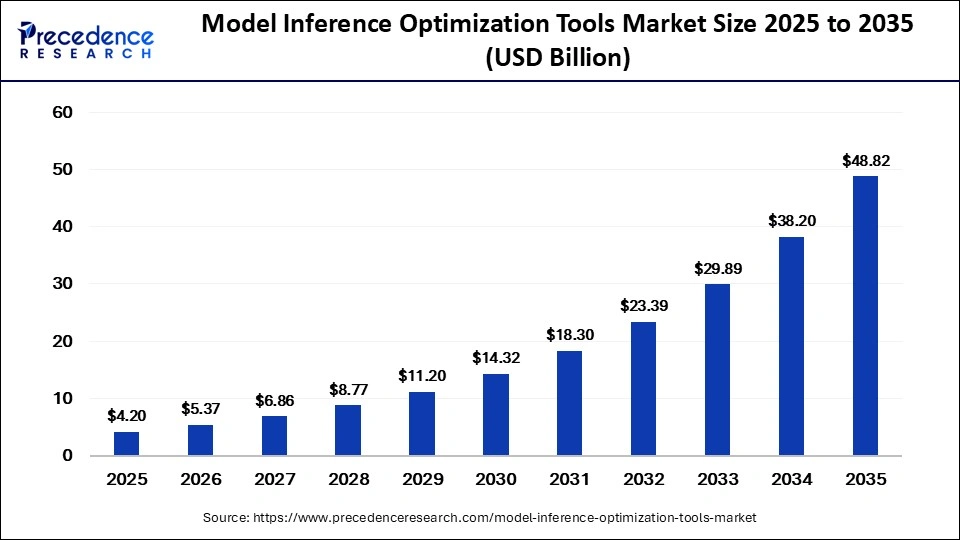
ICT industry specialist Gautam Mahajan estimates the model inference optimization tools market at USD 5.37 billion in 2026, with continued technology adoption expected to take the market to USD 48.82 billion by 2035 at a CAGR of 27.80%. Leading model inference optimization tools market providers such as NVIDIA Corporation, Amazon Web Services (AWS), Google Cloud (Alphabet), Microsoft Corporation are expanding their capabilities across segments including By Tool Type, By Deployment Environment, By Model Type, By Optimization Technique, By Application, By End-Use Industry.
Source: https://www.precedenceresearch.com/model-inference-optimization-tools-market
 Get a Sample
 Table Of Content


What is the Model Inference Optimization Tools Market Size in 2026?
The global model inference optimization tools market size was calculated at USD 4.20 billion in 2025 and is predicted to increase from USD 5.37 billion in 2026 to approximately USD 48.82 billion by 2035, expanding at a CAGR of 27.80% from 2026 to 2035. The model inference optimization tools market is driven by rising demand for low-latency AI deployment, increasing adoption of edge computing, and the need for efficient utilization of compute resources across large-scale AI workloads.
Key Takeaways
- North America led the model inference optimization tools market in 2025 with a 42% share.
- Asia Pacific is observed to be the fastest-growing region in the forecasted period.
- By tool type, the inference acceleration engines segment led the market with a 28% share in 2025.
- By tool type, the edge AI optimization tools segment is observed to grow at the fastest CAGR in the upcoming period.
- By deployment environment, the cloud-based optimization segment led the global market in 2025 with a 55% share.
- By deployment environment, the edge / on-device segment is expected to grow at the fastest CAGR during the forecast period.
- By optimization technique, the quantization segment led the global market in 2025 with a 30% share and is expected to grow at the fastest rate in the foreseeable period.
- By application, the real-time analytics segment led the global market in 2025 with a 28% share.
- By application, the customer experience segment is expected to expand at the fastest CAGR in the coming years.
Model Inference Optimization Tools Market Overview
Inference optimization refers to enhancing the performance and efficiency of AI models within production settings. This process allows developers to create faster, more responsive applications while ensuring a sustainable infrastructure footprint. Typically, model inference optimization involves adjusting a model to decrease its size, complexity, or computational demands. It encompasses various techniques employed by deep learning and machine learning engineers to boost prediction speed and operational efficiency. These tools act as robust, scalable assets in model optimization workflows, aiding in cost reduction per token, improving throughput, and expediting inference at scale.
Model Inference Optimization Tools Market Trends
- Shift Toward Edge AI Optimization: Organizations are increasingly deploying AI models at the edge (devices like smartphones, IoT systems, and autonomous machines), creating demand for lightweight and highly efficient inference optimization tools. These tools focus on reducing latency, power consumption, and memory usage while maintaining model accuracy in resource-constrained environments.
- Growing Adoption of Hardware-Aware Optimization: Inference optimization tools are being designed to align closely with specific hardware architectures such as GPUs, TPUs, and custom AI accelerators. This hardware-aware approach improves performance by tailoring model execution to fully utilize underlying compute capabilities, leading to faster and more cost-efficient inference.
- Rise of Automated Model Compression Techniques: There is increasing use of automated techniques such as quantization, pruning, and knowledge distillation to reduce model size and improve inference speed. These methods enable organizations to deploy complex AI models at scale without significantly compromising accuracy.
Market Scope
| Report Coverage | Details |
| Market Size in 2025 | USD 4.20 Billion |
| Market Size in 2026 | USD 5.37 Billion |
| Market Size by 2035 | USD 48.82 Billion |
| Market Growth Rate from 2026 to 2035 | CAGR of 27.80% |
| Dominating Region | North America |
| Fastest Growing Region | Asia Pacific |
| Base Year | 2025 |
| Forecast Period | 2026 to 2035 |
| Segments Covered | Tool Type, Deployment Environment, Model Type, Optimization Technique, Application, End-Use Industry, and Region |
| Regions Covered | North America, Europe, Asia-Pacific, Latin America, and Middle East & Africa |
Market Dynamics
Drivers
Growth of Large-Scale AI Models
The major factor driving the model inference optimization tools market is the rapid growth of large-scale AI models and real-time inference requirements. As models become more complex and are deployed in latency-sensitive applications such as autonomous systems, financial services, and customer-facing AI, organizations need tools that can deliver faster inference without high computational cost. This has made optimization technologies essential for reducing latency, improving efficiency, and enabling scalable deployment across cloud, edge, and hybrid environments.
Restraint
High Compute Cost and Hardware Compatibility Limitations
Model inference continues to encounter challenges due to increased latency, rising computational costs, and limitations in scalability. Additionally, hardware compatibility issues hinder the adoption of optimization techniques, as not all GPUs support advanced methods such as quantization. This makes deployment particularly difficult for organizations relying on older infrastructure systems.
Opportunity
Growth in Post Training Quantization and Deployment Efficiency
The implementation of post-training quantization and the availability of pre-quantized checkpoints create significant opportunities within the model inference optimization tool market. These advancements facilitate faster deployment, lower memory usage, and enhanced efficiency. Furthermore, adopting best practices such as continuous testing, monitoring, and alignment of model tasks contributes to improved overall system performance.
Segmental Insights
Tool Type Insights
The Inference Acceleration Engines Segment Led the Market in 2025
The inference acceleration engines segment led the model inference optimization tools market with nearly 28% share in 2025. This is mainly due to their capability to execute pre-trained machine learning models and generate predictions or insights from new data inputs in real time or through batch processing. This segment encompasses runtime, compilers, and tensor optimization. The demand for low latency and high throughput has further contributed to its expansion. The compilers within this segment enhance model efficiency by operating at the computational graph level, allowing it to maintain a dominant position.
The model compression tools segment accounted for approximately 22% market share in 2025, as these tools are designed to reduce model size and computational costs while preserving accuracy. Techniques such as quantization, pruning, and distillation are employed to minimize the size of neural networks. Additionally, these tools help decrease memory footprint and computational requirements.
Model Inference Optimization Tools Market Share, By Tool Type, 2025-2035 (%)
| Tool Type | 2025 | 2035 | CAGR (%) |
| Inference Acceleration Engines | 28.00% | 30.00% | 29.5% |
| Model Compression Tools | 22.00% | 20.00% | 26.0% |
| Edge AI Optimization Tools | 20.00% | 23.00% | 32.5% |
| Hardware-aware Optimization | 15.00% | 12.00% | 23.5% |
| AutoML Optimization Platforms | 15.00% | 15.00% | 28.0% |
The edge AI optimization tools segment captured around 20% share of the market in 2025 and is projected to grow at the fastest rate during the forecast period, driven by the increasing use of edge devices and the Internet of Things (IoT). Edge AI is emerging as a vital technology for enabling intelligent applications. As the volume of data generated and stored on edge devices continues to rise, the deployment of AI models for local processing and inference has become increasingly essential. These tools facilitate data transmission between local networks and clouds.
The AutoML optimization platforms segment held approximately 15% market share in 2025, fueled by the automation of optimization workflows. Automated machine learning offers methods and processes that make machine learning more accessible to non-experts, enhance the efficiency of machine learning practices, and expedite research. This segment aids businesses in automating decision-making, optimizing processes, and obtaining predictive insights more rapidly.
Deployment Environment Insights
Model Inference Optimization Tools Market Share, By Deployment Environment, 2025-2035 (%)
| Deployment Environment | 2025 | 2035 | CAGR (%) |
| Cloud-based Optimization | 55.00% | 50.00% | 25.5% |
| Edge / On-device | 30.00% | 38.00% | 33.5% |
| Hybrid Deployment | 15.00% | 12.00% | 24.0% |
Why Did the Cloud-Based Optimization Segment Lead the Market in 2025?
The cloud-based optimization segment led the model inference optimization tools market with a 55% share in 2025, thanks to its scalable infrastructure and seamless integration capabilities. This approach involves the management and allocation of cloud resources to enhance service performance and security while minimizing waste and reducing costs. By continuously monitoring usage patterns and implementing automated adjustments, such as scaling storage or updating network configurations, cloud-based optimization ensures that every resource is utilized effectively, thereby maintaining its dominant position in the market.
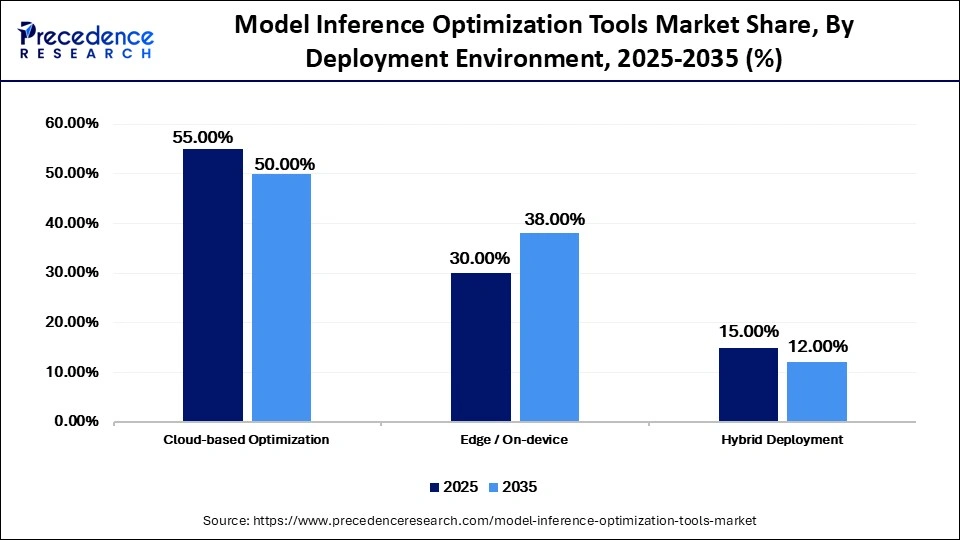
The on-device/edge optimization segment held a 30% share of the market in 2025 and is anticipated to grow at the fastest rate during the forecast period, driven by the increasing demand for real-time processing and reduced latency. Edge optimization presents significant opportunities for developers, as advancements in device speed, processing power, and battery life broaden the range of applications that can efficiently operate on the device.
The hybrid deployment segment held around 15% market share in 2025, driven by its ability to balance performance and cost efficiency. Hybrid deployments integrate public and private cloud environments, as well as on-premise legacy infrastructure. This strategy offers enhanced flexibility and scalability, improved data sovereignty and compliance, and a fortified security posture.
Optimization Technique Insights
The Quantization Segment Dominated the Market in 2025 with a 30% Share
The quantization segment dominated the model inference optimization tools market in 2025, holding a 30% share, and is anticipated to maintain its dominance throughout the forecast period. This is mainly due to its effectiveness in reducing computational and memory requirements by decreasing the precision of model weights and activations to smaller data types. Model quantization facilitates the deployment of increasingly sophisticated deep learning models in resource-constrained settings without significantly compromising accuracy.
The pruning & sparsity optimization segment held around 22% market share in 2025. This is mainly due to its capacity to eliminate redundant parameters and shape model weights into specific sparse patterns, which in turn accelerates inference times. Additionally, pruning can be integrated with other model compression techniques to achieve enhanced compression rates while minimizing model size and computational complexity.
Model Inference Optimization Tools Market Share, By Optimization Technique, 2025-2035 (%)
| Optimization Technique | 2025 | 2035 | CAGR (%) |
| Quantization | 30.00% | 33.00% | 30.5% |
| Pruning & Sparsity | 22.00% | 20.00% | 26.0% |
| Graph Optimization | 18.00% | 20.00% | 29.0% |
| Knowledge Distillation | 15.00% | 13.00% | 25.5% |
| Kernel Optimization | 15.00% | 14.00% | 27.0% |
The knowledge distillation segment held approximately 15% market share in 2025, driven by its capability to transfer knowledge from a large teacher model to a smaller student model, enabling organizations to maintain much of the original model's performance while allowing for more efficient inference. This method is especially beneficial for maximizing quality while operating at ultra-low precision during inference.
The graph optimization & compilation segment held around 18% market share in 2025, bolstered by improvements in compiler-level performance. Graph optimization techniques encompass various transformations, including simplifications, node eliminations, node fusions, and layout optimizations. These strategies are crucial for refining computational graph structures, thereby significantly enhancing the efficiency of neural network training and inference.
Application Insights
The Real-Time Analytics & Decision-Making Segment Held a 28% Share in 2025
The real-time analytics & decision-making segment dominated the model inference optimization tools market with a 28% share in 2025, driven by the increasing demand for immediate decision-making in practical applications. This capability is essential for harnessing machine learning potential across various sectors, including healthcare, finance, and retail. Inference plays a pivotal role by delivering instant insights and predictions that facilitate real-time decision-making.
The customer experience segment accounted for nearly 25% of the market in 2025 and is projected to grow at the fastest CAGR in the coming years. This growth is primarily driven by advancements in speech recognition inference, allowing virtual assistants to comprehend and execute voice commands effectively. Additionally, it plays a vital role in generating subtitles for videos, transcribing meetings and interviews, and facilitating broader adoption.
Model Inference Optimization Tools Market Share, By Application, 2025-2035 (%)
| Application | 2025 | 2035 | CAGR (%) |
| Real-time Analytics | 28.00% | 30.00% | 28.5% |
| Customer Experience | 25.00% | 27.00% | 30.0% |
| Autonomous Systems | 20.00% | 18.00% | 26.5% |
| Fraud Detection | 15.00% | 13.00% | 25.0% |
| Industrial AI | 12.00% | 12.00% | 27.0% |
The autonomous systems segment held approximately 20% market share in 2025, driven by the application of trained models to analyze sensor data, enabling decision-making and environmental navigation. Model inference empowers these systems to function autonomously and adapt to dynamic conditions.
The fraud detection & risk analytics segment held about 15% share of the market in 2025. This is mainly due to the increasing use of financial platforms leveraging AI inference analytics to provide real-time insights that can block suspicious transactions in milliseconds. The capability of Graph Neural Networks (GNNs) to aggregate information from a transaction's local environment enables the identification of broader patterns.
End-Use Industry Insights
IT & Cloud Providers Led the Market in 2025
The IT & cloud providers segment led the model inference optimization tools market, capturing approximately 40% of the total share in 2025, and is anticipated to continue its dominance throughout the forecast period. This growth is primarily driven by the rise of hyperscale AI deployments and the increasing demand for efficient model optimization. Techniques such as quantization enhance speed, memory efficiency, and deployment performance without significantly sacrificing accuracy by reducing the precision of model weights and activations.
The automotive sector segment held nearly 15% of the market share in 2025, driven by the heightened demand from automotive and robotics developers to implement conversational AI agents, multimodal perception, and advanced planning directly within vehicles and robots, where low latency, reliability, and offline capabilities are essential. Model optimization facilitates the integration of real-time intelligence into these systems while ensuring critical requirements such as accuracy, safety, efficiency, performance, and trust are maintained.
Model Inference Optimization Tools Market Share, By End-Use Industry, 2025-2035 (%)
| End-Use Industry | 2025 | 2035 | CAGR (%) |
| IT & Cloud Providers | 40.00% | 42.00% | 29.5% |
| Automotive | 15.00% | 14.00% | 26.5% |
| BFSI | 12.00% | 11.00% | 25.5% |
| Healthcare | 10.00% | 11.00% | 27.5% |
| Retail & E-commerce | 10.00% | 9.00% | 26.0% |
| Telecommunications | 8.00% | 7.00% | 25.0% |
| Manufacturing | 5.00% | 6.00% | 27.0% |
The healthcare sector segment held a 10% market share in 2025. In healthcare, optimization must emphasize safety and consistency alongside speed. With the proliferation of health monitoring devices and edge deployment, inference can be conducted directly on-device, thereby eliminating delays associated with network round-trip times. Model optimization is enabling applications such as medical literature analysis, medical report generation, AI-assisted imaging diagnosis, chronic disease monitoring and management, and medical record organization, ultimately enhancing the efficiency and quality of healthcare services.
The BFSI segment held nearly 12% of the market share in 2025, driven by the increasing demand for deep customization in BFSI applications, which includes proprietary financial product logic, multilingual compliance workflows, internal virtual assistants trained on standard operating procedures and policy manuals, as well as in-house regulatory response generation. Model optimization aids in the development of smaller, faster models that preserve the accuracy of larger models while being specifically tailored for distinct financial tasks.
Regional Insights
North America Model Inference Optimization Tools Market Size and Growth 2026 to 2035
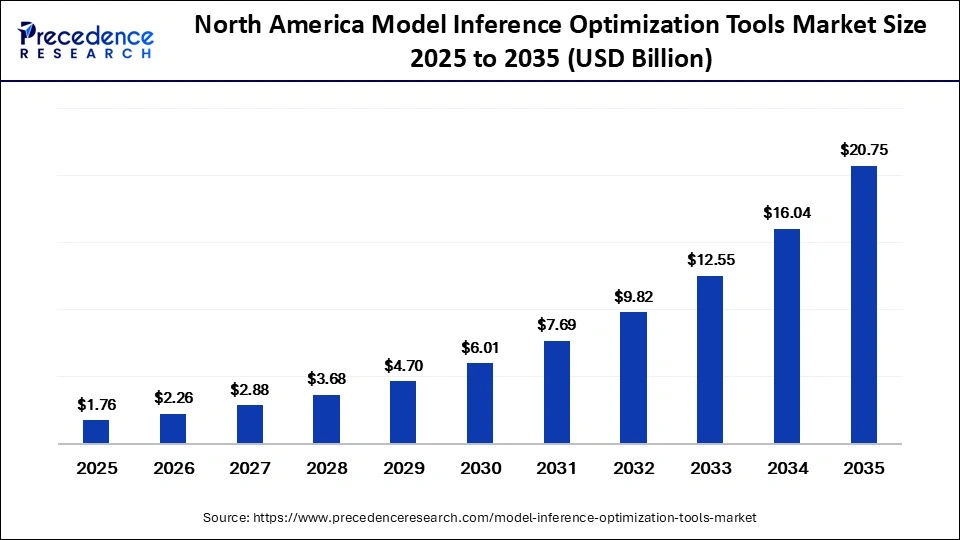
The North America model inference optimization tools market size is estimated at USD 1.76 billion in 2025 and is projected to reach approximately USD 20.75 billion by 2035, with a 27.98% CAGR from 2026 to 2035.
What Made North America the Dominant Region in the Market in 2025?
North America dominated the model inference optimization tools market with a 42% share in 2025. This is due to a strong hyperscale presence and a well-established AI ecosystem. In addition, the region benefits from clear regulations, sustainability goals, and strengthened supply chains supported by competitive manufacturing. Trends such as rising interest in smart technologies, automation, and high-performance materials are also helping the market grow.
U.S. Model Inference Optimization Tools Market Size and Growth 2026 to 2035
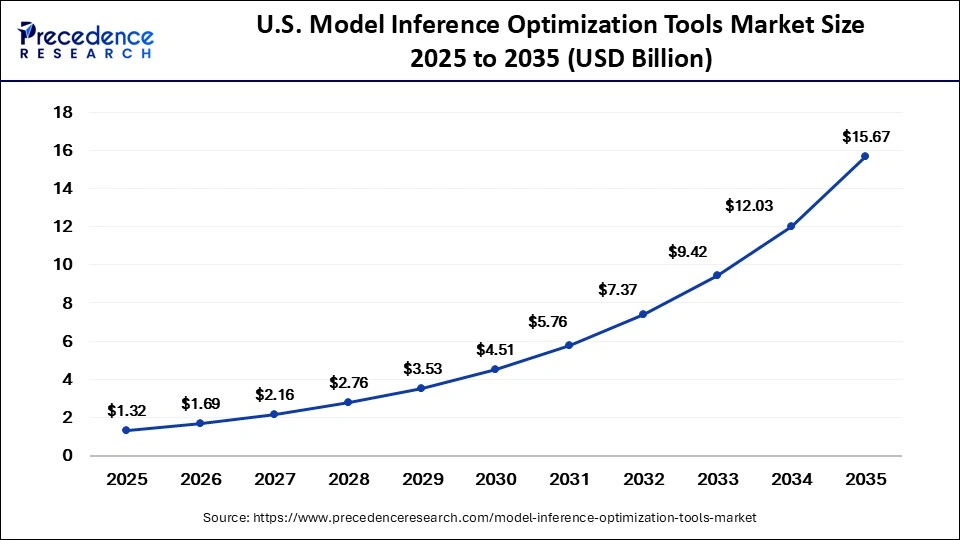
The U.S. model inference optimization tools market size is calculated at USD 1.32 billion in 2025 and is expected to reach nearly USD 15.67 billion in 2035, accelerating at a strong CAGR of 28.07% between 2026 and 2035.
U.S. Market Analysis
The U.S. is a major contributor to the North American market due to its high R&D activity and rapid adoption of new technologies. Moreover, growth is driven by the presence of a large number of hyperscale data center operators and the economic imperative to reduce the operational costs of large-scale LLM inference.
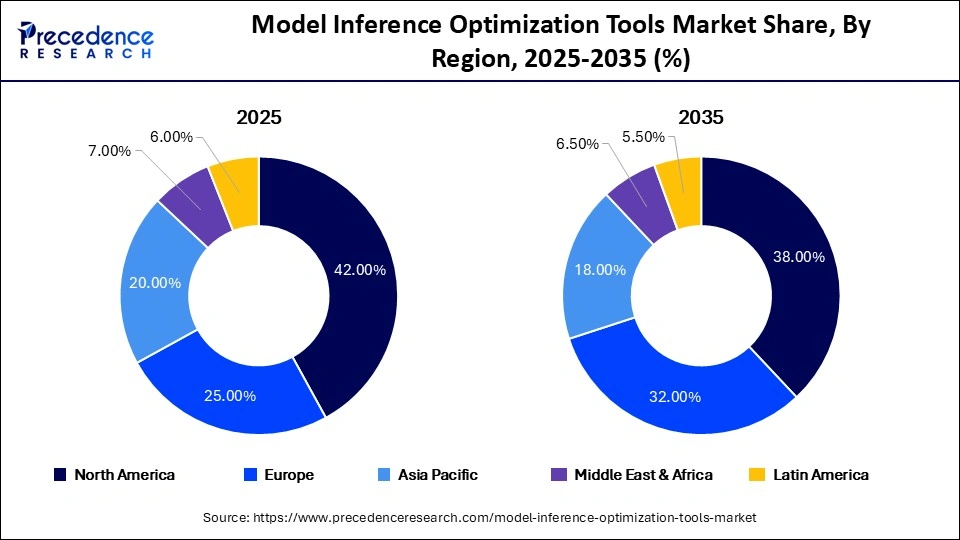
Asia Pacific: The Fastest-Growing Region
Asia Pacific held approximately 25% share of the model inference optimization tools market in 2025 and is projected to grow at the fastest rate during the forecast period. This growth is driven by AI adoption and chip innovation. Moreover, the region is growing quickly due to digital adoption, new manufacturing capacity, and strong interest in automation and production optimization. Industries are increasingly adopting model inference optimization tools for predictive analysis, and a tech-savvy population is accelerating AI tool adoption.
China Market Analysis
China dominates the Asia Pacific model inference optimization tools market due to a strong investment in AI infrastructure and the presence of major technology providers. Additionally, strong government backing through initiatives like the New Generation of Artificial Intelligence Development Plan is accelerating AI deployment across industries, creating demand for efficient inference and optimization tools.
How is the Opportunistic Rise of Europe in the Market?
Europe held a 20% share of the model inference optimization tools market in 2025 and is expected to grow at a significant rate in the coming years. This is mainly due to the rising enterprise AI adoption and regulatory support, along with a focus on automation and green technology. The region is also heavily influenced by data sovereignty mandates and a focus on green AI, creating strong demand for on-premises model inference optimization tool solutions and tools that maximize performance per watt.
Model Inference Optimization Tools Market Companies
- NVIDIA Corporation
- Amazon Web Services (AWS)
- Google Cloud (Alphabet)
- Microsoft
- IBM Corporation
- Advanced Micro Devices, Inc. (AMD)
- Intel Corporation
- Groq
- Cerebras Systems
- Qualcomm Technologies
- Hugging Face
- Mistral AI
- Anyscale
- Fireworks AI
- Together AI
Recent Developments
- In March 2026, Nebius and Eigen AI collaborated to enhance Token Factory, Nebius's managed inference platform, by delivering faster and optimized open-source AI models. Together, they plan to develop refined versions of prominent open-source models such as DeepSeek, GLM, GPT-OSS, Kimi, Llama, MiniMax, and Qwen, ensuring seamless integration into Token Factory.(Source: https://nebius.com)
- In January 2026, Inferact secured an impressive $150 million in seed funding to advance the commercialization of its innovative vLLM technology. This significant investment marks a pivotal transformation in the AI inference landscape, highlighting a new era for enterprises in deploying and scaling AI models.(Source: https://cryptorank.io)
Segments Covered in the Report
By Tool Type
- Model Compression Tools (Quantization, Pruning, Distillation)
- Inference Acceleration Engines (Runtime, Compilers, Tensor Optimization)
- Hardware-aware Optimization Tools
- Edge AI Optimization Tools
- AutoML & Optimization Platforms
By Deployment Environment
- Cloud-based Optimization
- On-device/Edge Optimization
- Hybrid Deployment
By Model Type
- Large Language Models (LLMs)
- Computer Vision Models
- Speech & Audio Models
- Recommendation & Ranking Models
- Multimodal Models
By Optimization Technique
- Quantization
- Pruning & Sparsity Optimization
- Knowledge Distillation
- Graph Optimization & Compilation
- Kernel & Runtime Optimization
By Application
- Real-time Analytics & Decision Making
- Autonomous Systems (AVs, Robotics, Drones)
- Customer Experience (Chatbots, Personalization)
- Fraud Detection & Risk Analytics
- Industrial AI & Predictive Maintenance
By End-Use Industry
- IT & Cloud Providers
- Automotive
- Healthcare
- BFSI
- Retail & E-commerce
- Telecommunications
- Manufacturing
By Region
- North America
- Latin America
- Europe
- Asia-pacific
- Middle and East Africa
For inquiries regarding discounts, bulk purchases, or customization requests, please contact us at sales@precedenceresearch.com
Frequently Asked Questions





Ask For Sample
No cookie-cutter, only authentic analysis – take the 1st step to become a Precedence Research client
 Get a Sample




 sales@precedenceresearch.com
 Schedule a Meeting
