



North America Biosolids Management Market Size, Share and Trends 2026 to 2035
North America Biosolids Management Market (By Process/Treatment Method: Anaerobic Digestion, Aerobic Digestion (including Heat Drying), Composting, Land Application, Incineration/Thermal Treatment, Landfilling, and Nutrient Removal/Recovery; By Product Type/Quality: Class A (Pathogen-Free, Safe for Unrestricted Use), Class A EQ (Exceptional Quality), Class B (Less Stringent, Limited-Use), and Class AB/Intermediate; By Application: Agricultural Land Application, Non-Agricultural Land Application, Energy Recovery, and Other Uses; By End-User: Municipalities (Wastewater Authorities), Industrial Facilities, Farmers/Agricultural Businesses, and Landscapers/Land Restoration Entities) Industry Size, Share, Growth, Trends 2025-2035
Source: https://www.precedenceresearch.com/north-america-biosolids-management-market
 Get a Sample
 Table Of Content


The North America biosolids management market size surpassed USD 570 million in 2025 and is predicted to reach around USD 937.35 million by 2035, registering a CAGR of 5.10% from 2026 to 2035. The market in North America is mainly driven by stricter environmental regulations, the circular economy, and the rising agricultural need for organic soil amendments.
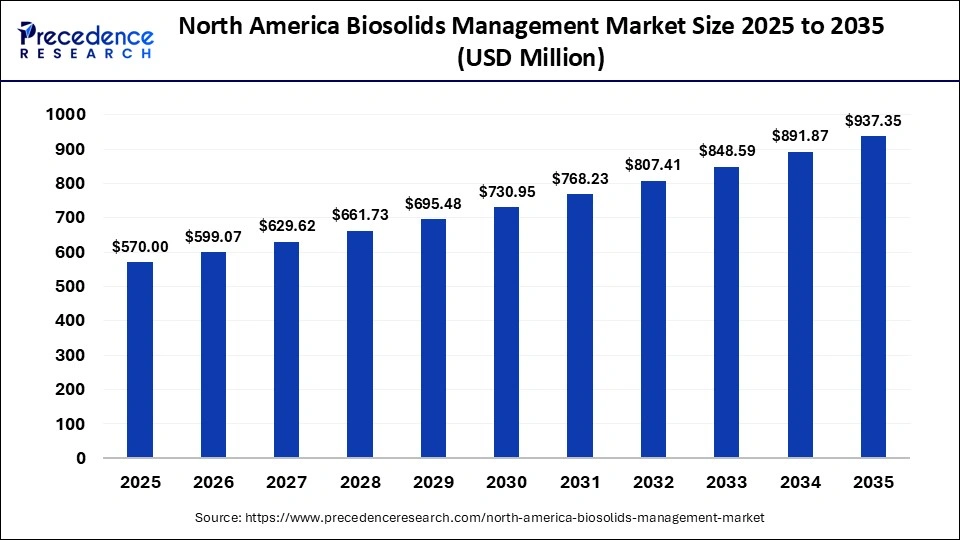
North America Biosolids Management Market Statical Scope
| Reports Attributes | Statistics |
| Market Size in 2025 | USD 570 Million |
| Market Size in 2026 | USD 599.07 Million |
| Market Size by 2035 | USD 937.35 Million |
| CAGR 2026 to 2035 | 5.10% |
| Base Year | 2025 |
| Forecast Period | 2026 to 2035 |
The market plays a vital role in changing wastewater treatment from waste disposal to resource recovery. With over 15,000 treatment facilities and stringent regulations, it creates significant value by converting millions of tons of sewage sludge into renewable energy, agricultural fertilizers, and soil amendments. Advanced processing techniques, like anaerobic digestion, not only minimize pathogens in Class A and Class B biosolids but also produce renewable natural gas (RNG), which benefits from various tax incentives.
The market is undergoing a major shift due to new contaminants like PFAS. Concerns about public health and related lawsuits have led to a higher demand for specialized hazardous waste services and alternative disposal methods, including landfilling and incineration. The market is highly consolidated, with key players such as Synagro Technologies, Casella Waste Systems, Anaergia, and Cambi ASA leading the processing and beneficial reuse operations throughout the continent.
North America Biosolids Management Market, By Process/Treatment Method, 2025
| Segments | Shares (%) |
| Anaerobic Digestion | 24.80% |
| Aerobic Digestion (including Heat Drying) | 18.70% |
| Composting | 15.90% |
| Land Application | 20.40% |
| Incineration/Thermal Treatment | 8.30% |
| Landfilling | 5.40% |
| Nutrient Removal/Recovery | 6.50% |
- Anaerobic Digestion - The anaerobic digestion (AD) segment, with a share of 24.80% in 2025, plays a dominant role in the North America Biosolids Management Market by turning wastewater sludge from a disposal problem into a valuable resource. It stabilizes organic waste and lowers greenhouse gas (GHG) emissions, producing renewable natural gas (RNG) and nutrient-rich Class A biosolids.
- Aerobic Digestion (including heat drying) - The aerobic digestion and heat drying segment, with a share of 18.70% in 2025, is essential in the North American biosolids market as it transforms municipal wastewater sludge into high-quality, Class A exceptional quality (EQ) fertilizers. This end product is highly stabilized, pathogen-free, and dry, significantly reducing its volume for cost-effective transport to agricultural markets.
- Composting - The composting segment, with a share of 15.90% in 2025, is crucial in the North America Biosolids Management Market as it converts sewage sludge into marketable, Class A organic fertilizers. By stabilizing waste and removing pathogens, composting helps municipalities divert large amounts of waste from landfills, effectively complying with strict environmental regulations like US EPA Part 503 standards.
North America Biosolids Management Market, By Product Type/Quality, 2025
| Segments | Shares (%) |
| Class A (Pathogen-Free, Safe for Unrestricted Use) | 38.60% |
| Class A EQ (Exceptional Quality) | 19.80% |
| Class B (Less Stringent, Limited-Use) | 31.40% |
| Class AB/Intermediate | 10.20% |
- Class A (Pathogen-Free, Safe for Unrestricted Use) - The Class A segment, with a share of 38.60% in 2025, is leading the North American biosolids management market due to its near-elimination of pathogens and strict pollutant limits, which allow for unrestricted beneficial uses. It avoids the strict land-use and permitting requirements associated with Class B biosolids, making it the preferred choice for agriculture, residential landscaping, and commercial soil blending.
- Class A EQ (Exceptional Quality) - The Class A EQ (Exceptional Quality) segment, with a share of 19.80% in 2025, is the most important and fastest-growing part of the North American biosolids management market. It is highly valued as it meets the strict EPA standards for pathogens and heavy metals, permitting completely unrestricted use by the public.
North America Biosolids Management Market, By Application, 2025
| Segments | Shares (%) |
| Agricultural Land Application | 46.70% |
| Non-Agricultural Land Application | 20.80% |
| Energy Recovery | 22.60% |
| Other Uses | 9.90% |
- Agricultural Land Application - The agricultural land application segment, with a share of 46.70% in 2025, is dominating the North American biosolids management market as it supports the circular economy. It offers a cost-effective and nutrient-rich alternative to costly synthetic fertilizers while addressing significant municipal waste disposal issues.
- Non-Agricultural Land Application - The Non-Agricultural Land Application segment, with a share of 20.80% in 2025, which encompasses forestry, land reclamation (like restoring degraded mining areas), and landscaping, plays a key role in the North American biosolids management market. It provides affordable waste disposal, helps in the restoration of damaged lands, and serves as a necessary option for municipalities facing regulations or limitations on agricultural land use.
North America Biosolids Management Market, By End-User, 2025
| Segments | Shares (%) |
| Municipalities (Wastewater Authorities) | 49.30% |
| Industrial Facilities | 18.40% |
| Farmers/Agricultural Businesses | 23.10% |
| Landscapers/Land Restoration Entities | 9.20% |
- Municipalities (Wastewater Authorities) - The municipalities and wastewater authorities segment, with a share of 49.30% in 2025, leads the North American biosolids market. As the main producers and processors of sewage sludge, local governments drive the volume, quality, and processing methods that define the regional circular economy.
- Industrial Facilities - The industrial facilities segment, with a share of 18.40% in 2025, is vital in the North American Biosolids Management Market as it generates large amounts of organic sludge, requires complex hazardous waste treatments, and promotes the shift towards renewable energy recovery and circular economy practices.
Competitive Landscape
The North American biosolids management market is very consolidated and is moving from basic disposal to advanced resource recovery. Key players are focusing on producing Class A biosolids, generating bioenergy, and developing PFAS-mitigation technologies to comply with stricter environmental regulations.
- Synagro Technologies is the largest player in the U.S. They specialize in designing, operating, and managing waste facilities for both municipal and industrial sectors. Their services include comprehensive residual management, blending commercial fertilizers, and extensive land application.
- Casella Waste Systems operates mainly in the Eastern and Northeastern U.S. and emphasizes resource solutions. They provide organic waste recycling, composting, and create specialized branded soil amendments and fertilizers for agricultural and commercial use.
- BCR Environmental is focused on innovative technology solutions. They offer patented, modular Class A biosolids treatment systems, such as CleanB and
- Neutralizer, which efficiently convert organic waste into nutrient-rich fertilizers while reducing odors.
- Lystek International offers thermal hydrolysis solutions. Their main process, Lystek THP, transforms biosolids into a high-quality, Class A organic product suitable for agriculture, energy production, and enhancing biological nutrient removal (BNR).
- Englobe is a leading engineering and environmental firm that provides complete biosolids management services in North America. Their offerings include dewatering, composting, drying, and the beneficial reuse of biosolids for agriculture, soil remediation, and land reclamation.
- New England Fertilizer Co. (NEFCO) specializes in processing biosolids regionally and beneficial reuse. They mainly operate large-scale thermal drying and pelletizing facilities that convert municipal sludge into marketable agricultural fertilizers.
Segments Covered in the Report
By Process/Treatment Method
- Anaerobic Digestion
- Aerobic Digestion (including Heat Drying)
- Composting
- Land Application
- Incineration/Thermal Treatment
- Landfilling
- Nutrient Removal/Recovery
By Product Type/Quality
- Class A (Pathogen-Free, Safe for Unrestricted Use)
- Class A EQ (Exceptional Quality)
- Class B (Less Stringent, Limited-Use)
- Class AB/Intermediate
By Application
- Agricultural Land Application
- Non-Agricultural Land Application
- Energy Recovery
- Other Uses
By End-User
- Municipalities (Wastewater Authorities)
- Industrial Facilities
- Farmers/Agricultural Businesses
- Landscapers/Land Restoration Entities
For inquiries regarding discounts, bulk purchases, or customization requests, please contact us at sales@precedenceresearch.com
Frequently Asked Questions





Ask For Sample
No cookie-cutter, only authentic analysis – take the 1st step to become a Precedence Research client
 Get a Sample




 sales@precedenceresearch.com
 Schedule a Meeting
