



North America Magnetic Beads Market Size, Share and Trends 2026 to 2035
North America Magnetic Beads Market (By Type: Cells & Microbes, Nucleic Acid, Proteins, and Others; By Application: Cell Separation & Expansion, Protein Sample Preparation & Protein Purification, IVD Assay Development, Nucleic Acid Isolation, Immunoprecipitation, Exosome Analysis, Antibody Purification, and Others; By End-use: Healthcare Facilities, Individual Pathology Labs, Research Labs, and Others) Industry Size, Share, Growth, Trends 2025-2035
Source: https://www.precedenceresearch.com/north-america-magnetic-beads-market
 Get a Sample
 Table Of Content


The North America magnetic beads market size surpassed USD 9.2 billion in 2025 and is predicted to reach around USD 17.66 billion by 2035, registering a CAGR of 6.74% from 2026 to 2035. The market is mainly driven by a well-established biotechnology sector, the widespread use of automated nucleic acid extraction in diagnostics, and investments in genomics and precision medicine.
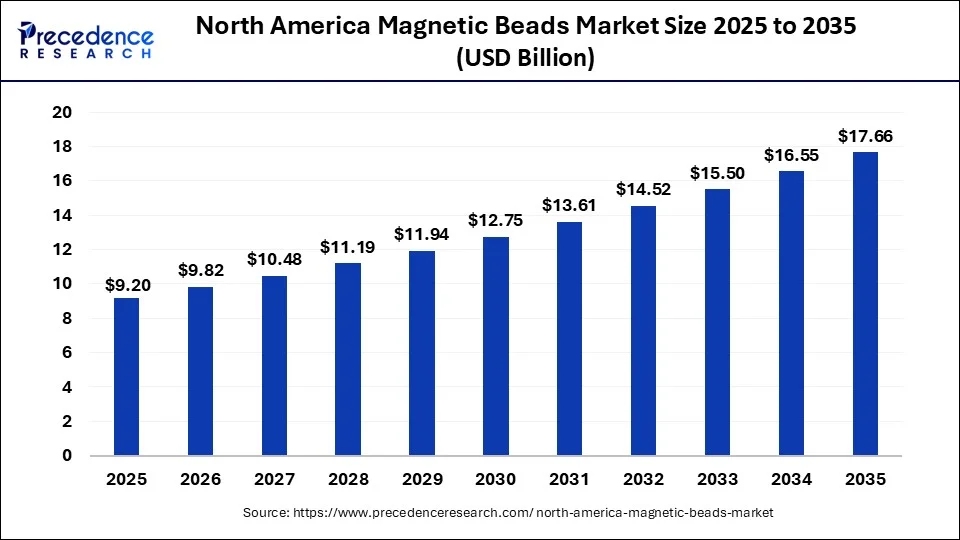
North America Magnetic Beads Market Statical Scope
| Reports Attributes | Statistics |
| Market Size in 2025 | USD 9.2 Billion |
| Market Size in 2026 | USD 9.82 Billion |
| Market Size by 2035 | USD 17.66 Billion |
| CAGR 2026 to 2035 | 6.74% |
| Base Year | 2025 |
| Forecast Period | 2026 to 2035 |
North America is the leading and fastest-growing center for the global magnetic beads market. The region's dominance is supported by strong healthcare investments, extensive research and development in life sciences, and clinical use of automated diagnostics. The growth of targeted therapies like CAR-T cell therapy, heavily depends on magnetic beads for the rapid and precise isolation of specific cell populations.
The U.S. magnetic bead market alone generates massive revenue, driven by major global companies such as Thermo Fisher Scientific, Qiagen, and Bio-Rad Laboratories. Research institutions in North America are advancing high-throughput testing and point-of-care (POC) devices, reinforcing the region's technological superiority.
North America Magnetic Beads Market, By Type, 2025
| Segments | Shares (%) |
| Cells & Microbes | 24.80% |
| Nucleic Acid | 38.60% |
| Proteins | 27.90% |
| Others | 8.70% |
- Cells & Microbes - The cells and microbes segment, with a share of 24.80% in 2025, plays a vital role in the North America magnetic beads market with innovative advancements in personalized medicine, cancer diagnostics, and infectious diseases. Functionalized magnetic beads allow researchers to rapidly and precisely isolate live cells such as stem cells or immune cells, and specific pathogens from complex biological mixtures.
- Nucleic Acid - The nucleic acid segment, with a share of 38.60% in 2025, is the leading and most important application in the North American magnetic beads market, as extracting DNA and RNA is the crucial "first step" for all subsequent molecular diagnostics. The move towards personalized medicine, oncology profiling, and liquid biopsies depends on retrieving these delicate nucleic acids.
- Proteins - The protein segment, with a share of 27.90% in 2025, is essential in the North American magnetic beads market as it supports high-throughput drug discovery, the production of therapeutic monoclonal antibodies, and clinical diagnostics. These beads, coated with functional groups like Protein A and G, allow for faster, scalable, and automation-friendly protein separation compared to traditional chromatography.
North America Magnetic Beads Market, By Application, 2025
| Segments | Shares (%) |
| Cell Separation & Expansion | 22.10% |
| Protein Sample Preparation & Protein Purification | 18.40% |
| IVD Assay Development | 15.30% |
| Nucleic Acid Isolation | 20.70% |
| Immunoprecipitation | 8.50% |
| Exosome Analysis | 5.90% |
| Antibody Purification | 6.80% |
| Others | 2.30% |
- Cell Separation & Expansion - The Cell Separation & Expansion segment, with a share of 22.10% in 2025, is leading the North American magnetic beads market due to high demand for targeted immunotherapies, stem cell research, and cell-based drug screening. Magnetic beads offer highly specific, gentle, and scalable cell isolation, which is crucial for generating pure, viable cells that meet clinical standards.
- Protein Sample Preparation & Protein Purification - The protein sample preparation and purification segment, with a share of 18.40% in 2025, is vital in the North America magnetic beads market as it supports high-throughput, automated workflows essential for the region's leading biopharmaceutical and proteomics sectors. Magnetic beads help reduce sample complexity and minimize loss without clogging columns.
North America Magnetic Beads Market, By End-use, 2025
| Segments | Shares (%) |
| Healthcare Facilities | 46.80% |
| Individual Pathology Labs | 18.90% |
| Research Labs | 28.70% |
| Others | 5.60% |
- Healthcare Facilities - The healthcare facilities segment, with a share of 46.80% in 2025, plays a dominant role in the North American magnetic beads market as it supports high-throughput automation, rapid sample processing, and precision medicine. These beads are crucial for isolating target cells, proteins, and nucleic acids from complex clinical samples like blood and tissue.
- Individual Pathology Labs - The individual pathology labs segment, with a share of 18.90% in 2025, is crucial in the North America magnetic beads market as it drives decentralized testing, high-throughput clinical diagnostics, and workflow automation. This segment is vital for high-volume, in-vitro diagnostics, handling both routine and advanced clinical tests. They depend on magnetic bead-based nucleic acid extraction and purification for quick, automated, and contamination-free sample processing.
Competitive Landscape
The North American market for magnetic beads is highly competitive, largely driven by research and development in molecular biology, genomics, and proteomics. Major companies are consistently investing in automation, increasing production capacity, and broadening application areas such as targeted cell isolation, nucleic acid purification, and protein immunoprecipitation.
- Thermo Fisher Scientific Inc. (USA) leads the market with its MagMAX extraction kits and Dynabeads. They provide a wide variety of surface-functionalized beads designed for high-throughput automated workflows, which work well with their KingFisher instruments.
- Merck KGaA (Germany/USA) is well-known for their PureProteome and MACS lines. They excel in protein purification, immunoprecipitation, and custom bioconjugation chemistry.
- Bangs Laboratories, Inc. (USA) focuses solely on microparticle and nanoparticle technologies, offering an extensive catalog of plain, dyed, and functionalized magnetic beads that are essential for lateral flow and in-vitro diagnostics (IVD).
- Cytiva (USA) is another key player, providing Sera-Mag and Sera-Xtracta magnetic beads that are optimized for binding total nucleic acids, widely used in viral and pathogen detection.
- Bio-Rad Laboratories, Inc. (USA) specializes in beads for separation, cell sorting, and multiplex immunoassay applications, including their Bio-Plex systems.
- Miltenyi Biotec is known for its MACS (Magnetic Activated Cell Sorting) technology, using MicroBeads for high-purity target cell isolation. New England Biolabs (NEB) offers Monarch magnetic beads that are optimized for total RNA extraction and DNA cleanup protocols in molecular biology.
- Promega Corporation features the Maxwell and Magna series of automated magnetic bead purification systems for extracting gDNA, total RNA, and viral nucleic acids.
Segments Covered in the Report
By Type
- Cells & Microbes
- Nucleic Acid
- Proteins
- Others
By Application
- Cell Separation & Expansion
- Protein Sample Preparation & Protein Purification
- IVD Assay Development
- Nucleic Acid Isolation
- Immunoprecipitation
- Exosome Analysis
- Antibody Purification
- Others
By End-use
- Healthcare Facilities
- Individual Pathology Labs
- Research Labs
- Others
For inquiries regarding discounts, bulk purchases, or customization requests, please contact us at sales@precedenceresearch.com
Frequently Asked Questions





Ask For Sample
No cookie-cutter, only authentic analysis – take the 1st step to become a Precedence Research client
 Get a Sample




 sales@precedenceresearch.com
 Schedule a Meeting
