



North America Heat Meter Market Size, Share and Trends 2026 to 2035
North America Heat Meter Market (By Type: Ultrasonic Meters, Turbine Meters, Vortex Meters, and Others; By Connectivity: Wired and Wireless; By Technology: Static and Mechanical; By Application: Residential, Commercial & Public, and Industrial) Industry Size, Share, Growth, Trends 2025-2035
 Get a Sample
 Table Of Content


The North America heat meter market size surpassed USD 6.2 billion in 2025 and is predicted to reach around USD 9.61 billion by 2035, registering a CAGR of 4.48% from 2026 to 2035. The market is mainly driven by strict energy efficiency regulations, increasing energy prices, and the rapid adoption of smart building technologies.
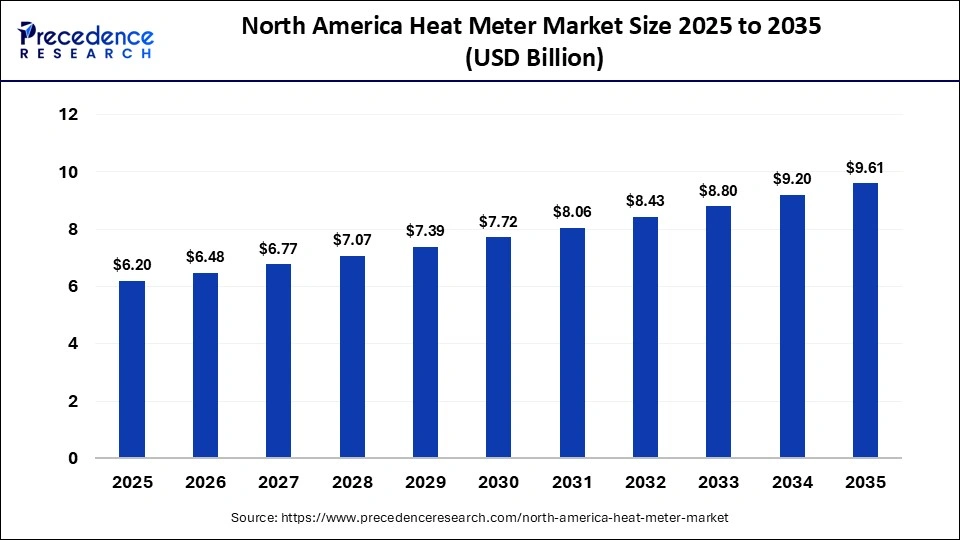
North America Heat Meter Market Statical Scope
| Reports Attributes | Statistics |
| Market Size in 2025 | USD 6.2 Billion |
| Market Size in 2026 | USD 6.48 Billion |
| Market Size by 2035 | USD 9.61 Billion |
| CAGR 2026 to 2035 | 4.48% |
| Base Year | 2025 |
| Forecast Period | 2026 to 2035 |
In North America, heat meters, also known as BTU meters, play a crucial role as they accurately monitor thermal energy use for heating and cooling. With rising energy prices, ambitious decarbonization targets, and smart building systems, this market is very valued in the region. It helps in reducing carbon emissions across residential, commercial, and industrial areas. These meters provide precise tracking of thermal consumption, assisting facility managers and homeowners in reducing overall energy use. They ensure fair, usage-based billing for modern centralized and district heating systems. Additionally, they promote the use of wireless and IoT-enabled smart meters for real-time monitoring. They assess performance and enhance hybrid systems that use solar or geothermal thermal energy.
As commercial properties adopt solar thermal, biomass, and geothermal heat pumps, heat meters are essential for measuring the amount of renewable energy generated compared to reliance on the grid. Current U.S. Heat Metering Standards guarantee that commercial operators accurately report their thermal footprints to meet local carbon reduction objectives. Large universities, hospitals, and contemporary district heating and cooling networks employ meters to monitor systemic thermal losses. Property managers leverage real-time tracking data to optimize HVAC operations, significantly reducing structural wear and energy waste.
North America Heat Meter Market, By Type, 2025 (%)
| Segments | Shares (%) |
| Ultrasonic Meters | 43.80% |
| Turbine Meters | 29.40% |
| Vortex Meters | 17.10% |
| Others | 9.70% |
- Turbine Meters - The turbine meters segment, with a share of 29.40% in 2025, which is part of mechanical heat meters, is crucial in the North America heat meter market as it is cost-effective, performs reliably in standard commercial and industrial settings, and is traditionally well-known.
- Ultrasonic Meters - The ultrasonic meters segment, with a share of 43.80% in 2025, plays a dominant role in the North America heat meter market due to its high measurement accuracy, low maintenance, and easy integration with IoT and smart-grid technologies.
- Vortex Meters - The vortex meter segment, with a share of 17.10% in 2025, is essential in the North America heat meter market due to its outstanding durability in tough industrial steam systems, minimal maintenance needs with no moving parts, and precise BTU energy monitoring.
North America Heat Meter Market, By Connectivity, 2025 (%)
| Segments | Shares (%) |
| Wired | 57.30% |
| Wireless | 42.70% |
- Wired - The wired segment, with a share of 57.30% in 2025, is leading the North America heat meter market as it ensures stable data transmission, strong security, and smooth integration with complex systems in commercial buildings.
- Wireless - The wireless segment, with a share of 42.70% in 2025, is crucial in the North America heat meter market as it experiences the fastest growth, simplifies installation, and integrates well with smart building systems.
North America Heat Meter Market, By Technology, 2025 (%)
| Segments | Shares (%) |
| Static | 53.50% |
| Mechanical | 46.50% |
- Mechanical - The mechanical segment, with a share of 46.50% in 2025, remains significant in the North American heat meter market due to its cost-effectiveness, proven reliability, and common use in older residential and commercial properties.
- Static - The static segment, with a share of 53.50% in 2025, leads the North American heat meter market as it provides high accuracy, has no moving parts to minimize wear, and integrates seamlessly with digital building systems, enhancing efficiency in commercial and multi-family infrastructures.
North America Heat Meter Market, By Application, 2025 (%)
| Segments | Shares (%) |
| Residential | 51.80% |
| Commercial and Public | 32.60% |
| Industrial | 15.60% |
- Residential - The residential segment, with a share of 51.80% in 2025, is the dominant driver in the North American heat meter market, mainly due to increasing heating costs, sub-metering in multi-family housing, and strict energy-efficiency regulations.
- Commercial and Public - The commercial and public segment, with a share of 32.60% in 2025, is crucial in the North American heat meter market due to strict energy-efficiency regulations, large-scale deployments on campuses, and rising energy costs.
Competitive Landscape
The North America heat meter market is dominated by major companies like Landis+Gyr, Itron, and Kamstrup, driven by smart building projects and energy efficiency regulations.
The market emphasizes ultrasonic technology, IoT connectivity, and precise submetering for commercial and campus facilities.
- Landis+Gyr offers integrated smart energy management solutions, advanced metering infrastructure (AMI), and multi-utility smart metering data platforms designed for large-scale commercial and utility monitoring.
- Itron provides extensive smart network platforms, communication modules, and thermal/energy measurement analytics tools that enable real-time consumption tracking and remote data gathering.
- Kamstrup focuses on high-precision ultrasonic heating and cooling meters (like the MULTICAL series) that feature long battery life, smart alarms, and remote wireless reading capabilities.
- Diehl Stiftung & Co. KG supplies static thermal energy meters and modular radio/Wireless M-Bus systems aimed at sub-metering and district energy accountability.
- Zenner offers mechanical and electronic heat meters, heat cost allocators, and IoT-enabled system integration components designed for cost allocation in multi-family and commercial buildings.
Segments Covered in the Report
By Type
- Ultrasonic Meters
- Turbine Meters
- Vortex Meters
- Others
By Connectivity
- Wired
- Wireless
By Technology
- Static
- Mechanical
By Application
- Residential
- Commercial and Public
- Industrial
For inquiries regarding discounts, bulk purchases, or customization requests, please contact us at sales@precedenceresearch.com
Frequently Asked Questions





Ask For Sample
No cookie-cutter, only authentic analysis – take the 1st step to become a Precedence Research client




 sales@precedenceresearch.com
 Schedule a Meeting



