



Offshore HVDC Platform Market Trends, Companies, Revenue / Sales Performance, Manufacturing Yield, Fab Capacity, Export & Import Dynamics, Supply Chain Analysis, Competitive Landscape, and Growth Forecast
Offshore HVDC Platform Market (Platform TypeL: Fixed, Floating; Component: Converter Stations, Transformers, Switchgear, Others; Application: Wind Power Integration, Oil & Gas Platforms, Grid Interconnection, Others; Capacity: Up to 500 MW, 501–1000 MW, Above 1000 MW) - Global Industry Analysis, Size, Trends, Leading Companies, Regional Outlook, and Forecast 2026 to 2035
Source: https://www.precedenceresearch.com/offshore-hvdc-platform-market
 Get a Sample
 Table Of Content


What is the Offshore HVDC Platform Market Size?
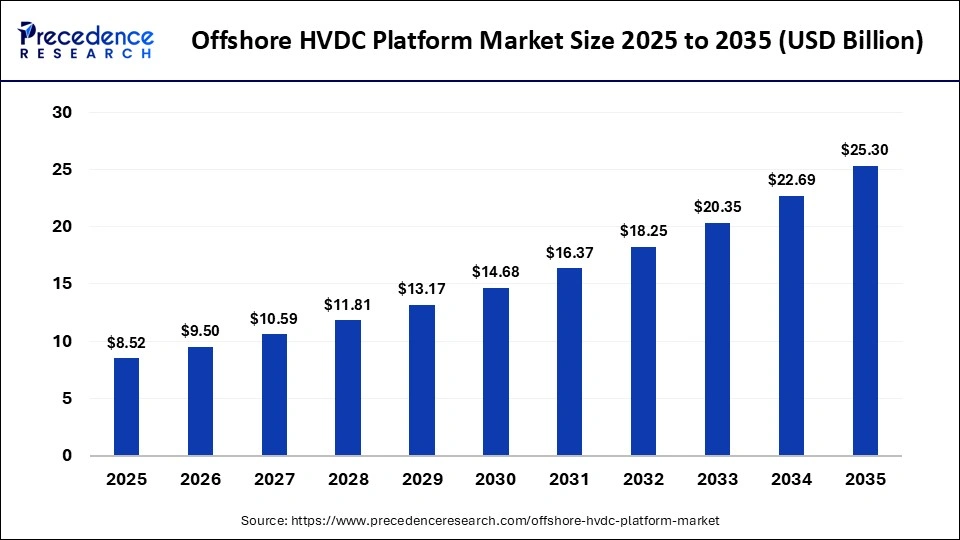
The global offshore HVDC platform market size was calculated at USD 8.52 billion in 2025 and is predicted to increase from USD 9.50 billion in 2026 to approximately USD 25.30 billion by 2035, expanding at a CAGR of 11.50% from 2026 to 2035.The offshore HVDC platform market is expected to grow significantly due to the higher demand for large-scale and distant offshore wind farms connecting to the mainland grid. The main focus of the market involves enhancing Voltage Source Converter (VSC) Technology. The market is also expected to expand due to increasing investments in the field of renewable energy, especially in major Asian countries. Efficiency in long-distance power transmission serves as the primary goal for market growth.
Key Takeaways
- Asia Pacific held the majority of the share of the offshore HVDC platform market in 2025.
- North America is observed to have a significant growth in the foreseen period.
- By platform type, the fixed segment held a dominant position in the market in 2025.
- By platform type, the floating segment is expected to grow at the fastest CAGR in the foreseen period.
- By component analysis, the converter stations segment led the global market with the highest revenue share in 2025.
- By component analysis, the transformer stations segment is expected to expand rapidly in the foreseen period.
- By application analysis, the wind power integration segment dominated the global market in 2025 and is also observed as the fastest-growing segment with the highest CAGR in the forecast period.
- By capacity analysis, the 501-1000MW segment registered its dominance over the global market in 2025.
- By capacity analysis, the above 1000MW segment is expected to witness the fastest growth in the foreseen period.
What is the Offshore HVDC Platform Market?
The offshore HVDC platform market involves specialized, floating, or fixed offshore-based converter systems that are helpful to convert Alternating Current (AC) from wind farms into high voltage direct current (HVDC) for efficient, long-distance transmission to shore. Such platforms are also helpful for integrating large-scale offshore renewables. The market is also defined as the global sector that is focused on the design, construction, and deployment of maritime installations that host high-voltage converter equipment. Such platforms are helpful for the transition of power between AC and DC to facilitate the efficient transmission of bulk renewable energy from remote offshore wind farms to onshore grids. The converter stations also play a crucial role in the market as they contain Voltage Source Converters (VSC) or Line-Communicated Converters (LCC) to rectify AC power from wind turbines into DC for long-distance transport.
Role of Technology in the Growth of the Offshore HVDC Platform Market
The segment has a major contribution to the growth of the market by enabling technical and economic feasibility, transmitting large-scale renewable energy from distant offshore wind farms to the mainland. The major shift of the market from AC to VSC-HVDC technology, as it helps to handle long-distance, high-power transmission with lower losses, reduced footprint, and superior grid stabilization. Technologies such as Modular Multilevel Converters (MMC) in compact designs help to reduce the platform's footprint and weight, which is helpful for the growth of the industry. It also leads to cost-effective, high-density converter stations with power densities. Advancements in Gas-Insulated Switch Gears (GIS) help to reduce equipment size for space-constrained, expensive offshore platforms. The segment also involves the industry's major shift towards lean HVDC platforms, which lowers operational costs and safety risks.
Offshore HVDC Platform Market Trends
- Technological Advancements: The major shift of the industry from LCC technology towards VSC technology for its ability to connect weak grids and provide black-start capability for offshore wind integration.
- Grid Integration: The main aim of the segment involves connecting large-scale, offshore wind farms to the mainland, requiring advanced subsea cables and compact platform designs.
- Digitalization: Higher preference for digital monitoring systems to improve real-time analysis and operational efficiency also helps to propel the market's growth.
Market Scope
| Report Coverage | Details |
| Market Size in 2025 | USD 8.52 Billion |
| Market Size in 2026 | USD 9.50 Billion |
| Market Size by 2035 | USD 25.30 Billion |
| Market Growth Rate from 2026 to 2035 | CAGR of 11.50% |
| Dominating Region | Asia Pacific |
| Fastest Growing Region | North America |
| Base Year | 2025 |
| Forecast Period | 2026 to 2035 |
| Segments Covered | Platform Type, Component, Application, Capacity, and region |
| Regions Covered | North America, Europe, Asia-Pacific, Latin America, and Middle East & Africa |
Segmental Insights
Platform Type Insights
Which Component of the Platform Segment Led the Global Market in 2025?
The fixed segment held a dominant position in the offshore HVDC platform market in 2025. The segment is observed to grow majorly due to factors such as proven reliability, established fabricator networks, and cost-effectiveness. The fixed platforms use monopiles and jackets to support high-voltage converter stations. Such a platform also observes growth due to its lower relative cost and the rapid expansion of shallow to transitional water wind farms. The fixed structures also benefit from mature supply chains and well-established engineering to provide lower initial capital costs.
The floating segment is observed to be the fastest-growing in the offshore HVDC platform market in the foreseeable period. Such platforms are strong enough to bear a harsh environment and can be easily deployed in locations where fixed platforms cannot sustain. The modular design of floating platforms allows for easier transportation, installation, and maintenance, to reduce project timelines and overall costs, further propelling the growth of the market. Such platforms can also be easily anchored with the help of the mooring systems to the seabed to provide stability in the dynamic movements of the sea. Hence, large-scale offshore wind farms highly adopt floating platforms as they can sustain conditions such as deep sea and challenging seabed conditions, where making a fixed platform is a bit impractical.
Component Insights
Why did the Converter Stations Segment Lead the Global Industry in 2025?
The converter stations segment had dominance over the global offshore HVDC platform market in 2025. The main responsibility of the segment involved converting AC to DC for long-distance transmission and vice versa as well. Such stations are also equipped with advanced power electronics, cooling systems, and control units to ensure stability and efficiency under challenging marine situations. The segment also observes growth with the growing demand for high-capacity, compact converter stations with the rising offshore wind projects. The modern converter stations are designed to handle 700MW to over 1GW, which is helpful for the growth of the industry. The use of compact VSC technology also allows for smaller, lighter offshore platforms to reduce structural steel requirements. The segment also observes growth due to advanced technologies such as MMC, 12-pulse converters, and VSC.
The transformer stations segment of the offshore HVDC platform market is observed to grow with the highest CAGR in the forecast period. The segment observes major growth in the foreseen period as it facilitates voltage regulation and also ensures safe and efficient transfer of electricity between different parts of the HVDC systems. The segment also observes growth in offshore transformers, as designed to sustain rough sea climate, high humidity, and temperature fluctuations with the help of robust insulation and protection systems. The transformer stations also observe major changes in the form of higher voltage and capacity ratings, with the focus on improving efficiency, reliability, and ease of maintenance.
Application Insights
Which Component of the Application Segment Leads the Global Market in 2025?
The wind power integration segment dominated the global offshore HVDC platform market in 2025, and is also observed to be the fastest growing region in the expected years, as it is highlighted to surge in offshore wind projects. The floating HVDC platforms enable the efficient transmission of electricity generated by offshore wind turbines to onshore grids. The procedure also helps to overcome limitations of traditional AC transmission in terms of factors such as distance, capacity, and losses. Growing demand for high-capacity HVDC transmission infrastructure due to wind farms moving further offshore is another major factor boosting the demand for the segment.
Capacity Insights
Which Component of the Capacity Segment Dominated the Market in 2025?
The 501-1000MW segment held the largest revenue share of the offshore HVDC platform market in 2025. The segment has a major contribution in the market as it represents an ideal balance between scalability, efficiency, and cost between different platforms, making the segment suitable for commercial offshore energy developments. The size and capacity of the offshore wind turbines are increasing day by day, leading to greater demand for higher-capacity HVDC platforms, further propelling the growth of the segment. Such platforms are also equipped with advanced power electronics, cooling systems, and automation technologies to ensure improved performance in case of operating conditions.
The above 1000MW segment is expected to witness the highest growth in the offshore HVDC platform market in the forecast period. The segment growth is majorly driven by the development of mega-scale offshore wind projects and cross-border interconnections. The segment is inclusive of the platforms that are designed to handle very high power ratings, allowing aggregation and transmission of electricity from multiple wind farms or energy hubs to onshore grids. The segment also experiences innovations in platform design, materials, and power electronics to manage the operational challenges faced by the segment seamlessly. The segment also has a major contribution to the growth of the market, as it is expected to set new benchmarks for the industry and provide new opportunities for large-scale offshore energy integration.
Regional Insights
Why did Asia Pacific Lead the Global Market in 2025?
Asia Pacific had the largest revenue share of the offshore HVDC platform market in 2025, mainly due to the rapid expansion of offshore wind capacity in multiple Asian countries, leading to growing demand for advanced transmission solutions. Such solutions are also helpful to overcome serious challenges of the industry, such as deep-water installations and long-distance power transfer. The market also observes growth in the region due to various supportive policies of the government, along with research incentives to promote the development and deployment of floating HVDC technologies. The involvement of local manufacturers and international names in the market is further supporting innovation, competition, and localization of supply chains.
China Offshore HVDC Platform Market Trends
China has a major contribution to the growth of the market due to the country's aggressive expansion of offshore wind power in coastal regions. The market is also elevated in the region due to the presence of advanced technologies such as VSC-HVDC to transmit large-scale, distant offshore wind power to mainland load centers.
Why is North America expected to have Significant Growth in the Foreseen Period?
North America is expected to experience significant growth in the coming years due to the region's aggressive offshore wind targets, along with the need to replace aging grid infrastructure. The growing investments in the HVDC transmission industry of the region are also propelling the growth of the market. Technological advancements in the form of VSC-HVDC for offshore platforms are helpful to stabilize weak offshore grids and are a major factor for the growth of the market.
The U.S. Offshore HVDC Platform Market Trends
The U.S. is poised to have significant growth in the foreseen period, rapid expansion in offshore wind capacity, and grid modernization of the region. The region is also expected to grow with the highest CAGR due to factors such as massive investments in renewable energy integration for long-distance subsea transmissions from offshore wind farms.
How is Europe Expanding in the Offshore HVDC Platform Market?
Europe is considered to be a significantly growing area, because of the fast growth of offshore wind farms and favorable government policies for renewable energy. Governments are looking to invest in grid connections and intelligent transmission systems. Increased demand for carbon-free energy and long-range transmission is driving growth in this market.
Germany Market Trends
The German market is growing due to the existence of powerful offshore wind power generation plants and the country's plans for renewable energy development. It plans to implement a technology that will enable the transportation of electric energy generated at offshore facilities using HVDC transmission systems.
How is Latin America Emerging in the Offshore HVDC Platform Market?
Latin America is expected to grow at a considerable CAGR in the upcoming period. The constant growth is attributed to the growing investments in renewable energy and advanced transmission facilities. The governments of Latin American countries are also encouraging efforts towards expanding and modernizing energy infrastructures in their countries.
Brazil Market Trends
Brazil can be considered a major market because of renewable energy developments, offshore wind capabilities, and advanced transmission systems. There have been improvements made in terms of efficient grids and power transmission over long distances through renewable sources. Growing electricity demands and the government's emphasis on sustainable power infrastructure have contributed to growth.
How is the Middle East and Africa Developing in the Offshore HVDC Platform Market?
The Middle East and Africa are expected to grow at a considerable CAGR in the upcoming period, due to an increase in renewable energy projects. Governments are concerned about grid stability, electricity provision, and renewable energy incorporation. Offshore energy installations have been rising, contributing to a rise in HVDC transmission systems.
UAE Market Trends
The UAE market is attributed to increased investments in renewable energy infrastructure and smart grids. The UAE has embarked on an energy diversification strategy that includes clean energy production and efficient energy transportation systems. Increasing numbers of sustainable infrastructure developments, energy transition, and low-carbon energy solutions have spurred market expansion.
Competitive Landscape
The offshore HVDC platform market is characterized as semi-consolidated, where there is dominance by a few players based on technology and expertise in offshore projects. Major players such as Siemens Energy, Hitachi Energy, GE Vernova, and ABB mainly deal with the provision of HVDC platforms, offshore power conversion units, and grids. Players are focusing on research & development, digitization, and developing compact converters. Competitiveness is expected to grow due to strategic collaboration, offshore wind projects, and long-term contracts. The high cost of investments, strict regulatory environment, and technological difficulty pose very high entry barriers in the market.
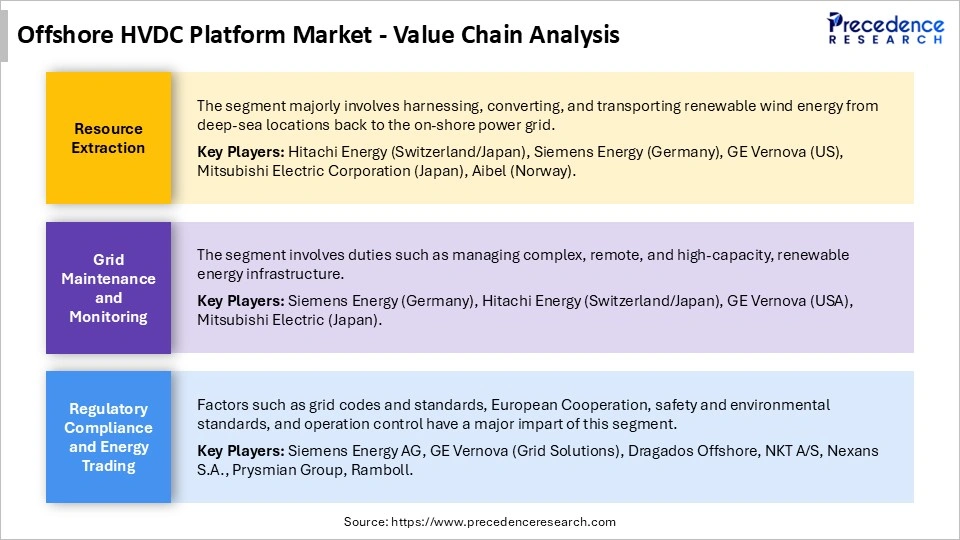
Offshore HVDC Platform Market Value Chain Analysis
Offshore HVDC Platform Market Companies
- Siemens Energy
- Hitachi Energy
- ABB
- Aker Solutions
- Schneider Electric
- GE Grid Solutions
- Mitsubishi Electric
- Nexans
- Prysmian Group
- Equinor
- Ørsted
- Technip Energies
- Subsea 7
- Saipem
- Petrofac
Recent Developments
- In June 2025, Aibel and Hitachi Energy installed the final technical equipment, including the HVDC converter and transformers, in Norway.
(Source- https://www.offshorewind.biz) - In April 2025, the offshore HVDC converter station of the BorWin5 grid connection departed from Dragados Offshore's yard in Puerto Real, Spain, in April 2025 and was en route to its final location in the German North Sea. (Source- https://www.offshorewind.biz)
Segments Covered in the Report
By Platform Type
- Fixed
- Floating
By Component
- Converter Stations
- Transformers
- Switchgear
- Others
By Application
- Wind Power Integration
- Oil & Gas Platforms
- Grid Interconnection
- Others
By Capacity
- Up to 500 MW
- 501–1000 MW
- Above 1000 MW
By Region
- North America
- Europe
- Asia-Pacific
- Latin America
- Middle East & Africa
For inquiries regarding discounts, bulk purchases, or customization requests, please contact us at sales@precedenceresearch.com
Frequently Asked Questions





Ask For Sample
No cookie-cutter, only authentic analysis – take the 1st step to become a Precedence Research client
 Get a Sample




 sales@precedenceresearch.com
 Schedule a Meeting
