



Silicon as a Platform Market Size, Key Companies, Company Product Portfolio, SoC and Chiplet Deployment, Silicon Production Capacity, AI Workload Adoption, Technology Roadmap, Market Penetration, and Competitive Landscape
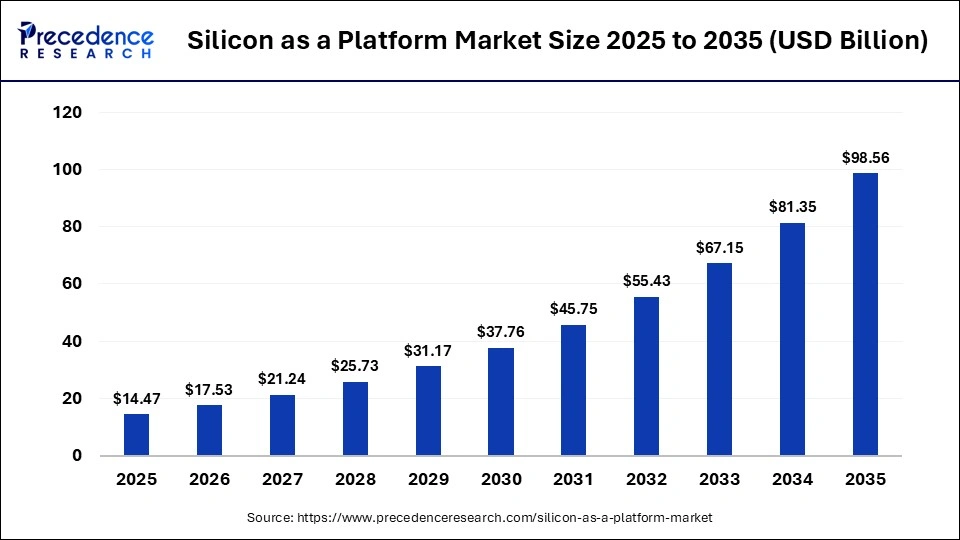
According to semiconductor and electronics specialist Laxmi Narayan, the silicon as a platform market is valued at USD 17.53 billion in 2026 and is forecast to reach USD 98.56 billion by 2035, reflecting a CAGR of 21.15%. Leading silicon as a platform market companies, including TSMC, Samsung Electronics, Intel Corporation, are strengthening their presence across key segments such as by platform type, by application, by technology node, by integration type, by end user.
Source: https://www.precedenceresearch.com/silicon-as-a-platform-market
 Get a Sample
 Table Of Content


What is the Silicon as a Platform Market Size?
The global silicon as a platform market size was calculated at USD 14.47 billion in 2025 and is predicted to increase from USD 17.53 billion in 2026 to approximately USD 98.56 billion by 2035, expanding at a CAGR of 21.15% from 2026 to 2035. The market growth is attributed to increasing demand for AI-optimized and workload-specific silicon platforms across cloud, edge, and automotive applications.
Market Highlights
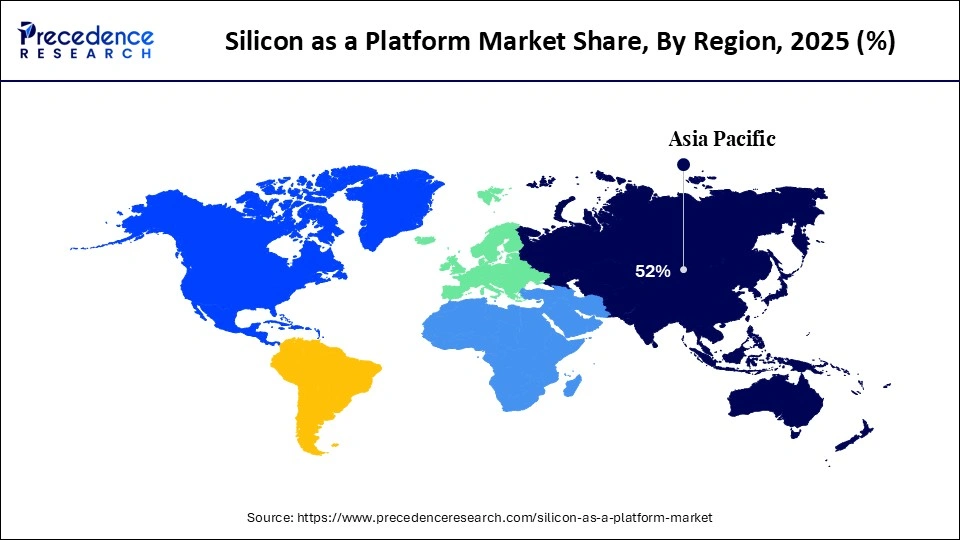
- Asia Pacific dominated the market with 52% of the market share in 2025.
- The North America is expected to grow at the fastest CAGR between 2026 and 2035.
- By platform type, the CMOS silicon platforms segment contributed the highest market share of 44% in 2025.
- By platform type, the heterogeneous silicon integration/chiplets segment is growing at the strongest CAGR between 2026 and 2035.
- By application, the computing & data centers segment held a major market share of 36% in 2025.
- By application, the automotive electronics (ADAS, EVs) segment is expected to expand at the fastest-growing CAGR from 2026 to 2035.
- By technology node, the below 7 nm segment captured the highest market share of 41% in 2025.
- By technology node, the advanced packaging nodes segment is poised to grow at the fastest rate between 2026 and 2035.
- By integration type, the system-on-chip (SoC) segment generated the biggest market share of 47% in 2025.
- By integration type, the chiplet-based architectures segment is expanding at the highest CAGR between 2026 and 2035.
- By end user, the foundries & IDMs segment accounted for the largest market share of 39% in 2025.
- By end-user, the hyperscalers & data center operators segment is projected to grow at the fastest-growth rate between 2026 and 2035.
Silicon as a Platform Market Overview
Rapid advances in artificial intelligence and related high-performance workloads are driving demand for programmable, integrated silicon platforms. Silicon platform capabilities are considered as of economic and national security by governments around the globe. The U.S. CHIPS and Science Act has funded over 140 semiconductor projects worth over 630 billion USD. This provides hundreds of thousands of jobs to enhance the US-based infrastructure of advanced chip design and innovation.
According to industry groups like the Semiconductor Industry Association (SIA), the global semiconductor sales are expected to reach 630 billion in 2024. This is largely due to the AI, automotive, and industrial automation demand, a trend that contributes to the platformized silicon usage in industries. Furthermore, the technology co-development between governments, industry consortia, and research institutions is likely to continue to be a major growth driver of silicon platform development in the coming years.
Impact of Artificial Intelligence on the Silicon as a Platform Market
The silicon as a platform market is being transformed by Artificial Intelligence (AI) to create demand in highly specific and workload-optimized silicon solutions. Firms are incorporating AI acceleratounits, and neural processing units, machine learning enhanced cores right into custom platforms. Additionally, organizations use AI-driven analytics to do well in platform utilization in cloud, edge, and automotive applications to achieve maximum performance and reliability.
Silicon as a Platform Market Growth Factors
- Rising Adoption of AI and Machine Learning Workloads: Increasing enterprise deployment of AI-driven applications is driving demand for specialized silicon platforms with enhanced compute and memory integration.
- Growing Edge Computing Implementation: Expansion of edge devices and IoT infrastructure is boosting the need for low-latency, high-efficiency silicon solutions across industries.
- Propelling Heterogeneous Integration Technologies: Advances in chiplet and 3D IC architectures are propelling performance scaling and enabling modular, workload-optimized platforms.
- Fueling High-Performance Data Center Expansion: Rapid growth of cloud services and HPC facilities is fueling demand for scalable, energy-efficient silicon architectures.
Inside the Silicon Stack: Quantitative Insights into the Silicon as a Platform Market
- The U.S. remains highly dependent on foreign silicon platform products, importing over $23.3 billion worth of semiconductors in 2024, with much of this sourced from Asian manufacturing hubs, reflecting the country's reliance on overseas production for core silicon and platform-derived components.
- In 2024, Taiwan was the largest single source of U.S. semiconductor imports, contributing approximately $11.9 billion in products, followed closely by Malaysia at nearly $10.3 billion, underscoring the heavy import reliance of U.S. silicon platforms on these Asian export hubs
- India shows growing import dependence on foreign silicon and semiconductor products, with recent quarter HS 8541 data indicating China supplies 95 % of India's semiconductor import quantities, even though that share represents a lower value, reflecting heavy reliance on volume shipments of basic platform components.
- Global semiconductor manufacturing equipment (SME) shipments reached approximately USD 117 billion in 2024, a record high, reflecting expanded wafer fab capacity additions tied directly to increased silicon platform production and cross-border silicon trade.
- Vietnam has rapidly emerged as a leading importer of semiconductor chips and silicon-derived components, accounting for approximately 16,470 shipments of semiconductor chips during Apr 2024 to Mar 2025 (TTM) of global semiconductor chip import shipments between June 2024 and May 2025, making it one of the fastest-growing import destinations for silicon-based technologies.
- Hyperscale cloud providers are materially increasing deployment of their own custom silicon, with AWS reporting that Graviton custom CPUs now power more than 50% of instances launched on its platform over the past two years, indicating broad operational penetration of in-house silicon at scale.
- AWS's Graviton custom silicon powered more than 250,000 CPUs during peak demand events such as Prime Day 2024, demonstrating large-scale production and utilization of custom silicon in live cloud environments.
Silicon as a Platform Market Outlook
- Industry Growth Overview: The silicon as a platform market is experiencing high growth activity as silicon design and fabrication are replaced by highly configurable, domain-specific platforms. They are optimized for AI, cloud, edge computing, automotive control, and communications infrastructure. The need to use custom and application-optimized silicon solutions is growing at a very fast pace in both enterprises and hyperscalers.
These entities want to gain performance, energy efficiency, and workload specialization to levels that are well beyond the capabilities of traditional commodity chips. Furthermore, as digital transformation reshapes industries through AI, 5G, and next-generation compute workloads, silicon platforms are positioned as core enablers of performance, efficiency, and competitive differentiation. - Sustainability Trends: Sustainability within the silicon as a platform market is increasingly focused on energy efficiency, reduced power consumption, and longer product lifecycles. Designers are focusing on designs with a lower energy footprint, especially in AI accelerators and edge devices, where battery life and thermal performance are of primary importance. Furthermore, the shift toward reconfigurable and modular silicon platforms in the industry discusses the long useful life of hardware, less frequent redesign requirements, and helps to eliminate electronic waste.
- Global Expansion: The market's geographic footprint continues to broaden as semiconductor design and platform capabilities spread beyond traditional hubs. Asia Pacific is also a center of activity of production and innovation, where national semiconductor programs in China, India, Japan, and South Korea are reinforcing regional design ecosystems and supply engineering capacity. On the other hand, worldwide growth not only enhances supply chain resiliency but also brings silicon platform innovations closer to the emerging end markets in cloud, automotive, and edge computing.
- Major Investors: The strategic value of the technology is becoming more apparent, which prompts greater interest from investors in silicon as a platform asset. Direct investments by major private equity funds, sovereign wealth funds, and corporate venture arms are going to silicon-based startups, IP-based custom IP developers, and platform-enabling technology. Furthermore, such investment flows indicate optimism in the technology course of the sector and long-term demand in the markets of AI, networking, and embedded systems.
- Startup Ecosystem: A vibrant startup ecosystem is emerging around silicon platforms, particularly in areas such as open architecture processors and cloud-integrated design tooling. RISC-V, chiplet architectures, and Silicon PaaS frameworks are being used by new entrants to replace the traditional silicon development paradigm with lower barriers to entry and faster innovation cycles. Additionally, the strategic acquisitions by large technology companies of well-positioned startups underscore the appetite for novel silicon platform capabilities that can be quickly integrated into broader compute and AI infrastructure.
Market Scope
| Report Coverage | Details |
| Market Size in 2025 | USD 14.47 Billion |
| Market Size in 2026 | USD 17.53 Billion |
| Market Size by 2035 | USD 98.56 Billion |
| Market Growth Rate from 2026 to 2035 | CAGR of 21.15% |
| Dominating Region | Asia Pacific |
| Fastest Growing Region | North America |
| Base Year | 2025 |
| Forecast Period | 2026 to 2035 |
| Segments Covered | Platform Type, Application, Technology Node, Integration Type, End User, and Region |
| Regions Covered | North America, Europe, Asia-Pacific, Latin America, and Middle East & Africa |
Segments Insights
Platform Type Insights
Why Are CMOS Silicon Platforms Dominating the Market?
CMOS silicon platforms segment dominated the silicon as a platform market in 2025, accounting for an estimated 44% market share. Driven by their unmatched versatility in handling high-volume digital logic and general-purpose computing workloads. General-purpose compute and control functions were still preferentially done on established and advanced CMOS process nodes, including 3 nm and the new 2 nm category technology. Furthermore, the robust toolchain support and design ecosystem maturity further cement CMOS platforms as the backbone of workload-optimized computing solutions
The heterogeneous silicon integration/chiplets segment is expected to grow at the fastest rate in the coming years, as they help designers to incorporate dozens of specialized dies into a single package with yield cost benefits that large monolithic chips do not have. Additionally, the emerging trends in advanced interconnects and 3D stacking enhance performance density and power efficiency, making heterogeneous integration particularly attractive.
Application Insights
Why Are Computing & Data Centers Driving Silicon as a Platform Market Demand?
Computing & data centers segment held the largest revenue share in the silicon as a platform market in 2025, holding a market share of about 36%. Driven by AI, high-performance computing (HPC), and cloud workloads. Hyperscalers Google, Amazon AWS, and Microsoft Azure put a larger number of custom silicon units to work on AI inference and virtualization last year, with an equal focus on power efficiency and computational density.
Greater numbers of 3 nm and 2 nm process platforms were used in advanced node CMOS platforms, facilitating multi-tenant cloud infrastructure and massive HPC clusters. Jericho4 by Broadcom and the new routing silicon of Cisco supported internal and inter-data-center links at 25-30% bandwidth better than their predecessors in a demonstration of silicon innovation, eliminating latency whilst scaling throughput. Furthermore, the computing & data centers enterprises invested heavily in workload-specific silicon to reduce energy costs and accelerate processing times, thus fueling the segment growth.
Automotive electronics (ADAS, EVs) segment is expected to grow at the fastest CAGR in the coming years. EV powertrain management, in-car AI, and sensor fusion platforms built on silicon completed 3.5 exa-operations per second (ExaOps) in real-world autonomous and assisted driving systems. The high-bandwidth technologies, such as TSMC CoWoS and Intel Foveros/EMIB, increased bandwidth, which is important to real-time ADAS demands. Additionally, the investments in high-efficiency EV silicon platforms and secure communication stacks increased year on year, thus reflecting rising demand for autonomous and connected vehicle solutions, such as silicon as a platform.
Technology Node Insights
Why Are Sub-7 nm Nodes Driving the Future of Silicon Platforms?
The below 7 nm segment dominated the silicon as a platform market in 2025, accounting for an estimated 41% market share. Due to their unmatched ability to deliver high-density logic, ultra-fast AI processing, and HPC acceleration. Furthermore, the platforms that are below 7nm are likely to remain dominant in the market for their efficiency, performance, and the ability to be used in almost all AI, HPC, and cloud deployments.
Advanced packaging nodes (2.5D/3D ICs) segment is expected to grow at the fastest rate in the coming years, owing to the scale of performance improvement beyond the constraints of the Moore Law. It is expected that these packaging technologies support AI accelerators, HPC clusters, and modular chiplet designs. Additionally, by 2026, 2.5D/3D ICs are predicted to become a foundation of next-generation silicon platforms with investments in interposer materials, TSVs, and high-bandwidth memory integration.
Integration Type Insights
Why Are System-on-Chip (SoC) Designs Dominating Silicon Platform Deployments?
System-on-chip (SoC) segment held the largest revenue share in the silicon as a platform market in 2025, holding a market share of about 47%, driven by demand for compact, energy-efficient, and high-performance compute solutions across cloud, edge, and automotive applications. The major vendors, including Apple Silicon Group, Qualcomm, Nvidia, and AMD, sold more units of SoCs over the previous year, which are used in AI accelerators, mobile processors, and car domain controllers. Furthermore, it is estimated that enterprises and hyperscalers keep on spending heavily on SoCs to accommodate the rising demands of AI, HPC, and clouds.
Chiplet-Based architectures segment is expected to grow at the fastest CAGR in the coming years, as they allow modular design and high-performance computing without monolithic die scaling performance. Chiplets enable the designers to combine various technology nodes and functional blocks to have a better performance, reduce cost, and shorten time-to-market. Additionally, the investment in modular interconnects, silicon photonics, and 3D stacking is expected to drive chiplet adoption to become a key growth engine of next-generation silicon platforms.
End User Insights
Why Are Foundries and IDMs Dominating Silicon Platform Adoption?
Foundries & IDMs segment dominated the silicon as a platform market in 2025, accounting for an estimated 39% market share, as foundries' positions as central pillars of global silicon production. TSMC, Samsung, and Intel are delivering a large number of units in HPC, automotive, and consumer markets. In 2026, foundries are estimated to increase platform capabilities by investing in 3D IC stacking, 2.5D chiplets, and advanced interconnects. In 2025, GlobalFoundries and UMC added 7% more capacity in wafer capacity that served heterogeneous compute and AI workloads. Furthermore, the foundries' focus on emerging materials, EUV lithography adoption, and advanced packaging strategies further facilitates their competitive edge and market presence in the coming years.
The hyperscalers & data center operators segment is expected to grow at the fastest rate in the coming years, owing to the escalating AI, HPC, and cloud workloads. TPU division of Google and Microsoft Azure provided cloud services with 1.2 million AI accelerators and 850,000 AI-optimized FPGAs. Hyperscale's using Modular SoCs and chiplet-based designs allowed deploying 10-15% more interconnect bandwidth as well as 18-percent-lower latency within data-center clusters. Additionally, the use of AI workloads is likely to increase in 2026, leading to faster adoption of silicon as a platform in these types of operators.
Regional Insights
What is the Asia Pacific Silicon Platform Market Market Size?
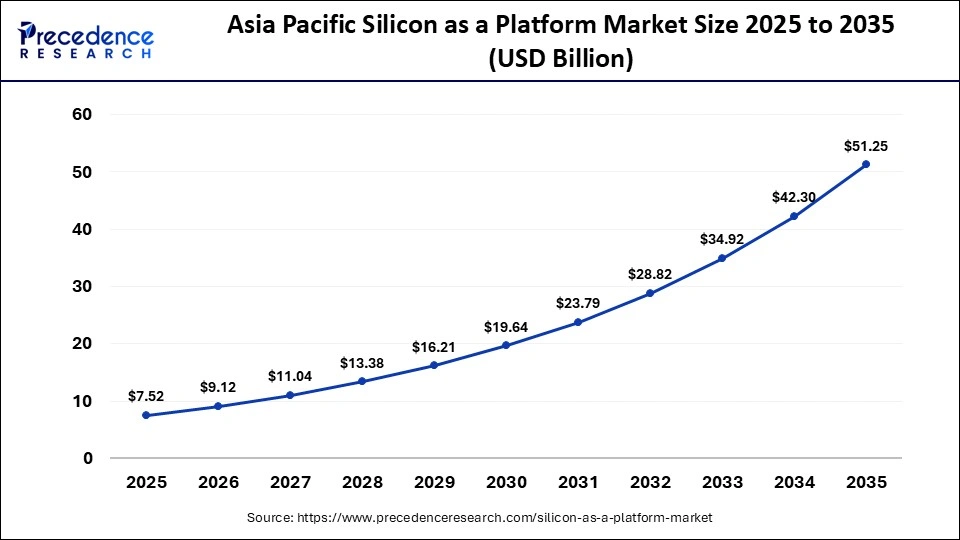
The Asia Pacific silicon as a platform market size is expected to be worth USD 51.25 billion by 2035, increasing from USD 7.52 billion by 2025, growing at a CAGR of 21.16% from 2026 to 2035.
Why is Asia-Pacific Dominating the Silicon Platform Market?
Asia Pacific led the silicon as a platform market, capturing the largest revenue share in 2025, accounting for an estimated 52% market share. Due to the concentration of semiconductor manufacturing centers in Taiwan, South Korea, China, and Japan. In 2024, TSMC made 12 million wafers, which were used to provide AI accelerators, HPC chips, and consumer electronics processors to all parts of the world. Government support through tax exemption, research and development subsidies, and talent development schemes. This enhances regional manufacturing, and thus, the Asia-Pacific became the workhorse of the worldwide silicon supply. Furthermore, the domination of the region is further supported by established foundry systems, integration of supply-chains and quick adoption of the latest technologies in packaging.
Taiwan Powerhouse of Asia-Pacific Silicon Platforms
Taiwan is leading the charge in the Asia Pacific market, driven by TSMC's unparalleled foundry capabilities and ecosystem strength. The manufacturing superiority of Taiwan is combined with the partnership with Cadence, Synopsys, and Arm. This allows the company to achieve swift innovation and high-yield manufacturing. On the other hand, good government incentives, export infrastructure, and a qualified semiconductor market make Taiwan an industry pillar of silicon supply in the world.
Why is North America the Fastest-Growing Region in Silicon Platforms?
North America is anticipated to grow at the fastest rate in the market during the forecast period. Driven by the growing AI silicon demand, government incentives, and heavy R&D investments. In 2025, the U.S. CHIPS and Science Act made it possible to boost the production of silicon in the country, empowering companies like Intel, GlobalFoundries, and Texas Instruments to increase wafer capacity. The deployment of custom silicon in the form of more than 1.5 million units in 2025 the North American data center by the cloud and hyperscale providers. Such as Google TPU Division, Amazon AWS, and Microsoft Azure, in 2025, further boosted the adoption of modular and chiplet-based architectures. Moreover, the North American development also includes the development of AI, HPC, and automotive silicon R&D and is estimated fuel the market growth in the coming years.
U.S. Driving North America Silicon Platform Surge
The U.S. is a major player in the market, supported by hyperscalers, AI workloads, and government incentives. Hyperscalers, including Google TPU/ASIC Division, Amazon AWS Custom Silicon, and Microsoft Azure, installed a high number of custom silicon devices, minimizing latency, power use, and AI inference throughput. The partnership with MIT Microsystems Technology Laboratories, Stanford SystemX Alliance, and RISC-V International secures the U.S. leadership on next-generation silicon platforms.
Why is Europe a Notable Region for Silicon Platforms?
The Europe region is expected to hold a notable revenue share of the market, owing to its focus on automotive, industrial automation, and AI-driven innovation. The silicon platforms with chiplet architecture and low power consumption are being developed. This is expected to be accelerated by the advanced R&D centers in Germany, France, and the Netherlands to meet the European emissions and energy usage requirements. Additionally, Europe is anticipated to increase its market footprint as governments and OEMs prioritize localized semiconductor supply chains and AI platform adoption through the late 2020s.
Germany Europe Hub for Advanced Silicon Platforms
Germany leads the market, fueled by automotive electronics, industrial automation, and EV-related semiconductor demand. STMicroelectronics, Infineon, and Bosch Sensortec had more units of silicon automotive and industrial, specializing in ADAS, EV power management, and AI-enabled in-vehicle processing. Furthermore, the reduction of emissions by the regulators also drives silicon adoption in Germany, making the country the most advanced European center of silicon semiconductor platforms.
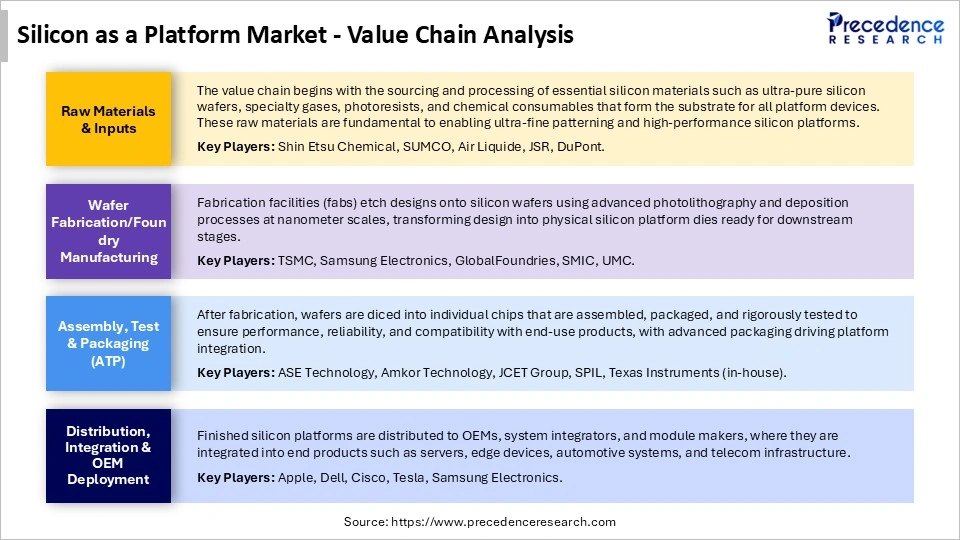
Silicon as a Platform Market Value Chain Analysis
Who are the Major Players in the Global Silicon as a Platform Market?
- TSMC
- Samsung Electronics
- Intel Corporation
- GlobalFoundries
- SMIC
- UMC
- STMicroelectronics
- Texas Instruments
- Infineon Technologies
- NXP Semiconductors
- Analog Devices
- Broadcom
- Qualcomm
- NVIDIA
- AMD
- Apple (Custom Silicon Platforms)
- Sony Semiconductor Solutions
- Renesas Electronics
- Micron Technology.
Recent Developments
- In September 2025, Wolfspeed, Inc., a global leader in silicon carbide (SiC) technology, announced the commercial launch of its 200mm SiC materials products, marking a pivotal step in the industry's transition from silicon to silicon carbide. Following an initial release to select customers, the strong market response and demonstrated benefits prompted Wolfspeed to expand availability to the broader market.
- In August 2025, izmomicro, a specialized division of izmo Ltd., revealed a major advancement in silicon photonics packaging, highlighting its pioneering role in India's semiconductor ecosystem and strengthening the country's position in next-generation data and AI infrastructure. The company developed a high-density silicon photonics packaging platform capable of handling 32-channel fiber input and output with an industry-leading insertion loss of less than 2 dB. Achieving this density involved nanometer-scale optical alignment, advanced assembly techniques, and seamless integration with electronics.
- In November 2025, Azimuth AI and Cyient Semiconductor launched 'ARKA GKT-1', touted as India's first-generation intelligent-power platform-on-a-chip for high-efficiency edge AI and smart energy applications. Unveiled by Union Minister for Electronics and IT Ashwini Vaishnaw, the chip represents a major milestone in India's pursuit of semiconductor self-reliance and reinforces the country's ambitions to become a global hub for semiconductor design and technological innovation.
(Source: https://www.wolfspeed.com)
(Source: https://www.prnewswire.com)
(Source: https://economictimes.indiatimes.com)
(Source: https://www.marvell.com)
Segments Covered in the Report
By Platform Type
- CMOS Silicon Platforms
- Silicon Photonics Platforms
- Silicon MEMS Platforms
- Silicon Power & Analog Platforms
- Heterogeneous Silicon Integration/Chiplets
By Application
- Computing & Data Centers
- Telecommunications (5G/Optical Networks)
- Consumer Electronics
- Automotive Electronics (ADAS, EVs)
- Industrial Automation & IoT
- Healthcare & Medical Devices
By Technology Node
- Above 28 nm
- 28 nm-14 nm
- 10 nm-7 nm
- Below 7 nm
- Advanced Packaging Nodes (2.5D/3D ICs)
By Integration Type
- Monolithic Integration
- System-on-Chip (SoC)
- System-in-Package (SiP)
- Chiplet-Based Architectures
By End User
- Foundries & IDMs
- Fabless Semiconductor Companies
- Hyperscalers & Data Center Operators
- Automotive OEMs & Tier-1 Suppliers
- Industrial & Medical Device Manufacturers
By Region
- North America
- Europe
- Asia-Pacific
- Latin America
- Middle East & Africa
For inquiries regarding discounts, bulk purchases, or customization requests, please contact us at sales@precedenceresearch.com
Frequently Asked Questions





Ask For Sample
No cookie-cutter, only authentic analysis – take the 1st step to become a Precedence Research client
 Get a Sample




 sales@precedenceresearch.com
 Schedule a Meeting
