



Pneumatic Nebulizers Market Size, Key Companies, Company Technology / Innovation, Production Economics, Trade Analysis, Material Efficiency, Market Penetration, Company Investment Strategies, and Sustainability Trends
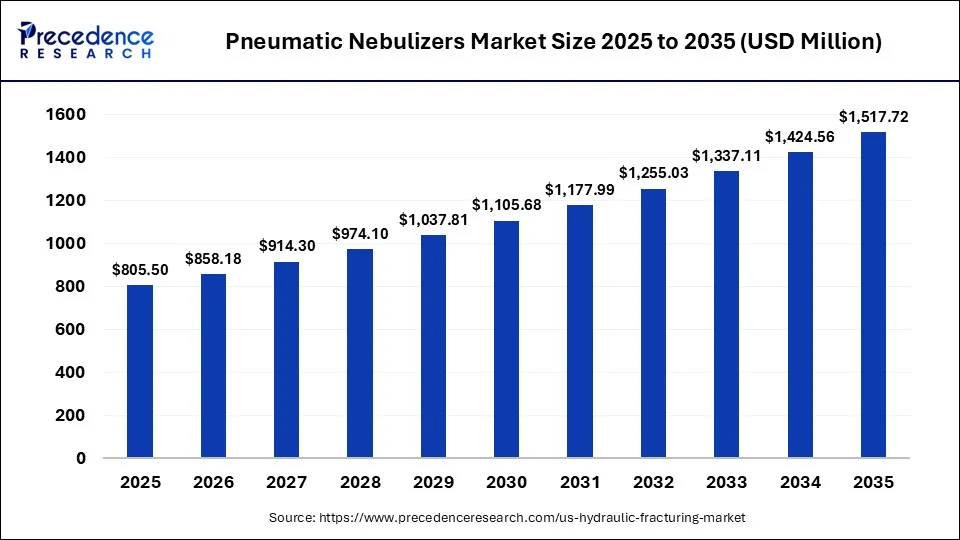
The pneumatic nebulizers market was valued at USD 858.18 million in 2026 and is projected to grow at a CAGR of 6.54% through 2035. The market is propelled by the rising prevalence of respiratory disorders, increasing requirement for effective drug-delivery systems, and growing adoption of nebulizer therapy across hospitals, clinics, as well as home-care settings. Key trends include the development of compact and portable nebulizers, quieter compressor technologies, improved aerosol delivery efficiency, and greater adoption of home-based respiratory care. Expanding healthcare access, increasing asthma, rising geriatric populations, and COPD prevalence, and technological advancements in respiratory drug delivery are expected to create new opportunities for pneumatic nebulizer manufacturers through 2035.
Source: https://www.precedenceresearch.com/pneumatic-nebulizers-market
 Get a Sample
 Table Of Content


Pneumatic Nebulizers Market Size, Share, Trends and Forecast Analysis 2035
The pneumatic nebulizers market is forecasted to expand from USD 858.18 million in 2026 to USD 1517.72 million by 2035, growing at a CAGR of 6.54% from 2026 to 2035.
Key Takeaways
- Pneumatic nebulizers remain a major inhaled drug-delivery segment, despite increasing competition from mesh nebulizers and other inhalation technologies.
- Home healthcare is the fastest-growing end-use opportunity, while hospitals and clinics remain the largest revenue-generating users. The shift toward outpatient and home-based respiratory treatment is a central market theme.
- Breath-actuated nebulizers currently lead the product segment, accounting for about 65.1% of 2026 revenue, while vented systems are expected to grow faster due to improvements in aerosol consistency and drug-delivery efficiency.
- Chronic respiratory diseases provide the market's underlying demand base, particularly COPD, asthma, and cystic fibrosis. Aging populations and increasing respiratory disease prevalence are expected to support long-term device demand.
- North America currently represents a major revenue pool, accounting for approximately 35.3% of global revenue in 2024, while Asia Pacific is expected to record the fastest growth due to rising respiratory illness, expanding healthcare access, home-based treatment, and demand for affordable devices.
- The market's competitive focus is moving beyond basic compressor performance. Noise, treatment time, aerosol output, residual medication, portability, durability, and ease of use are increasingly important areas of differentiation.
- Technology substitution is a major competitive pressure. Pneumatic nebulizers face increasing competition from portable mesh nebulizers and inhalers, particularly in home care and chronic respiratory therapy where portability, low noise, convenience, and faster treatment are valued.
- Affordability remains an important advantage of pneumatic devices, particularly in emerging markets. Regional manufacturers can compete through lower-cost production, localized manufacturing, and local distribution networks.
- Portfolio breadth is becoming an important competitive differentiator. Companies covering hospital devices, portable home-care systems, pediatric products, specialist applications, and replacement accessories can address multiple care settings and capture repeat demand.
- The competitive landscape is moderately concentrated rather than dominated by one company. Major established players include Philips, OMRON Healthcare, PARI, and Drive DeVilbiss Healthcare, while specialist and regional manufacturers compete through technology focus, cost efficiency, and local market access.
- 1Premiumization is possible when product improvements provide clear patient or caregiver benefits. Quieter operation, shorter treatment times, compact designs, portability, and improved usability can support higher selling prices.
Pneumatic Nebulizers Compete on Delivery Efficiency, Portability and Home-Care Demand
North America accounted for about 35.3% of global revenue in 2026, making it a major market for pneumatic nebulizers. Asia Pacific is expected to record the fastest growth, supported by the rising burden of respiratory illness, increasing use of home-based treatment, improving healthcare access, and demand for affordable respiratory devices.
The pneumatic nebulizers market also has a broader revenue base than the device itself. Revenue is generated across compressors, nebulizer cups, tubing, mouthpieces, replacement parts, and distribution. As a result, manufacturers compete on several factors, including clinical performance, drug output, particle size, noise, portability, treatment time, durability, price, and insurance coverage.
Breath-actuated devices accounted for about of pneumatic nebulizer revenue in 2026, supported by their ability to reduce medication waste and improve delivery efficiency. Hospitals and clinics remain the largest buyers, while home healthcare is expanding faster as respiratory treatment increasingly moves from hospital settings to outpatient and home-based care.
What the Report Covers
- Revenue by condition, end user, region, and device type.
- The shift from hospital-based treatment to home care and its cost impact.
- Comparison of breath-actuated and vented pneumatic devices.
- Regional demand, insurance coverage, and distribution.
- Market concentration and competitive positioning of manufacturers.
- Comparison of products, technologies, manufacturing, and sales channels.
Segmentation Analysis Breath-Actuated Systems Lead Today, Vented Systems Offer Faster Growth
The market is generally segmented based on operation mode, end use, application, portability, distribution channel, and geography.
In operation mode, breath-actuated pneumatic nebulizers are the dominant type, with about 65.1% of 2025 revenue. Vented systems are anticipated to grow faster, as more consistent aerosol output and thus better drug delivery improve treatment efficiency.
Further, in end use, hospitals and clinics are the largest revenue source today, which is driven by emergency respiratory care and acute-care needs. Home healthcare is the fastest-growing segment, as more patients prefer to be treated outside hospitals, and compact compressor units are becoming easier to find.
Other segments covered:
- Applications: COPD, asthma, cystic fibrosis, and other respiratory conditions.
- Portability: tabletop and portable devices.
- Sales channels: direct institutional purchasing, distributors, pharmacies, and online.
- Patient groups: adult, pediatric, and geriatric.
Key Coverage
- Breath-actuated and vented systems.
- Hospitals, clinics, and home healthcare.
- COPD, asthma, cystic fibrosis, and other conditions.
- Tabletop vs. portable devices.
- Institutional vs. retail or online channels.
- Pediatric, adult, and geriatric demand.
- Country-level revenue and growth.
Market Dynamics: Rising Disease Burden and Home Care Drive Growth, but Competing Technologies and Price Pressure Limit It
Growth Drivers
- Rising rates of chronic respiratory disease.
- Greater use of home care.
- Aging populations.
- Wider healthcare access in emerging markets.
- Steady need for low-cost aerosol delivery, where pneumatic devices keep a clear price advantage over many newer technologies.
Restraints
- Longer treatment times.
- Dependence on electricity for many tabletop units.
- Compressor noise and bulky devices.
- Cleaning and maintenance requirements.
- Competition from portable mesh nebulizers and other inhalation technologies.
Opportunities
- Quieter compressors and smaller designs.
- Less wasted medication (lower residual volume).
- Breath-synchronized drug delivery.
- Child-friendly device designs.
- Connected tools to track patient adherence.
- Products tailored to emerging markets.
Key Coverage
- Impact of disease burden.
- Competing technologies.
- Shift toward home care.
- Device affordability.
- Shorter treatment times.
- Reimbursement and access.
- Noise and portability.
- Emerging-market growth.
Tentative Leading Company Universe - 20+ Manufacturers With Direct or Strategic Relevance
| Company | Headquarters | Market Position | Core Strength | Major Applications/Segments |
| Philips | Netherlands | Global respiratory-device leader | Broad respiratory portfolio | Hospital, home care |
| OMRON Healthcare | Japan | Global home-respiratory leader | Home-care distribution | Asthma, COPD, home care |
| PARI | Germany | Respiratory specialist | Aerosol-delivery expertise | Chronic respiratory, pediatric |
| Drive DeVilbiss Healthcare | U.S. | Home-care specialist | DME and respiratory channels | Home care, institutional |
| Medline Industries | U.S. | Medical-device supplier | Institutional distribution | Hospitals, home care |
| Vyaire Medical | U.S. | Respiratory-care specialist | Respiratory systems | Acute and hospital care |
| GE HealthCare | U.S. | Healthcare technology player | Hospital respiratory ecosystem | Acute care |
| BD | U.S. | Medical-device leader | Hospital distribution | Respiratory care |
| Teleflex | U.S. | Respiratory/interventional specialist | Airway and respiratory products | Hospitals |
| Trudell Medical International | Canada | Aerosol-delivery specialist | Breath-actuated technology | Asthma, respiratory care |
| Aerogen | Ireland | Aerosol-delivery specialist | Advanced nebulization | Acute/critical care |
| Rossmax | Taiwan | Regional/global device supplier | Affordable respiratory devices | Home care |
| Jiangsu Yuyue | China | Major Asian device manufacturer | Cost-efficient home devices | Home care |
| GF Health Products | U.S. | Home medical equipment supplier | DME distribution | Home care |
| Allied Healthcare Products | U.S. | Respiratory equipment supplier | Medical gas/respiratory equipment | Institutional |
| Briggs Healthcare | U.S. | Healthcare equipment supplier | Home/long-term care | Home care |
| Beurer | Germany | Consumer-health device player | Consumer distribution | Home care |
| Flaem Nuova | Italy | Respiratory-device specialist | Compressor nebulizers | Home and clinical |
| 3A Health Care | Italy | Respiratory specialist | Nebulization equipment | Home/clinical |
| Microlife | Switzerland/Taiwan | Home healthcare player | Respiratory monitoring/devices | Home care |
| Medel | Italy | Inhalation specialist | Nebulizer systems | Pediatric/home care |
| CA-MI | Italy | Medical-device manufacturer | Respiratory equipment | Hospital/home |
| Lepu Medical | China | Diversified medical-device player | Medical-device manufacturing | Institutional/home |
| Besmed | Taiwan | Respiratory-device specialist | Jet nebulizers and components | Clinical/home |
How Concentrated is the Pneumatic Nebulizers Market and Who is Best Placed to Win the Next Phase of Growth?
The market is moderately concentrated. No single firm dominates. The main players are large respiratory-care and medical-devices companies with strong hospital and home-care distribution, specialist aerosol-delivery makers, and even lower-cost regional competitors. Leaders like Philips, PARI, OMRON Healthcare, and Drive DeVilbiss Healthcare win on product performance, clinical credibility, distribution reach, reliability, and brand strength, not on price alone.
Success increasingly relies on serving many care settings. Companies that provide a full range, including portable home devices, stationary compressor units, pediatric options, specialist respiratory products, and even replacement accessories, are better placed. This range lets them capture more hospital and clinic needs as well as steady, repeat home-care purchases. Regional manufacturers add pressure. They compete with local production, lower prices, and growing reach through pharmacies, distributors, and e-commerce.
The main battleground is moving beyond basic compressor function to better aerosol delivery and overall value of ownership. Firms that can shorten treatment time, cut noise, shrink device size, and decrease wasted medication, while keeping aerosol output clinically sound, can protect premium pricing and limit losses to mesh nebulizer and inhalers. The result is a two-speed market. Established brands will compete on clinical trust, technology, and distribution. Newer players can gain share through local presence, cost efficiency, and focus on underserved markets.
Which Companies are Best Positioned to Capture Growth in Hospital, Home-Care and Specialist Pneumatic Nebulizer Segments?
Success in the pneumatic nebulizer market depends less on compressor technology and more on geographic reach, distribution strength, portfolio breadth, and the ability to serve different care settings. Market growth is driven by chronic respiratory disease, the shift to home healthcare, and wider access to respiratory-treatment devices. Large companies with broad portfolios and strong hospital and even home-care channels are best placed to win repeat need. Specialist and regional manufacturers can compete via focused technology, lower costs, and local distribution.
We see three distinct groups of competitors:
- Diversified medical-device firms: use scale and distribution reach.
- Respiratory specialists: compete on aerosol-delivery expertise and even clinical credibility.
- Regional producers: use low cost and local presence to win price-sensitive markets.
Portfolio breadth is becoming a key differentiator because demand spans hospital systems, pediatric models, portable home devices, and specialist applications. Firms that cover several segments can cross-sell, build stronger distributor relationships, and decrease reliance on any single customer or product category.
We believe the strongest advantage will come from pairing product performance with channel depth and even tailored customer positioning. Companies offering quieter operation, faster treatment, reliability, portability, and ease of use can sustain premium pricing. Those with efficient manufacturing and local supply chains will be better placed in emerging markets.
This report benchmarks leading firms on:
- Estimated market position.
- Technology capabilities.
- Product portfolio breadth.
- Geographic presence and manufacturing footprint.
- Distribution model.
- Pricing position.
- Hospital and home-care exposure.
- RandD focus.
- Recent strategic initiatives.
It also highlights capability gaps and areas where challengers can gain share.
What Sets Leading Pneumatic Nebulizer Makers Apart from Emerging Challengers?
Companies perform very differently within this expansion, depending on product range, pricing, geographic reach, technology, distribution, and customer coverage. Established manufacturers have an edge via strong hospital and home-care channels. Regional challengers are gaining ground with local manufacturing, lower-cost products, and focused distribution.
No single capability decides who leads. The strongest players combine a broad product portfolio, efficient manufacturing, strong channel access, effective aerosol delivery, and wide geographic coverage. Competition is also moving beyond basic compressor performance. Buyers now look at treatment time, reliability, leftover medication, noise level, portability, ease of use, and suitability for children and specialist care. Firms that pair these advantages with broad distribution can hold higher prices and keep customers longer. Cost-focused players remain better placed in price-sensitive markets.
Competitors differ in price, device features, evidence of performance, distribution and after-sales support. Premium producers can protect higher-value segments with quieter, faster, more compact devices that are easier for patients to use. Challengers can win share by lowering component costs, producing locally, and then expanding through pharmacies, distributors, and e-commerce.
This report compares leading players on product range, technology, market position, pricing, geographic presence, distribution reach, manufacturing footprint, hospital and home-care exposure, R&D focus, and even strategic initiatives. It highlights where each firm holds a lasting advantage and where it has gaps.
How Concentrated is the Pneumatic Nebulizers Market and Who Holds the Largest Revenue Pools?
The market is competitive, with global respiratory-device makers, specialist aerosol-delivery firms, and low-cost regional producers. The largest revenue pools sit with established players that have strong networks across hospitals, home care, alongside distributors. Regional challengers are gaining ground by providing lower prices and stronger local access.
Our analysis shows that concentration is meaningful but not absolute. This leaves room for both leaders and new entrants to win share. Competitive positioning depends on product breadth, distribution reach, technology differentiation, brand credibility and manufacturing efficiency, wide distribution reach, technology differentiation, brand credibility, and efficient manufacturing. Firms that serve both institutional buyers and the home healthcare segment are best placed to capture repeat demand. Regional producers can win share where price, local availability, and distributor relationships matter more than premium brands.
The key takeaway is that share gains through 2030 will be uneven across regions and product tiers. Established leaders can protect higher-value segments via proven performance, reliability, and also broad respiratory-care portfolios. Cost-efficient challengers have the best opportunity in emerging markets and price-sensitive channels.
This report ranks leading firms by estimated pneumatic nebulizer revenue and market share. It also measures top-5 and top-10 concentration and compares competitive positioning by product category, end user, pricing tier, geography, technology, and distribution channel.
Key Strategic Questions
- How will the shift from hospital-based treatment to home healthcare reshape pneumatic nebulizer demand by 2035?
- Which pneumatic nebulizer segments are expected to capture the highest incremental revenue by 2035?
- How will replacement demand compare with new-device demand across hospitals, clinics, and home healthcare?
- How will breath-actuated and vented nebulizers compete as aerosol-delivery requirements evolve?
- What factors will determine whether pneumatic nebulizers can retain their cost advantage over mesh nebulizers and inhalers?
- How much market share could pneumatic nebulizers lose to mesh nebulizers and other inhalation technologies by 2035?
- Which product attributes-treatment time, noise, portability, aerosol output, or residual volume-will have the greatest influence on purchasing decisions?
- How will reimbursement and insurance coverage affect pneumatic nebulizer adoption across major markets?
- Which patient groups-pediatric, adult, or geriatric-will create the strongest growth opportunities for manufacturers?
- How will demand differ between stationary, portable, and compact pneumatic nebulizer systems?
- Which distribution channels will gain the most importance as home-based respiratory care expands?
- How will pricing pressure and price erosion affect manufacturer margins by 2035?
- Which manufacturing and component-cost factors create the greatest opportunities for cost reduction?
Pneumatic Nebulizers Market Segments
By Product Type
- Compressor Nebulizers
- Breath-Actuated Nebulizers
- Ventilated Nebulizers
- Portable Pneumatic Nebulizers
- Continuous Nebulizers
By Portability
- Stationary/Desktop
- Portable
- Compact/Mini
By Patient Age
- Pediatric
- Adult
- Geriatric
By Application
- Asthma
- Chronic Obstructive Pulmonary Disease (COPD)
- Cystic Fibrosis
- Bronchiectasis
- Respiratory Infections
- Other Respiratory Conditions
By End User
- Hospitals and Clinics
- Home Healthcare
- Ambulatory Care Centers
- Specialty Respiratory Centers
- Emergency and Critical Care
- Others
By Distribution Channel
- Hospital/Institutional Procurement
- Medical Device Distributors
- Pharmacies and Drugstores
- Online/E-commerce
- Direct Sales
- Retail Medical Equipment Stores
By Region
- North America
- Europe
- Asia Pacific
- Latin America
- Middle East and Africa
For inquiries regarding discounts, bulk purchases, or customization requests, please contact us at sales@precedenceresearch.com
Frequently Asked Questions





Ask For Sample
No cookie-cutter, only authentic analysis – take the 1st step to become a Precedence Research client
 Get a Sample
.webp)



 sales@precedenceresearch.com
 Schedule a Meeting
