



Post Combustion Carbon Capture and Storage Market Size, Share and Trends 2026 to 2035
Post Combustion Carbon Capture and Storage Market (By Technology: Oxy-Fuel Combustion, Post Combustion Capture, Pre-Combustion Capture; By Application: Power Generation, Industrial Processes, Other) - Global Industry Analysis, Size, Trends, Leading Companies, Regional Outlook, and Forecast 2026 to 2035
Source: https://www.precedenceresearch.com/post-combustion-carbon-capture-and-storage-market
 Get a Sample
 Table Of Content


What is the Post Combustion Carbon Capture and Storage Market Size?
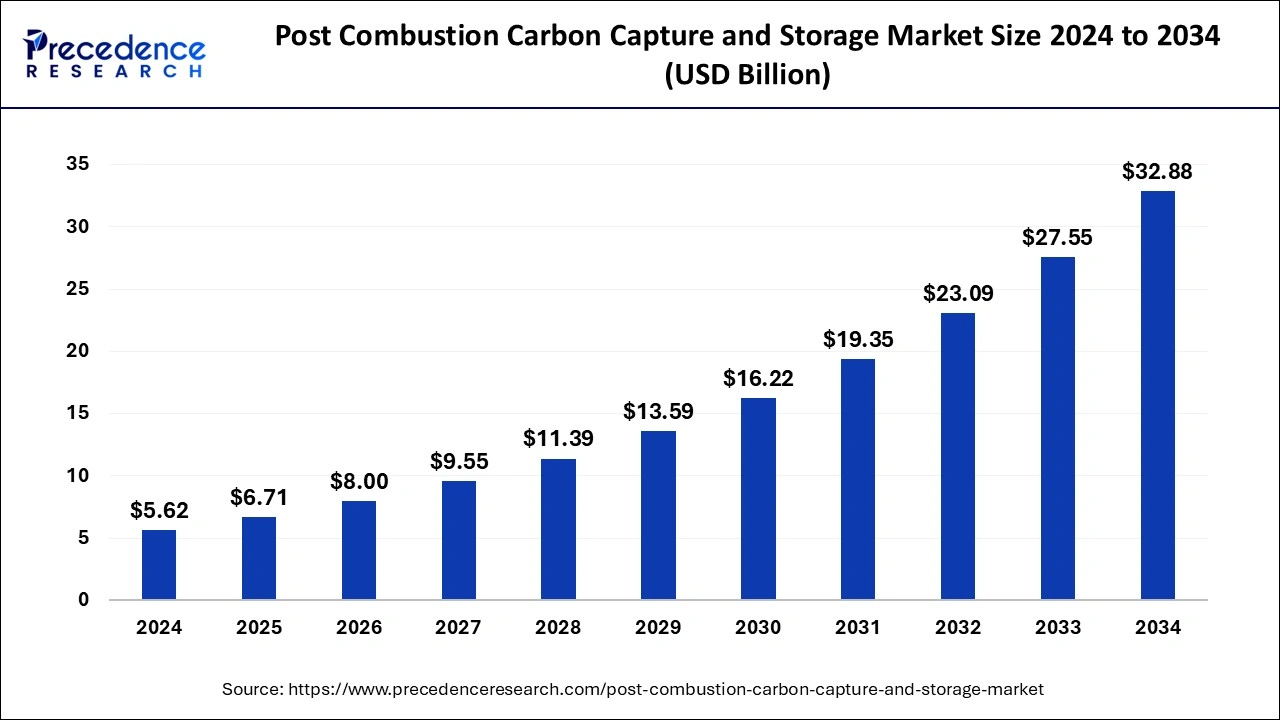
The global post combustion carbon capture and storage market size accounted for USD 6.71 billion in 2025 and is expected to exceed around USD 37.63 billion by 2035, growing at a CAGR of 18.82% from 2026 and 2035. The post combustion carbon capture and storage market is rapidly growing due to increased regulations of carbon emissions, innovation, and expanding investments.
Post Combustion Carbon Capture and Storage Market Key Takeaways
- North America dominated the post combustion carbon capture and storage market with the largest market share of 45% in 2025.
- Asia Pacific is anticipated to witness the fastest CAGR during the forecasted years.
- By technology, the post combustion carbon capture segment noted the largest share in 2025.
- By technology, the pre combustion carbon capture segment is projected to witness the fastest growth during the forecast period.
- By application, the power generation segment has contributed a significant share in 2025.
What is the Post Combustion Carbon Capture and Storage?
Post combustion carbon capture and storage is a process by which carbon dioxide (CO2) is removed from the flue gases of a power plant after the combustion of fossil fuels and storing the removed CO2 in geological formations. The flue gases resulting from combustion have gained traction due to their ability to retrofit existing power plants and industries, making it a sustainable solution for industries looking to lessen their carbon footprint.
Rising carbon emissions across the world and a growing concern about the impact of carbon on the environment have favored the adoption of this carbon capture and storage across the globe thus boosting the post combustion carbon capture and storage market. Governments worldwide are working on promoting this technology through pilot projects in different industries. The technology is accepted for its potential as a large-scale solution to achieve ambitious CO2 emission reduction targets and address climate control objectives.
Artificial Intelligence (AI) Integration in the Post Combustion Carbon Capture and Storage Market
Artificial intelligence can enhance the operation of the post combustion carbon capture and storage market by regulating operating parameters and predicting capture rates to increase efficiency and reduce costs. Industries can enhance rates of CO? capture while preserving resources by using industrial AI algorithms-based parameters such as the concentration of solvents, pressure, and temperature. Optimization in equipment maintenance is done through the use of artificial intelligence in the early identification of anomalies.
Post Combustion Carbon Capture and Storage Market Growth Factor
- Emission reduction requirements: Due to regulatory restrictions and corporate responsibility to minimize output emissions, power, cement, and chemical industries need to incorporate post combustion carbon capture and storage solutions.
- Advancements in technology: Advanced CCS techniques include enhanced solvents, membranes, and solid sorbents as they increase feasibility in post combustion capture.
- Global energy demand: Energy demand is rising, particularly among developing nations, and most of them rely on coal or gas. It means that through CCS adoption demand is met alongside global emissions compliance.
Market Scope
| Report Coverage | Details |
| Market Size by 2025 | USD 6.71 Billion |
| Market Size in 2026 | USD 8 Billion |
| Market Size in 2035 | USD 37.63 Billion |
| Market Growth Rate from 2026 and 2035 | CAGR of 18.82% |
| Dominating Region | North America |
| Fastest Growing Region | Asia Pacific |
| Base Year | 2025 |
| Forecast Period | 2026 and 2035 |
| Segments Covered | Technology, Application, and Regions |
| Regions Covered | North America, Europe, Asia-Pacific, Latin America, and Middle East & Africa |
Market Dynamics
Driver
Implementing sustainable technologies for manufacturing
The post combustion carbon capture and storage market is driven by several factors contributing to its growth and impact on substantial decarbonization. These technologies can capture and store carbon dioxide emissions, decreasing greenhouse gas emissions and modifying climate change impacts. Also, the use of sustainable technologies in industries such as manufacturing and chemicals drives the demand for carbon capture and storage solutions. These industries recognize the need to control CO2 emissions and meet emission reduction targets. Through carbon capture and storage technologies, they can effectively capture and store CO2 emissions, allowing them to meet regulatory requirements and increase their environmental performance.
Restraint
High installation cost
The restraint with the implementation of the post combustion carbon capture and storage market is its high initial cost. Cost estimates for establishing CCS are high, particularly in the costs of equipment for carbon dioxide capture, compression equipment, pipelines, and reservoirs. Extending green construction to current structures is another cost factor, especially in power or industrial plants. Furthermore, the CCS operation is energy-intensive, thus implying more establishment running costs and discouraging adoption. Small and developing industries in developing countries are most affected as they cannot afford these systems.
Opportunity
Government regulations and incentives
Government policies and regulations are accelerating the acceptance of the post combustion carbon capture and storage market technologies. Supportive processes like carbon pricing, emission standards, and financial incentives boost industries to invest in these solutions. Also, CCS is used in different sectors of industry, especially cement and steel industries, which emit a large amount of CO2. Further novel technologies and practices are currently emerging in the processes of capturing carbon dioxide from flue gas generated after the burning of fossil fuels. These include low-cost, more efficient solvents for capturing CO2, new and enhanced novel capture processes, and new materials for the capture system.
Segment Insights
Technology Insights
The post-combustion carbon capture segment noted the largest share of the post combustion carbon capture and storage market in 2025. Customers can use post combustion carbon capture as an effective method for trapping CO2 from flowing flue gases and meeting emissions limits. Carbon dioxide recovered from flue gases generated when the primary fuel burns in the presence of air is captured using post combustion technology. Such systems usually use a liquid solvent to dissolve a small amount of carbon dioxide in the flue gas streams, of which nitrogen is the main component. In addition, main driving and post combustion capture technology is expected to have a higher growth rate. These include enhanced electricity generation coupled with the improvement of new amine systems and the incorporation of heat systems, which are expected to contribute significantly towards post combustion capture technology demand over the forecast period.
The pre-combustion carbon capture segment is projected to witness the fastest growth in the post combustion carbon capture and storage market during the forecast period. Integrated Flow Solutions Pre combustion carbon capture is a process that is used to eliminate carbon dioxide (CO2) from fuel before burning it. It's more efficient than post combustion technology because the CO2 is more concentrated. Pre combustion CO2 capture using the water gas shift reaction (WGSR) and its removal with acid gas removal (AGR) process is commercially carried out.
Application Insights
The power generation segment has contributed a significant share of the post combustion carbon capture and storage market in 2025. Post combustion carbon capture and storage involves capturing carbon dioxide (CO2) from the flue gases in a power plant and storing it in geological formations. Owing to high greenhouse gas emission rates, the potential of using carbon capture and storage technology is extremely high in coal-fired power plants. When post combustion capture technology is combined with other renewable energy systems, such as biomass power plants or solar thermal power plants, the resulting emissions can be balanced, and low carbon electricity can be generated.
Regional Insights
What is the What is the U.S. Post Combustion Carbon Capture and Storage Market Size?
The U.S. post combustion carbon capture and storage market size was exhibited at USD 2.57 billion in 2025 and is expected to be worth around USD 14.68 billion by 2035, growing at a CAGR of 19.04% from 2026 and 2035.
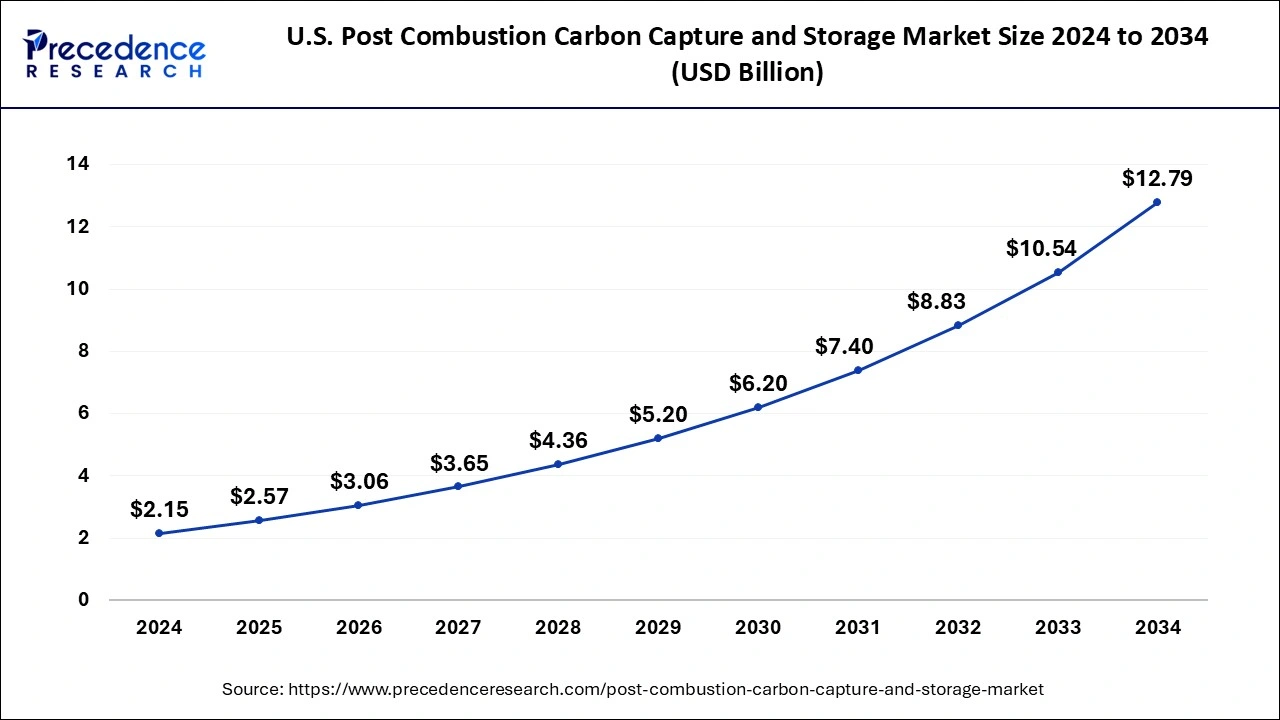
North America accounted for the largest share of the post combustion carbon capture and storage market share in 2025. The utilization of CO2 in the Enhanced Oil Recovery method, combined with the rising trend of clean technology, will further boost the market in the United States and other countries, including Canada. The technologies are currently used widely in industries such as power generation and manufacturing through the application of post combustion capture. Market expansion is predicted to occur with government pressures toward carbon neutrality goals and the development of several large-scale CCS projects by energy giants.
- In 2023, the Congressional Budget Office of the federal government of the United States notes that about fifteen CCS facilities are operating in the country, and most of them are embedded in plants that process natural gas or produce ethanol for fuel or ammonia for fertilizers.
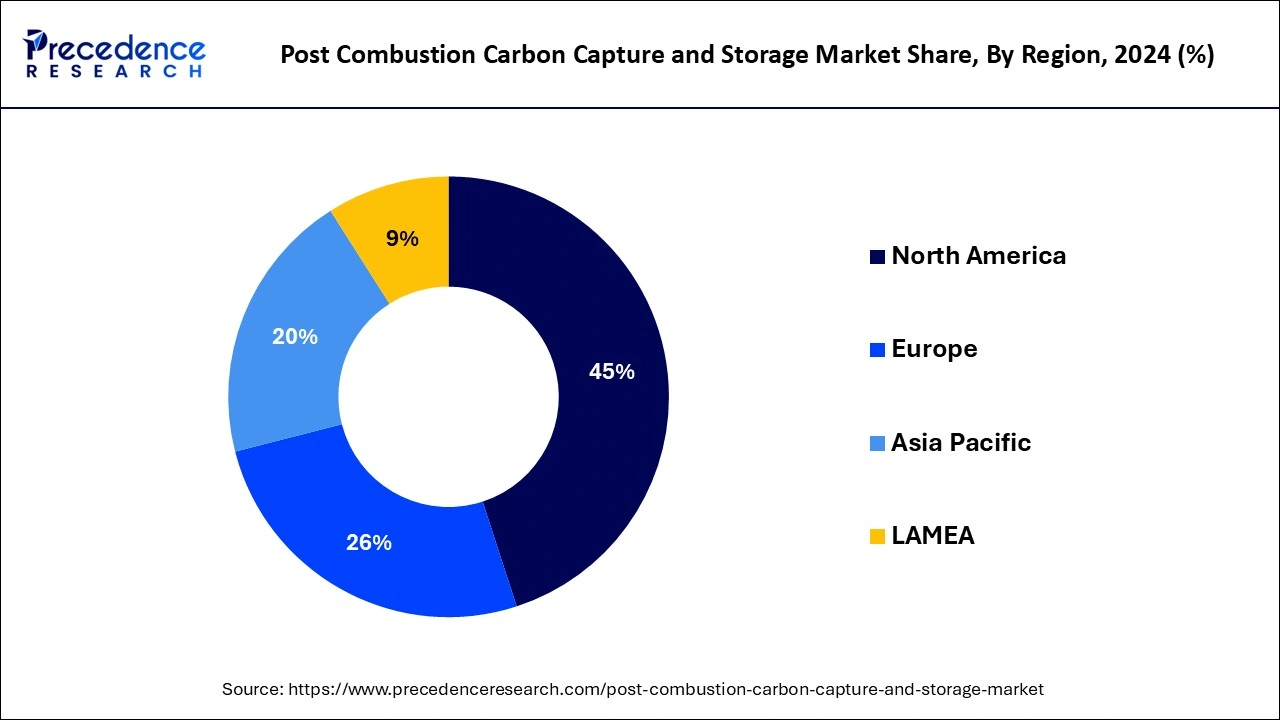
Asia Pacific is anticipated to witness the fastest growth in the post combustion carbon capture and storage market during the forecasted years. Global industrialization has enhanced the emission of carbon, thus forcing governments to enact strict environmental policies and encourage the use of green technology. Several Asian countries like China, Japan, and South Korea use CCS technologies to reduce emissions from power generation based on coal and vast industries like cement and steel industries. Aimed at encouraging environmentally friendly energy generation techniques and emission restrictions are driving the use of CCS systems.
- In June 2023, China ENERGY Investment Group Co., LTD. announced the launch of Asia's largest carbon capture project in China. This project is expected to generate 500,000 tons of carbon dioxide per annum.
What are the Driving Factors of the Post-Combustion Carbon Capture and Storage Industry in Europe?
Europe is expected to grow at a significant rate during the forecast period. Europe develops with stringent emission controls. Large-scale carbon capture projects are well-financed. Decarbonization strategies are implemented speedily in heavy industries. Storage is enhanced by cross-border transport networks. Long-term investments are motivated by policy commitments. The area develops an integrated infrastructure that facilitates industrial transformation to low-emission operations in various industries.
Norway Post Combustion Carbon Capture and Storage Market Trends
Norway is at the forefront of introducing carbon capture solutions. Vibrant infrastructure can facilitate the decarbonization of industries. The initial projects prove large-scale viability. Storage solutions can be carried out efficiently by the use of cross-border transport systems. There are advanced research facilities that enhance capture technologies. Constant innovation empowers leadership to establish scalable and reliable carbon capture and storage ecosystems.
Post Combustion Carbon Capture and Storage Market Companies
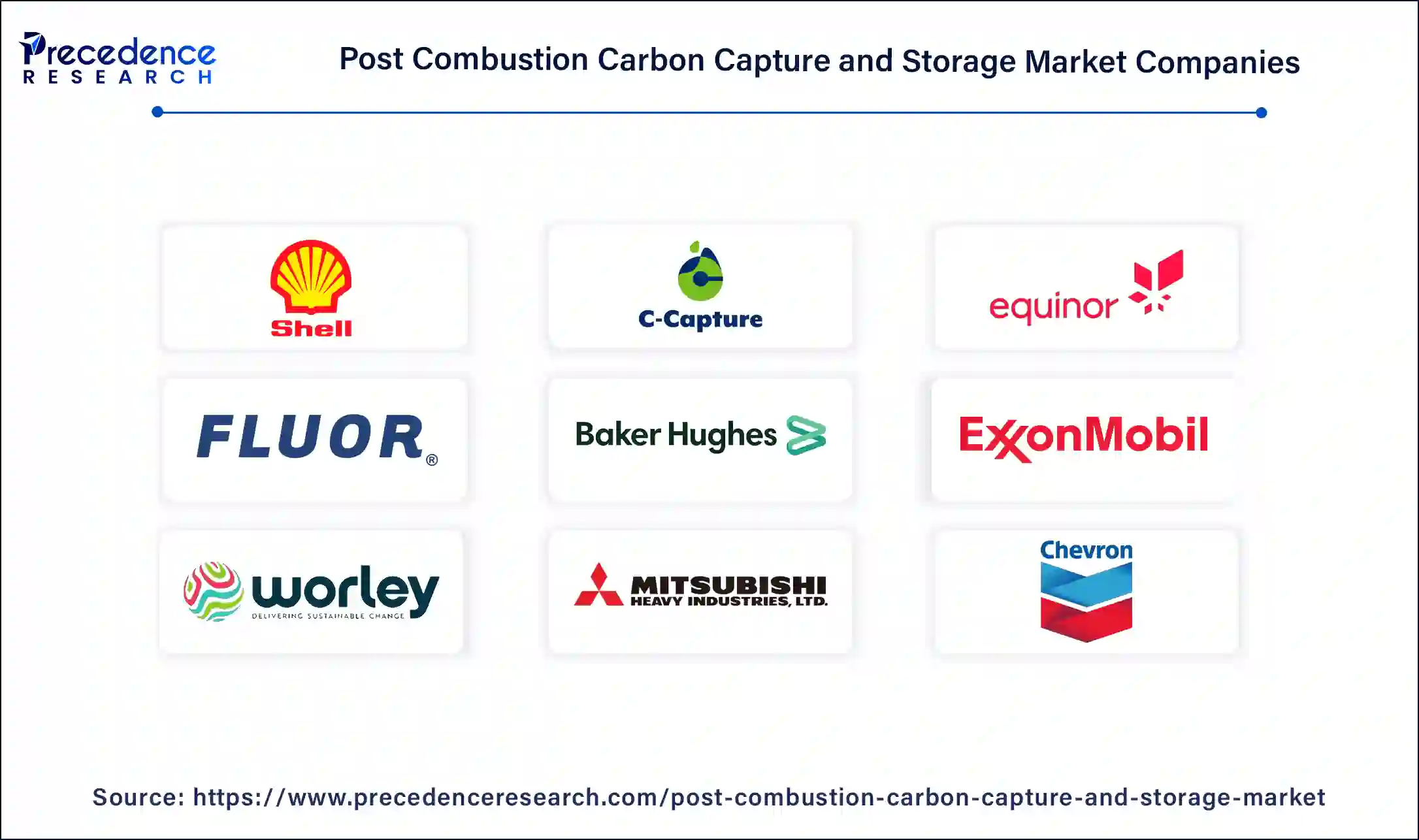
- Shell plc.: Offers amine-based carbon capture technology with massive storage hubs to the industry.
- CCapture: Proposes solvent-based capture technology with amine-free processes that save energy and operational costs.
- Equinor ASA: Establishes massive carbon transit and storage systems that facilitate cross-border management of industrial emissions.
- Fluor Corporation: Provides patented capture technology and engineering services that incorporate carbon reduction in industrial plant operation.
Other Major Key Players
- Baker Hughes Company.
- Exxon Mobile Corporation.
- Worley Limited.
- Mitsubishi Heavy Industries, Ltd.
- Chevron Corporation.
- Sumitomo Chemical Co., Ltd.
- Xebec Adsorption Inc.
- Honeywell International Inc.
- Climeworks AG.
- Johnson Matthey plc.
- Total Energies SE.
Key Player Announcement
As mentioned by Atoco's CEO, Dr. Samer Taha, in an interview with Carbon Pulse, the present and future applications of Atoco's solid-state carbon material are indeed revolutionary. It is also essential to note that our technology has the ability to selectively capture CO2 at much lower concentrations than other technologies. This makes it versatile and applicable for both post combustion carbon capture and direct air capture (DAC). Although it is primarily aimed at natural gas power plants, this solution has many more possible uses in the future.
Recent Developments
- In September 2025, Ducon Infratechnologies Ltd. announced the start of R&D for a next-generation solvent-based carbon capture technology. The program targets scalable, cost-effective solutions for capturing COâ‚‚ from flue gas in power, cement, steel, oil & gas, and other industries. (https://www.businesswireindia.com )
- In July 2025, Technip Energies and Shell Catalysts & Technologies formed a global alliance. The alliance will provide a post-combustion amine-based carbon capture solution using Shell's CANSOLV1 CO2 Capture System. (https://investors.technipenergies.com )
- In October 2024, Linde Engineering signed a deal with NEXTCHEM to provide a carbon capture solution for the Hail and Ghasha project in ADNOC company. The company will showcase its new adsorption based carbon capture technology for the purification of carbon dioxide (CO2) which greatly reduces emissions in natural gas and oil production.
- In September 2024, Europe's first post combustion carbon capture plant began operations, utilizing MHI technology as part of the Ravenna CCS Project, Phase 1. This plant is central to the first CCS project in Italy for environmental purposes and was developed by Eni and Snam.
- In March 2023, Carbfix hf. declared an expansion of its global footprint by the introduction of a new carbon capture plant in Iceland. This plant is projected to capture 3,000 tons of carbon annually.
Segments Covered in the Report
By Technology
- Oxy-Fuel Combustion
- Post Combustion Capture
- Pre-Combustion Capture
By Application
- Power Generation
- Industrial Processes
- Other
By Geography
- North America
- Asia Pacific
- Europe
- Latin America
- Middle East and Africa
For inquiries regarding discounts, bulk purchases, or customization requests, please contact us at sales@precedenceresearch.com
Frequently Asked Questions





Ask For Sample
No cookie-cutter, only authentic analysis – take the 1st step to become a Precedence Research client
 Get a Sample




 sales@precedenceresearch.com
 Schedule a Meeting
