



AI in Healthcare Governance and Safety Market Revenue to Attain USD 19.65 Bn by 2035
Published: 15 May 2026
Author: Precedence Research



AI in Healthcare Governance and Safety Market Revenue and Trends 2026 to 2035
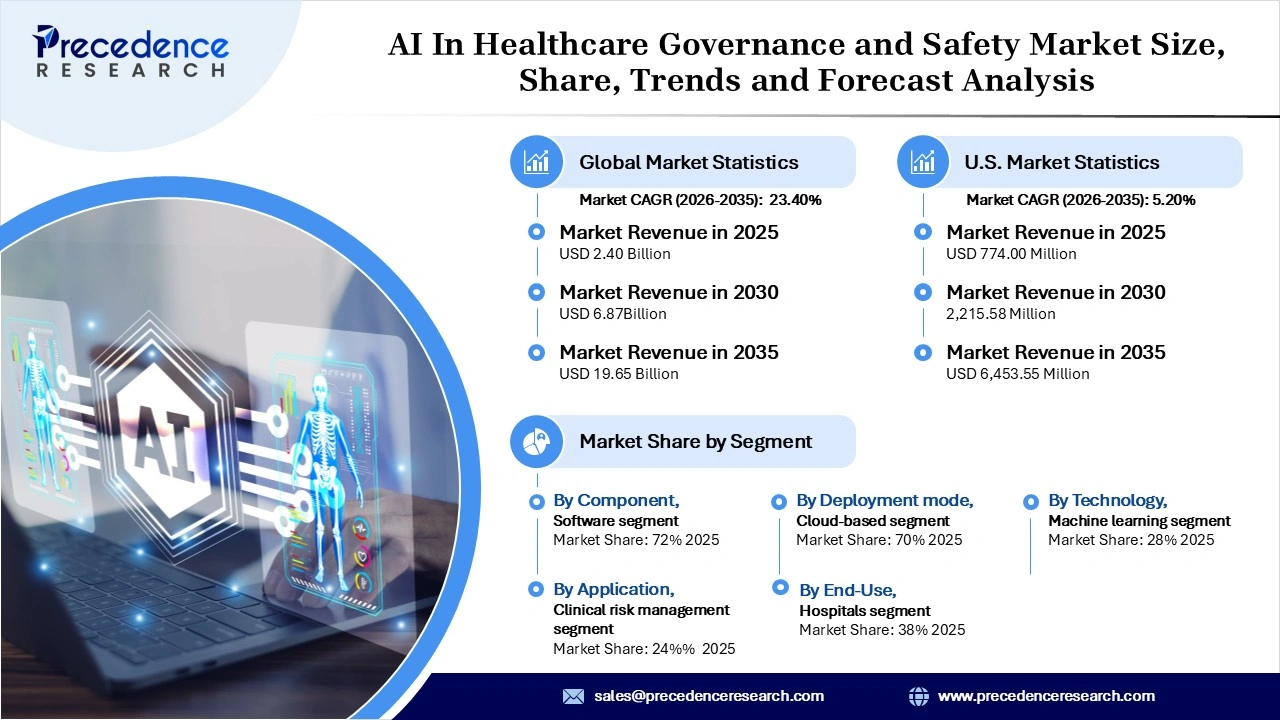
The global AI in healthcare governance and safety market revenue surpassed USD 2.40 billion in 2025 and is predicted to attain around USD 19.65 billion by 2035, growing at a CAGR of 23.40%. The market is driven by the rising demand to automate clinical coding and documentation, increasing requirement to adhere to changing regulations like HIPAA and GDPR, and to ensure patient safety with the help of real-time monitoring of vitals and drug administration.
The Role of AI in Ensuring Patient Safety
The AI in healthcare governance and safety market involves the application of AI technologies that include machine learning, natural language processing, and predictive analytics in the monitoring and management of healthcare services. It helps improve the quality, safety, and compliance with regulations in healthcare organizations. The products and services in this market include clinical decision support systems that are capable of detecting medication errors, adverse drug interactions, and allergies.
The market also involves patient monitoring solutions that leverage the analysis of patients’ vital signs obtained using bedside monitors and wearable devices to provide early warnings of impending sepsis, cardiac arrest, and respiratory failure. Adverse event detection platforms use data mining algorithms to detect patterns in electronic health records and adverse event reports to identify occurrences of hospital-acquired infections and pressure ulcers. The market has been adopted in hospitals, nursing homes, ambulatory surgical centers, health insurance firms, and pharmaceutical firms.
Agentic AI Governance Systems for Healthcare Regulatory Compliance
The emerging trend in the market is the use of agentic AI systems, which not only monitor but also plan, reason, and carry out complex compliance processes, such as creating audit logs, producing bias reports, and submitting regulatory reports. The automation provided by this technology saves compliance personnel's effort and enables prompt adjustments in response to changing safety regulations. In 2025, the FDA implemented Elsa, an AI-based large language model (LLM) in a highly secure GovCloud environment, to aid employees, such as scientific reviewers and investigators, to become more efficient. This helped speed up the process of evaluating clinical protocols and reducing the duration of scientific assessments.
Adoption of Clinical AI to Automate Prior Authorization
The AI in healthcare governance and safety market is witnessing rapid adoption of clinical AI in the prior authorization process done by health plans by embedding AI into the utilization management process. The manual and fragmented processes of prior authorization by health plans require clinical personnel to go through hundreds of medical documents. The embedded clinical AI automates the entire process of clinical decision-making to check the necessity of the case and reduce manual work significantly. In 2026, HealthEdge, in collaboration with Anterior, introduced its GuidingCare Decision Intelligence Ecosystem. This solution was able to achieve 99.24 percent accuracy in clinical decision-making, validated by KLAS research, along with time savings of about 74 percent and deployments at major health plans like Geisinger Health Plan.
Government Frameworks for AI Healthcare Governance
Governments across the globe have started major initiatives aimed at developing regulatory frameworks to govern AI in the healthcare sector, realizing the fact that regulatory frameworks and compliance pathways are crucial for effective governance. Various national health bodies have set up expert commissions with the purpose of giving advice about new regulatory frameworks for AI and software as medical devices. There have been efforts from regulatory agencies that involve the introduction of a new transition period and other compliance support mechanisms related to the regulation of high-risk AI that impact medical devices. In 2025, the European Commission’s Digital Omnibus on AI amends the AI act in such a way that the provisions on high-risk AI in relation to medical devices according to MDR and IVDR will not come into force until 2 August 2028.
Black Book Survey Regarding AI Audit Preparedness of Hospitals
According to a survey conducted by Black Book, among 182 surveyed U.S hospital executives, just 22 percent claim to be confident in their capability of producing an auditable and comprehensive explanation of AI in 30 days for regulatory and payer bodies. The median share for IT and quality budgets in 2026 stood at just 4.2 percent, while only 29 percent had completed AI policies for model inventories and approvals.
Market Segmentation Overview
- By deployment mode, the cloud-based segment led the AI in healthcare governance and safety market with 70% share in 2025, and is expected to expand at the highest CAGR of 25% during the forecast period, due to its robust scalability and centralized AI governance capabilities, rapid adoption of cloud-native healthcare applications, fast-paced deployment of compliance and monitoring tools, and growing remote healthcare data management needs.
- By deployment mode, the on-premise segment held the second-largest share of 30% in 2025, because of its adoption among healthcare organizations with strict data control policies, compliance requirements for sensitive patient information, rapid adoption in legacy healthcare infrastructure, and great customization capabilities for enterprise systems.
- By technology, the machine learning segment dominated the market with 28% share in 2025, due to its rising use in predictive healthcare governance systems, increasing AI-based patient risk analysis capabilities, expansion of intelligent healthcare monitoring platforms, and rapid adoption in operational decision-making systems.
- By technology, the explainable AI (XAI) segment is expected to expand at the highest CAGR of 29.5% during the forecast period, owing to growing demand for transparent AI decision-making systems, increasing regulatory focus on explainability in healthcare AI, rising need for physician trust in AI outputs, and expansion of ethical AI implementation frameworks.
- By application, the clinical risk management segment led the AI in healthcare governance and safety market with 24% share in 2025, because of growing focus on reducing clinical errors and adverse events, rapid adoption of AI-based predictive risk analysis, expansion of hospital quality management initiatives, and increasing patient safety requirements.
- By application, the AI model governance segment is expected to grow at the fastest CAGR of 30.5% from 2026 to 2035, due to the growing need to audit and monitor AI model performance, rising demand for responsible and ethical AI systems, expansion of explainable AI frameworks in healthcare, and increasing regulatory scrutiny on healthcare AI models.
- By end-use, the hospitals segment dominated the market with 38% share in 2025, owing to its large-scale adoption of AI-enabled patient safety systems, growing hospital digital transformation initiatives, rising use of predictive healthcare analytics, and increasing operational efficiency requirements.
- By end-use, the pharmaceutical companies segment is expected to expand at the highest CAGR of 25.5% during the forecast period, because of the increasing use of AI in clinical governance and compliance, expansion of AI-driven drug safety monitoring systems, rising regulatory complexity in pharmaceutical operations, and growing investments in responsible AI frameworks.
Regional Analysis
North America led the AI in healthcare governance and safety market with 43% share in 2025, because it has a significant number of big hospitals, health insurance companies, and pharmaceutical firms investing in the development of risk mitigation technologies powered by AI. The U.S dominated the market owing to its highly intricate healthcare system that features a remuneration model that incentivizes practitioners to minimize unnecessary medical errors and readmissions due to payment through fee-for-service. Canada witnessed notable market growth due to its publicly funded healthcare system, which promotes the widespread use of AI technologies, coupled with extensive government support for AI research projects.
Asia-Pacific is expected to expand at the highest CAGR of 30.5% during the forecast period, owing to its largest and aging population, rapid expansion in healthcare facilities, and greater usage of digital healthcare solutions. China led the market in Asia-Pacific due to heavy investments made by the Chinese government for AI solutions in healthcare under its “Healthy China 2030” mission and a significant presence of large technology firms such as Tencent, Alibaba, and Baidu that offer AI diagnostic and patient monitoring solutions. India is a significant contributor to the market because of a significant population suffering from chronic ailments, and initiatives by the Indian Government, including “Ayushman Bharat” and “National Digital Health Mission,” which are transforming healthcare services in the nation.
AI in Healthcare Governance and Safety Market Coverage
| Report Attribute | Key Statistics |
| Market Revenue in 2025 | USD 2.40 Billion |
| Market Revenue by 2035 | USD 19.65 Billion |
| CAGR from 2026 to 2035 | 23.40% |
| Quantitative Units | Revenue in USD million/billion, Volume in units |
| Largest Market | North America |
| Base Year | 2025 |
| Regions Covered | North America, Europe, Asia-Pacific, Latin America, and the Middle East & Africa |
Top Companies in the AI in Healthcare Governance and Safety Market
IBM, Microsoft, Oracle, Google Cloud, and Amazon Web Services (AWS) provide cloud computing and AI platforms for governance frameworks, model validation, and responsible AI toolkits for healthcare regulation compliance. Epic Systems and Cerner provide health information systems platforms that incorporate AI governance into the electronic health records software. Philips, Siemens Healthineers, and GE Healthcare specialize in AI safety in medical diagnostic imaging in their health information systems. SAS provides healthcare, advanced analytics, and model governance software.
Segments Covered in This Report
By Deployment Mode
- Cloud-based
- On-premise
By Technology
- Machine Learning
- Natural Language Processing (NLP)
- Computer Vision
- Predictive Analytics
- Explainable AI (XAI)
By Application
- Clinical Risk Management
- Regulatory Compliance
- Patient Safety Monitoring
- AI Model Governance
- Healthcare Data Security
- Fraud Detection
By End-use
- Hospitals
- Healthcare Providers
- Pharmaceutical Companies
- Health Insurance Companies
- Government Healthcare Agencies
By Region
- North America
- Latin America
- Europe
- Asia-pacific
- Middle and East Africa
Get this report to explore global market size, share, CAGR, and trends, featuring detailed segmental analysis and an insightful competitive landscape overview @ https://www.precedenceresearch.com/sample/8411
You can place an order or ask any questions. Please feel free to contact us at sales@precedenceresearch.com |+1 804 441 9344