



Aquafeed and Aquaculture Additive Market Revenue to Attain USD 150.17 Bn by 2035
Published: 04 Jun 2026
Author: Precedence Research



Aquafeed and Aquaculture Additive Market Revenue and Trends 2026 to 2035
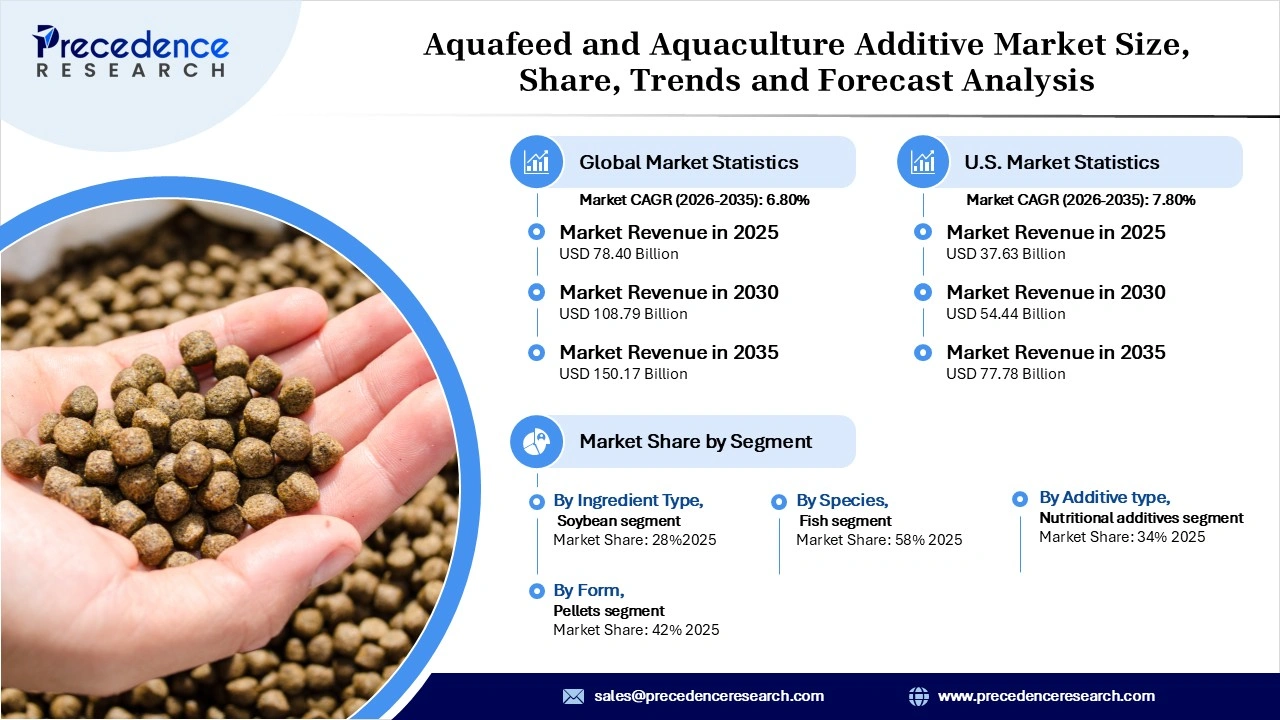
The global aquafeed and aquaculture additive market revenue surpassed USD 78.40 billion in 2025 and is predicted to attain around USD 150.17 billion by 2035, growing at a CAGR of 6.80%. The market is driven by the increased adoption of aquaculture or wild fish catching, the growing need for sustainable and disease-resistant aquaculture, and the increasing usage of functional additives like probiotics, prebiotics, and enzymes.
Nourishing the World’s Most Rapidly Growing Protein Source Sector
The aquafeed and aquaculture additive market consists of formulated feed products and nutritional supplements that are fed to farmed fish, shrimp, and other aquatic creatures in a controlled environment. This market involves aquafeeds formulated as either floating or sinking pellets based on the specific nutritional needs of different aquatic species at different stages of their lives. It includes protein rich feed such as fishmeal, soybean meal, and insect meal, lipid ingredients such as fish oil and algal oil, vitamins, and minerals.
This market also includes functional additives to enhance the health, development, and sustainability of the farmed fish, such as probiotics, prebiotics, enzymes, immunostimulants, attractants, and mold inhibitors. It also involves carotenoid compounds used in salmon and shrimp feed for flesh coloring, as well as organic acids for gut health. This market has been adopted in aquafarms that raise salmon, tilapia, shrimp, carp, catfish, sea bass, and trout.
Black Soldier Fly Protein for Shrimp Feed
The latest trend in the market is the usage of insect-based proteins from the larvae of black soldier flies as a sustainable replacement for fishmeal and plant-based proteins. This aids in reducing the strain on wild fish stocks and minimizing the impact of feed production on the environment. This closed loop involves using low-quality agricultural waste as feed for insects, which produce high-quality protein that can be used for shrimp and fish farming. In 2025, BioMar teamed up with Innovafeed and Auchan to introduce black soldier fly protein as a new ingredient in their shrimp feed products. It replaced conventional ingredients and wild fish stocks with a low-environmental impact solution.
Adoption of Functional Feed Additives for Stress Management
The aquafeed and aquaculture additive market is benefiting from the adoption of functional feed ingredients that target environmental stressors, changes in temperature, and poor water quality, beyond traditional nutritional supplements to promote optimal health outcomes. Precision nutrition technology is making it possible to adopt more sophisticated feed management systems that enhance production and minimize wastage. In 2025, ADM launched Nutripiscis Oxygen feed, after 18 months of research in Brazil and Vietnam, which helps to reduce the impact of environmental stressors and changes in temperature.
Government Initiatives for the Development of Aquafeed and Aquaculture
Governments across the world have undertaken several funding schemes and subsidy programs to facilitate the establishment and development of the aquafeed and aquaculture sector. This includes subsidies for feed and seed expenses, investment subsidies for the construction and management of feed mills, and infrastructure subsidies for improving the efficiency of the supply chain in fish and shrimp aquaculture operations. In 2026, the government of Kazakhstan launched several new state support measures aimed at assisting the country’s aquaculture industry. These include partial reimbursement of expenses incurred for setting up or expanding the capacity of feed production facilities, and subsidies on water supplies.
BioMar Aquaculture Volume Expands to 1.56 Million Tons in 2025
According to the BioMar Group, the total volume of feed sales was 1.56 million tons in 2025. The volume of shrimp feed sales jumped by 31% while the volume of joint venture sales increased by 21% in comparison to the previous year. The sales of salmon feed and selected species increased by 8% and 11%, respectively.
Market Segmentation Overview
- By ingredient type, the soybean meal segment led the aquafeed and aquaculture additive market with 28% share in 2025, due to the fact that soybean meal is the best source of protein for farmed fish and shrimp, as it is highly digestible, and has an amino acid composition that aligns well with the nutrient needs of commercial aquatic species.
- By ingredient type, the additives segment is expected to expand at the highest CAGR of 9.8% during the forecast period, owing to the increasing demand for functional additives like prebiotics, probiotics, enzymes, immunostimulants, and attractants to enhance immunity, improve feed efficiency, and prevent disease outbreaks.
- By species, the fish segment dominated the market with 58% share in 2025, because fish culture is the largest aquaculture segment in terms of volume of production, and species like salmon, tilapia, carp, pangasius, trout, catfish, sea bass, and sea bream need formulated feed during their production.
- By species, the crustaceans segment is expected to grow at the fastest CAGR of 8.5% from 2026 to 2035, due to the fact that shrimp aquaculture is growing fast in Asia and Latin America to satisfy the increasing demand, and shrimp need feeds that have high nutritional value and special ingredients to form shells, resist diseases, and have pigment.
- By additive type, the nutritional additives segment led the aquafeed and aquaculture additive market with 34% share in 2025, since vitamins, minerals, amino acids, and fatty acids are mandatory elements in all formulations of aquafeeds as they aid in preventing deficiencies, supporting growth, and ensuring the good health of farmed fish and shrimp.
- By additive type, the health additives segment is expected to expand at the highest CAGR of 9.5% during the forecast period, owing to the increasing trend of minimizing the use of antibiotics, which leads to the adoption of health-based substitutes for enhancing gut health, increasing disease resistance, and decreasing mortality rates.
- By form, the pellets segment dominated the market with 42% share in 2025, because it provides the optimal combination of water stability, nutrition content, and ease of use, resulting in minimal wastage and water pollution, which makes it sustainable for extensive use without any harsh impact on the environment.
- By form, the extruded feed segment is expected to grow at the fastest CAGR of 8.8% from 2026 to 2035, due to its ability to facilitate improved digestibility, minimize wastage during feed distribution, and help farmers track the amount of feed consumed, which makes it ideal for salmon, trout, and marine fish.
Regional Analysis
Asia Pacific led the aquafeed and aquaculture additive market with 48% share in 2025, and is expected to expand at the highest CAGR of 7.8% during the forecast period, owing to the presence of a large number of feed mills that produce formulated aquafeeds catering to the needs of both freshwater and marine species of fish and shrimp.
China dominated the market in Asia-Pacific since it is the world’s biggest producer of aquaculture products in the form of millions of tons of farmed fish and shrimp produced annually, and caters to fish such as carp, tilapia, and catfish, and crustaceans. India is a notable contributor to the market because of the rapid expansion of its shrimp farming sector, which requires highly nutritious and protein-rich aquafeeds, along with extensive freshwater farming of carp and pangasius.
Europe held the second-largest market share of 20% in 2025, since it has an advanced and lucrative aquaculture industry producing premium aquatic products such as salmon, trout, seabass, and seabream, and has strict sustainability regulations that increase the demand for aquafeed. Norway led the market in Europe owing to its well-developed salmon farming industry, which requires high-value, nutritionally advanced aquafeed and the use of offshore and recirculating aquaculture systems that need specialized feed formulations. Spain witnessed significant market growth due to its significant production of seabass, seabream, and trout, and government funding schemes for the enhancement of the aquaculture industry in the country.
Aquafeed and Aquaculture Additive Market Coverage
| Report Attribute | Key Statistics |
| Market Revenue in 2025 | USD 78.40 Billion |
| Market Revenue by 2035 | USD 150.17 Billion |
| CAGR from 2026 to 2035 | 6.90% |
| Quantitative Units | Revenue in USD million/billion, Volume in units |
| Largest Market | North America |
| Base Year | 2025 |
| Regions Covered | North America, Europe, Asia-Pacific, Latin America, and the Middle East & Africa |
Top Companies in the Aquafeed and Aquaculture Additive Market
Cargill Incorporated, BioMar Group, Skretting, and Tongwei Co. Ltd. are some of the key players that produce formulated feed for salmon, shrimp, tilapia, and other aquaculture. Alltech Inc., ADM Animal Nutrition, and Nutreco N.V. concentrate on aqua additives that include mycotoxin control, gut health, and functional aquafeed ingredients. Ridley Corporation Limited and Avanti Feeds Limited are the dominant firms in the regional aquaculture feeds market in Australia and India, respectively. Evonik Industries AG, BASF SE, and DSM-Firmenich supply essential amino acids, enzymes, and omega-3 from algae used in aquafeed.
Segments Covered in This Report
By Ingredient Type
- Soybean Meal
- Fish Meal
- Corn
- Fish Oil
- Additives
- Amino Acids
- Vitamins & Minerals
- Probiotics
- Enzymes
- Acidifiers
- Antioxidants
- Immunostimulants
By Species
- Fish
- Salmon
- Tilapia
- Carp
- Catfish
- Seabass
- Crustaceans
- Shrimp
- Crab
- Mollusks
- Other Aquatic Species
By Additive Type
- Nutritional Additives
- Health Additives
- Palatability Enhancers
- Growth Promoters
- Feed Binders
By Form
- Pellets
- Extruded Feed
- Powder
- Liquid Feed
By Distribution Channel
- Direct Sales
- Distributors
- Online Sales
By End-User
- Commercial Aquaculture Farms
- Hatcheries
- Research Institutes
- Ornamental Fish Farms
By Region
- North America
- Latin America
- Europe
- Asia-pacific
- Middle and East Africa
Get this report to explore global market size, share, CAGR, and trends, featuring detailed segmental analysis and an insightful competitive landscape overview @ https://www.precedenceresearch.com/sample/8445
You can place an order or ask any questions. Please feel free to contact us at sales@precedenceresearch.com |+1 804 441 9344