



Aquafeed and Aquaculture Additive Market Size, Share, Trends, Companies, and Forecast 2026-2035
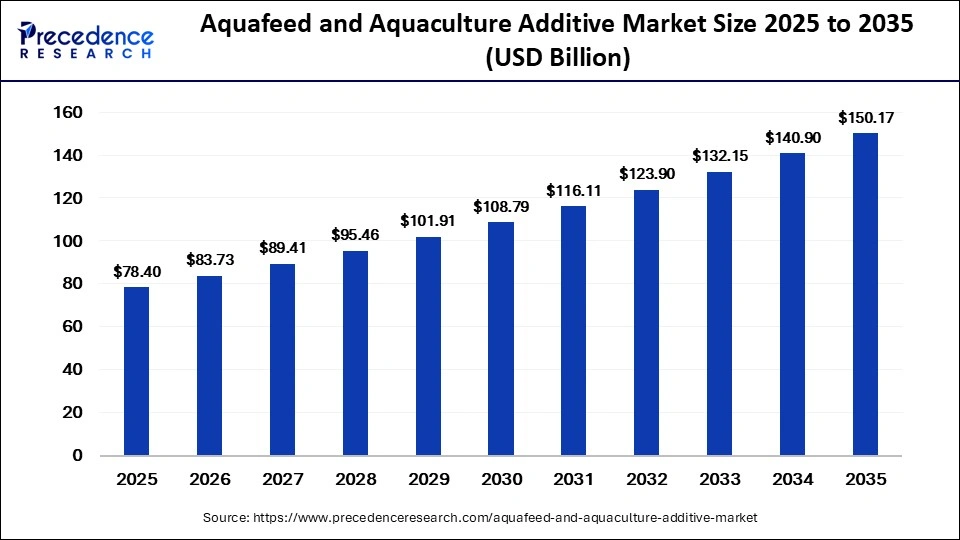
Deepa Pandey, a Healthcare Industry Expert, highlights that the aquafeed and aquaculture additive market has reached USD 83.73 billion in 2026 and is on track to reach USD 150.17 billion by 2035, advancing at a CAGR of 6.80%. Key aquafeed and aquaculture additive market companies shaping the market include Cargill Incorporated, BioMar Group, Skretting, Alltech Inc., Nutreco N.V., while major growth segments span By Ingredient Type, By Species, By Additive Type, By Form, By Distribution Channel, By End-User.
Source: https://www.precedenceresearch.com/aquafeed-and-aquaculture-additive-market
 Get a Sample
 Table Of Content


What is the Aquafeed and Aquaculture Additive Market Size in 2026?
The global aquafeed and aquaculture additive market size is predicted to increase from USD 83.73 billion in 2026 to approximately USD 150.17 billion by 2035, expanding at a CAGR of 6.80% from 2026 to 2035. The market growth is attributed to increasing global seafood consumption, expanding commercial aquaculture production, and rising adoption of functional and sustainable feed technologies.
Key Takeaways
- Asia-Pacific dominated the market with 48% of the market share in 2026 and is expected to be the fastest-growing region with a CAGR of 7.8% during the forecast period.
- Europe held the second-largest market share of 20% in 2026 and is expected to register a significant growth of 5.5% CAGR during 2026 and 2035.
- By ingredient type, the soybean segment contributed the highest aquafeed and aquaculture additive market share of 28% in 2026.
- By ingredient type, the additives segment held a 26% share of the market in 2026 and is expected to grow at the fastest CAGR of 9.8% between 2026 and 2035.
- By species, the fish segment held a major market share of 58% in 2026.
- By species, the crustaceans segment held a 28% share in 2026 and is expected to register the fastest growth of 8.5% CAGR during 2026 and 2035.
- By additive type, the nutritional additives segment contributed the highest market share of 34% in 2026.
- By additive type, the health additives segment contributed 28% to the market in 2026 and is expected to grow at a strong CAGR of 9.5% over the projected period.
- By form, the pellets segment contributed the highest market share of 42% in 2026.
- By form, the extruded feed segment held a 36% share of the market in 2026 and is expected to grow at the highest CAGR of 8.8% between 2026 and 2035.
Market Overview
Rising global seafood demand and expanding commercial aquaculture operations are strongly driving the aquafeed and aquaculture additive market. Balanced nutritional formulation comprising probiotics, enzymes, amino acids, phytogenics, and omega-3 ingredients is tested in Aquafeed technologies. These add to the benefits of increased fish growth, feed efficiency, immunity, and water stability in intensive aquaculture systems.
Fish produced in aquaculture surpassed the catches of capture fisheries worldwide for the first time, at 130.9 million tonnes, according to the FAO 2024 report. Advanced aquaculture nutrition technologies are further driving investments due to increasing concerns about aquatic disease outbreaks and feed efficiency.
Impact of Artificial Intelligence on the Aquafeed and Aquaculture Additive Market
Feed manufacturers rely on artificial intelligence platforms to monitor fish behaviour, feeding activity, water quality, and environmental conditions in real time. These technologies enable producers to maximize feed formulations and feeding programs, whilst minimizing feed waste and feed cost. Additionally, AI-driven predictive analytics aids in the early detection of disease, which helps ensure the well-being of aquatic animals and minimizes losses in intensive aquaculture environments.
Growth Factors
- Driving Integration of Smart Feeding Technologies: AI-enabled feeding systems and automated biomass monitoring platforms are improving feed optimization across commercial aquaculture farms.
- Growing Commercialization of Precision Hatchery Nutrition: Advanced larval feed technologies and micronutrient-enriched starter diets are strengthening juvenile survival and aquaculture productivity.
Market Trends
Commercial Scaling of Single-Cell Proteins in Aquafeed
Aquafeed manufacturers rapidly increased the commercialization of single-cell proteins derived from methane, yeast, and microbial fermentation. These can be used as substitutes for conventional fishmeal and soy-protein, and are becoming popular. Investments in aquaculture are supporting businesses to lessen marine resource dependence and streamline production value chains.
Feeding the Blue Revolution Driving the Aquafeed and Additives Boom
- China is the world's largest producer of aquafeed, totaling around 43% of the world's aquafeed production in 2026.
- The production of aquafeed is estimated to be larger than 5 million tons in 2024-25, driven by robust demand from Andhra Pradesh and the shrimp farming zones along the coast of India.
- The global demand for aquafeed is estimated to grow to around 52.97 MT in 2024, and extruded aquafeed is being adopted across various aquaculture segments, including salmon, shrimp, and tilapia production, for its enhanced feed conversion ratio and water stability.
Market Dynamics
Drivers
Rising Global Seafood Consumption
Rising global seafood consumption is expected to drive the aquafeed and aquaculture additive market. Demand for high-quality aquafeeds and special nutritional additives in commercial fish farming activities is increasing, as the world population keeps growing and eating more seafood.
The OECD-FAO Outlook forecasts a rise in global per-capita consumption of fish and seafood from 21.1 kg in 2022–2024. Supporting urbanisation and the growing demand for protein continues to boost seafood production interests in Asia-Pacific, Europe, and Latin America. Furthermore, the large aquaculture producers are also increasing investments in precision nutrition technologies to improve productivity and reduce farming losses.
Restraint
Volatile Fishmeal and Marine Ingredient Prices Restraining Aquafeed Production Costs
Volatile fishmeal and fish oil prices are anticipated to create significant cost pressures, thus hindering the market. Climate changes, fishing quotas, and shifting oceanic conditions keep Aquafeed producers facing the challenges of exotic marine ingredients.
Less availability of fishmeal made from anchovies for shrimp and salmon feed, due in part to El Niño events and falling wild fish stocks. The costs for companies that buy feed are also rising with increased demand for high-protein marine ingredients demanded by the premium aquaculture nutrition products market. Furthermore, the impending stringent environmental regulations are estimated to slow the expansion of conventional aquafeed ingredient manufacturing activities across multiple regions.
Opportunity
High Demand for Export-Quality Seafood Estimated to Expand Premium Feed Ingredient Commercialization
High demand for export-quality seafood is estimated to create immense opportunities for the aquafeed and aquaculture additive industry. The high demand for seafood product quality geared for export is estimated to promote the commercialization of premium aquafeed ingredients and nutritional specialty additives on a global scale. Buyers from around the world are seeking traceability, sustainability, quality nutrition, and residue-free standards of aquaculture production. Furthermore, the surging investments in precision aquaculture technologies are likely to strengthen the development of intelligent feeding systems and customized nutritional solutions.
Segmental Insights
Aquafeed and Aquaculture Additive Market by Ingredient Type 2026 Share & Size
| Segments | 2026 Share | 2026 Market Value (USD Billion) |
| Soybean Meal | 28% | 23.444 |
| Fish Meal | 22% | 18.421 |
| Corn | 15% | 12.56 |
| Fish Oil | 9% | 7.536 |
| Additives | 26% | 21.77 |
Sources: Expert Interview, Secondary Sources, Precedence Research Database, Precedence Research Analysts and Researcher.
Soybean Meal leads due to its widespread use as a protein source in aquafeed formulations and its role in replacing some marine-derived ingredients. Additives represent a substantial share as producers increasingly use functional ingredients to improve feed efficiency, animal health, and aquaculture productivity.
Aquafeed and Aquaculture Additive Market by Species 2026 Share & Size
| Segments | 2026 Share | 2026 Market Value (USD Billion) |
| Fish | 58% | 48.563 |
| Crustaceans | 28% | 23.444 |
| Mollusks | 8% | 6.698 |
| Other Aquatic Species | 6% | 5.024 |
Sources: Expert Interview, Secondary Sources, Precedence Research Database, Precedence Research Analysts and Researcher.
Fish lead because finfish farming accounts for substantial commercial aquaculture feed demand across salmon, tilapia, carp, catfish, and seabass production. Crustaceans represent the second-largest category, supported by intensive shrimp farming and the need for species-specific nutritional formulations.
Aquafeed and Aquaculture Additive Market by Additive Type 2026 Share & Size
| Segments | 2026 Share | 2026 Market Value (USD Billion) |
| Nutritional Additives | 34% | 28.468 |
| Health Additives | 28% | 23.444 |
| Palatability Enhancers | 16% | 13.397 |
| Growth Promoters | 14% | 11.722 |
| Feed Binders | 8% | 6.698 |
Sources: Expert Interview, Secondary Sources, Precedence Research Database, Precedence Research Analysts and Researcher.
Nutritional Additives lead because aquaculture producers need to maintain balanced diets that support growth, feed conversion, and species-specific nutrient requirements. Health Additives are also significant as producers focus on disease prevention, immune function, and reducing production losses.
Aquafeed and Aquaculture Additive Market by Form 2026 Share & Size
| Segments | 2026 Share | 2026 Market Value (USD Billion) |
| Pellets | 42% | 35.167 |
| Extruded Feed | 36% | 30.143 |
| Powder | 13% | 10.885 |
| Liquid Feed | 9% | 7.536 |
Sources: Expert Interview, Secondary Sources, Precedence Research Database, Precedence Research Analysts and Researcher.
Pellets lead the estimated market because they are widely used in commercial aquaculture and can be formulated for different species, feeding practices, and production environments. Extruded Feed holds a substantial share because extrusion allows manufacturers to control buoyancy, digestibility, and feed structure for different aquatic species.
Regional Insights
| Segments | 2026 Share | 2026 Market Value (USD Billion) |
| North America | 14% | 11.722 |
| Latin America | 11% | 9.21 |
| Europe | 20% | 16.746 |
| Asia-Pacific | 48% | 40.19 |
| Middle East and Africa | 7% | 5.861 |
Sources: Expert Interview, Secondary Sources, Precedence Research Database, Precedence Research Analysts and Researcher.
Asia-Pacific leads the market, consistent with the supplied 48% share, reflecting its extensive aquaculture production, seafood consumption, and established feed manufacturing industry. Europe holds the second-largest share at the supplied 20%, supported by commercial fish farming, established feed producers, and demand for specialized nutritional formulations.
Asia Pacific Aquafeed and Aquaculture Additive Market Size and Growth 2026 to 2035
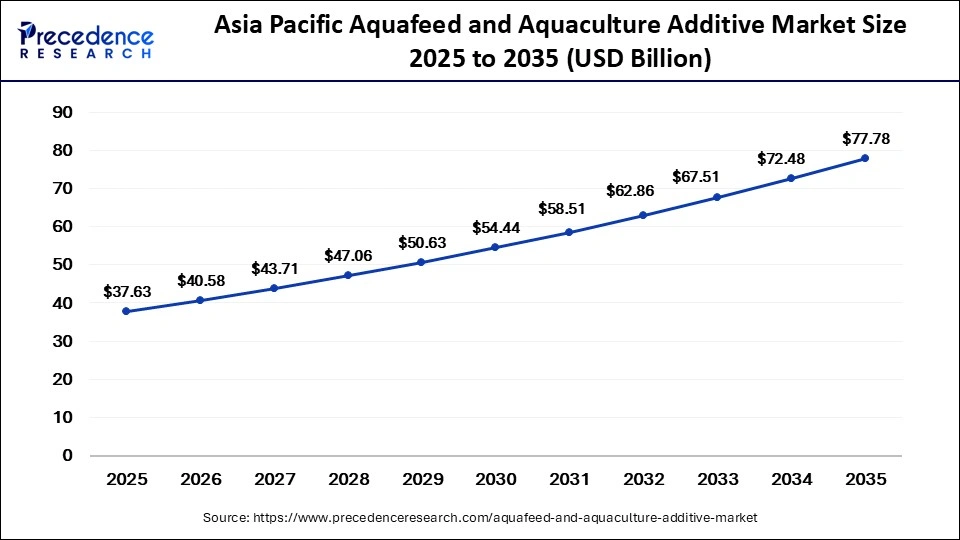
The Asia Pacific aquafeed and aquaculture additive market size was exhibited at USD 40.58 billion in 2026 and is projected to be worth around USD 77.78 billion by 2035, growing at a CAGR of 7.80% from 2026 to 2035.
Asia-Pacific: The Dominant Region
Asia-Pacific dominated the aquafeed and aquaculture additive market while holding a 48% share in 2026 and is expected to grow at the fastest CAGR of 7.8% during the projection period. This is mainly due to the huge concentration of commercial aquaculture facilities throughout China, India, Thailand, Vietnam, and Indonesia. In 2026, the region accounted for nearly 90% of global aquaculture production volume, reinforcing its position as the world's leading hub for commercial seafood production. Strong adoption of advanced aquafeed products, coupled with government-led aquaculture modernization initiatives and sustainable seafood development programs, continues to support regional market expansion.
China Market Trends
China leads the market within Asia Pacific due to the rapid modernization of its commercial aquaculture infrastructure and large-scale seafood production capacity. The country has witnessed significant adoption of advanced nutritional technologies, including high-performance feed formulations for shrimp and freshwater fish enriched with enzymes, probiotics, and precision nutrition additives. According to the Food and Agriculture Organization, China ranked first globally in aquaculture production volume in 2026, driven by strong domestic consumption and robust export demand for aquaculture products.
Europe: The Second-Largest Market
Europe held the second-largest market share of 20% in 2026 and is expected to grow at a notable CAGR of 5.5% over the projected period, supported by advanced aquaculture nutrition technologies and sustainable feed innovation activities. Norway, Scotland, and the Faroe Islands continue to lead regional salmon farming production and premium feed consumption trends. Aquaculture companies across Europe are increasingly utilizing algae-derived omega-3 oils, microbial proteins, and antibiotic-free nutritional additives supporting environmentally responsible seafood production.
Norway Market Trends
Norway is a major contributor to the market due to the salmon farming expansion in 2026, coupled with high-level uptake of feed technology. Record market appetite for farmed salmon exports puts an increased demand on producers to boost feed efficiency and quality of fish management, the Norwegian Seafood Council reported. The Norwegian Seafood Council reported that Norway exported over 1.3 million tons of seafood during 2026, increasing demand for high-performance salmon nutrition and specialty feed additives.
How is North America Growing in the Aquafeed and Aquaculture Additive Market?
North America held 16% of the market share in 2026 and is expected to grow at a 5.8% CAGR between 2026 and 2035, driven by rising seafood demand and increasing investments in sustainable aquaculture systems. The United States and Canada continue expanding salmon, trout, and marine fish farming operations utilizing advanced feed technologies and digital aquaculture platforms. Regional growth is further supported by increasing consumer preference for premium seafood products containing strong sustainability and traceability credentials.
Canada Market Trends
In Canada, the market is due to the advances in edge aquaculture feed innovations and in aquaculture nutrition for sustainable seafood. Investments in land-based salmon farming projects and recirculating aquaculture infrastructure in British Columbia and Atlantic Canada increased, as highlighted by Fisheries and Oceans Canada. Canadian aquaculture companies are working to capitalize on alternative proteins, such as algae oils and microbial proteins, that lessen reliance on traditional fishmeal resources.
What Drives the Aquafeed and Aquaculture Additive Market in Latin America?
Latin America held an 11% market share in 2026 and is expected to grow at a significant CAGR of 6.8% over the forecast period. This is due to the rising seafood consumption, expanding aquaculture production, and increasing export demand for shrimp and fish products. Across the region, aquaculture operators are adopting high-performance feeds, disease management strategies, and functional feed additives to improve productivity, fish health, and sustainability, supporting the continued development of commercial aquaculture operations.
Brazil Market Trends
Brazil is emerging as a major contributor to the regional market, supported by the rapid expansion of tilapia farming and favorable aquaculture conditions. Growing domestic demand for seafood products is encouraging producers to adopt nutritionally balanced feed solutions and advanced farming technologies. In addition, government support for sustainable aquaculture development and increasing investments in modern fish farming practices are contributing to market growth.
How is the Opportunistic Rise of the Middle East & Africa in the Market?
The Middle East & Africa held a 5% share of the market in 2026 and is expected to grow at a 6.2% CAGR in the upcoming years. This is mainly due to the increasing investments in aquaculture, rising seafood consumption, and regional food security initiatives. Governments across the region are promoting local fish production to reduce dependence on seafood imports, while the expansion of commercial fish farms and recirculating aquaculture systems is driving demand for specialized aquafeed products and nutritional additives.
Saudi Arabia Market Trends
Saudi Arabia is experiencing strong growth in the aquafeed and aquaculture additive market due to government initiatives aimed at expanding aquaculture production as part of broader food security and economic diversification strategies. The adoption of functional feed ingredients such as probiotics, amino acids, enzymes, and immune stimulants is increasing to enhance aquatic animal healthcare and productivity. Furthermore, the expansion of marine aquaculture activities in the Red Sea and investments in modern aquaculture infrastructure are supporting continued market development.
Aquafeed and Aquaculture Additive Market Value Chain Analysis
- Raw Material Sourcing
Fishmeal, soybean meal, algae proteins, vitamins, minerals, and specialty ingredients form the foundation of aquafeed and additive production.
Key Players: Cargill, ADM, Corbion.
- Feed Additive & Formulation Development
Manufacturers develop probiotics, amino acids, enzymes, and functional nutritional solutions, improving aquatic animal growth and immunity.
Key Players: DSM-Firmenich, Evonik Industries, Kemin Industries.
- Aquafeed Manufacturing & Processing
Feed producers process ingredients into pellets, extruded, powder, and liquid feed formulations for commercial aquaculture operations.
Key Players: BioMar, Skretting, De Heus.
- Distribution to Aquaculture Farms
Finished aquafeed products are supplied to fish farms, shrimp hatcheries, and marine aquaculture facilities supporting seafood production.
Key Players: Mowi, Thai Union, Cermaq.
Competitive Landscape
The global aquafeed and aquaculture additive market is characterized by the presence of major multinational aquaculture nutrition companies alongside regional feed and additive suppliers, creating a moderately competitive landscape. Leading players such as Cargill, BioMar Group, Skretting, Alltech, and Nutreco continue to strengthen their market positions through product innovation, sustainability initiatives, and global expansion strategies. For instance, BioMar Group has been actively advancing sustainable aquaculture nutrition solutions and low-carbon feed technologies to support environmentally responsible fish farming practices.
Technological innovation is reshaping the competitive landscape, with companies investing in precision nutrition, functional feed additives, probiotics, enzymes, and alternative protein sources such as insect meal and algal protein. The adoption of digital aquaculture technologies, AI-driven feed optimization systems, and advanced feed formulations is further enhancing production efficiency, fish health, and sustainability outcomes. As a result, companies that combine nutritional innovation with digital capabilities are expected to gain a stronger competitive advantage in the evolving aquaculture market.
Aquafeed and Aquaculture Additive Market Companies
- Cargill Incorporated
- BioMar Group
- Skretting
- Alltech Inc.
- Nutreco N.V.
- ADM Animal Nutrition
- Ridley Corporation Limited
- Evonik Industries AG
- BASF SE
- DSM-Firmenich
- Kemin Industries
- Novus International Inc.
- Charoen Pokphand Foods PCL
- Tongwei Co., Ltd.
- Avanti Feeds Limited
Recent Developments
- In May 2026, the Aquaculture Stewardship Council (ASC) marked significant progress with the certification of the first two feed mills in Venezuela, Agropecuaria Nivar and Proporca, both producing shrimp feed. This highlights a growing demand for sustainable aquafeed in the region and reinforces Latin America's role in the global shrimp supply chain. (Source: https://www.feedstrategy.com)
- In May 2026, Phibro launched Verratain Verified Sustainability Solutions, its first master brand for sustainable products aimed at reducing emissions in animal protein and pet food supply chains. The initial product line, developed in partnership with VAXA Technologies, features Verratain Spirulina and Verratain Omega Oil-low-carbon microalgae feed ingredients that help lower the carbon intensity of animal feed while promoting animal health. (Source: https://www.aquafeed.com)
Segments Covered in the Report
By Ingredient Type
- Soybean Meal
- Fish Meal
- Corn
- Fish Oil
- Additives
- Amino Acids
- Vitamins & Minerals
- Probiotics
- Enzymes
- Acidifiers
- Antioxidants
- Immunostimulants
By Species
- Fish
- Salmon
- Tilapia
- Carp
- Catfish
- Seabass
- Crustaceans
- Shrimp
- Crab
- Mollusks
- Other Aquatic Species
By Additive Type
- Nutritional Additives
- Health Additives
- Palatability Enhancers
- Growth Promoters
- Feed Binders
By Form
- Pellets
- Extruded Feed
- Powder
- Liquid Feed
By Distribution Channel
- Direct Sales
- Distributors
- Online Sales
By End-User
- Commercial Aquaculture Farms
- Hatcheries
- Research Institutes
- Ornamental Fish Farms
By Region
- North America
- Latin America
- Europe
- Asia-Pacific
- Middle East and Africa
For inquiries regarding discounts, bulk purchases, or customization requests, please contact us at sales@precedenceresearch.com
Frequently Asked Questions





Ask For Sample
No cookie-cutter, only authentic analysis – take the 1st step to become a Precedence Research client
 Get a Sample
.webp)



 sales@precedenceresearch.com
 Schedule a Meeting
