



Additive Manufacturing for Medical Devices Market Size, Companies, Share, Patient Volume, Treatment Adoption Rates, Pricing Analysis, Regulatory Landscape, Competitive Positioning, and Demand Forecast
Additive Manufacturing for Medical Devices Market (By Technology: Stereolithography (SLA), Selective Laser Sintering (SLS), Fused Deposition Modeling (FDM), Electron Beam Melting (EBM), Direct Metal Laser Sintering (DMLS); By Material: Metals, Polymers, Ceramics, Biomaterials; By Application: Orthopedic Implants, Dental Implants, Prosthetics and Orthotics, Surgical Instruments, Tissue Engineering; By End-Use: Hospitals, Specialty Clinics, Academic and Research Institutes, Medical Device Companies; By Device Type: Implants, External Wearable Devices, Surgical Guides, Custom Medical Devices) - Global Industry Analysis, Size, Trends, Leading Companies, Regional Outlook, and Forecast 2026 to 2035
Source: https://www.precedenceresearch.com/additive-manufacturing-for-medical-devices-market
 Get a Sample
 Table Of Content


What is the Additive Manufacturing for Medical Devices Market Size in 2026?
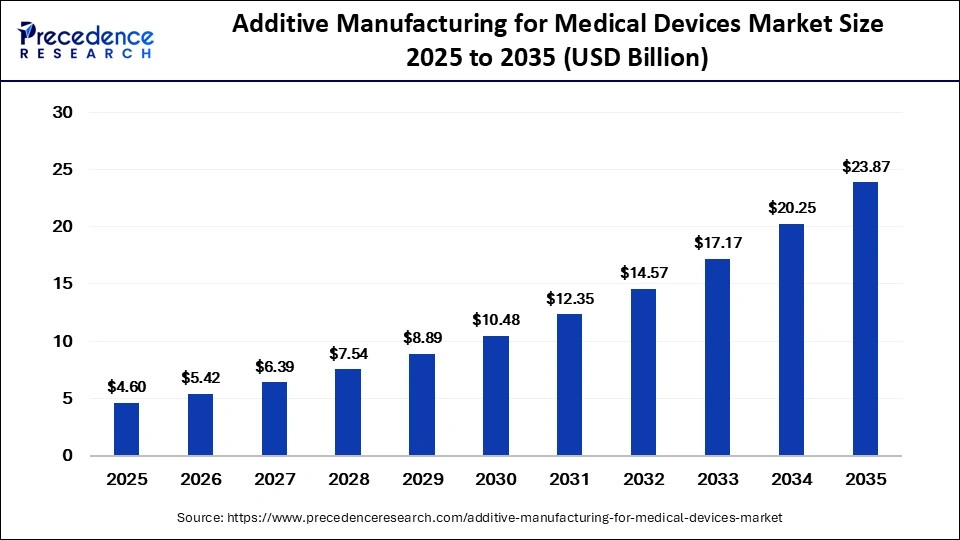
The global additive manufacturing for medical devices market size accounted for USD 4.60 billion in 2025 and is predicted to increase from USD 5.42 billion in 2026 to approximately USD 23.87 billion by 2035, expanding at a CAGR of 17.90% from 2026 to 2035. The additive manufacturing for medical devices market is driven by demand for patient-specific implants and rapid advancements in biocompatible 3D printing technologies.
Key Takeaways
- North America dominated the global market with a share of 40.00% in 2025.
- Asia Pacific is expected to grow at the fastest CAGR of 23.5% during the forecast period.
- By technology, the SLS segment contributed the highest market share of 25.00% in 2025.
- By technology, the DMLS segment is expected to grow at a strong CAGR of 20.5% between 2026 and 2035.
- By material, the metals segment held a major market share of 40.00% in 2025.
- By material, the biomaterials segment is expected to expand at the highest CAGR of 21.5% from 2026 to 2035.
- By application, the orthopedic implants segment captured the highest market share of 30.00% in 2025.
- By application, the tissue engineering segment is poised to grow at a healthy CAGR of 20.5% between 2026 and 2035.
- By end-use, the hospitals segment held the biggest market share of 45.00% in 2025.
- By end-use, the academic & research institutes segment is expected to expand at the fastest CAGR of 20.5% between 2026 and 2035.
- By device type, the implants segment accounted for the largest market share of 45.00% in 2025.
- By device type, the prosthetic devices segment is projected to grow at a solid CAGR of 19.5% between 2026 and 2035.
Market Overview
The additive manufacturing for medical devices market is transforming healthcare by leveraging advanced 3D printing technologies, such as laser sintering, and using biocompatible materials to create customized titanium implants, dental solutions, and prosthetics. Key materials involved in this process include titanium, polymers, and ceramics. This sector is driving growth through unparalleled customization and improved patient outcomes, fundamentally changing surgical planning and patient care with a shift toward personalized, precise, and efficient digital fabrication.
How is AI Impacting the Additive Manufacturing for Medical Devices Market?
Artificial intelligence (AI) is significantly impacting the market by automating design processes with generative algorithms, optimizing printing parameters in real-time, and performing AI-driven quality inspections to minimize defects. AI analyzes patient imaging data to produce patient-specific implants, prosthetics, and surgical guides that precisely match individual anatomies. Generative design algorithms facilitate the creation of complex, lightweight lattice structures, enhancing osseointegration. Additionally, AI-integrated sensors can detect defects, reduce material waste, and make real-time adjustments.
Additive Manufacturing for Medical Devices Market Trends
- Patient-Matched Implants and Prosthetics: 3D printing enables the production of highly customized, complex, and lightweight implants, prosthetics, and dental restorations that fit a patient's anatomy perfectly, thereby improving fit, functionality, and comfort.
- Point-of-Care (POC) Manufacturing: Hospitals are increasingly adopting on-site 3D printing to facilitate the immediate production of surgical guides, anatomical models, and custom devices, which reduces lead times and enhances patient-centered care.
- Advanced Materials and Bioprinting: The industry is transitioning toward advanced biocompatible metals, polymers, and ceramics for permanent implants, with an emphasis on developing tissue-engineered products.
- AI-Enabled Design and Surgical Planning: AI and software are increasingly integrated with imaging technologies, accelerating the design of complex, customized devices and aiding in surgical planning through accurate patient-specific anatomical models.
Market Scope
| Report Coverage | Details |
| Market Size in 2025 | USD 4.60 Billion |
| Market Size in 2026 | USD 5.42 Billion |
| Market Size by 2035 | USD 23.87 Billion |
| Market Growth Rate from 2026 to 2035 | CAGR of 17.90% |
| Dominating Region | North America |
| Fastest Growing Region | Asia Pacific |
| Base Year | 2025 |
| Forecast Period | 2026 to 2035 |
| Segments Covered | Technology, Material, Application, End-Use, Device Type, and Region |
| Regions Covered | North America, Europe, Asia-Pacific, Latin America, and Middle East & Africa |
Market Dynamics
Drivers
Demand for Personalized and Patient-Specific Implants
The growing demand for personalized and patient-specific implants is a major factor driving the adoption of additive manufacturing in healthcare. This technology enables the production of customized implants, dental prosthetics, and surgical guides designed according to individual patient anatomies. Additive manufacturing supports the creation of highly intricate geometries that improve implant fit, reduce surgical time, and enhance post-operative recovery outcomes compared to conventional manufacturing techniques.
Restraint
High Initial Capital Investment
One of the primary challenges limiting market growth is the high initial investment required for advanced 3D printing systems and specialized biocompatible raw materials, which are often costly. In addition, the stringent and time-intensive approval processes imposed by regulatory authorities such as the Food and Drug Administration create significant barriers for personalized 3D-printed medical devices. Manufacturers must conduct extensive validation to ensure product safety, efficacy, and consistency before commercialization.
Opportunity
Expansion of Point-Of-Care Manufacturing and AI Integration
The integration of additive manufacturing within clinical and hospital environments presents substantial growth opportunities. Point-of-care manufacturing enables healthcare providers to produce patient-specific anatomical models, implants, and surgical tools directly within medical facilities, thereby reducing logistics costs and improving treatment efficiency. Furthermore, the integration of artificial intelligence and machine learning with 3D design software is expected to optimize implant structures for enhanced bone integration and clinical performance. Advancements in multi-material printing technologies are also supporting the future development of biofabrication and 4D printing applications in healthcare.
Segment Insights
Technology Insights
The SLS Segment Held a 25% Share of the Market in 2025
The SLS segment held a dominant position in the additive manufacturing for medical devices market with a 25% share in 2025. This leadership is primarily due to its capability to produce high-strength, biocompatible, and complex patient-specific devices without the need for support structures. SLS allows for the nesting of multiple unique parts within a single build chamber, significantly reducing production time and lowering the cost per unit. This makes it an efficient method for producing specialized, custom medical devices, particularly for patient-specific implants.
The DMLS segment held a 20% share of the market in 2025 and is anticipated to grow at the fastest CAGR of 20.5% between 2026 and 2035. This growth is driven by DMLS's ability to create high-precision, biocompatible titanium and cobalt-chromium implants with complex, patient-specific geometries. It enables manufacturers to develop tailor-made prosthetics and implants that perfectly align with patient anatomy, enhancing comfort and improving patient outcomes. Additionally, these facilitate the swift production of specialized surgical instruments, reducing the overall time.
Additive Manufacturing for Medical Devices Market Share, By Technology, 2025-2035 (%)
| Technology | 2025 | 2035 | CAGR (%) |
| SLS | 25.00% | 26.00% | 18.5% |
| SLA | 22.00% | 20.00% | 16.0% |
| FDM | 18.00% | 17.00% | 14.5% |
| DMLS | 20.00% | 22.00% | 20.5% |
| EBM | 15.00% | 15.00% | 17.5% |
The SLA segment held the second-largest market share at 22% and is expected to grow at a CAGR of 16% during the forecast period. This is attributed to its unparalleled precision, superior surface finish, and capability to utilize biocompatible resins for patient-specific applications. SLA offers exceptional resolution compared to other methods, crucial for creating intricate, patient-specific surgical guides, dental aligners, and customized prosthetic components used in surgical tools and implantable devices.
The FDM segment accounted for 18% of the market share in 2025 and is projected to grow at a CAGR of 14.5%. This is due to its high adoption rate in rapid prototyping and specialized medical production. These are generally more affordable and have lower operational costs, making them popular choices for in-hospital 3D printing labs. They support biocompatible, high-strength thermoplastic materials that meet medical standards for surgical planning, custom anatomical models, and orthopedic applications.
Material Insights
Additive Manufacturing for Medical Devices Market Share, By Material, 2025-2035 (%)
| Material | 2025 | 2035 | CAGR (%) |
| Metals | 40.00% | 42.00% | 19.5% |
| Polymers | 30.00% | 28.00% | 15.5% |
| Biomaterials | 20.00% | 22.00% | 21.5% |
| Ceramics | 10.00% | 8.00% | 14.0% |
The Metals Segment Held 40% Share of the Market in 2025
The metals segment dominated the additive manufacturing for medical devices market with a 40% share in 2025. This dominance is attributed to metals' unmatched biocompatibility, high strength, and their ability to create complex, patient-specific orthopedic implants, such as hip and knee replacements. Metal 3D printing, particularly powder bed fusion, allows for tailored, intricate geometries for customized patient implants, thereby enhancing orthopedic performance. The adoption of metal materials is favored for their high strength, corrosion resistance, and regulatory acceptance.
The biomaterials segment held a 20% share in 2025 and is expected to grow at the fastest CAGR of 21.5% in the coming years. This growth is driven by their superior versatility, biocompatibility, and ease of processing. These are rapidly being adopted for creating patient-specific implants, drug delivery systems, and applications in tissue engineering. Additionally, the regenerative medicine segment, particularly bioprinting using bioinks to create functional tissues and organs due to breakthroughs in cell viability-enhancing osseointegration.
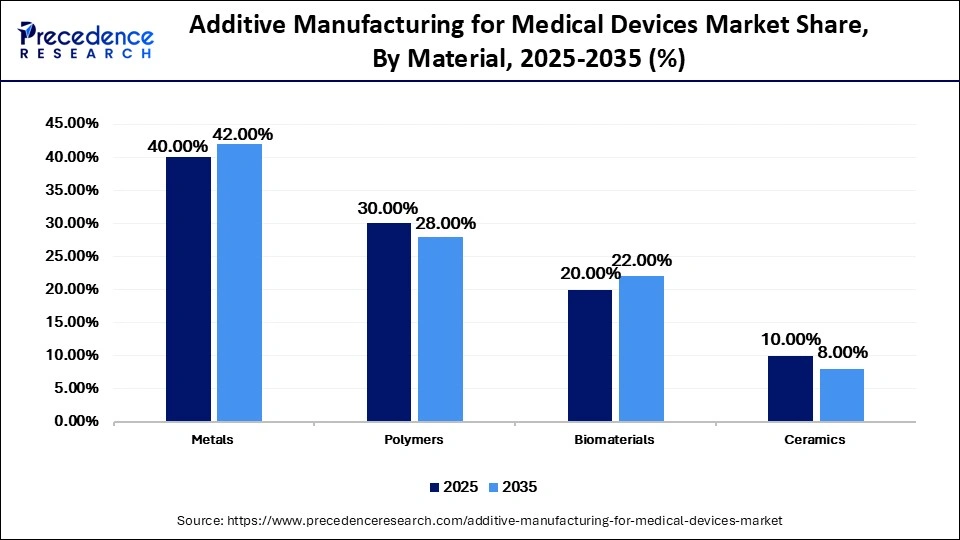
The polymers segment held the second-largest market share of 30% in 2025 and is projected to grow at a CAGR of 15.5% throughout the forecast period. This growth is driven by the high adoption rate of biocompatible, patient-specific applications. Polymers are widely used in medical instruments, prosthetic limbs, and customized wearable devices due to their lightweight and durable nature. They are relatively affordable and easy to process, allowing for rapid prototyping and low-cost production of final components for implants.
The ceramics segment accounted for 10% of the market share in 2025 and is expected to grow at a CAGR of 14% during the projection period. This is mainly due to its biocompatibility, high-performance mechanical properties, and the increasing demand for personalized, complex, and sterile implants. Ceramics such as zirconia and alumina are inert and biocompatible, reducing the risk of immune rejection. Their 3D-printing capabilities enable the creation of porous structures that promote osseointegration, making them superior for specific applications.
Application Insights
The Orthopedic Implants Segment Dominated with a 30% Share in 2025
The orthopedic implants segment dominated the additive manufacturing for medical devices market with a 30% share in 2025. This segment's growth is driven by the use of advanced CAD techniques and material customization to produce personalized titanium, porous, and bioresorbable implants. This manufacturing allows for implants that fit an individual's unique anatomy, improving clinical outcomes compared to standardized options. Customized implants also reduce surgical times and post-surgical complications, significantly enhancing patient outcomes and meeting growing demand.
The tissue engineering segment is projected to grow at the fastest CAGR of 20.5% in the coming years. This growth is attributed to breakthroughs in bioprinting and regenerative medicine. Additionally, the ability to create personalized, patient-specific tissues helps reduce rejection rates and improve surgical outcomes. The increasing demand for customized implants to address orthopedic injuries and chronic cardiovascular conditions is key to overcoming current challenges related to cost and time efficiency.
Additive Manufacturing for Medical Devices Market Share, By Application, 2025-2035 (%)
| Application | 2025 | 2035 | CAGR (%) |
| Orthopedic Implants | 30.00% | 32.00% | 18.5% |
| Dental Implants | 22.00% | 20.00% | 15.5% |
| Prosthetics & Orthotics | 18.00% | 20.00% | 19.5% |
| Surgical Instruments | 15.00% | 14.00% | 16.5% |
| Tissue Engineering | 15.00% | 14.00% | 20.5% |
The dental implants segment held the second-largest market share at 22.00% in 2025 and is expected to grow at a robust CAGR of 15.5% throughout the studied period. This growth is driven by the rapid adoption of personalized, complex geometries and high-volume, cost-effective production methods. These advancements allow for the creation of patient-specific dental implants and abutments, resulting in a superior anatomical fit and better clinical success rates by driving the volume of dental implant procedures.
The prosthetics & orthotics segment captured 18.00% of the market share in 2025 and is expected to grow at a CAGR of 19.5% during the projection period. This growth is fueled by the shift toward personalized, complex, and lightweight patient-specific devices, which are essential for addressing the increasing number of diabetic and trauma-related amputations. 3D printing technology enables high customization of prosthetic sockets and orthotic braces based on individual 3D scans to improve fit and comfort.
End-Use Insights
Hospitals Held a 45% Share of the Additive Manufacturing for Medical Devices Market in 2025
The hospitals segment registered dominance in the market, holding a 45.00% market share in 2025. This dominance is primarily due to the growing adoption of on-site 3D printing labs, which facilitate personalized care and the on-demand production of patient-specific orthopedic, cranial, and dental implants. The capability to generate tailored orthopedic and dental implants, along with customized surgical guides, has made in-house 3D printing invaluable for faster design and manufacturing of complex and personalized devices.
The academic & research institutes segment is expected to grow at the fastest CAGR of 20.5% between 2026 and 2035. This is due to intense research and development efforts focused on bioprinting, the development of customized implants, and the rapid prototyping of medical tools. Accelerated research into printing functional cells and tissues for regenerative medicine, drug testing, and personalized therapies is allowing researchers to design intricate patient-specific anatomical models.
Additive Manufacturing for Medical Devices Market Share, By End-Use, 2025-2035 (%)
| End-Use | 2025 | 2035 | CAGR (%) |
| Hospitals | 45.00% | 42.00% | 16.5% |
| Medical Device Companies | 30.00% | 32.00% | 18.5% |
| Specialty Clinics | 15.00% | 14.00% | 15.5% |
| Academic & Research Institutes | 10.00% | 12.00% | 20.5% |
The medical device companies segment held the second-largest market share of 30.00% in 2025 and is anticipated to grow at a CAGR of 18.5% in the coming years. This is driven by significant investments in research and development, as well as the production-scale application of 3D printing and regulatory expertise. These companies maintain substantial market share by leading the way in obtaining FDA and other regulatory approvals for 3D-printed devices for creating high-performance, complex components.
The specialty clinics segment accounted for 15.00% of the market share in 2025 and is expected to grow at a CAGR of 15.5% during the forecast period. This growth is primarily due to the increasing demand for patient-specific, on-demand, and specialized devices that can be produced rapidly outside of traditional hospital settings. The heightened need for customized dental implants and orthopedic and cranial prosthetics has fueled adoption in clinics that focus heavily on these areas, allowing for quicker onsite customization.
Device Type Insights
Additive Manufacturing for Medical Devices Market Share, By Device Type, 2025-2035 (%)
| Device Type | 2025 | 2035 | CAGR (%) |
| Implants | 45.00% | 47.00% | 18.5% |
| Surgical Guides | 20.00% | 18.00% | 16.5% |
| Prosthetics Devices | 20.00% | 22.00% | 19.5% |
| External Wearable Devices | 15.00% | 13.00% | 15.0% |
The Implants Segment Dominated the Additive Manufacturing for Medical Devices Market in 2025
The implants segment dominated the market with a share of 45.00% in 2025. This is largely driven by the potential to create patient-specific, complex geometries that enhance osseointegration, reduce surgical times, and improve customization for orthopedics and dentistry. Additive manufacturing enables the production of personalized implants designed from patient imaging data, ensuring a perfect fit, minimizing rejection rates, and accelerating recovery, driving high volume and adoption rates.
The prosthetic devices segment is anticipated to grow at a CAGR of 19.5% during the projection period. This is primarily due to its capability to provide highly customized, patient-specific solutions, such as sockets and prosthetic limbs, which significantly improve comfort, functionality, and accessibility. Additive manufacturing allows for the creation of personalized sockets and prosthetic limbs tailored precisely to an individual's anatomy, enhancing user comfort, alignment, and long-term usability.
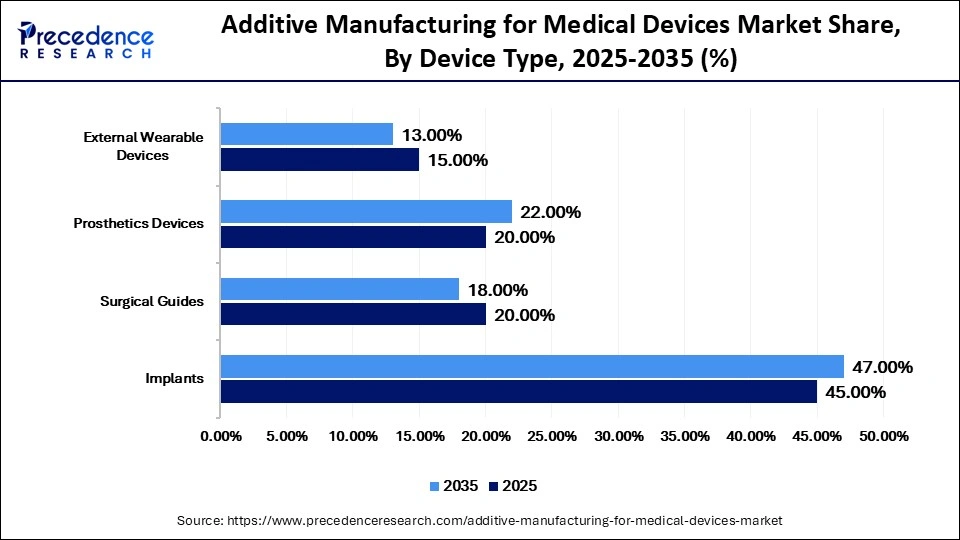
The surgical guides segment held the second-largest market share of 20.00% in 2025 and is expected to grow at the fastest CAGR of 16.5%, driven by rapid adoption in dental, orthopedic, and neurosurgical procedures that enhance surgical precision and patient outcomes. These guides enable surgeons to perform complex procedures with greater accuracy, reducing operating times, minimizing bleeding, and lowering patient risk, thereby increasing demand for customized, in-house-produced guides.
The external wearable devices segment held 15.00% of the market share in 2025 and is expected to grow at the fastest CAGR of 15.0%. This growth is driven by rapid advancements in 3D printing technology that enable highly customized, cost-effective, and comfortable patient-specific solutions. These manufacturing enables the creation of personalized orthoses and prosthetic sockets that match the exact anatomy of the user, improving compliance and patient comfort and making complex custom wearables more affordable.
Regional Insights
North America Additive Manufacturing for Medical Devices Market Size and Growth 2026 to 2035
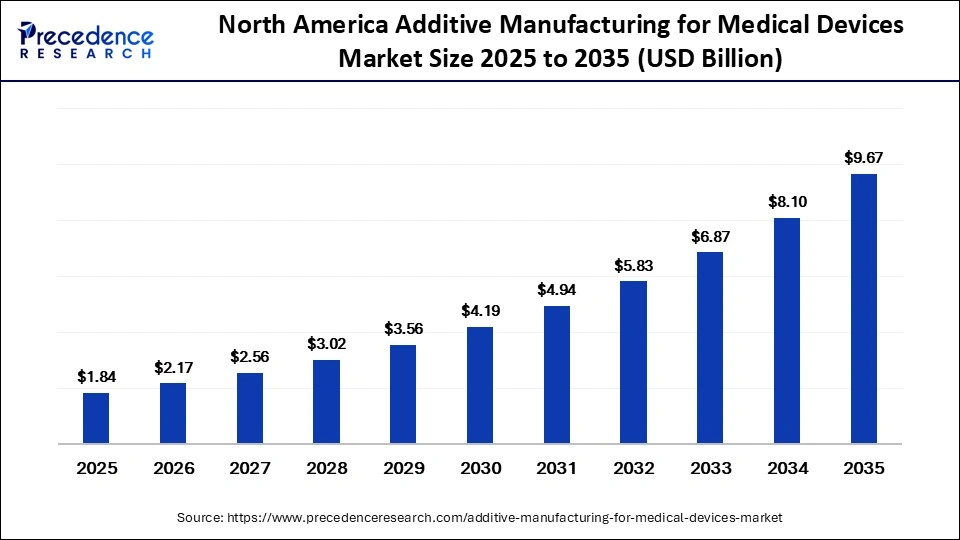
The North America additive manufacturing for medical devices market size is estimated at USD 1.84 billion in 2025 and is projected to reach approximately USD 9.67 billion by 2035, with a 18.05% CAGR from 2026 to 2035.
What Made North America the Dominant Region in the Market?
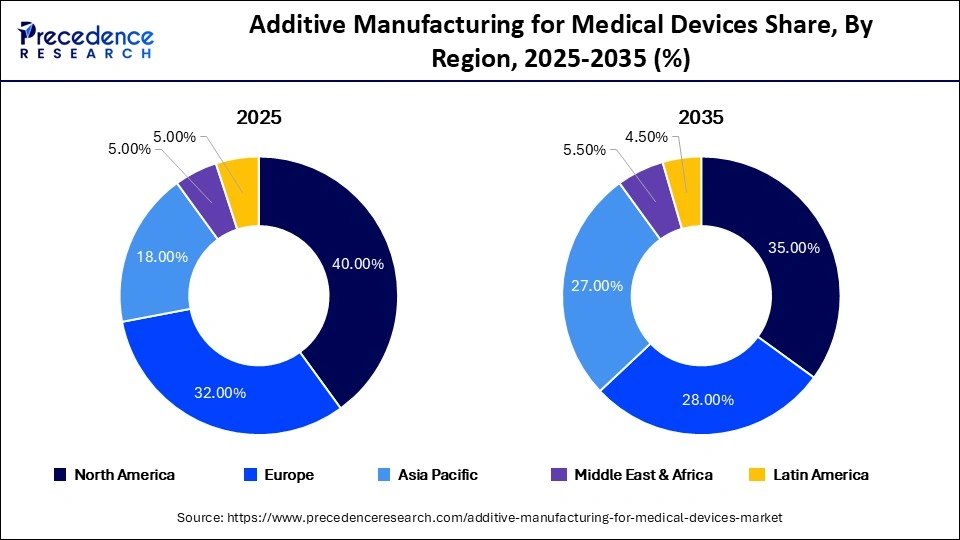
North America dominated the global additive manufacturing for medical devices market with a market share of 40.00% in 2025. This dominance stems from high healthcare spending, rapid adoption of 3D printing technologies, and a large geriatric population. Large healthcare systems, particularly in the U.S., frequently integrate 3D printing for customized orthopedic implants, surgical planning, and prosthetics. Favorable regulatory frameworks allow faster approval and implementation of 3D-printed, patient-specific devices. Increasing demand for implants and prosthetics among the elderly drives the need for customized additive solutions.
U.S. Additive Manufacturing for Medical Devices Market Size and Growth 2026 to 2035
The U.S. additive manufacturing for medical devices market size is calculated at USD 1.38 billion in 2025 and is expected to reach nearly USD 7.30 billion in 2035, accelerating at a strong CAGR of 18.13% between 2026 and 2035.
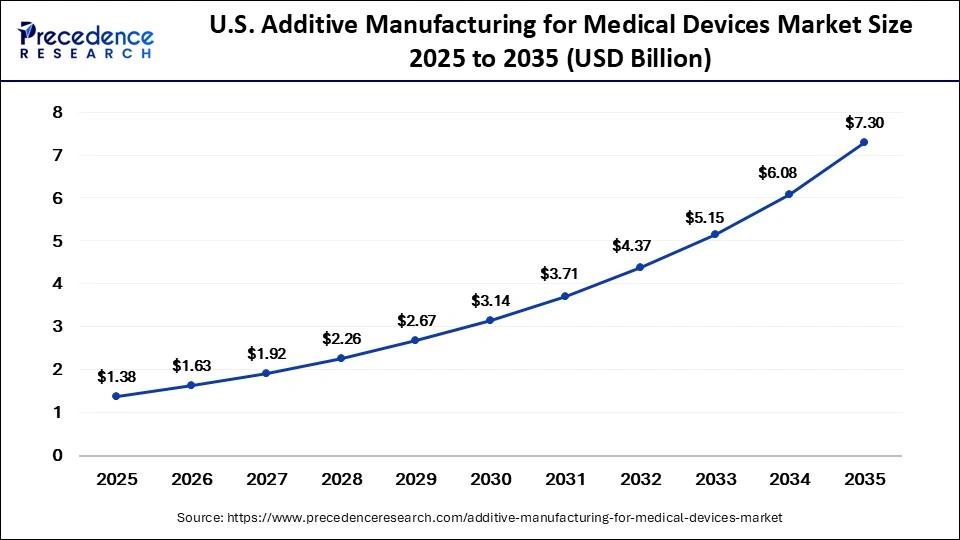
As the premier global hub for high-end, patient-specific orthopedic and dental implants, the U.S. is revolutionizing medical manufacturing by integrating advanced materials, cutting-edge software, and AI-driven precision. Leading the charge, industry innovators like 3D Systems are aggressively expanding into virtual surgical simulation and haptic design tools, cementing a future of highly personalized care and unparalleled surgical accuracy.
Asia Pacific: The Fastest-Growing Region
Asia Pacific held a 18.00% of the market share in 2025 and is expected to grow at the fastest CAGR of 23.5% during the forecast period. This growth is mainly driven by China, Japan, and India, owing to high demand for personalized medicine, massive infrastructure investments, and favorable government policies. Favorable policies such as Made in China 2025 and India's digital transformation programs are driving the adoption of advanced manufacturing technologies to reduce reliance on imports. There is a strong trend toward establishing 3D printing labs directly within hospitals to produce surgical guides and anatomical models rapidly.
India is rapidly transforming into a global MedTech hub by harnessing Additive Manufacturing, driven by the National Strategy on Additive Manufacturing and PLI schemes for medical devices. Through the establishment of seven dedicated Healthcare AM Hubs, the nation is fast-tracking the development and deployment of advanced 3D-printed solutions, cementing its role in the future of personalized healthcare manufacturing.
How is the Opportunistic Rise of Europe in the Additive Manufacturing for Medical Devices Market?
Europe held a 32.00% of the market share in 2025 and is expected to grow at a notable CAGR of 15.0% in the coming years. This is due to intense demand for personalized medicine, robust healthcare infrastructure, and rapid technological advancements in biocompatible materials. These manufacturing capabilities enable the creation of patient-specific implants, prosthetics, and surgical guides that match a patient's anatomy, improving fit, functionality, and surgical outcomes. Europe benefits from collaborations between academic institutions, hospitals, and industry, fostering innovation and rapid technology transfer to clinical practice.
Germany is pioneering the future of personalized healthcare by blending surgical precision with innovation, leveraging biocompatible materials, advanced ceramics, and high-performance thermoplastics for next-gen medical devices. Driven by major research and development investments like GE Additive's new metal printing facility and Fraunhofer IAP's sustainable implant initiatives, establishing itself as a global leader in high-precision technology.
Additive Manufacturing for Medical Devices Market Companies
- 3D Systems
- Stratasys
- Materialise
- GE Additive
- Stryker
- Zimmer Biomet
- Medtronic
- Johnson and Johnson
- EOS GmbH
- Renishaw
- Desktop Metal
- EnvisionTEC
- Prodways
- Formlabs
- HP
Recent Developments
- In August 2025, OIC International, Medi Mold, and AddUp announced a strategic partnership to establish a 3D printing-enabled orthopaedic implant manufacturing facility at the Andhra Pradesh MedTech Zone in India.(Source: https://www.expresshealthcare.in)
- In November 2025, Ricoh 3D for Healthcare established as an independent business unit to accelerate the adoption of FDA-cleared patient-specific medical devices. The division has leveraged 3D printing technologies for healthcare applications for nearly five years and recently expanded its capabilities through the deployment of Materialise software solutions and expanded FDA 510(k) clearance for 3D anatomical modeling.(Source: https://www.tctmagazine.com)
Segments Covered in the Report
By Technology
- Stereolithography (SLA)
- Selective Laser Sintering (SLS)
- Fused Deposition Modeling (FDM)
- Electron Beam Melting (EBM)
- Direct Metal Laser Sintering (DMLS)
By Material
- Metals
- Polymers
- Ceramics
- Biomaterials
By Application
- Orthopedic Implants
- Dental Implants
- Prosthetics and Orthotics
- Surgical Instruments
- Tissue Engineering
By End-Use
- Hospitals
- Specialty Clinics
- Academic and Research Institutes
- Medical Device Companies
By Device Type
- Implants
- External Wearable Devices
- Surgical Guides
- Custom Medical Devices
By Region
- North America
- Latin America
- Europe
- Asia-pacific
- Middle and East Africa
For inquiries regarding discounts, bulk purchases, or customization requests, please contact us at sales@precedenceresearch.com
Frequently Asked Questions





Ask For Sample
No cookie-cutter, only authentic analysis – take the 1st step to become a Precedence Research client
 Get a Sample




 sales@precedenceresearch.com
 Schedule a Meeting
