



Breast Lesion Localization Methods Market Revenue to Attain USD 1,480.00 Mn by 2035
Published: 12 May 2026
Author: Precedence Research



Breast Lesion Localization Methods Market Revenue and Trends 2026 to 2035
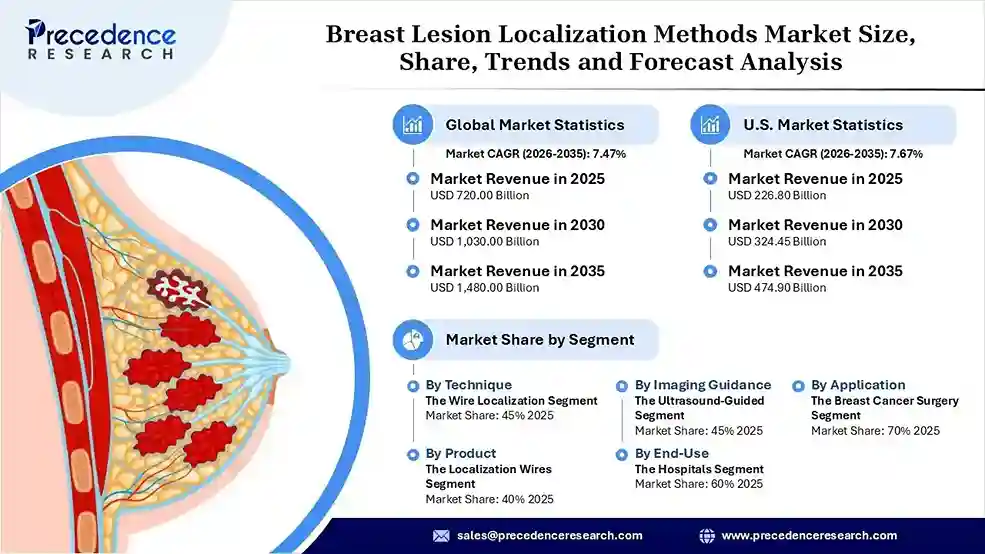
The global breast lesion localization methods market revenue reached USD 720.00 million in 2025 and is predicted to attain around USD 1,480.00 million by 2035 with a CAGR of 7.47%. The market for breast lesion localization methods is experiencing significant growth driven by increasing breast cancer screenings, earlier identification of non-palpable lesions, and a rising preference for accurate, tissue-conserving surgical procedures that necessitate effective preoperative localization technologies.
Market at a Glance
The breast lesion localization methods market comprises medical techniques used to identify suspicious and non-palpable breast abnormalities prior to biopsy or surgery. These methods enable surgeons to accurately locate lesions that cannot be detected through physical examination, ensuring precise removal of malignant tissue while preserving healthy surrounding tissue.
The market includes a range of technologies such as wire-guided systems, magnetic seed markers, radioactive tracers, radar reflectors, and imaging-guided devices. It also covers components, consumables, and imaging-assisted tools used for preoperative localization. These solutions are widely utilized across hospitals, oncology centers, and diagnostic facilities. Market demand is influenced by screening volumes, surgical approaches, technological advancements, reimbursement frameworks, and the growing adoption of wire-free localization techniques across both developed and emerging healthcare markets.
What Factors Drive the Breast Lesion Localization Methods Market?
- Rising Demand for Wire-Free Systems : The shift from traditional wire-guided localization to wire-free techniques is gaining momentum, driven by improved patient comfort and greater procedural flexibility. These systems allow for more efficient scheduling and streamlined clinical workflows. Strategic developments, such as Stryker’s acquisition of MOLLI Surgical in July 2024, highlight strong industry confidence in the long-term growth potential of wire-free localization technologies.
- Early Detection Programs Driving Growth: Expanding breast cancer screening programs are significantly contributing to market growth. Screening mammography enables the detection of preclinical and non-palpable lesions, which require precise localization before surgical intervention. As access to organized screening programs increases globally, the demand for localization procedures is expected to rise accordingly.
Cancer Burden Accelerating Localization Demand
- In 2022, approximately 2.3 million new breast cancer cases were reported globally, creating a substantial demand for diagnostic and surgical localization procedures.
- The disease accounted for nearly 670,000 deaths worldwide, underscoring its continued global health impact.
- According to global health data, breast cancer is the most common cancer among women in 157 out of 185 countries, highlighting a significant market opportunity for localization technologies.
- Notably, around 80% of breast cancer cases occur without identifiable risk factors other than age and gender, emphasizing the importance of routine screening and early detection, which in turn drives the need for effective localization methods.
Market Segmentation Overview
- By technique, the wire localization segment accounted for a revenue share of 45% in 2025. This is because of its proven reliability and widespread use across breast surgery centers. Hospitals continued relying on this conventional technique because surgeons and radiologists were already trained on established workflows, making adoption steady and operationally convenient.
- By technique, the radiofrequency identification (RFID) localization segment is expected to grow at the fastest CAGR of 11.0% in the market between 2026 and 2035, due to its real-time tracking capability. It improves workflow management and facilitates rapid lesion detection, making it increasingly appealing for centers looking for advanced wire-free alternatives.
- By product, the localization wires segment held a major revenue share of 40% in the market in 2025, as it has traditionally been used to mark non-palpable breast lesions. It's routine integration in hospital procedures, leading to stable procedural demand in established healthcare systems.
- By product, the localization seeds segment is expected to grow at a CAGR of 9.5% in the breast lesion localization methods market between 2026 and 2035, as healthcare providers are seeking wireless methods. These solutions reduce patient discomfort, simplify pre-surgical coordination, and support same-day workflows, contributing to their growing adoption in breast care practices.
- By imaging guidance, the ultrasound guided segment dominated the breast lesion localization methods market with a 45% share in 2025 and is expected to maintain its leading position in the coming years. This is because of its widespread availability, cost-effectiveness, real-time imaging capability, and absence of ionizing radiation, which make it a preferred method for routine lesion localization.
- By end-use, the hospitals segment held the largest share of 60% in the breast lesion localization methods market in 2025, as they serve as primary centers for breast cancer diagnosis and surgical treatment. Their multidisciplinary teams, advanced imaging infrastructure, and operating facilities support extensive use of localization technologies.
- By end-use, the diagnostic imaging centers segment is expected to expand rapidly in the market with a CAGR of 7.5% in the coming years, driven by the increasing volume of diagnostic procedures and expansion of screening programs. These centers are becoming key hubs for preoperative lesion localization.
- By application, the breast cancer surgery segment dominated the breast lesion localization methods market with a 70% share in 2025 and is expected to maintain its leading position with a CAGR of 7.0% in the coming years, supported by the high global prevalence of breast cancer. The increasing number of breast-conserving surgeries continues to drive demand for precise lesion localization.
Regional Analysis
North America dominated the global breast lesion localization methods market with a share of 42% in 2025 due to its robust healthcare system, widespread use of mammography, and the broad availability of image-guided surgical services. The U.S. remains the largest contributor due to its advanced cancer care infrastructure and rapid adoption of wire-free localization technologies. Moreover, the region benefits from organized screening programs and well-established hospital systems.
Asia Pacific held a market share of 18% in 2025 and is expected to grow at the fastest CAGR of 9% during the forecast period. The regional market growth is driven by rising cancer incidence and healthcare advancements. China is leading regional growth with expanding hospital infrastructure and increasing screening volumes. India is witnessing rapid growth due to improving diagnostic capabilities, expansion of private oncology networks, and rising awareness of early-stage breast cancer detection.
Breast Lesion Localization Methods Market Coverage
| Report Attribute | Key Statistics |
| Market Revenue in 2025 | USD 720.00 Million |
| Market Revenue by 2035 | USD 1,480.00 Million |
| CAGR from 2026 to 2035 | 7.47% |
| Quantitative Units | Revenue in USD million/billion, Volume in units |
| Largest Market | North America |
| Base Year | 2025 |
| Regions Covered | North America, Europe, Asia-Pacific, Latin America, and the Middle East & Africa |
Top Companies in the Breast Lesion Localization Methods Market
Hologic remains a leading player in the market, supported by its comprehensive breast health portfolio that includes imaging, biopsy, and localization systems. BD (Becton, Dickinson and Company) and Bard Medical continue to maintain strong recognition through their expertise in interventional access devices and surgical marking solutions. Companies such as Cook Medical, Merit Medical Systems, and Argon Medical Devices are strengthening their market presence through minimally invasive technologies and established hospital partnerships. Meanwhile, European players like SOMATEX Medical Technologies have developed a strong niche in localization markers and biopsy accessories, contributing to advancements in breast diagnostics.
Segments Covered in the Report
By Technique
- Wire Localization
- Radioisotope Localization (ROLL)
- Magnetic Seed Localization
- Radar Localization
- Radiofrequency Identification (RFID) Localization
By Product
- Localization Wires
- Localization Seeds
- Localization Tags & Markers
- Accessories
By Imaging Guidance
- Mammography-guided
- Ultrasound-guided
- MRI-guided
By End-Use
- Hospitals
- Ambulatory Surgical Centers
- Diagnostic Imaging Centers
By Application
- Breast Cancer Surgery
- Biopsy Procedures
By Region
- North America
- Latin America
- Europe
- Asia-pacific
- Middle and East Africa
Get this report to explore global market size, share, CAGR, and trends, featuring detailed segmental analysis and an insightful competitive landscape overview @ https://www.precedenceresearch.com/sample/8397
You can place an order or ask any questions, please feel free to contact us at sales@precedenceresearch.com |+1 804 441 9344