



Breast Lesion Localization Methods Market Size, Companies, Share, Patient Volume, Treatment Adoption Rates, Pricing Analysis, Regulatory Landscape, Competitive Positioning, and Demand Forecast
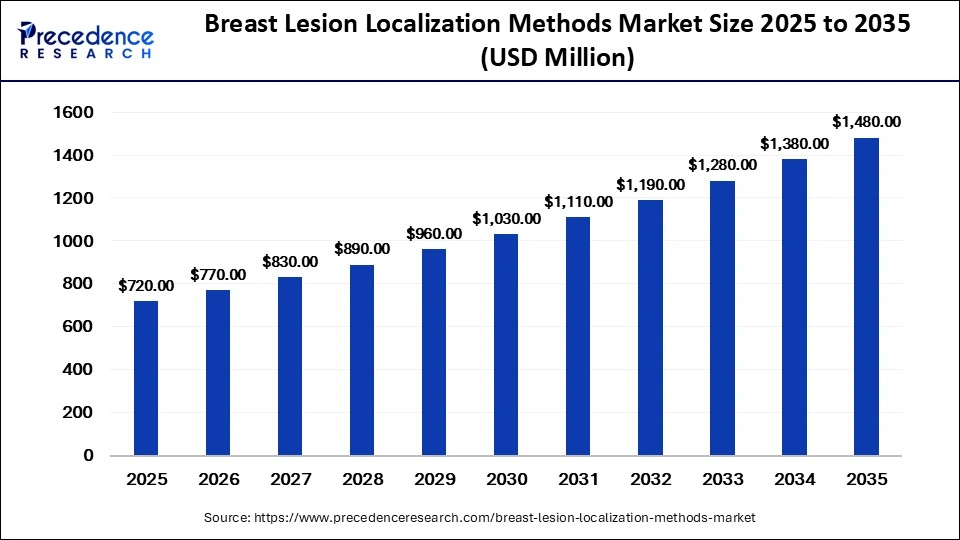
Rohan Patil, a Healthcare Industry Expert, highlights that the breast lesion localization methods market has reached USD 770.00 million in 2026 and is on track to reach USD 1,480.00 million by 2035, advancing at a CAGR of 7.47%. Key breast lesion localization methods market companies shaping the market include Hologic, BD (Becton Dickinson), Cook Medical, Merit Medical Systems, while major growth segments span By Technique, By Product, By Imaging Guidance, By End-Use, By Application.
Source: https://www.precedenceresearch.com/breast-lesion-localization-methods-market
 Get a Sample
 Table Of Content


What is the Breast Lesion Localization Methods Market Size in 2026?
The global breast lesion localization methods market size accounted for USD 720.00 million in 2025 and is predicted to increase from USD 770.00 million in 2026 to approximately USD 1,480.00 million by 2035, expanding at a CAGR of 7.47% from 2026 to 2035. The breast lesion localization methods market is driven by rising cases of breast cancer and demand for minimally invasive diagnostics.
Key Takeaways
- North America dominated the global breast lesion localization methods market with a share of 42% in 2025.
- Asia Pacific is expected to grow at the fastest CAGR of 9% during the forecast period.
- By technique, the wire localization segment held a dominant position in the market, accounting for 45% of the market share in 2025.
- By technique, the magnetic seed localization segment is the second-largest shareholder and is expected to grow at a 10.5% CAGR between 2026 and 2035.
- By product, the localization wires segment accounted for a revenue share of 40% in the market in 2025.
- By product, the localization seeds segment is the second-largest shareholder and is expected to grow at a 9.5% CAGR between 2026 and 2035.
- By imaging guidance, the ultrasound-guided segment led the global market with a share of 45% in 2025.
- By imaging guidance, the mammography-guided segment is the second-largest shareholder and is expected to grow at a 5.5% CAGR between 2026 and 2035.
- By end-use, the hospitals segment accounted for the largest revenue share of 60% in the market in 2025.
- By end-use, the diagnostic imaging centers segment is the second-largest shareholder and is expected to grow at a 7.5% CAGR between 2026 and 2035.
- By application, the breast cancer surgery segment led the global market with a share of 70% in 2025.
- By application, the biopsy procedures segment is the second-largest shareholder and is expected to grow at a 6.5% CAGR between 2026 and 2035.
Market Overview
Breast lesion localization methods play a vital role in the management of breast cancer because they have the capability to identify and locate unreachable abnormalities in the breast cavity. These methods are widely applied in biopsies, preoperative planning, and breast-conserving surgery. The market has been growing steadily, driven by several key factors. The rising global incidence of breast cancer has significantly increased the demand for accurate and early diagnostic solutions. In addition, expanding screening programs and growing awareness among patients and healthcare providers are contributing to earlier detection of smaller lesions, thereby increasing reliance on advanced localization technologies.
Impact of AI on the Breast Lesion Localization Methods Market
The breast lesion localization methods market is rapidly changing with the integration of AI, which contributes to the improved surgical process by enhancing accuracy, efficiency, and making better clinical decisions in terms of breast cancer management. AI algorithms are being incorporated in imaging systems such as mammography, ultrasound, and MRI to automatically detect, segment, and characterize suspicious lesions with high accuracy. AI systems are increasingly being used to analyze medical images in real time, optimizing the placement of localization markers such as radiofrequency tags and magnetic seeds. Integration with digital health platforms further streamlines workflows, improves data management, and enhances collaboration across multidisciplinary clinical teams.
Breast Lesion Localization Methods Market Trends
- There is increasing use of wireless localization technology, which is reducing patient discomfort and improving the effectiveness of surgical workflow. This technology is also replacing the conventional system of wire-guided tools with more advanced systems (radiofrequency and magnetic seed systems).
- There is growing interest in minimally invasive procedures, which is increasing the demand for highly precise image-guided localization techniques. These methods ensure accurate targeting of lesions, including those that are non-palpable or only partially palpable.
- The expansion of organized screening programs is leading to earlier detection of smaller, non-palpable breast lesions. This is driving the need for more effective localization methods that enable accurate biopsy and removal, becoming a central focus in modern oncology practice.
- The accuracy and reliability of breast lesion localization techniques have improved significantly with advancements in imaging technologies such as digital mammography and ultrasound, resulting in better clinical decision-making and improved patient outcomes.
Market Scope
| Report Coverage | Details |
| Market Size in 2025 | USD 720.00 Million |
| Market Size in 2026 | USD 770.00 Million |
| Market Size by 2035 | USD 1,480.00 Million |
| Market Growth Rate from 2026 to 2035 | CAGR of 7.47% |
| Dominating Region | North America |
| Fastest Growing Region | Asia Pacific |
| Base Year | 2025 |
| Forecast Period | 2026 to 2035 |
| Segments Covered | Technique, Product, Imaging Guidance, End-Use, Application, and Region |
| Regions Covered | North America, Europe, Asia-Pacific, Latin America, and Middle East & Africa |
Market Dynamics
Drivers
Increasing Awareness of Breast Cancer
An increased awareness of breast cancer is one of the key factors contributing to the growth of the breast lesion localization methods market. Government-based screening programs and public health campaigns have resulted in a high rate of early detection in both the developed and the developing regions. As an increasing number of people undergo regular mammography and imaging, the need for more accurate localization methods increases. The rapid shift toward early-stage diagnosis has increased the urgency to discover minimally invasive and highly precise modalities that are useful in the effective biopsy and breast-conserving surgery outcomes.
Restraint
Limited Access to Healthcare Services
The lack of accessibility to healthcare services, especially in low and middle-income regions, has been a major constraint in the breast lesion localization methods market. Breast cancer management often requires advanced equipment, which is costly. This cost burden creates a significant barrier to widespread adoption. The substantial financial investment needed limits access for small hospitals and clinics with constrained budgets, preventing them from implementing new technologies. Additionally, inadequate healthcare infrastructure and a shortage of trained professionals further restrict the availability and effective utilization of these advanced systems.
Opportunity
Innovative Approaches and Collaborations
The rise of innovative approaches is creating strong opportunities in the breast lesion localization methods market. Partnerships among medical device manufacturers, research institutions, and healthcare providers are accelerating the development and adoption of next-generation localization technologies. These collaborations are facilitating the integration of advanced solutions such as magnetic tracers, radar-based systems, and wireless localization tools into clinical practice, enabling faster innovation and improved patient outcomes.
Segment Insights
Technique Insights
The Wire Localization Segment Held a 45% Market Share in 2025
The wire localization segment dominated the breast lesion localization methods market with a major share of 45% in 2025. This is because it is a widely used technology in breast cancer management. This technology has been proven to be clinically reliable as well as readily available. Many healthcare professionals continue to lean toward the use of wire-guided localization because of its cost-effectiveness.
The magnetic seed localization segment held a 18% share of the market in 2025 and is expected to grow at a CAGR of 10.5% during the projection period. This is mainly due to the lower operational complexity and follow-up requirements associated with this technology. This technique is gaining popularity in breast cancer treatment due to its scheduling flexibility. Magnetic seeds can be implanted several days before the procedure, simplifying the clinical workflow.
Breast Lesion Localization Methods Market Share, By By Technique, 2025-2035 (%)
| Technique | 2025 | 2035 | CAGR (%) |
| Wire Localization | 45.00% | 35.00% | 4.50% |
| Magnetic Seed Localization | 18.00% | 22.00% | 10.50% |
| Radioisotope Localization (ROLL) | 15.00% | 14.00% | 6.00% |
| Radar Localization | 12.00% | 15.00% | 9.50% |
| RFID Localization | 10.00% | 14.00% | 11.00% |
The radioisotope localization segment held a 15% share of the market in 2025 and is expected to grow at a CAGR of 6% during the projection period. The segment growth is supported by its long-standing clinical use and proven accuracy. It remains a key method in complex breast cancer surgeries, backed by strong clinical evidence and widespread adoption in established healthcare systems.
The radar localization segment held a 12% market share in 2025 and is expected to grow at a CAGR of 9.5% during the projection period. This is mainly due to ongoing technological advancements and increasing preference for wireless and radiation-free solutions. Radar-based systems offer real-time tracking and high precision, improving surgical accuracy and outcomes.
The RFID localization segment held a 10% share of the market in 2025 and is expected to grow at the fastest CAGR of 11% in the coming years. This is mainly due to its high precision, wireless operation, and ability to provide real-time tracking without the need for wires or radiation exposure. It improves surgical workflow efficiency by allowing flexible scheduling and accurate lesion localization even before surgery.
Product Insights
Breast Lesion Localization Methods Market Share, By Product, 2025-2035 (%)
| Product | 2025 | 2035 | CAGR (%) |
| Localization Wires | 40.00% | 32.00% | 4.50% |
| Localization Seeds | 25.00% | 30.00% | 9.50% |
| Tags & Markers | 20.00% | 23.00% | 8.50% |
| Accessories | 15.00% | 15.00% | 6.50% |
The Localization Wires Segment Lead the Market With a 40% Share in 2025
The localization wires segment held a dominant position in the breast lesion localization methods market with a share of 40% in 2025, driven by their conventional approach. Localization wires are still popular in breast cancer procedures due to their many years of clinical acceptance and inexpensive nature. Breast-conserving surgery, in most cases, is determined by localization wires, which specify the localization of lesions.
The localization seeds segment held a 25% share of the market in 2025 and is expected to grow at the fastest CAGR of 9.5% during the forecast period, propelled by growing disposition of non-wire options. These kinds of seeds are commonplace in breast cancer surgical procedures as they are relatively non-invasive and capable of giving a patient more comfort. Unlike wires, seeds may be sown long before surgery, so scheduling is flexible, and patients no longer experience anxiety.
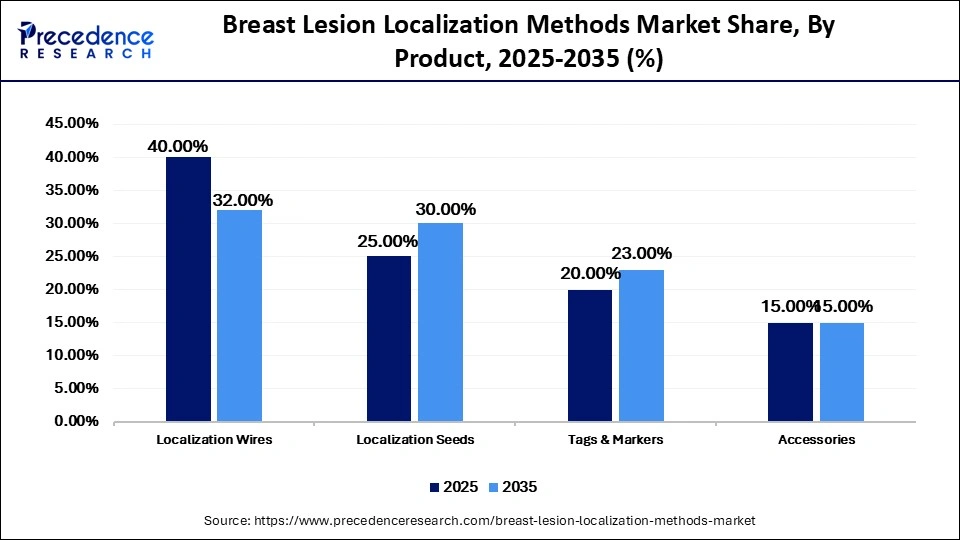
The tags & markers segment held a 20% share of the market in 2025 and is expected to grow at a CAGR of 8.5% in the upcoming period, driven by their higher accuracy. These products are essential in the treatment of breast cancer because they enable accurate determination and monitoring of the lesions during the imaging and surgery processes. Real-time localization can be achieved by using a high-level marker system, such as radar and radiofrequency tagging. These products also improve surgical outcomes.
The accessories segment held a 15% market share in 2025 and is expected to grow at a CAGR of 6.5% in the coming years, due to the necessity to have products that give support. Accessories include introducers, needles, and guidance tools, which are used in the localization processes of breast cancer. These are valuable products that are utilized to ensure efficiency and safety in the procedures.
Imaging Guidance Insights
Breast Lesion Localization Methods Market Share, By Imaging Guidance, 2025-2035 (%)
| Imaging Guidance | 2025 | 2035 | CAGR (%) |
| Ultrasound-guided | 45.00% | 48.00% | 8.00% |
| Mammography-guided | 35.00% | 32.00% | 5.50% |
| MRI-guided | 20.00% | 20.00% | 7.50% |
Why Did the Ultrasound-Guided Segment Dominate the Breast Lesion Localization Methods Market?
The ultrasound-guided segment dominated the global market with a share of 45% in 2025, driven by its large availability and low cost. Ultrasound-guided imaging is heavily utilized in the diagnosis and treatment of breast cancer due to its convenience and easy accessibility. The ultrasound guidance system allows an effective localization of the lesions with no radiation exposure to patients and clinicians.
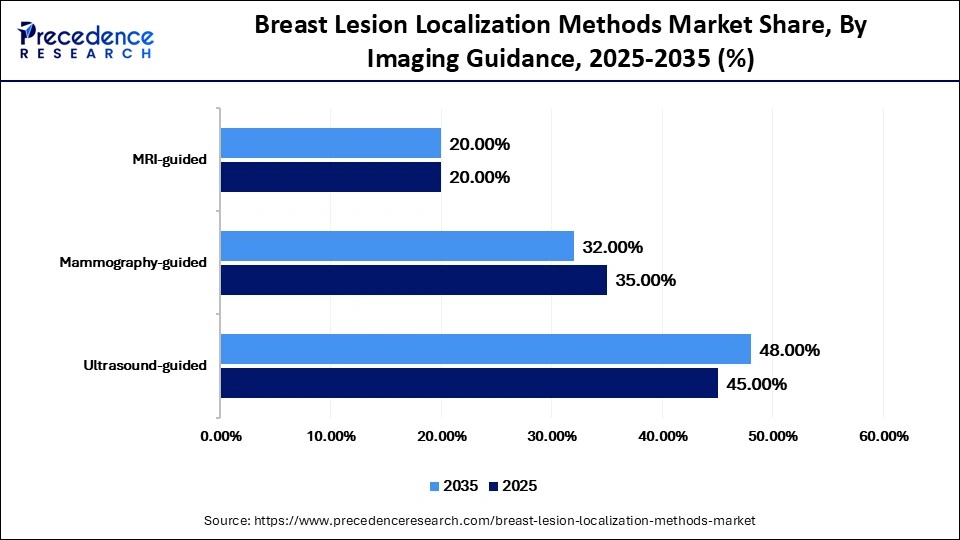
The mammography-guided segment held a 35% share of the market in 2025 and is expected to grow at a CAGR of 5.5% during the projection period. This is mainly due to the fact that it is a popular screening procedure. It plays a significant role in identifying and positioning palpable lesions in conjunction with breast cancer. This imaging approach has been widely used in the detection and treatment of diseases in a timely manner.
The MRI-guided segment accounted for a 20% market share in 2025 and is projected to grow at a CAGR of 7.5% during the forecast period, driven by its high-precision imaging capabilities. This technique is widely used in complex breast cancer cases where lesions are not detectable through mammography or ultrasound. Its superior soft tissue contrast and detailed visualization enable highly accurate localization of difficult-to-identify abnormalities.
End-Use Insights
Hospitals Held a 60% Share of the Breast Lesion Localization Methods Market in 2025
The hospitals segment registered dominance in the global market by holding a 60% share in 2025, driven by advanced infrastructure and the availability of specialized oncological services. Hospitals remain the primary centers for breast cancer care, offering integrated diagnostic, surgical, and post-operative services within a single facility. Their access to advanced imaging systems, skilled surgical teams, and coordinated clinical workflows supports highly accurate lesion localization procedures.
Breast Lesion Localization Methods Market Share, By End-Use, 2025-2035 (%)
| End-Use | 2025 | 2035 | CAGR (%) |
| Hospitals | 60.00% | 58.00% | 6.50% |
| Diagnostic Imaging Centers | 25.00% | 27.00% | 7.50% |
| Ambulatory Surgical Centers | 15.00% | 15.00% | 7.00% |
The diagnostic imaging centers segment held a 25% market share in 2025 and is expected to grow at the fastest CAGR of 7.5% during the projection period. This is mainly due to their crucial role in early cancer detection through advanced imaging services. These centers specialize in identifying and characterizing breast lesions using modalities such as mammography, ultrasound, and MRI. Short waiting times, specialized expertise, and cost-effective diagnostic services are further driving their adoption.
The ambulatory surgical centers segment held a 15% share of the market in 2025 and is expected to grow at a CAGR of 7% in the upcoming period. The segment's growth is driven by the increasing shift toward outpatient and minimally invasive procedures in breast cancer care. These centers are increasingly handling lesion localization and biopsy procedures, offering advantages such as lower treatment costs, reduced hospital stays, and faster patient recovery.
Application Insights
The Breast Cancer Surgery Segment Held a 70% Share of the Market in 2025
The breast cancer surgery segment dominated the breast lesion localization methods market with the highest share of 70% in 2025, driven by the high global prevalence of breast cancer and the critical need for precise tumor removal. Lesion localization techniques are widely used in breast-conserving surgeries to accurately target non-palpable tumors, improving surgical precision, minimizing recurrence risk, and achieving better cosmetic outcomes.
Breast Lesion Localization Methods Market Share, By Application, 2025-2035 (%)
| Application | 2025 | 2035 | CAGR (%) |
| Breast Cancer Surgery | 70.00% | 72.00% | 7.00% |
| Biopsy Procedures | 30.00% | 28.00% | 6.50% |
The biopsy procedures segment held a 30% share of the market in 2025 and is expected to grow at a CAGR of 6.5% in the upcoming period. This is mainly due to the rising demand for diagnostic procedures, as breast cancer screening and awareness increase globally. Biopsy remains a key method for confirming breast cancer, where accurate lesion localization is essential for obtaining representative tissue samples and ensuring diagnostic accuracy.
Regional Insights
North America Breast Lesion Localization Methods Market Size and Growth 2026 to 2035
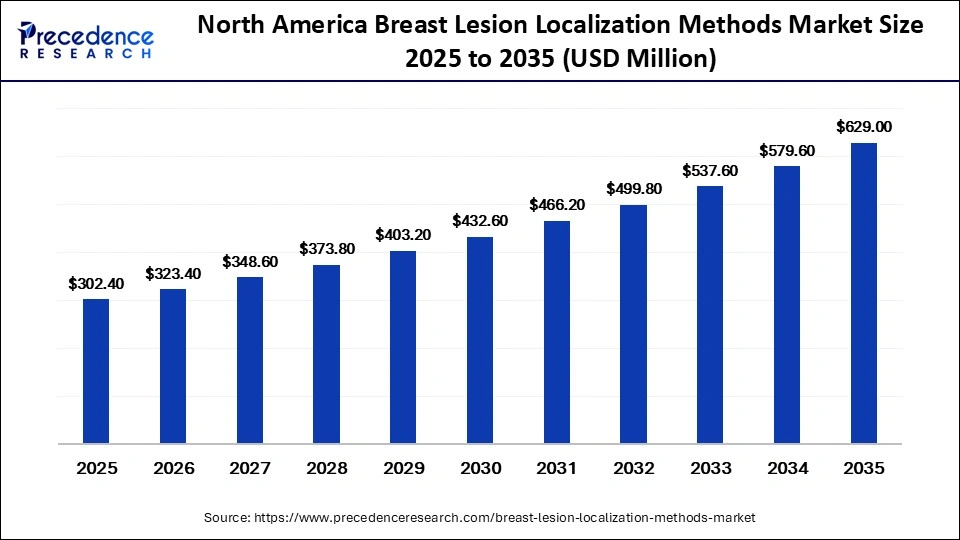
The North America breast lesion localization methods market size is estimated at USD 302.40 million in 2025 and is projected to reach approximately USD 629.00 million by 2035, with a 7.60% CAGR from 2026 to 2035.
Why Did North America Lead the Breast Lesion Localization Methods Market?
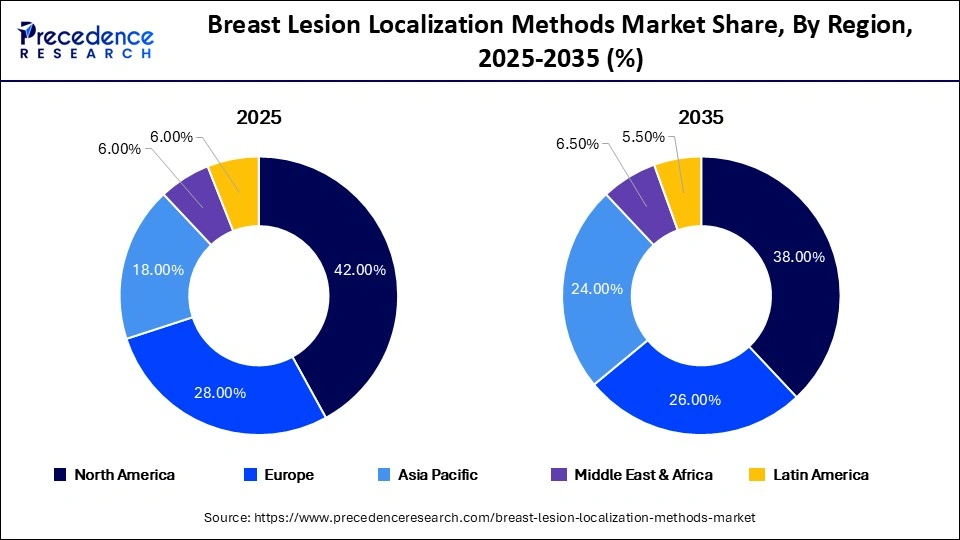
North America led the global breast lesion localization methods market with a share of 42% in 2025, driven by its advanced healthcare systems. The region is home to leading medical imaging device and medical equipment manufacturers. There is a heightened awareness of breast cancer and well-established screening programs, supporting early detection and increasing demand for precise lesion localization techniques. Favorable reimbursement policies and strong investments in healthcare innovation further strengthen market growth.
U.S. Breast Lesion Localization Methods Market Size and Growth 2026 to 2035
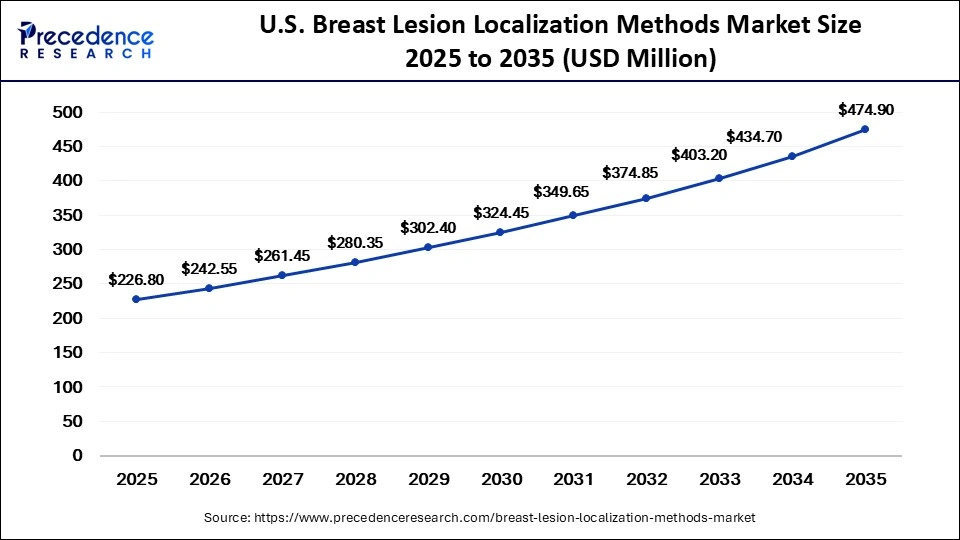
The U.S. breast lesion localization methods market size is calculated at USD 226.80 million in 2025 and is expected to reach nearly USD 474.90 million in 2035, accelerating at a strong CAGR of 7.67% between 2026 and 2035.
U.S. Market Analysis
The U.S. is a major contributor to the North American market due to its advanced healthcare system and strong emphasis on early breast cancer detection. Breast cancer is further highly common in the country, and this has led to the rampant introduction of regular mammographic screening programs, with the idea of identifying breast cancer in its early stages. This approach plays a major role in the better detection of non-palpable lesions and, consequently, boosts the need for advanced localization techniques.
Europe: The Second-Largest Market
Europe held the second-largest market share of 28% in 2025 and is expected to grow at a notable CAGR of 6.2% during the projection period. This growth is driven by structured screening programs and strong emphasis on early diagnosis. The region benefits from well-established public healthcare systems and national breast cancer screening initiatives. Strong government support, increasing awareness, and a robust medical technology ecosystem continue to drive innovation and adoption of advanced localization methods.
UK Market Analysis
The UK plays a major role in the European market, supported by its structured national breast cancer screening program under the NHS. Widespread access to mammography and strong awareness initiatives have increased early detection rates, driving demand for advanced lesion localization procedures.
Asia Pacific: The Fastest-Growing Region
Asia Pacific held a 18% share of the breast lesion localization methods market in 2025 and is expected to grow at the fastest CAGR of 9% during the projection period. This growth is driven by rising breast cancer incidence, improving healthcare infrastructure, and increasing awareness of early diagnosis. Expanding healthcare investments and growing private sector participation are improving access to advanced imaging and localization technologies across the region.
Japan Market Analysis
Japan's market is expanding steadily due to its highly advanced healthcare system and strong focus on early cancer detection. The country's well-developed imaging and diagnostic infrastructure enables accurate early-stage identification of breast lesions. High screening participation and strong public awareness further support the demand for precise localization technologies.
Breast Lesion Localization Methods Market Companies
- Hologic
- BD (Becton Dickinson)
- Cook Medical
- Merit Medical Systems
- Argon Medical Devices
- SOMATEX Medical Technologies
- Endomagnetics
- Cianna Medical
- IZI Medical Products
- Theragenics Corporation
- Stryker
- GE HealthCare
- Siemens Healthineers
- Bard Medical
- Mammotome
Recent Developments
- In March 2026, QT Imaging entered into a UAE-only distribution agreement with its FDA-cleared Breast Acoustic CT scanner and cloud platform. This will be an alternative to the Gulf market, which is a 3D radiation-free imaging system that will give high-tech access to breast imaging in increased numbers.(Source: https://www.businesswire.com)
- In December 2024, AI-controlled breast imaging technologies were introduced by Hologic at RSNA in Chicago to enhance cancer detection and patient comfort. The Envision Mammography Platform and Genius AI Detection PRO solution are some of the key innovations.(Source: https://www.appliedradiationoncology.com)
- In July 2024, Stryker acquired, through an acquisition, MOLLI Surgical Inc., a California-based company that focuses on patient care in the field of breast cancer. This enhances its capacity in wireless localization technology with the aim of enhancing the accuracy in surgery and augmentation in the working workflow.(Source: https://www.stryker.com)
Segments Covered in the Report
By Technique
- Wire Localization
- Radioisotope Localization (ROLL)
- Magnetic Seed Localization
- Radar Localization
- Radiofrequency Identification (RFID) Localization
By Product
- Localization Wires
- Localization Seeds
- Localization Tags & Markers
- Accessories
By Imaging Guidance
- Mammography-guided
- Ultrasound-guided
- MRI-guided
By End-Use
- Hospitals
- Ambulatory Surgical Centers
- Diagnostic Imaging Centers
By Application
- Breast Cancer Surgery
- Biopsy Procedures
By Region
- North America
- Latin America
- Europe
- Asia-pacific
- Middle and East Africa
For inquiries regarding discounts, bulk purchases, or customization requests, please contact us at sales@precedenceresearch.com
Frequently Asked Questions





Ask For Sample
No cookie-cutter, only authentic analysis – take the 1st step to become a Precedence Research client
 Get a Sample




 sales@precedenceresearch.com
 Schedule a Meeting
