



CAD Mammography Market Revenue to Attain USD 2.70 Bn by 2035
Published: 27 Apr 2026
Author: Precedence Research



CAD Mammography Market Revenue and Trends 2026 to 2035
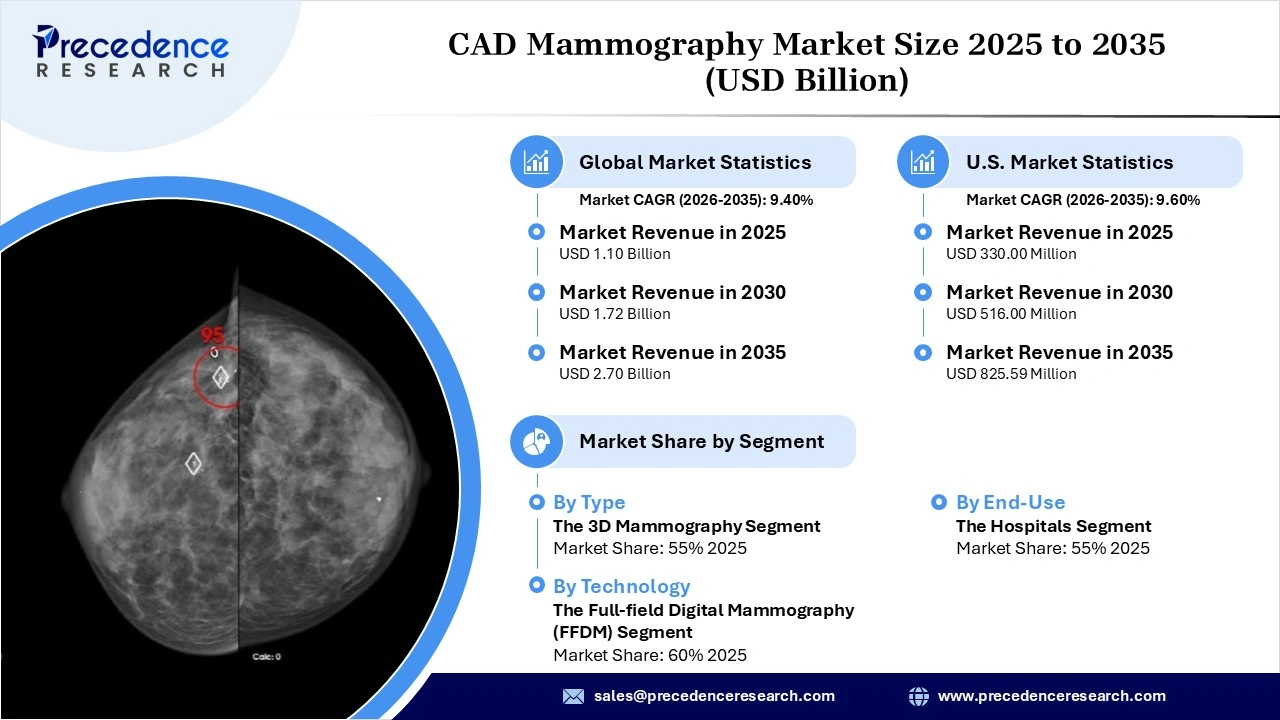
The global CAD mammography market revenue surpassed USD 1.10 billion in 2025 and is predicted to attain around USD 2.70 billion by 2035, growing at a CAGR of 9.40%. The market is driven by rising rates of breast cancer screening, increasing demand for early and precise detection, and rapid adoption of AI in radiology.
Market Overview
The CAD mammography market comprises hardware and software solutions that make use of computer-aided detection techniques to help radiologists evaluate mammograms for the presence of any abnormalities that could indicate breast cancer. This helps to enhance diagnosis consistency and facilitate clinical decision-making. These solutions can be implemented using standalone CAD software, imaging system integration, and advanced AI algorithms.
CAD mammography has been adopted in hospitals, imaging centers, and dedicated breast care clinics, where it assists in breast cancer screening procedures as well as more complex diagnostic procedures that demand high imaging accuracy. These solutions have been increasingly used in radiology, where it contributes to a rise in the speed of image interpretation without sacrificing accuracy.
What Factors Influence the Growth of the CAD Mammography Market?
AI Adoption in Mammography Imaging Systems
The market is driven by the integration of deep learning algorithms that can detect breast anomalies better than the conventional approach. Cloud computing systems have been implemented to facilitate rapid analysis of imaging data, collaboration with other radiologists at different locations, and integration with hospitals’ imaging infrastructure.
- In 2026, GE Healthcare extended its partnership with RadNet’s DeepHealth subsidiary to continue advancing AI solutions in mammography, such as ProFound Pro and Safeguard Review systems.
Cloud Picture Archiving and Communication System (PACS) Usage in Radiology Workflows
The use of cloud-based PACS is growing as organizations move from conventional on-premises imaging storage solutions towards cloud-based solutions for managing radiology data. This allows hospitals and diagnostic centers to access and store vast amounts of data in a remote location, making collaboration among radiologists easier. The integration of enterprise imaging solutions is also facilitating standardization in image management in hospital networks.
- At RSNA 2025, Fujifilm demonstrated its cloud-enabled enterprise imaging and PACS workflow improvements, emphasizing the benefits of increased automation and enhanced interoperability between hospital IT infrastructure.
Government Initiatives
There are government efforts in the EU via comprehensive policies intended to enhance the efficiency and consistency of mammography screening programs in the member countries. These policies concentrate on creating evidence-based clinical guidelines, implementing quality assurance measures, and harmonizing screening procedures in order to achieve consistency in breast cancer screening procedures.
- In 2025, the European Commission continued to pursue the development of EU-wide guidelines and quality assurance programs through the European quality assurance scheme for breast cancer screening and standardization among the member countries. The EU implemented these guidelines and programs via the Joint Research Center (JRC) and the European Commission Initiative on Breast Cancer (ECIBC).
Breast Cancer Screening Program Uptake in Australia
According to the AIHW 2025 report, the number of women participating in BreastScreen Australia was observed to be up to 1.8 million (50 percent of the target population aged 50-74 years in 2021-2022), compared to more than 1.9 million women (52 percent of the target population aged 50-74 in 2023-2024). There were 11,540 new breast cancer cases among females aged 50-74 years in 2021, where 49% of them were diagnosed by screening. Since 1991, more than 26.7 million mammograms have been conducted, which have detected more than 137,000 invasive breast cancers.
AI Powered Mammography Boom Redefining Breast Imaging and Supercharging the CAD Mammography Market
- The U.S. conducted more than 40 million mammography screening examinations per year from 2024-2025 to support the steady clinical utilization of decision-support technologies, according to data from the American College of Radiology and the Breast Cancer Surveillance Consortium.
- According to the European Union of Private Hospitals' report, in 2024, organized screening programs in Greece completed 410,000 mammograms, with CAD and AI-assisted reading becoming popular in a dual-read workflow.
- In 2024-2025, a total of over 8,931 certified mammography facilities will be active in the U.S., according to the American College of Radiology, which indicated an increase in the use of algorithm-assisted interpretation in screening procedures.
- FDA approval in November 2024, iCAD Inc. got approval of its ProFound Detection Version 4.0, a next-generation AI-based CAD program in digital breast tomosynthesis, showing the ability to improve outcomes, with a 22% increase in aggressive cancer subtype detectability, by 2025-2026.
Market Segmentation Overview
- By Type: The 3D mammography segment led the CAD mammography market with a 55% share in 2025, owing to its capability to create layered images of breasts that do not have any issues related to tissue overlapping. This segment ensures better detection of lesions when compared to 2D imaging and is preferred because of its high rate of diagnostic accuracy and lower recall rates.
- By Type: The 2D mammography segment held the second-largest market share of 45% in 2025, because of its affordability and status as the gold-standard screening test. It continues to be widely used since it is cheaper and more easily implemented than newer imaging methods.
- By Technology: The full-field digital mammography (FFDM) segment dominated the market with a 60% share in 2025, due to its ability to provide excellent image quality, significant imaging speed, and high contrast resolution. This segment has been widely adopted in healthcare institutions because it makes image archiving and transfer much easier in contemporary digital radiology equipment.
- By Technology: The contrast-enhanced mammography (CEM) is expected to expand at the highest CAGR during the forecast period, owing to its capability to provide anatomical images along with contrast uptake, which helps in detecting lesions that are often overlooked during regular mammography.
- By End-Use: The hospitals segment led the CAD mammography market with a 55% share in 2025, because of their significant influx of patients, access to state-of-the-art imaging technologies, and possession of specialized radiology units that can manage mass screenings for breast cancer detection and diagnosis.
- By End-Use: The diagnostic imaging centers segment is expected to grow at the fastest rate from 2026 to 2035, due to the preference for diagnosis procedures in an outpatient setting where patients enjoy quick appointments, lower prices, and fast-paced reporting. Its focused structure and imaging techniques make it more efficient in handling large screening programs.
Regional Insights
North America dominated the CAD mammography market with a 40% share in 2025 because of its advanced healthcare industry, significant initiatives to conduct breast cancer screening programs, and a significant presence of key players in the field of medical imaging technology. This region has ample access to advanced mammography technology and well-established reimbursement models that help achieve routine screening of patients. The U.S. led the market in North America due to significant funds allotted for healthcare purposes and the usage of advanced breast imaging systems. Canada is a significant contributor to the market owing to its systematic screening program and growing availability of medical imaging equipment.
Asia Pacific is expected to expand at the highest CAGR during the forecast period because of growing awareness regarding breast cancer screening, advancement of healthcare infrastructure, and rapid adoption of the latest diagnostic imaging systems. Government initiatives and increasing conduct of screening programs have also contributed to the market growth in this region. China led the market growth in Asia Pacific due to significant modernization of healthcare infrastructure, widespread coverage of screening procedures, and rapid growth in diagnostic imaging facilities. India witnessed notable market growth owing to rising awareness levels and significant access to breast cancer screening procedures.
CAD Mammography Market Coverage
| Report Attribute | Key Statistics |
| Market Revenue in 2025 | USD 1.10 Billion |
| Market Revenue by 2035 | USD 2.70 Billion |
| CAGR from 2026 to 2035 | 9.40% |
| Quantitative Units | Revenue in USD million/billion, Volume in units |
| Largest Market | North America |
| Base Year | 2025 |
| Regions Covered | North America, Europe, Asia-Pacific, Latin America, and the Middle East & Africa |
Top Companies in the CAD Mammography Market
General Electric (GE) Healthcare, Siemens Healthineers, Philips Healthcare, Fujifilm Holdings Corporation, Canon Medical Systems Corporation, and Carestream Health Inc. are key players offering proprietary CAD algorithms integrated into their imaging systems. Hologic Inc. has incorporated its Genius AI software into advanced 2D and 3D mammography solutions to enhance diagnostic accuracy.
Major PACS integrators such as Merge Healthcare (under IBM Watson Health) and Agfa-Gevaert Group provide CAD-enabled capabilities within radiology imaging workflows. Additionally, Konica Minolta Inc. and NDS Surgical Imaging focus on high-resolution mammography display systems that support CAD applications for improved image interpretation and clinical decision-making.
Segments Covered in the Report
By Type
- 2D Mammography
- 3D Mammography (Tomosynthesis)
By Technology
- Full-Field Digital Mammography (FFDM)
- Analog Mammography
- Digital Breast Tomosynthesis (DBT)
- Contrast-Enhanced Mammography (CEM)
By End-Use
- Hospitals
- Diagnostic Imaging Centers
- Breast Cancer Screening Clinics
- Others
By Region
- North America
- Latin America
- Europe
- Asia-pacific
- Middle and East Africa
Get this report to explore global market size, share, CAGR, and trends, featuring detailed segmental analysis and an insightful competitive landscape overview @ https://www.precedenceresearch.com/sample/8341
You can place an order or ask any questions, please feel free to contact us at sales@precedenceresearch.com |+1 804 441 9344