



Cellulose Acetate Market Revenue to Attain USD 10.15 Bn by 2035
Published: 19 Dec 2025
Author: Precedence Research



Cellulose Acetate Market Revenue and Trends 2026 to 2035
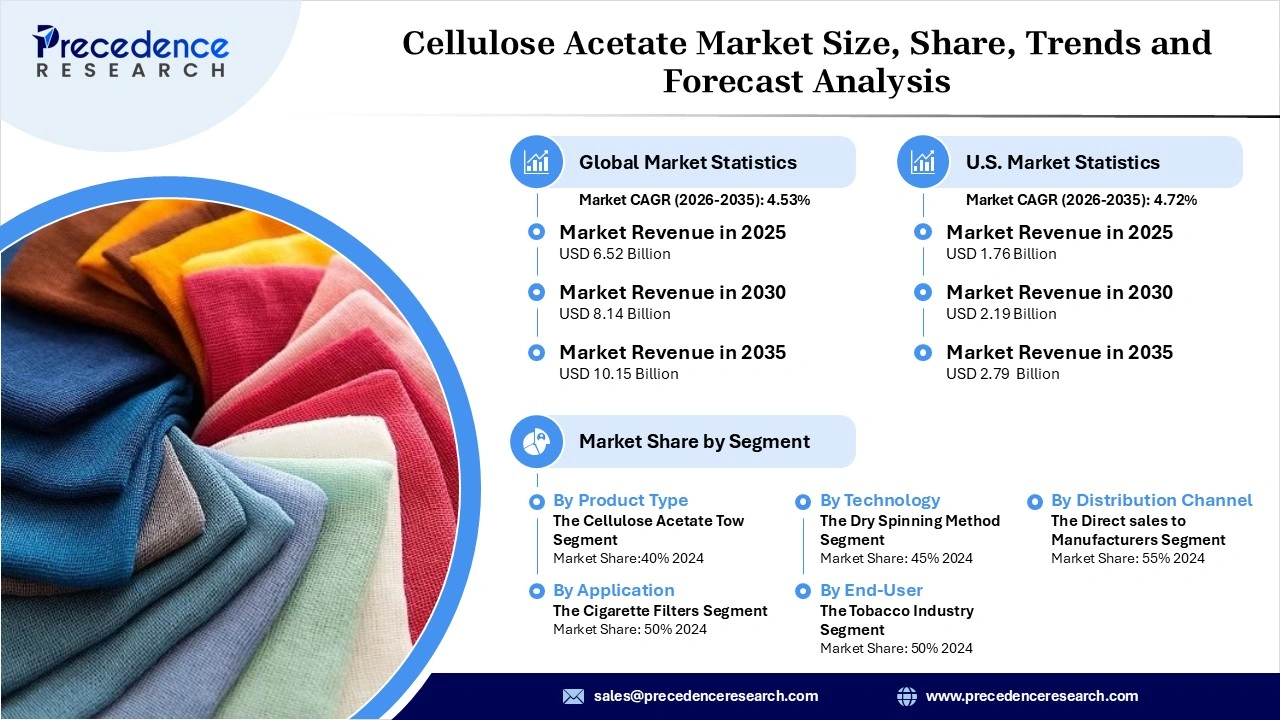
The global cellulose acetate market revenue was valued at USD 6.52 billion in 2025 and is expected to attain around USD 10.15 billion by 2035, growing at a CAGR of 4.53% during forecast period. Market growth is primarily driven by rising demand for bio-based and semi-synthetic polymers, increasing substitution of petroleum-derived plastics, and expanding use of cellulose acetate across textiles, films, eyewear, and electronics-related applications.
What are the Key Driving Factors of the Cellulose Acetate Market?
One of the primary drivers of the cellulose acetate market is its strong positioning as a plant-derived, biodegradable material with favorable mechanical strength, optical clarity, and chemical resistance. As regulatory pressure intensifies around plastic waste and fossil-based polymers, manufacturers across apparel, packaging, and consumer goods are increasingly shifting toward cellulose-based alternatives that balance performance with environmental compliance.
The market is further supported by steady demand from the textile and apparel industry, where cellulose acetate fibers are valued for softness, drape, and dye affinity. In parallel, advances in polymer modification and film-casting technologies are expanding the use of cellulose acetate in higher-value applications such as optical components, specialty films, and electronic insulation. Growing investments in sustainable material innovation and improved acetylation efficiency continue to enhance product consistency and scalability.
Segmental Insights
- By product type, fibers and filaments dominate the market, supported by their long-standing use in textile yarns, apparel linings, and blended fabrics. Their dominance is reinforced by established spinning infrastructure, predictable processing behavior, and consistent demand from fashion and home textile manufacturers. Films and sheets represent the fastest-growing product category, driven by increasing use in packaging films, protective coatings, and optical-grade applications. Transparent and specialty cellulose acetate films are gaining traction due to their clarity, dimensional stability, and compatibility with bio-based packaging initiatives.
- By application, textile and apparel applications account for the dominant share of the market. Cellulose acetate continues to be widely used in fashion garments, linings, scarves, and decorative textiles due to its aesthetic properties and comfort characteristics. Eyewear and optical lenses are the fastest-growing application segment, supported by rising global demand for premium eyewear frames and lenses. Cellulose acetate’s moldability, color versatility, and skin-friendly properties make it a preferred material in mid-range and premium eyewear manufacturing.
- By end-use industry, the apparel and fashion industry remains the leading consumer, supported by consistent production volumes and integration of cellulose acetate in both mass-market and premium apparel categories. The electronics and electrical segment is expanding at the fastest pace, driven by the use of cellulose acetate films and components in insulation, display-related films, and precision-molded parts that require dimensional stability and controlled dielectric properties.
- By technology and manufacturing process, acetylation of cellulose remains the dominant process, as it forms the foundational step for producing cellulose acetate with controlled substitution levels and consistent polymer quality. Solution spinning and film casting technologies are growing the fastest, driven by increasing demand for specialty fibers and high-clarity films for advanced applications, including optics and electronics.
- By grade, standard-grade cellulose acetate dominates the market, driven by its broad applicability across textiles and commodity applications. Modified and specialty grades are the fastest-growing, as downstream industries increasingly require tailored performance characteristics such as enhanced heat resistance, improved transparency, or specific mechanical properties.
- By distribution channel, direct sales from manufacturers to end users dominate, particularly for large-volume textile producers and industrial buyers requiring consistent supply and technical customization. Online and e-commerce channels are emerging as the fastest-growing route, especially for smaller manufacturers, specialty compounders, and eyewear component buyers seeking flexible procurement models.
Regional Insights
Europe holds a significant share of the global cellulose acetate market, supported by strong regulatory frameworks promoting sustainable materials and long-standing expertise in cellulose chemistry. The region benefits from a well-established textile and fashion industry, particularly in Italy, France, and Germany, where cellulose acetate fibers and films are widely used in apparel, eyewear, and specialty consumer products. European manufacturers are also at the forefront of developing modified and specialty-grade cellulose acetate aligned with circular economy objectives.
Asia Pacific is projected to grow at the fastest rate over the forecast period. Rapid expansion of textile manufacturing, increasing eyewear production, and rising electronics manufacturing activity are key growth drivers. China plays a central role due to its integrated supply chains for cellulose derivatives, large-scale fiber production capacity, and growing domestic demand for sustainable materials. Expanding investments in specialty films and electronics-related applications further strengthen the region’s growth outlook.
Cellulose Acetate Market Coverage
| Report Attribute | Key Statistics |
| Market Revenue in 2025 | USD 6.52 Billion |
| Market Revenue by 2035 | USD 10.15 Billion |
| CAGR from 2026 to 2035 | 4.53% |
| Quantitative Units | Revenue in USD million/billion, Volume in units |
| Largest Market | Europe |
| Base Year | 2025 |
| Regions Covered | North America, Europe, Asia-Pacific, Latin America, and the Middle East & Africa |
Recent Development
- In August 2025, Eastman Chemical Company and Huafon Chemical announced a strategic partnership to establish a local manufacturing facility in China dedicated to producing Naia cellulose acetate yarn. This facility aims to expand localized production and support product innovation for cellulose acetate filament yarns for textiles. (Source: https://www.eastman.com)
Get this report to explore global market size, share, CAGR, and trends, featuring detailed segmental analysis and an insightful competitive landscape overview @ https://www.precedenceresearch.com/sample/7210
You can place an order or ask any questions, please feel free to contact us at sales@precedenceresearch.com |+1 804 441 9344