



Cholestatic Pruritus Market Revenue to Attain USD 2.55 Bn by 2035
Published: 21 Apr 2026
Author: Precedence Research



Cholestatic Pruritus Market Revenue and Trends 2026 to 2035
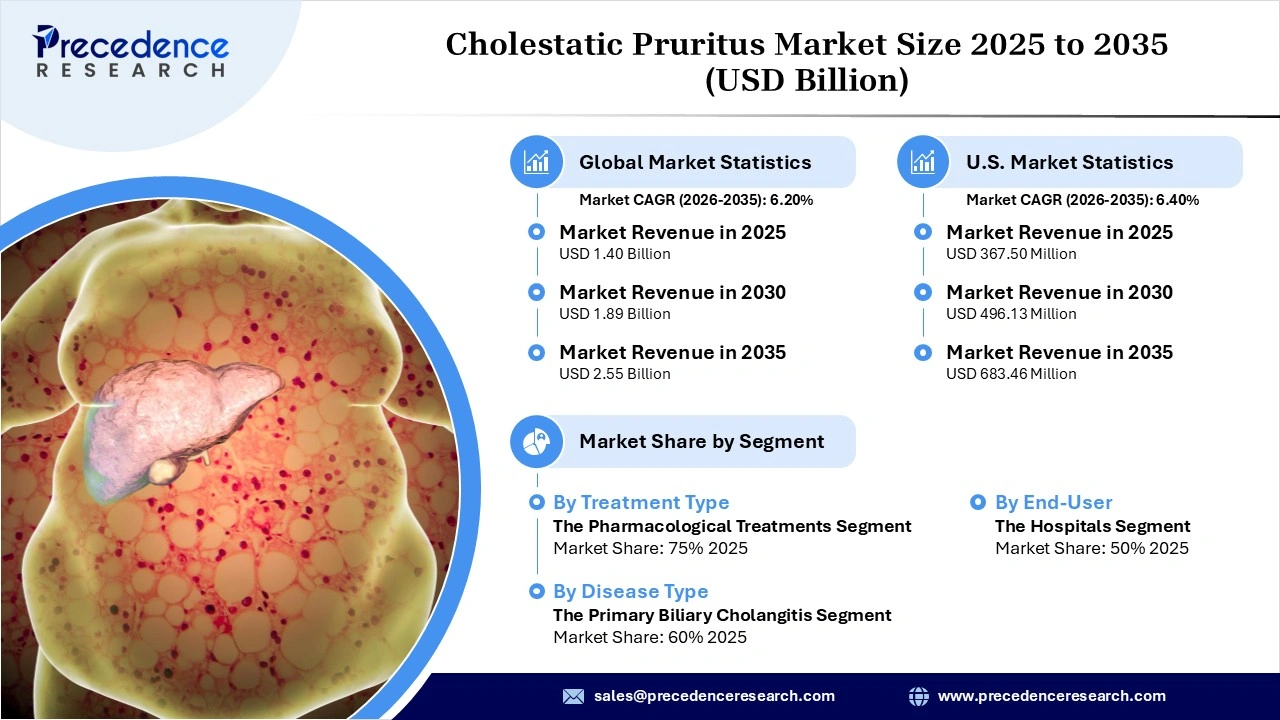
The global cholestatic pruritus market revenue was valued at USD 1.40 billion in 2025 and is expected to attain around USD 2.55 billion by 2035, growing at a CAGR of 6.20% during forecast period. The cholestatic pruritus market is inching into focus as rising liver disease cases and a long-overdue shift toward treating relentless itching as a clinical priority, not a side note, begin to drive steady, quietly compounding growth.
Market at a Glance
The cholestatic pruritus market focuses on treatments and procedures for reducing the chronic and severe itching caused by reduced bile flow resulting from liver diseases. It includes conventional treatment with bile acid sequestrants and new medications that modulate itch signaling or bile acid transport. The behaviour of this market is more related to the absence of efficacious methods than it is to its size, which exists in an interface between hepatology and symptom management, such that improving patient comfort seems to be an established therapeutic aim.
In addition, the market for cholestatic pruritus is much bigger than just being symptomatic relief and is considered specialized, with more than just an oral or injectable option. The niche also includes a growing number of newer bile acid modulators and complementary treatments such as phototherapy or new oral and injectable therapies.
Market Forecast
- Clinical momentum is turning commercial: There is a noticeable thickening of the drug pipeline, with late-stage candidates steadily approaching commercialization. For instance, multiple therapies such as linerixibat and volixibat are progressing through advanced clinical trials, reflecting a shift from symptomatic relief to mechanism-driven treatment. The U.S. alone recorded ~76,000 PBC cases contributing to demand, reinforcing the patient base for upcoming drugs.
- Investment signals are getting louder: Commercial confidence is becoming visible through deal-making. A notable example: GSK’s licensing agreement with Alfasigma is worth up to $690 million, tied to the same pruritus therapy. These structured milestone payments and royalties suggest expectations of strong future revenues rather than speculative interest.
Statistics Shaping the Cholestatic Pruritus Market
- Cholestatic pruritus is a major symptom of primary biliary cholangitis (PBC), affecting ~50% of patients at any given time after diagnosis, and up to 75% during the disease course, indicating a substantial patient pool requiring treatment.
- The global prevalence of PBC ranges between 1.9 and 40.2 cases per 100,000 individuals, forming the primary base population for cholestatic pruritus therapies.
- Despite high symptom prevalence, only 18% of pruritus patients received bile acid sequestrants or other therapies (e.g., rifampicin, naltrexone), which had even lower usage. This highlights significant unmet therapeutic demand and market expansion potential.
- Around 90% of PBC patients are women. Peak diagnosis age: 55–65 years, which defines a target demographic concentration for market strategies.
Market Segmentation Overview
- By Treatment Type, the pharmacological treatment segment accounted for a considerable revenue share of 75.0% in the market in 2025, due to rising dependence on drugs that do more than just dull the itch. The growing uptake of targeted therapies such as Ocaliva and other PBC-specific options has shifted treatment patterns toward precision, making drug-based intervention the central axis of care rather than a supporting act.
- By Treatment Type, the non-pharmacological treatment segment held the second-largest dominance with a market share of 25.0% in 2025, as it is holding relevance through interventions like liver transplantation and phototherapy. However, high expenses and access barriers limited usage, and wide adoption did not enable them to be used by the vast majority of the population.
- By Disease Type, the primary biliary cholangitis segment held a major revenue share of 60.0% in the market in 2025, largely due to an increasing incidence in older segments of the population. The condition's deep association with chronic itching has established it as one of the most clinically and commercially significant categories of disease, putting its treatment needs ahead of the trend.
- By Disease Type, the cholestasis due to hepatic failure segment is the second-largest shareholder with 20.0% market share in 2025, supported by a rise in hepatic disease morbidity. The need for treatment has increased steadily, especially among high-risk groups experiencing advanced levels of illness for whom the expansion is not due to visibility at all times or even proactivity but due to clinical need.
- By End-Use, the hospital segment accounted for a considerable revenue share of 50.0% in the market in 2025, functioning as indispensable for diagnosis and ICU-care center locations. Many patients with advanced conditions often need treatment, requiring the combined attention of multiple specialists and intensive care units to operate on a larger scale, thus favoring hospitals. This is a reflection of how important they are in affecting both the amount of time treated and the clinical outcomes that a hospital provides.
- By End-Use, the clinics segment is the second-largest shareholder with 30.0% market share in 2025, gradually expanding its role as outpatient care centers. Their extension was associated with increased access, as they act as a good first point of engagement for people suffering from less serious conditions while keeping hospitals free of pressure by overseeing routine visits and continuing patients in their care.
Regional Insights
North America dominated the global cholestatic pruritus market with a market share of 35.0% in 2025, due to a high rate of liver diseases that had produced a sizeable population of patients, such as primary biliary cholangitis (PBC) that affected more than 100,000 adults in the United States alone. It delivered prompt diagnoses, as well as consistently high treatment demands, owing to a developed health system in the region. The United States had relatively good clinical trials and approvals of drugs, though Canada had well-organized care pathways. As a result, it created an already mature market relative to other places.
Asia-Pacific holds a market share of 25.0% in 2025 and is expected to grow at the fastest CAGR in the market during the forecast period. The region carries over 60% of global liver disease-related deaths, creating a vast and still-expanding patient base that is difficult to ignore. Countries like China and India are seeing rising cases tied to hepatitis and metabolic disorders, while Japan continues to advance in diagnosis and specialty care. As healthcare access improves and awareness sharpens, what was once underdiagnosed is now entering the treatment stream, quietly accelerating market growth.
Cholestatic Pruritus Market Coverage
| Report Attribute | Key Statistics |
| Market Revenue in 2025 | USD 1.40 Billion |
| Market Revenue by 2035 | USD 2.55 Billion |
| CAGR from 2026 to 2035 | 6.20% |
| Quantitative Units | Revenue in USD million/billion, Volume in units |
| Largest Market | North America |
| Base Year | 2025 |
| Regions Covered | North America, Europe, Asia-Pacific, Latin America, and the Middle East & Africa |
Top Companies in the Cholestatic Pruritus Market
AbbVie Inc. and Pfizer Inc. have deep commercial muscle and broad hepatology portfolios, and Novartis AG and Johnson & Johnson feature varied pipelines, helping to support liver disease treatment at times. On the other hand, the current focus of Intercept Pharmaceuticals on research on the bile acid pathway directly engages this market with a greater approach, positioning that company nearer the center of the market. Conversely, Takeda Pharmaceuticals and Eisai Co., Ltd. are involved in specialized R&D in specialized drugs and treatments. While not exclusively focused on this path, Eli Lilly and Company and Amgen Inc. are among other organizations that improve further understanding by employing biologics and inflammation research that would indirectly help patients with pruritus.
Segments Covered in the Report
By Treatment Type
- Pharmacological Treatments
- Ursodeoxycholic Acid (UDCA)
- Antihistamines
- Opioid Antagonists
- Glucocorticoids
- Topical Steroids
- Others
- Non-pharmacological Treatments
- Phototherapy
- Plasmapheresis
- Liver Transplantation
By Disease Type
- Primary Biliary Cholangitis (PBC)
- Primary Sclerosing Cholangitis (PSC)
- Cholestasis due to Hepatic Failure
- Others
By End-Use
- Hospitals
- Clinics
- Ambulatory Surgery Centres
- Homecare Settings
By Region
- North America
- Latin America
- Europe
- Asia-pacific
- Middle and East Africa
Get this report to explore global market size, share, CAGR, and trends, featuring detailed segmental analysis and an insightful competitive landscape overview @ https://www.precedenceresearch.com/sample/8320
You can place an order or ask any questions, please feel free to contact us at sales@precedenceresearch.com |+1 804 441 9344