



Cloud Backup Market Revenue to Attain USD 33.45 Bn by 2035
Published: 17 Jun 2026
Author: Precedence Research



Cloud Backup Market Revenue and Trends 2026 to 2035
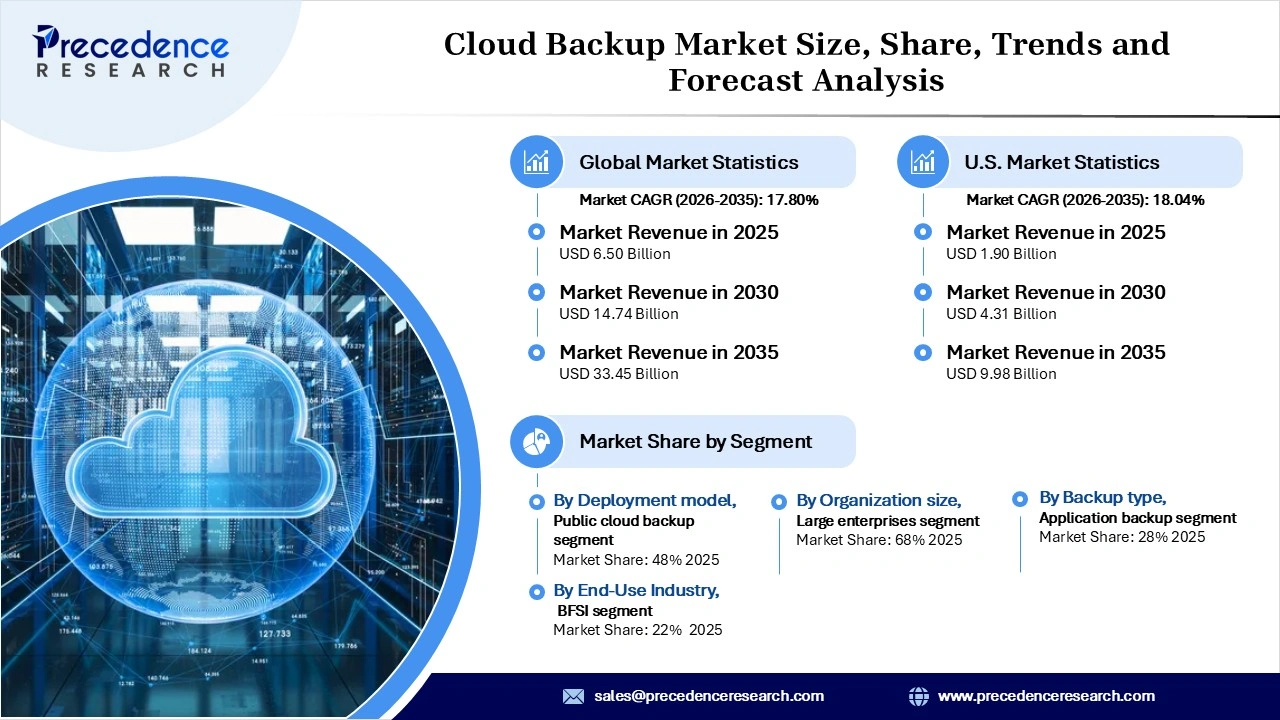
The global cloud backup market revenue reached USD 6.50 billion in 2025 and is predicted to attain around USD 33.45 billion by 2035 with a CAGR of 17.80%. The market is driven by the increase in corporate and personal data at an exponential rate, high risk of ransomware and other cyberattacks, changing trends towards remote working, and stringent regulations concerning off-site data storage and disaster recovery.
Protecting Digital Assets Through Cloud Backup Services
The cloud backup market comprises services and software that enable automatic backup of data from various sources, such as servers, endpoints, applications, and databases, to remote cloud environments. In contrast to conventional tape-based backups and external hard drives, cloud backup provides a more cost-effective and scalable solution that comes with scheduled automatic backup, data encryption, and fast recovery of information.
The market consists of backup solutions for personal computer owners, small businesses, and large enterprise-grade products that ensure the security of hybrid cloud workloads. Such solutions provide features such as incremental forever backups, versioning, and compliance with various standards such as GDPR, HIPAA, and PCI-DSS. This market has been adopted in healthcare, finance, retail, education, IT and telecommunications, and government sectors.
AI Threat Scans and Synthetic Recovery Technology
The market is incorporating AI-based threat scanning and recovery technologies designed to precisely extract ransomware from infected data in a backup environment before restoring it. This solution scans the backup copy for ransomware, separates malicious elements, and restores the data. Commvault revealed at its SHIFT 2025 event that its new AI-based threat scan enables the detection of compromised data and its proprietary Synthetic Recovery technology, which is able to clean up malware in the process of restoring while keeping only legitimate data untouched.
Hybrid Cloud Integration Provides Immutable Off-Site Backup
There are many new developments being made within the cloud backup sector by using hybrid integration, which involves integrating cloud storage tiers directly to on-premises backup appliances. By doing this, there will be no need for an additional gateway setup or manually uploading the backup, as the system can automatically create an immutable copy of backups stored on-premises to protect against ransomware attacks. In 2026, Syncology and Wasabi Technologies collaborated with each other to combine Wasabi’s hot cloud storage services with the backup devices from Syncology. The purpose was to make the process of creating off-site backup copies possible, which is helpful when protecting against ransomware.
National Cloud Strategies Enhance the Need for Cloud Backup in Government
Governments across the world have updated their national cloud adoption strategies to add requirements for data backup, disaster recovery, and contingency measures beyond the primary cloud service offerings. This is done in order to provide business continuity assurance and comply with national cybersecurity guidelines. Australia’s Whole-of-Government Cloud Computing Policy, released by the DTA in December 2025 and effective from 1 July 2026, requires agencies to develop contingency backups external to their cloud service, according to the guidelines stipulated by the Information Security Manual.
Eon Cloud Backup Startup Raises USD 300 Million in Funding in December 2025
Eon, a company offering cloud backup solutions, announced that it raised a Series D funding worth USD 300 million in December 2025. As a result of this funding, the company’s total capital stands at USD 500 million with a USD 4 billion valuation. According to the startup, it was able to reduce customer backup costs by 30% to 50% and harness backup data through AI and analytics.
Market Segmentation Overview
- By deployment model, the public cloud backup segment led the cloud backup market with 48% share in 2025, and is expected to expand at the highest CAGR of 18.5% during the forecast period, because it does not require any initial hardware spending and maintenance costs. It provides a lot of benefits, such as scalability and automation. Moreover, it provides built-in geographic redundancy, which makes this segment very cost-effective and usable for small businesses.
- By deployment model, the hybrid cloud backup segment held the second largest market share of 30% in 2025, since many organizations prefer to have critical information stored in their on-premise data centers due to various reasons such as privacy compliance and regulatory requirements, whereas at the same time they utilize cloud storage services for keeping backups. Hybrid backup can help overcome the problem of vendor lock-in by enabling enterprises to use various public cloud services for storage purposes at different levels of retention, without moving their most critical workloads to the cloud.
- By organization size, the large enterprises segment dominated the market with 68% share in 2025, due to the fact that it produces large amounts of crucial information need to be compliant with various regulations such as GDPR and HIPAA. Large enterprises have enough personnel to control the complexities of multi-cloud environments, implement disaster recovery testing, and use legal holds.
- By organization size, the SMEs segment is expected to grow at the fastest CAGR of 19.8% from 2026 to 2035, owing to the fact that small businesses are quickly embracing cloud backups due to their simplicity and low cost, providing them with an easy-to-implement alternative to traditional tape or drive backups. With ransomware attacks increasingly targeting small firms, SMEs understand that implementing cloud backups with immutability and fast recovery capabilities is a necessity.
- By backup type, the application backup segment led the cloud backup market with 28% share in 2025, since it provides robust protection for all critical information, namely databases, e-mails, and other types of data, where any delay in restoration may disrupt company operations. Unlike generic system and file backups, application-aware backups guarantee transactional consistency, offer granularity of restoration, and are capable of using application-specific APIs.
- By backup type, the VM and container backup segment is expected to expand at the highest CAGR of 20% during the forecast period, due to the fact that contemporary software applications are using more virtual machine and containerized applications. Such systems need to be backed up and restored, as these technologies have certain characteristics that require a specialized approach.
- By end-use industry, the BFSI segment dominated the market with 22% share in 2025, because it deals with very sensitive transaction information, which has to abide by regulations stipulating that backups should be secure and should be recoverable during disasters. Moreover, banks and insurance companies cannot afford any disruptions since each second lost costs them huge amounts of money.
- By end-use industry, the healthcare segment is expected to grow at the fastest CAGR of 19.5% from 2026 to 2035, since hospitals and clinics are moving to digital platforms for storing patient information. This segment is experiencing a rapid rise in cyber threats, which prompts them to seek immutable backup options because ransomware can result in loss of crucial information or having to pay ransom money. Moreover, there are rigorous regulations like HIPAA that require encrypted off-site backups with recoverability.
Regional Analysis
North America led the cloud backup market with 39% share in 2025 because of the extensive adoption of cloud architecture, the presence of enterprises with highly advanced data security requirements, and strict regulations regarding off-site storage backups. The U.S. dominated the market in North America due to the significant presence of leading cloud service providers such as Amazon Web Services (AWS), Microsoft Azure, and Google Cloud, as well as a robust ecosystem of cloud backup software vendors and regulations such as HIPAA, FINRA, and GLBA, which made cloud backup mandatory. Canada is a significant contributor to the market owing to the rapidly growing use of cloud computing technology, well-implemented privacy laws such as PIPEDA, and government-backed programs aimed at digital transformation and contingency cloud backups.
Asia-Pacific is expected to expand at the highest CAGR of 20.5% during the forecast period, because of rapid digitization as small and medium companies adopt cloud-based technologies, and the increasing incidences of ransomware attacks against firms, prompting the adoption of economical and immutable backups. China led the market in Asia Pacific due to its huge internet-based economy, stringent government regulations requiring localization and backup of data based on the Cybersecurity Law, and the presence of cloud backup solution providers such as Alibaba Cloud and Tencent Cloud. India witnessed notable market growth owing to its rapidly expanding startup community, requirements for backups specified in the Digital Personal Data Protection Act, and the increased use of cloud backup in small, price-sensitive businesses looking to migrate from tapes to more economical alternatives.
Europe held the second-largest cloud backup market share of 26% in 2025, due to the presence of a large number of enterprises and public institutions that are governed by stringent data protection laws like GDPR and the NIS-2 directive, where encryption of backups, disaster recovery solutions, and backup recovery tests have been mandated. Germany led the market in Europe because of its advanced automotive, manufacturing, and financial services industries, which need enterprise-grade backups along with the need to maintain performance standards. The U.K. is a significant contributor to the market owing to its well-developed finance and healthcare sectors, extensive use of hybrid cloud backup systems, and mandatory policy of cloud backup by the government.
Cloud Backup Market Coverage
| Report Attribute | Key Statistics |
| Market Revenue in 2025 | USD 6.50 Billion |
| Market Revenue by 2035 | USD 33.45 Billion |
| CAGR from 2026 to 2035 | 17.80% |
| Quantitative Units | Revenue in USD million/billion, Volume in units |
| Largest Market | North America |
| Base Year | 2025 |
| Regions Covered | North America, Europe, Asia-Pacific, Latin America, and the Middle East & Africa |
Top Companies in the Cloud Backup Market
Veeam Software, Commvault Systems, Veritas Technologies, and Acronis International are some of the key players that provide cloud backup solutions. Rubrik, Cohesity, and Druva concentrate on future-oriented approaches to cloud backup solutions based on zero trust security, immutable storage, and AI-based ransomware detection. Arcserve, HYCU, and Unitrends produce specialized appliances and cloud backup software designed to support virtual and legacy systems.
Quest Software, Nakivo, and OpenText provide cross-platform backup solutions for Microsoft 365, SharePoint, and similar services. Barracuda Networks offers cloud backup solutions specifically for email and edge devices, while Zero focuses on continuous replication and disaster recovery solutions. Rubrik, Cohesity, and Druva compete in the portfolio of immutable backups and fast recoveries after ransomware attacks. Veeam, Commvault, and Veritas improve their portfolio of offerings with cloud mobility capabilities.
Segments Covered in This Report
By Deployment Model
- Public Cloud Backup
- Private Cloud Backup
- Hybrid Cloud Backup
By Organization Size
- Large Enterprises
- SMEs
By Backup Type
- File & Folder Backup
- Application Backup
- Database Backup
- VM & Container Backup
- Endpoint Backup
By End-Use Industry
- BFSI
- IT & Telecom
- Healthcare
- Government
- Retail & E-Commerce
- Manufacturing
- Education
- Media & Entertainment
- Others
By Region
- North America
- Latin America
- Europe
- Asia-pacific
- Middle and East Africa
Get this report to explore global market size, share, CAGR, and trends, featuring detailed segmental analysis and an insightful competitive landscape overview @ https://www.precedenceresearch.com/sample/8488
You can place an order or ask any questions. Please feel free to contact us at sales@precedenceresearch.com |+1 804 441 9344