



Cloud Backup Market Trends, Companies, Revenue / Sales Performance, Subscriber Growth, Pricing Strategies, Cloud Adoption, Infrastructure Expansion, Competitive Landscape, and Industry Outlook
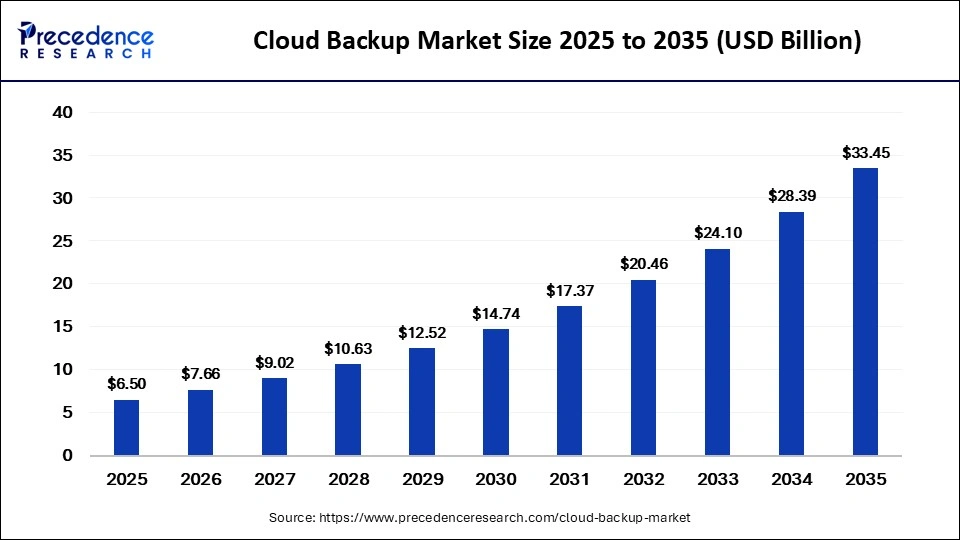
ICT industry specialist Shivani Zoting estimates the cloud backup market at USD 7.66 billion in 2026, with continued technology adoption expected to take the market to USD 33.45 billion by 2035 at a CAGR of 17.80%. Leading cloud backup market providers such as Veeam Software, Commvault Systems, Veritas Technologies are expanding their capabilities across segments including deployment model, organization size, backup type, end-use industry.
Source: https://www.precedenceresearch.com/cloud-backup-market
 Get a Sample
 Table Of Content


Cloud Backup Market Size and Forecast 2026 to 2035
The global cloud backup market size accounted for USD 6.50 billion in 2025 and is predicted to increase from USD 7.66 billion in 2026 to approximately USD 33.45 billion by 2035, expanding at a CAGR of 17.80% from 2026 to 2035. The market is driven by an exponential, massive expansion in global data generation. As enterprises scale operations, the sheer volume of data exceeds the restrictions of on-premises servers, making scalable, elastic, and cost-effective cloud repositories essential for uninterrupted business continuity.
Key Takeaways
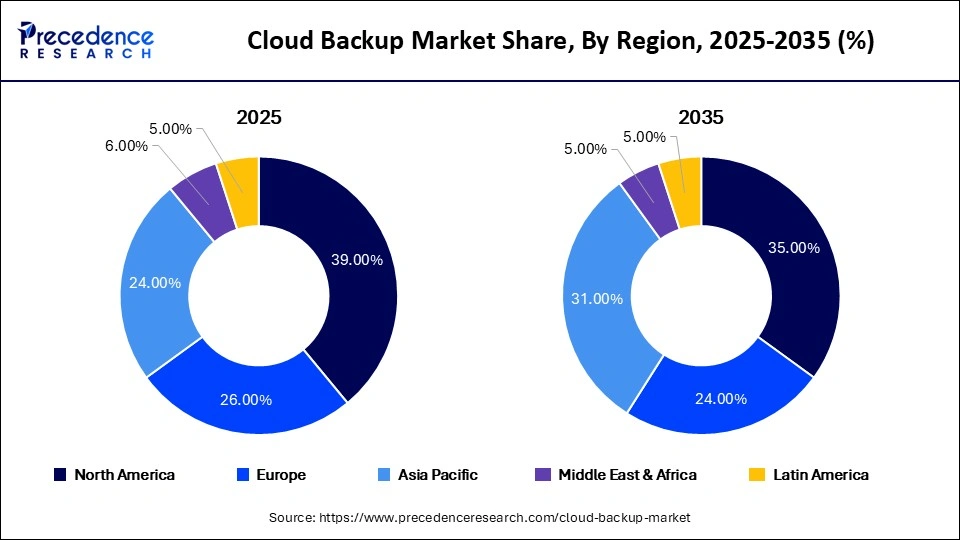
- North America dominated the global cloud backup market with a share of 39% in 2025.
- Asia-Pacific is expected to grow at the fastest CAGR of 20.5% during the forecast period.
- By deployment model, the public cloud backup segment led the global market with a share of 48% in 2025.
- By deployment model, the hybrid cloud backup segment held the second largest share of 30% in 2025 and is expected to grow at a CAGR of 17% between 2026 and 2035.
- By organization size, the large enterprises segment accounted for the highest revenue share of 68% in the market in 2025.
- By organization size, the SMEs segment is expected to grow at the fastest CAGR of 19.8% between 2026 and 2035.
- By backup type, the application backup segment held the largest revenue share of 28% in the cloud backup market in 2025.
- By backup type, the VM and container backup segment is expected to grow at the fastest CAGR of 20% between 2026 and 2035.
- By end-use industry, the BFSI segment contributed the biggest revenue share of 22% in the market in 2025.
- By end-use industry, the healthcare segment is expected to expand rapidly with a CAGR of 19.5% between 2026 and 2035.
Market Overview
The cloud backup market is the global industry that offers secure, off-site data storage services and disaster recovery solutions over the internet. It enables both individuals and enterprises to protect critical data against hardware failure, natural disasters, and even cyberattacks like ransomware. The primary driving factors for the market are the explosive growth of global data, the increasing threat of ransomware, and the need for remote-work accessibility. These elements push businesses to accept market solutions over capital-intensive on-premises hardware.
Cloud Backup Market Trends
- Vendors are increasingly embedding AI into backup consoles. AI automates data classification, identifies anomalies, and dynamically assigns storage tiers. This trend is vital for ransomware protection, as it helps security teams detect breaches early and maintain immutable, certified backups.
- With the explosion of secondary data and cloud egress fees, budget-conscious enterprises and even SMEs are seeking transparent pricing. Providers offering predictable, flat-rate bandwidth bundles and egress-free storage, such as Backblaze and Wasabi, are gaining massive momentum.
How is AI Influencing the Cloud Backup Market?
Artificial intelligence is fundamentally transforming the market by shifting it from a reactive, storage-only model to proactive, cyber-resilient data management. AI automates backups, offers intelligent threat detection, optimizes storage, and helps enterprises navigate rising costs in hybrid and multi-cloud environments. AI improves how and when backups occur by analyzing data usage and value to schedule routines during low network traffic. Furthermore, machine learning handles intelligent deduplication along with compression to minimize storage footprints, mitigating unexpected cloud egress and storage fees. AI handles policy enforcement by monitoring configurations, proactively flagging compliance violations, and generating necessary reports to ease complex regulatory audit trails.
Market Report Coverage and Key Metrics
| Report Coverage | Details |
| Market Size in 2025 | USD 6.50 Billion |
| Market Size in 2026 | USD 7.66 Billion |
| Market Size by 2035 | USD 33.45 Billion |
| Market Growth Rate from 2026 to 2035 | CAGR of 17.80% |
| Dominating Region | North America |
| Fastest Growing Region | Asia Pacific |
| Base Year | 2025 |
| Forecast Period | 2026 to 2035 |
| Segments Covered | Deployment Model, Organization Size, Backup Type, End-Use Industry, and Region |
| Regions Covered | North America, Europe, Asia-Pacific, Latin America, and Middle East & Africa |
Market Dynamics
Drivers
Explosive Enterprise Data Generation
Explosive enterprise data generation is the primary driver of the market because traditional on-premises infrastructure cannot sustain the costs, scalability, and security requirements needed to manage modern, petabyte-to-zettabyte scale data loads. As the volume of generated data increases, the attack surface for enterprises expands, making data backups a strategic priority. The increase in ransomware attacks and digital downtime forces organizations to adopt automated cloud-based disaster recovery. Standard backup strategies dictate keeping three copies of data across two different media types, with at least one off-site. The cloud fulfills this off-site mandate perfectly.
Restraint
Stringent Data Localization Laws
Stringent data localization laws restrain the market as they undermine the foundational mechanics of cloud computing, scalability, redundancy, and even seamless global data flow. These laws fragment infrastructure, increase IT costs, and complicate disaster recovery, thus fundamentally forcing providers to rebuild architecture around geographic borders rather than optimal network performance.
Opportunity
Direct Infrastructure Investment
Direct infrastructure investment is the primary opportunity for the market because it allows providers to capitalize on surging data volume and strict regulatory demands. By building physical data centers, they secure localized control, lower latency, and capture the expanding enterprise need for scalable, off-site data protection. As internet usage and device density explode, processing everything in massive, centralized hyperscale data centers becomes a bottleneck for data recovery. Direct investment into distributed edge computing nodes means backups occur closer to where the data is generated. This significantly decreases bandwidth costs and latency, providing faster recovery times in the event of a disaster.
Market Segmentation Analysis
Deployment Model Insights
The Public Cloud Backup Segment Held the Largest Market Share of 48% in 2025
The public cloud backup segment dominated the cloud backup market with a share of 48% in 2025 and is expected to grow at the fastest CAGR of 18.5% during the forecast period, owing to its lower deployment costs and scalability advantages. The escalating frequency and sophistication of ransomware attacks have made secure, off-site backups essential. Automated public cloud backups provide a vital defense mechanism by ensuring uncorrupted, recoverable copies of vital data are easily accessible. Strict global data protection standards, such as GDPR in Europe and CCPA, demand that businesses maintain rigorous data retention, security, and disaster recovery strategies, which cloud backup natively supports.
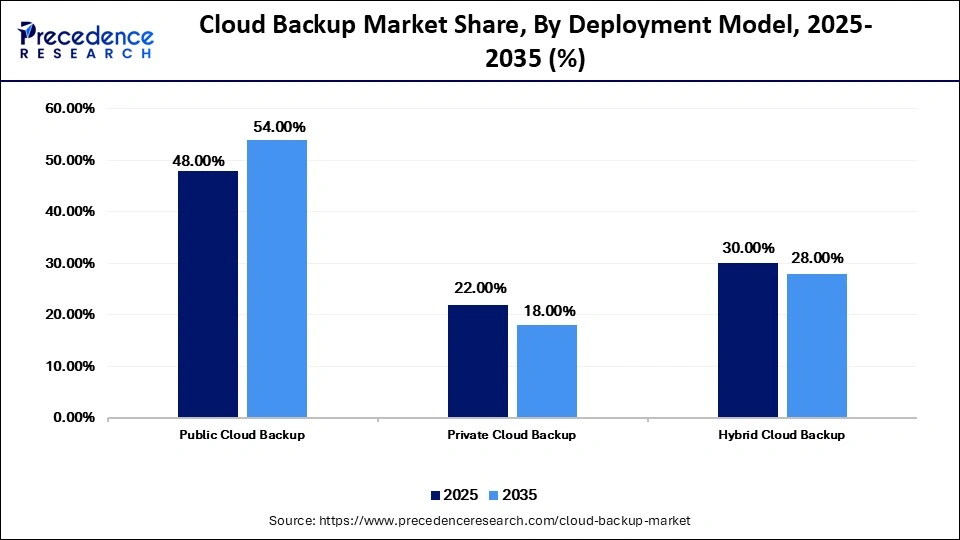
The hybrid cloud backup segment held a 30% share of the market in 2025 and is expected to grow at the fastest CAGR of 17% during the projection period. This is mainly due to flexible workload management, compliance and security balance, and legacy infrastructure integration. Strict privacy laws mandate where specific sensitive data can be stored. Moreover, the hybrid setup lets organizations securely process and back up compliance-heavy data in private clouds. The growth of AI and machine learning workloads has made hybrid clouds essential. It enables organizations to handle massive, data-intensive tasks across flexible environments while keeping core infrastructure secure.
The private cloud backup segment held a 22% share of the market in 2025 and is expected to grow at a CAGR of 14% during the projection period. This is due to data sovereignty requirements, sensitive data protection, and regulatory compliance needs. The spike in ransomware and malware attacks has made secure, off-site data backups a critical necessity for disaster recovery. Cloud backups remove the high capital expenditure associated with physical, on-premises disaster recovery sites, enabling businesses to seamlessly scale their storage as data volumes explode.
Organization Size Insights
The Large Enterprises Segment Held the Largest Market Share of 68% in 2025
The large enterprises segment dominated the cloud backup market with a share of 68% in 2025, owing to large data volumes, regulatory compliance obligations, and multi-site disaster recovery requirements. Highly regulated sectors such as BFSI, healthcare, and government must follow rigorous data protection laws. Cloud backups ensure secure data sovereignty, integrity, and disaster recovery.
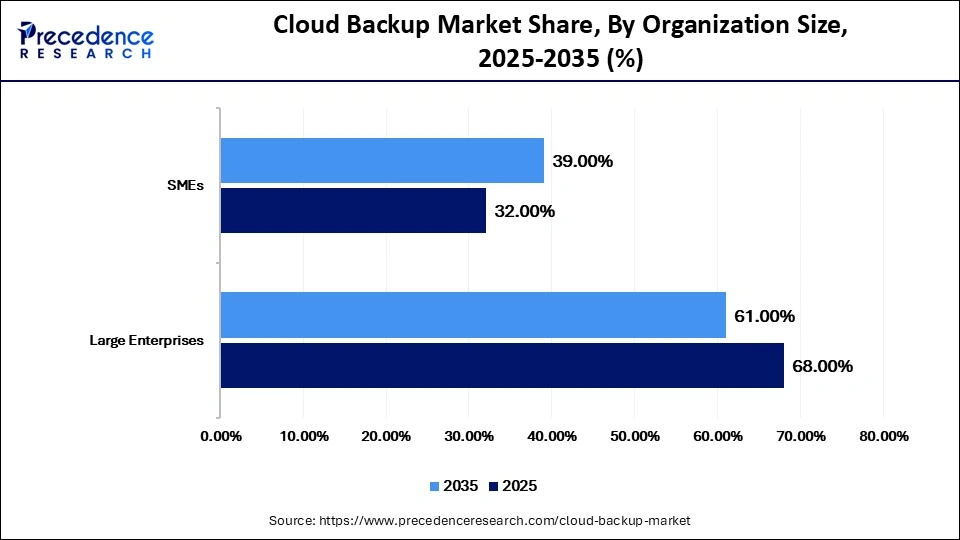
The SMEs segment held a 32% share of the market in 2025 and is expected to grow at the fastest CAGR of 19.8% during the projection period. This is mainly due to affordable cloud subscriptions and limited IT infrastructure. The global change toward hybrid and remote work models necessitated centralized, off-site storage options that distributed teams can safely and quickly access.
Backup Type Insights
Why Did the Application Backup Segment Lead the Cloud Backup Market in 2025?
The application backup segment held a dominant position in the market with a share of 28% in 2025, driven by SaaS application growth, business-critical workload protection, and compliance requirements. Industry mandates in sectors such as healthcare and finance need stringent data protection and verifiable disaster recovery plans.
Cloud Backup Market Share, By Backup Type, 2025-2035 (%)
| Backup Type | 2025 | 2035 | CAGR (%) |
| File & Folder Backup | 22.00% | 18.00% | 13.50% |
| Application Backup | 28.00% | 31.00% | 18.50% |
| Database Backup | 24.00% | 23.00% | 16.00% |
| VM & Container Backup | 18.00% | 21.00% | 20.00% |
| Endpoint Backup | 8.00% | 7.00% | 14.00% |
The VM and container backup segment held a 18% share of the market in 2025 and is expected to grow at the fastest CAGR of 20% during the projection period. This is mainly due to containerized workloads, cloud-native infrastructure expansion, and disaster recovery requirements. The exponential growth of enterprise data makes on-premises storage unsustainable, forcing businesses to rely on public cloud providers for scalable, cost-effective backup storage.
The database backup segment held a 24% share of the market in 2025 and is expected to grow at a CAGR of 16% during the projection period. This is due to an increase in data breaches and ransomware attacks, which have made secure, off-site backups essential to recover corrupted or stolen data. Cloud backups enable businesses to avoid the high costs of maintaining on-premises secondary data centers, thus, offering affordable on-demand scaling.
End-Use Industry Insights
What Made the BFSI Dominant Segment in the Cloud Backup Market in 2025?
The BFSI segment dominated the global market with the largest share of 22% in 2025. This is due to the regulatory data retention, fraud and cyberattack protection, and disaster recovery requirements. Financial firms process enormous amounts of structured and unstructured data daily. Cloud services provide the massive scalability and automated, real-time backups needed to manage this scale without system downtime.
Cloud Backup Market Share, By End-Use Industry, 2025-2035 (%)
| End-Use Industry | 2025 | 2035 | CAGR (%) |
| BFSI | 22.00% | 21.00% | 16.00% |
| IT & Telecom | 20.00% | 19.00% | 16.50% |
| Healthcare | 14.00% | 16.00% | 19.50% |
| Government | 11.00% | 10.00% | 15.00% |
| Retail & E-Commerce | 10.00% | 11.00% | 18.00% |
| Manufacturing | 9.00% | 10.00% | 18.50% |
| Education | 6.00% | 5.00% | 14.50% |
| Media & Entertainment | 4.00% | 4.00% | 15.50% |
| Others | 4.00% | 4.00% | 15.00% |
The healthcare segment held a 14% share of the market in 2025 and is expected to grow at the fastest CAGR of 19.5% during the projection period. This is mainly due to the electronic health record growth, compliance requirements, and medical imaging data expansion. Malicious cyberattacks on medical institutions have now increased, forcing providers to back up data into secure, immutable cloud vaults to prevent total data loss. Cloud infrastructures allow healthcare firms to eliminate the high costs of securing and maintaining their own physical servers while scaling storage capacity on demand.
The IT and telecom segment held a 20% share of the market in 2025 and is expected to grow at the fastest CAGR of 16.5% during the projection period. This is mainly due to the massive data generation, multi-cloud environments, and SaaS ecosystem expansion. The sustained shift toward remote and distributed work cultures requires data to be securely stored and accessed over geographically diverse networks. Cloud-based systems ensure business continuity regardless of physical location.
Market Regional Analysis: North America, Europe, Asia-Pacific
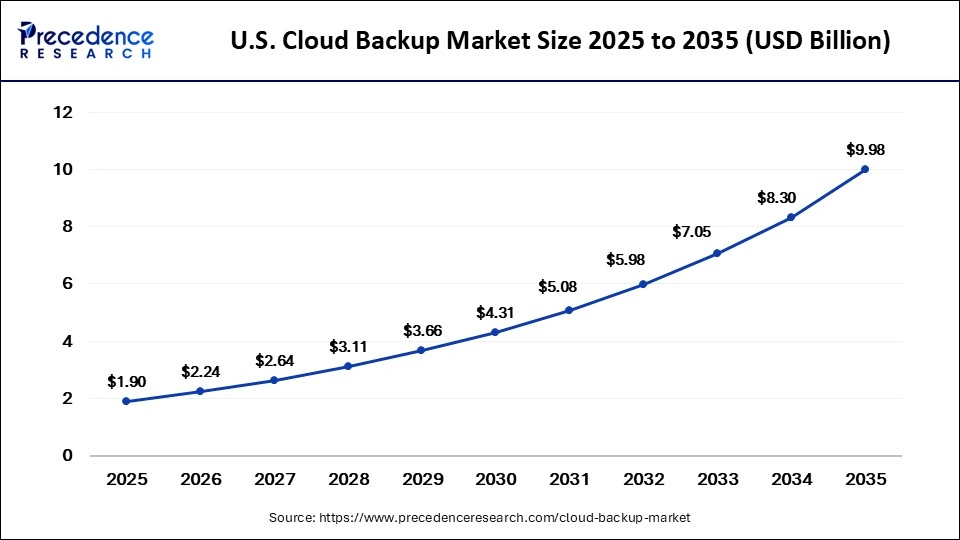
U.S. Cloud Backup Market Size and Growth 2026 to 2035
The U.S. cloud backup market size was evaluated at USD 1.90 billion in 2025 and is projected to reach around USD 9.98 billion by 2035, growing at a CAGR of 18.04% from 2026 to 2035.
What Led the Global North America Cloud Backup Market Grow in 2025?
North America led the market by holding a major share of 39% in 2025. This is due to rising ransomware attacks and cyber threats, strong cloud adoption among enterprises, and stringent data protection and recovery requirements. Organizations in data-intensive sectors such as finance, healthcare, and retail are now heavily adopting cloud backups to comply with strict data protection legislation. The regional market is dominated by major cloud service providers such as Amazon Web Services (AWS), Microsoft Azure, and Google Cloud.
U.S. Market Analysis
The U.S. market is primarily driven by surging cyber threats, the widespread adoption of remote work, and rapid digital transformations across enterprises.
Europe: The Second-Largest Market
Europe held the second-largest share of 26% in 2025 and is expected to grow at a notable CAGR of 16% during the projection period, driven mainly by GDPR-mandated data retention requirements, growing hybrid and multi-cloud deployments, and increasing enterprise digitization initiatives. An escalation in ransomware attacks and data security breaches has driven organizations to prioritize automated as well as immutable backup capabilities for rapid disaster recovery. Businesses are moving away from traditional on-premises setups and embracing flexible, cost-effective hybrid environments that distribute workloads across different cloud platforms.
UK Market Analysis
The UK market is growing due to stringent data compliance regulations, rising cyber threats, widespread remote work, and an explosion in enterprise data. Cloud backup solutions provide flexible, on-demand capacity. This affordability attracts small and medium-sized enterprises (SMEs) looking to avoid expensive on-premises infrastructure.
Asia-Pacific: The Fastest-Growing Region
Asia-Pacific held a 24% share of the cloud backup market in 2025 and is expected to grow at the fastest CAGR of 20.5% during the projection period, driven by the growing digital transformation spending, rising SME cloud adoption, and increasing data generation across industries. A surge in digital transactions across the Banking, Financial Services, and Insurance (BFSI) sector has made organizations prime targets for cyberattacks and ransomware. Businesses are prioritizing secure, immutable cloud backups as a vital business-continuity strategy to prevent permanent data loss and downtime.
China Market Analysis
The Chinese market is driven by exponential data growth, strict data localization mandates, surging cybersecurity threats, and government digital transformation initiatives. Local infrastructure investments by hyperscalers have also significantly driven cloud storage adoption.
What Drives the Cloud Backup Market in Latin America?
Latin America held a 6% share of the market in 2025 and is expected to grow at a significant CAGR of 15% during the projection period, driven by increasing cloud migration projects, rising cyberattack incidents, and growing fintech sector adoption. A steep increase in ransomware and malware attacks has thus forced enterprises to abandon physical, on-premises servers in favor of resilient, secure, and automated cloud backup strategies. Major global cloud providers are investing heavily in local availability zones. This localized infrastructure significantly decreases network latency for businesses across the region.
Brazil Market Analysis
Brazil's market is driven by surging ransomware threats, widespread digital transformation in finance and retail, and even stringent new data sovereignty mandates that require local data storage.
How is the Opportunistic Rise of the Middle East and Africa in the Cloud Backup Market?
The Middle East and Africa held a 5% share of the market in 2025 and are expected to grow at a notable CAGR of 16.5% during the projection period, driven by the expansion of regional data centers, increasing cloud adoption among enterprises, and growing regulatory focus on data security. As the sophistication of cybercrimes escalates, enterprises in the financial, telecommunications, and even healthcare sectors are prioritizing cyber resilience. Immutable, automated cloud backups are now essential to prevent catastrophic data loss.
Saudi Arabia Market Analysis
The Saudi Arabian market is primarily driven by strict national data residency laws, government investments under Vision 2030, increasing cybersecurity concerns, and the launch of local hyperscale data centers. The nation's economic diversification and smart city projects, such as NEOM, are generating massive volumes of data, forcing the public and private sectors to accept robust cloud-based disaster recovery solutions.
Market Competitive Landscape: Leading Companies and Strategies
The cloud backup market is highly competitive, driven by increasing data volumes, cybersecurity threats, and cloud adoption. Key players like Microsoft, Amazon Web Services, Google Cloud, IBM, and Veeam Software provide scalability, security, disaster recovery, and hybrid-cloud capabilities. Vendors are integrating AI-driven threat detection and ransomware protection, along with automated recovery features to differentiate their offerings. Strategic partnerships, acquisitions, and multi-cloud support remain common growth strategies as organizations seek resilient, compliant, and even cost-effective data protection solutions across diverse IT environments.
Cloud Backup Market Companies
- Veeam Software
- Commvault Systems
- Veritas Technologies
- Acronis International
- Rubrik
- Cohesity
- Druva
- Arcserve
- HYCU
- Unitrends
- Zerto
- Quest Software
- Nakivo
- OpenText
- Barracuda Networks
Recent Developments
- In April 2026, Commvault, a leader in unified resilience at enterprise scale, declared that the Commvault Cloud platform will be available on Google Cloud, bringing new levels of resilience to customers.(Source: https://ir.commvault.com)
Segments Covered in the Report
By Deployment Model
- Public Cloud Backup
- Private Cloud Backup
- Hybrid Cloud Backup
By Organization Size
- Large Enterprises
- SMEs
By Backup Type
- File & Folder Backup
- Application Backup
- Database Backup
- VM & Container Backup
- Endpoint Backup
By End-Use Industry
- BFSI
- IT & Telecom
- Healthcare
- Government
- Retail & E-Commerce
- Manufacturing
- Education
- Media & Entertainment
- Others
By Region
- North America
- Latin America
- Europe
- Asia-pacific
- Middle and East Africa
For inquiries regarding discounts, bulk purchases, or customization requests, please contact us at sales@precedenceresearch.com
Frequently Asked Questions





Ask For Sample
No cookie-cutter, only authentic analysis – take the 1st step to become a Precedence Research client
 Get a Sample




 sales@precedenceresearch.com
 Schedule a Meeting
