



Retail Cloud Market Trends, Companies, Revenue / Sales Performance, Subscriber Growth, Pricing Strategies, Cloud Adoption, Infrastructure Expansion, Competitive Landscape, and Industry Outlook
Retail Cloud Market (By Solution: Software as a Service (SaaS), Platform as a Service (PaaS), Infrastructure as a Service (IaaS); By Deployment Mode: Public Cloud, Private Cloud, Hybrid Cloud; By Application: Customer Relationship Management (CRM), Supply Chain Management, Inventory and Warehouse Management, Omnichannel Commerce, Point of Sale (POS), Data Analytics and Business Intelligence; By Enterprise Size: Large Enterprises, Small and Medium Enterprises (SMEs); By End-Use: Supermarkets and Hypermarkets, Department Stores, Specialty Stores, E-commerce Retailers) - Global Industry Analysis, Size, Trends, Leading Companies, Regional Outlook, and Forecast 2026 to 2035
Source: https://www.precedenceresearch.com/retail-cloud-market
 Get a Sample
 Table Of Content


Retail Cloud Market Size and Forecast 2026 to 2035
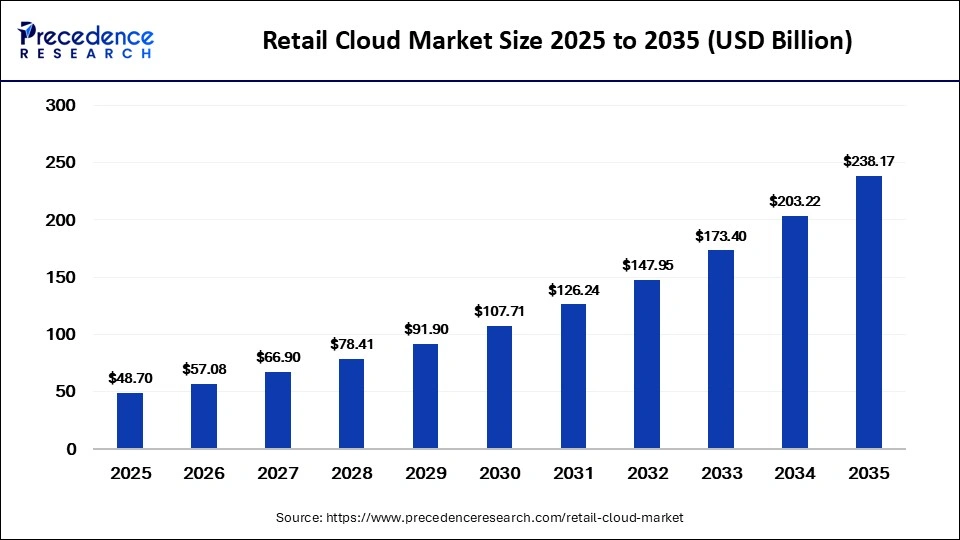
The global retail cloud market size accounted for USD 48.70 billion in 2025 and is predicted to increase from USD 57.08 billion in 2026 to approximately USD 238.17 billion by 2035, expanding at a CAGR of 17.20% from 2026 to 2035. Increasing digitization and disposable income are benefiting market growth.
Key Takeaways
- North America led the retail cloud market with a share of 39% in 2025.
- Asia-Pacific is expected to be the fastest-growing region with a CAGR of 21.4% in the forecasted duration.
- By solution, the software as a service (SaaS) segment held a dominant position in the market with a share of 58% in 2025 and is expected to grow at the fastest CAGR of 18.6% in the market between 2026 and 2035.
- By deployment mode, the public cloud segment accounted for a considerable revenue share of 54% in the market in 2025 and is expected to grow with the highest CAGR of 19.1% in the market during the studied years.
- By application, the customer relationship management (CRM) segment led the global market with a share of 20% in 2025.
- By application, the omnichannel commerce segment is expected to expand rapidly in the market with a CAGR of 20.1% in the coming years.
- By enterprise size, the large enterprises segment registered its dominance over the global retail cloud market with a share of 66% in 2025.
- By enterprise size, the small and medium enterprises (SMEs) segment is expected to witness the fastest growth in the market with a CAGR of 20.2% over the forecast period.
- By end use, the supermarkets and hypermarkets segment led the global market with a share of 24% in 2025.
- By end use, the e-commerce retailers segment is expected to expand rapidly in the market with a CAGR of 21.5% in the coming years.
Market Overview
A retail cloud is a complete set of software and services that are cloud-based and built for the retail industry. It consolidates all the essential functions, from customer relationship management (CRM) and commerce to supply chain and service, into a single unified platform. This combination allows businesses to solve typical pain points such as segmented customer experiences and workflow silos. In the end, a retail cloud builds a powerful, connected digital ecosystem that boosts the performance of the entire retail enterprise.
Impact of Artificial Intelligence on the Retail Cloud Market
Artificial intelligence (AI) technologies are transforming the retail industry, harnessing data analysis to improve efficiencies and designing more personalized and effective experiences for customers and retailers alike. Retailers can use AI to offer highly personalized interactions, as these systems can analyse vast amounts of data to find valuable insights. For example, machine learning based demand forecasting can reduce forecasting errors by up to 50% and inventory costs by about 10%. AI also enables personalised marketing messages and custom digital receipts. The ability to track stock levels in real time enables retailers to make timely decisions on replenishment. AI can also help with store design and product placement, creating the best layouts to get customers more engaged and boost sales.
Retail Cloud Market Trends
- Generative AI-Driven Retail Innovation: Generative AI is becoming an important retail cloud trend, allowing retailers to quickly create tailored product assortments, automate content generation, and improve merchandising strategies for targeted customer engagement.
- Retail Chatbots: Retail chatbots are making rapid progress in the market in their contextual understanding, personalisation capabilities, and autonomous problem-solving, to make customer interactions more personal and more efficient.
- Retail Cloud Inventory Software Applications: Retail cloud inventory software applications are gaining popularity with retailers looking to personalise every interaction with integrated clienteling, checkout, endless aisle, omnichannel operation, and inventory management capabilities on a single platform.
Market Report Coverage and Key Metrics
| Report Coverage | Details |
| Market Size in 2025 | USD 48.70 Billion |
| Market Size in 2026 | USD 57.08 Billion |
| Market Size by 2035 | USD 238.17 Billion |
| Market Growth Rate from 2026 to 2035 | CAGR of 17.20% |
| Dominating Region | North America |
| Fastest Growing Region | Asia Pacific |
| Base Year | 2025 |
| Forecast Period | 2026 to 2035 |
| Segments Covered | Solution, Deployment Mode, Application, Enterprise Size, End-Use, and Region |
| Regions Covered | North America, Europe, Asia-Pacific, Latin America, and Middle East & Africa |
Market Dynamics
Drivers
Growing Adoption of Cloud Computing and AI-Driven Automation
Major factors driving the market are the increasing adoption of cloud computing and the digital transformation strategies to enhance customer experience and increase sales growth. Also, benefits such as cost savings, flexibility, scalability, security, innovation, and AI-powered automation further accelerate market expansion.
Restraint
Data Security and Regulatory Compliance Challenges
Stringent regulatory requirements and data security concerns are hampering the retail cloud market. Protecting customer, payment, and business data is crucial, and compliance challenges posed by varying regional rules on security, privacy, and operations can impede international business transactions.
Opportunity
Cloud-Enabled Customer Experience and Retail Innovation
Cloud computing provides a great opportunity to reduce miscommunication and foster retail innovation. Trends like improved customer experiences, sustainability initiatives, contactless shopping, and augmented reality shopping experiences are changing the game for cloud utilization and creating new growth opportunities for retailers.
Market Segmentation Analysis
Solution Insights
The Software as a Service (Saas) Segment Dominated the Market with 58% Market Share in 2025
The software as a service (SaaS) segment dominated the retail cloud market with a 58% share in 2025 and is expected to sustain its dominance with a CAGR of 18.6% in the coming years. This growth can be attributed to its subscription-based deployment model and rapid implementation capabilities. SaaS providers take on the responsibility of operating, managing, and maintaining both the software and the underlying infrastructure, making it an attractive option for retailers due to its lower upfront investment and high adoption rates.
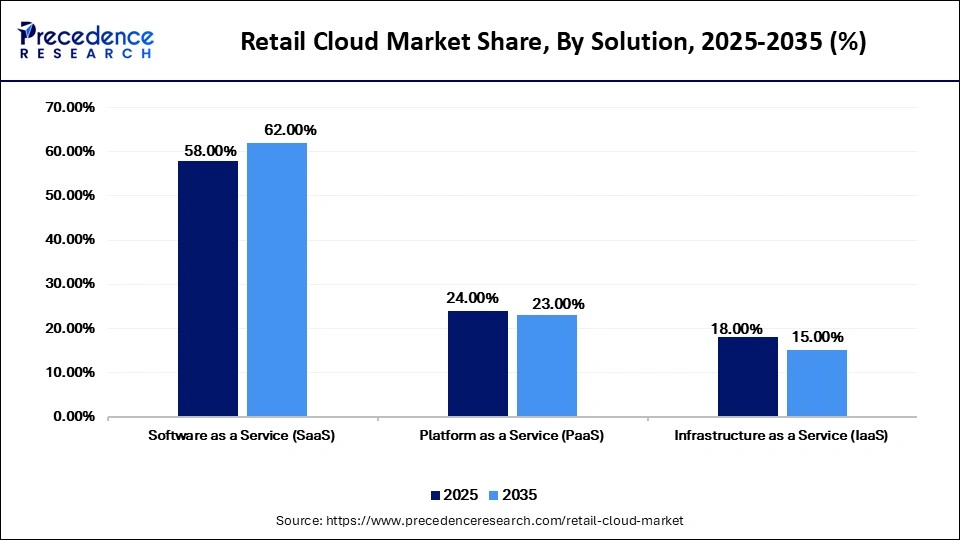
The platform as a service (PaaS) segment captured 24% of the market share in 2025 and is expected to grow at a CAGR of 16.3% during the forecast period, driven by the increasing demand for custom application development. PaaS offers developers a robust platform to build, deploy, and manage applications, further bolstered by the rising need for API integration and the expansion of retail innovation platforms.
The infrastructure as a service (IaaS) segment accounted for 18% of the market share in 2025 and is expected to experience a CAGR of 14.5% throughout the forecast period, supported by the growing adoption of scalable computing infrastructure and the ongoing migration of enterprises to the cloud. IaaS provides virtualized computing resources hosted in cloud provider data centers, accessible via web interfaces or APIs. Furthermore, the increasing emphasis on business continuity planning and the demand for flexible resource allocation are significant factors supporting this market's expansion.
Deployment Mode Insights
The Public Cloud Segment Led the Market with a 54% Share in 2025
The public cloud segment led the retail cloud market with a 54% share in 2025 and is expected to be the fastest-growing segment with a CAGR of 19.1% over the forecast period, driven by lower deployment costs and high scalability. In addition, rapid implementation, the expansion of SaaS retail platforms, and easy integration with digital services further support its adoption.
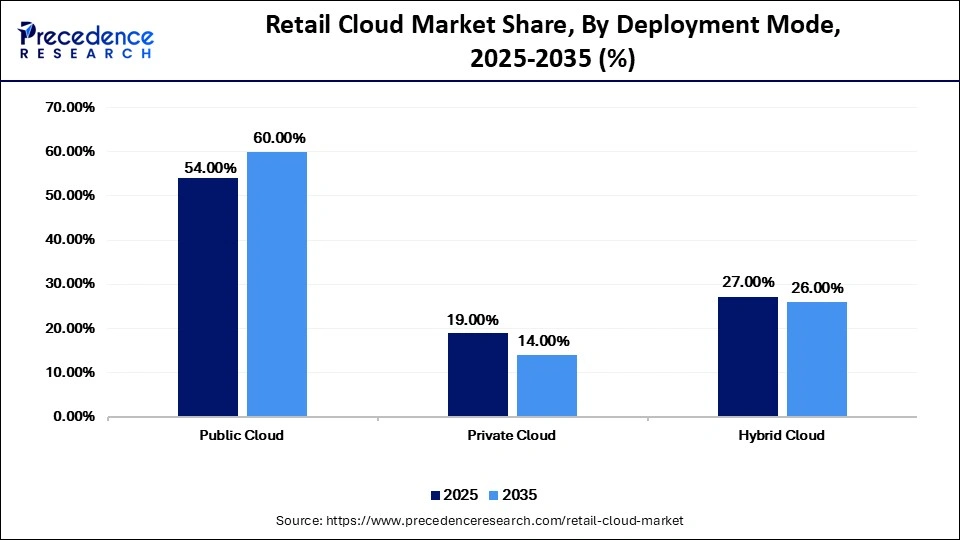
The private cloud segment accounted for 19% of the market share in 2025 and is expected to grow at a CAGR of 11.8% during the forecast period, supported by enhanced data security and regulatory compliance requirements. Private cloud deployments also provide greater infrastructure control and enterprise-specific customization. Furthermore, the protection of sensitive customer information contributes to market growth.
The hybrid cloud segment captured 27% of the market share in 2025 and is expected to grow at a CAGR of 16.8% over the forecast period, driven by the integration of legacy systems and flexible deployment architectures. Hybrid cloud models offer a balance between security and scalability and support the adoption of multi-cloud strategies. Additionally, growing business continuity requirements further bolster segment growth.
Application Insights
The Customer Relationship Management (CRM) Segment Dominated the Market with 20% Share in 2025
The customer relationship management (CRM) segment dominated the retail cloud market with a share of 20% in 2025, driven by the increasing emphasis on personalized customer engagement and the management of loyalty programs. CRM software empowers companies to effectively measure and control their lead generation and sales pipelines. Furthermore, advancements in AI-driven customer insights, an omnichannel customer experience, and marketing automation are set to enhance the growth of this segment.
Retail Cloud Market Share, By Application, 2025-2035 (%)
| Application | 2025 | 2035 | CAGR (%) |
| Customer Relationship Management (CRM) | 20.00% | 19.00% | 16.8% |
| Supply Chain Management | 18.00% | 17.00% | 16.5% |
| Inventory & Warehouse Management | 17.00% | 16.00% | 16.3% |
| Omnichannel Commerce | 19.00% | 22.00% | 20.1% |
| Point of Sale (POS) | 15.00% | 14.00% | 15.7% |
| Data Analytics & Business Intelligence | 11.00% | 12.00% | 19.6% |
The supply chain management segment accounted for 18% of the market share and is expected to grow at a CAGR of 16.5% in the coming years. This growth is largely driven by the demand for end-to-end supply visibility and inventory optimization. SCM focuses on refining the network to ensure that products arrive precisely where and when they are needed. Additional factors such as supplier collaboration, demand forecasting, and improved logistics efficiency are expected to further propel this segment's growth.
The omnichannel commerce segment held 19% of the market share in 2025 and is expected to be the fastest-growing segment with a CAGR of 20.1% over the forecast period, driven by the rise of digital commerce and the demand for unified shopping experiences. Omnichannel commerce adopts a comprehensive approach to sales, ensuring seamless customer interactions across various channels. Moreover, the integration across channels, enhanced customer convenience, and the growth of mobile commerce will further support the expansion of this segment.
Enterprise Size Insights
The Large Enterprises Segment Dominated the Market with a 66% Share in 2025
The large enterprises segment dominated the retail cloud market with a 66% share in 2025, fuelled by complex retail operations and substantial IT transformation budgets. Additionally, enterprise-wide cloud migration and the adoption of advanced analytics are contributing to this growth. The ability to manage multiple locations further enhances their market presence.
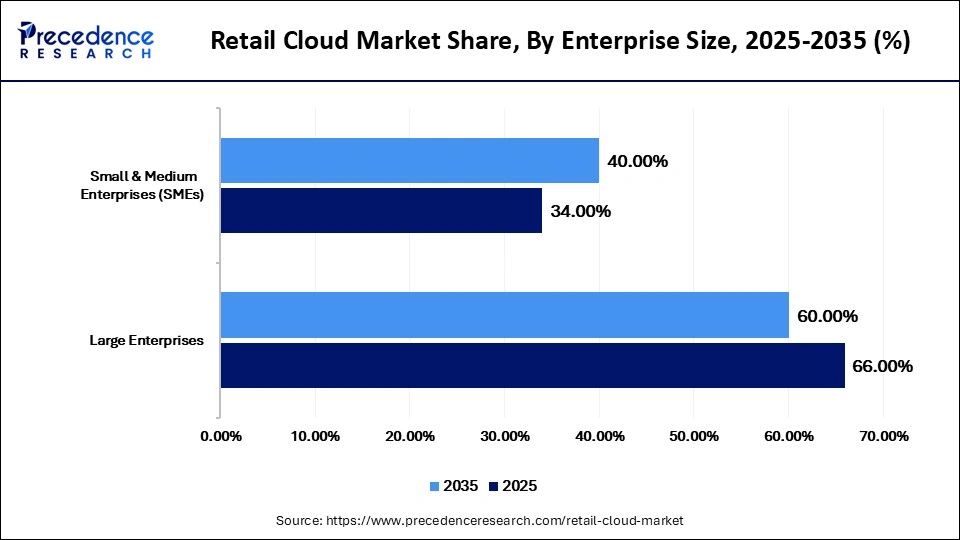
The small and medium enterprises (SMEs) segment held 34% of the market share in 2025 and is expected to expand rapidly with a CAGR of 20.2% in the coming years, driven by the availability of affordable SaaS platforms and user-friendly deployment models. Furthermore, the expansion of digital business, increasing cloud awareness, and efforts to optimize operational costs are all supporting this upward trend.
End-Use Insights
The Supermarkets and Hypermarkets Segment Held the Largest Market Share of 24% in 2025
The supermarkets and hypermarkets segment held the largest revenue share of 24% in the retail cloud market in 2025, propelled by significant transaction volumes and a strong embrace of inventory automation. The growth of this segment is further enhanced by the expansion of omnichannel grocery strategies, customer loyalty initiatives, and the integration of AI-driven demand forecasting.
Retail Cloud Market Share, By End-Use, 2025-2035 (%)
| End-Use | 2025 | 2035 | CAGR (%) |
| Supermarkets & Hypermarkets | 24.00% | 23.00% | 16.3% |
| Department Stores | 16.00% | 14.00% | 14.8% |
| Specialty Stores | 18.00% | 17.00% | 16.9% |
| E-commerce Retailers | 28.00% | 33.00% | 21.5% |
| Convenience Stores | 9.00% | 8.00% | 15.4% |
| Others | 5.00% | 5.00% | 15.8% |
The department stores segment captured 18% of the market share in 2025 and is expected to experience a CAGR of 16.9%, driven by the transformation of digital storefronts and the implementation of unified commerce platforms. Additionally, the emphasis on personalized shopping experiences, innovative customer engagement solutions, and improved operational efficiency is driving further advancements in this sector.
The e-commerce retailers segment held 28% of the market in 2025 and is expected to witness the fastest growth with a CAGR of 21.5% during the forecast period, driven by cloud-native commerce platforms and the early adoption of AI-based recommendation systems. Furthermore, the development of scalable digital infrastructure and real-time customer analytics is significantly contributing to the growth of this segment.
Market Regional Analysis: North America, Europe, Asia-Pacific
U.S. Retail Cloud Market Size and Growth 2026 to 2035
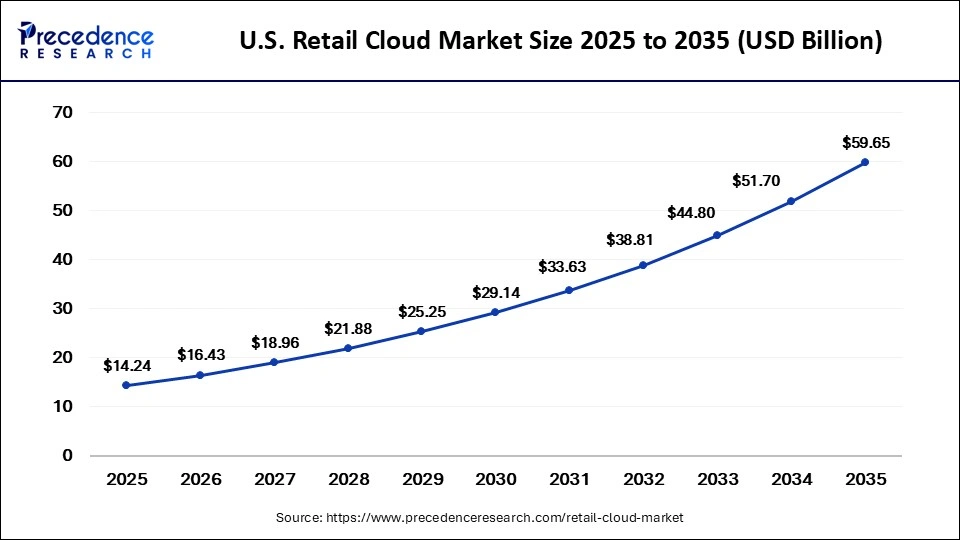
The U.S. Retail Cloud market size was evaluated at USD 14.24 billion in 2025 and is projected to reach around USD 59.65 billion by 2035, growing at a CAGR of 15.50% from 2026 to 2035.
Which Factors Drive the Retail Cloud Market in North America?
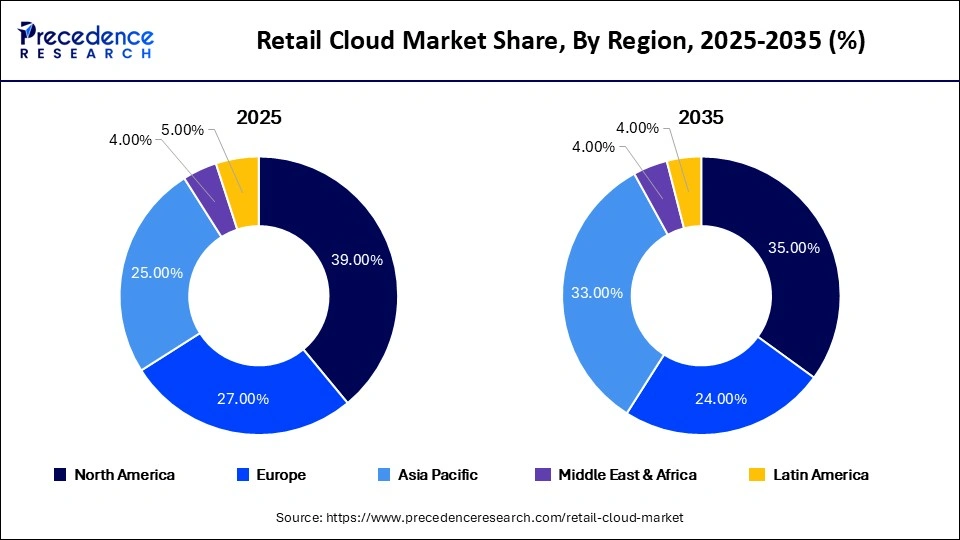
North America led the market, capturing approximately 39% in 2025, driven by a significant increase in cloud adoption among retailers and a robust omnichannel retail ecosystem. Additionally, the rise of AI-driven customer engagement, the expansion of cloud-based POS systems, and heightened investments in retail analytics are all contributing factors.
United States Market Analysis
The U.S. is at the forefront of the North American market, driven by a growing demand for digital solutions that enhance operational efficiency, customer experiences, and business agility. Furthermore, the integration of AI with cloud platforms enables U.S. retailers to deliver hyper-personalized experiences, boosting customer engagement, conversion rates, and brand loyalty, ultimately leading to increased sales.
How is Asia-Pacific Growing in the Retail Cloud Market?
Asia-Pacific accounted for 25% of the market share in 2025 and is anticipated to be the fastest-growing, with a CAGR of 21.4% during the forecast period, driven by the rapid expansion of e-commerce platforms and increasing investments in cloud infrastructure. Additionally, the rising adoption of digital payments, greater cloud deployment among SMEs, and strong retail modernization initiatives are further propelling this growth.
China Market Analysis
China is leading the charge in the Asia-Pacific market, fueled by the digitalization of retail and cloud adoption. The shift towards omnichannel retailing is gaining traction, with retailers utilizing real-time data and cloud platforms to optimize inventory management, track product movements, and enhance delivery efficiency.
Europe: The Second-Largest Region
Europe held 27% of the retail cloud market share in 2025 and is expected to grow at a CAGR of 15.9% from 2026 to 2035, supported by the increasing adoption of digital commerce and cloud migration among retailers. Additionally, the rising demand for integrated retail platforms, the expansion of customer experience solutions, and strong data governance initiatives are contributing to the market's expansion.
Germany Market Analysis
Germany is performing robustly within the European market, driven by digital transformation initiatives. The increasing adoption of multi-cloud and hybrid strategies in retail, along with the expansion of digital commerce and a surge in data-generating touchpoints, is expected to further accelerate growth.
Will the Middle East and Africa Grow in the Retail Cloud Market?
The Middle East and Africa region represented about 4% of the market share in 2025 and is projected to grow at a CAGR of 16.3% in the coming years, driven by the rise of smart retail projects and the adoption of cloud-first business strategies. Additionally, the expansion of organized retail, increasing omnichannel commerce adoption, and government-led digital transformation initiatives are all supporting this growth.
UAE Market Analysis
In the UAE, significant investments in cloud infrastructure and services are driving progress in the Middle East and Africa region. The competitive landscape for retail cloud is evolving, with local companies increasingly partnering with international cloud providers to enhance their service offerings.
What are the Key Trends of the Retail Cloud Market in Latin America?
Latin America held 5% of the market share in 2025 and is projected to grow at a CAGR of 16% in the coming years, spurred by rising online retail penetration and the growth of cloud-based retail management solutions. Additionally, the expanding digital payment ecosystem, advancements in retail automation, and a demand for operational efficiency are all contributing to this growth.
Brazil Market Analysis
Brazil is leading the Latin American market, with cloud technologies enabling Brazilian retailers to enhance efficiency and foster innovation, particularly in urban areas. The government is also playing a supportive role in this transformation, focusing on modernizing public services and improving data security.
Market Competitive Landscape: Leading Companies and Strategies
The retail cloud market is characterized as semi-consolidated, with companies prioritizing software solutions tailored for retail, including supply chain logistics, personalization engines, and real-time inventory management. These providers leverage unified product catalogs, clienteling strategies, and advanced AI tools to create a seamless integration between online and brick-and-mortar stores.
However, significant challenges to market growth include data security risks and difficulties associated with integrating legacy systems, especially given their susceptibility to cyberattacks. Despite these hurdles, leading vendors are committed to enhancing physical store operations by investing in smart retail networking hardware, cloud security measures, and IoT-based tracking solutions. They are also focused on developing robust platforms that emphasize advanced personalization, customer experience analytics, and efficient content delivery, all while navigating increasingly intricate cross-border digital operations, consumer interactions, and back-end financial processes.
Retail Cloud Market Companies
- Microsoft
- Amazon Web Services
- Oracle
- SAP
- Salesforce
- IBM
- Adobe
- Infor
- VTEX
- Shopify
- Commercetools
- Manhattan Associates
- NCR Voyix
- Cegid
Recent Developments Retail Cloud Market (2025-2026)
- In April 2026, Cognizant introduced Agentic Retail CX, an AI-powered contact center solution built on Google Cloud's Gemini Enterprise for Customer Experience (CX). Tailored for retailers, the platform enables brands to deliver personalized, omnichannel customer journeys while lowering operational costs, boosting employee productivity, and speeding up the adoption of agentic AI across the retail value chain.(Source: https://www.prnewswire.com)
- In January 2026, Google Cloud introduced Gemini Enterprise for Customer Experience, a platform that unifies shopping and customer service in a single interface and orchestrates multiple AI agents across the customer journey. Aimed at retailers and restaurants, the solution offers prebuilt and configurable agents powered by Google's Gemini models, enabling businesses to deploy AI-driven experiences in just a few days.(Source: https://itbrief.com.au)
Segments Covered in the Report
By Solution
- Software as a Service (SaaS)
- Platform as a Service (PaaS)
- Infrastructure as a Service (IaaS)
By Deployment Mode
- Public Cloud
- Private Cloud
- Hybrid Cloud
By Application
- Customer Relationship Management (CRM)
- Supply Chain Management
- Inventory and Warehouse Management
- Omnichannel Commerce
- Point of Sale (POS)
- Data Analytics and Business Intelligence
By Enterprise Size
- Large Enterprises
- Small and Medium Enterprises (SMEs)
By End-Use
- Supermarkets and Hypermarkets
- Department Stores
- Specialty Stores
- E-commerce Retailers
By Region
- North America
- Latin America
- Europe
- Asia-pacific
- Middle and East Africa
For inquiries regarding discounts, bulk purchases, or customization requests, please contact us at sales@precedenceresearch.com
Frequently Asked Questions
Tags





Ask For Sample
No cookie-cutter, only authentic analysis – take the 1st step to become a Precedence Research client
 Get a Sample




 sales@precedenceresearch.com
 Schedule a Meeting
