



CNS Drug Discovery Market Revenue to Attain USD 27.55 Bn by 2035
Published: 12 Jun 2026
Author: Precedence Research



CNS Drug Discovery Market Revenue and Trends 2026 to 2035
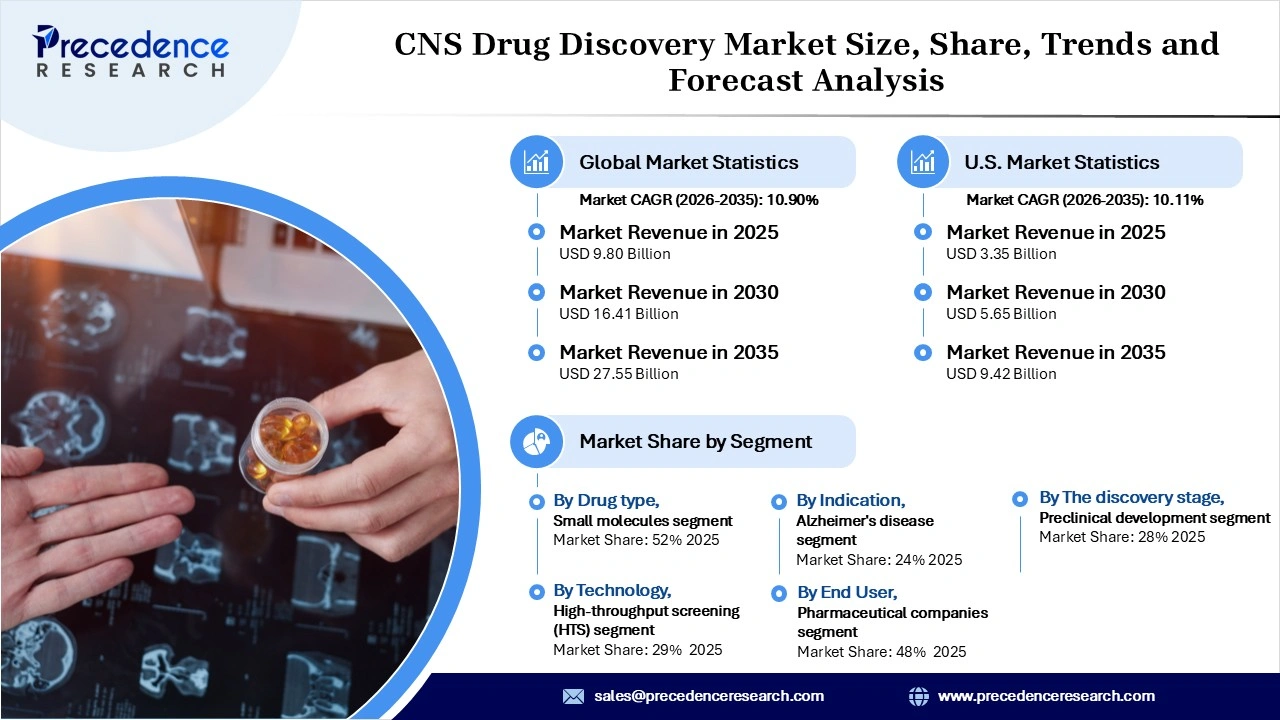
The global CNS drug discovery market revenue was valued at USD 9.80 billion in 2025 and is expected to attain around USD 27.55 billion by 2035, growing at a CAGR of 10.90% during forecast period. The market is driven by the increasing incidences of neurological and psychiatric diseases, including Alzheimer’s, Parkinson’s, depression, and epilepsy, along with the growing need for disease-modifying drugs and breakthrough technologies to bypass the blood-brain barrier.
Exploring the Functioning of the Mind
The CNS drug discovery market comprises the discovery, technology, and service efforts directed towards the development of therapeutic products for conditions affecting the central nervous system (CNS). It includes conditions such as Alzheimer’s disease, Parkinson’s disease, multiple sclerosis, epilepsy, depression, schizophrenia, and chronic pain. Some of the key focus areas of the market include blood-brain barrier (BBB) technology, patient biomarker stratification tools, and human cell models, such as brain organoids.
This market encompasses CROs dedicated to neurology, CNS animal models, and imaging agents used in assessing the interactions between drugs and their targets. It also involves innovative technologies like AI for discovering targets, cell-based models derived from patients, and CNS-penetrating delivery technology. The end users of this market include pharmaceutical and biotechnology companies, academic institutions, and government agencies.
Innovation in Nose-to-Brain Delivery Platform to Improve Peptide Delivery to CNS
The market is moving forward with new non-invasive delivery platforms that do not use the BBB. These approaches are based on direct delivery through neural passages like olfactory and trigeminal pathways. The advantages of using these platforms for peptide drugs include overcoming problems associated with receptor-mediated transcytosis and the cost-effectiveness of drug delivery. In 2026, MetP Pharma AG showed that the intranasal nose-to-brain delivery technology provides a brain-to-plasma ratio higher than 1 and percentage-of-injected dose levels for peptides that lie in the range of high success, significantly surpassing the intravenous drug transporters-based delivery systems.
Emerging CNS Drug Delivery Technologies Reach Regulatory Milestones
There is a trend towards greater use of innovative drug delivery techniques that enable the delivery of biological drugs into the brain. These include engineered receptor-mediated transcytosis shuttles and other advanced methods that have successfully reached late-stage clinical trials and now stand on the brink of regulatory approval. Positive approval will help confirm their use in the market, thereby attracting more investments into such drug classes. In 2026, the FDA approved the drug AVLAYAH by Denali Therapeutics, which is used for the treatment of Hunter syndrome, becoming the first drug belonging to a new group of biotherapeutics using transferrin receptors to deliver drugs through the BBB.
Government Investment Promotes CNS Medication Development
Governments across the world are funding CNS drug research and development programs, which help to de-risk the initial stage of developing new medications for brain conditions like Alzheimer’s and Parkinson’s diseases, augmenting the CNS drug discovery market. The funding helps in sustaining innovation and developing necessary research facilities. The government investment at the state level is a supplement to national-level funding, which helps to fill the gap between neuroscience and clinical practice. In 2025, the government of Pennsylvania, U.S., committed USD 5 million dollars to fund research on neurodegenerative disorders for the first time in history, with a focus on Alzheimer’s, amyotrophic lateral sclerosis (ALS), Parkinson’s, and related disorders.
Aerska Secures USD 39 Million Series A Funding for Brain Shuttle Delivery of Medications
Aerska revealed in 2026 that it had received a total of USD 39 million in Series A funding from EQT Dementia Fund and age1, raising its total capital raised since inception to USD 60 million. The investment will facilitate the development of Aerska’s antibody-oligonucleotide conjugates platform, along with a brain shuttle delivery system for RNA interference-based medicines.
Market Segmentation Overview
- By drug type, the small molecules segment led the CNS drug discovery market with 52% share in 2025, due to its ability to diffuse across the BBB owing to its low molecular weight and lipophilicity, rendering it the best candidate to address diseases of the CNS. Moreover, they are known to be effective orally, and their production is relatively easier and more cost-effective than biologics and gene therapy approaches.
- By drug type, the gene therapies segment is expected to expand at the highest CAGR of 16.5% during the forecast period, owing to the emergence of breakthroughs in the engineering of viral vectors and shuttles of the BBB, which have made it possible to deliver gene therapies effectively to the CNS. As a result, potential therapies for neurological diseases that could not be cured before are now on the horizon.
- By indication, the Alzheimer’s disease segment dominated the market with 24% share in 2025, and is expected to grow at the fastest CAGR of 13.5% from 2026 to 2035, since it is the most common neurodegenerative condition globally, and a large population requires treatments for this condition. This results in robust demand for drugs that can alter the progression of this disease.
- By indication, the depression and anxiety disorders segment held the second largest market share of 18% in 2025, because of its significant prevalence worldwide, and contrary to neurodegenerative disorders that are usually developed at an older age, depression and anxiety disorders can be experienced by individuals of any age. Moreover, due to the low efficacy of the currently available drugs and side effects associated with these drugs, pharmaceutical companies have been consistently researching new drugs to target different neurotransmitter pathways.
- By discovery stage, the preclinical development segment led the CNS drug discovery market with 28% share in 2025, and is expected to expand at the highest CAGR of 12.5% during the forecast period, because more active drug candidates targeting the CNS are at this stage, as many compounds cannot prove their efficacy, safety, and penetration through the BBB. This makes them unable to undergo further development in the pipeline, and thus, the number of drug candidates in further stages decreases.
- By discovery stage, the target identification and validation segment held the second largest market share of 26% in 2025, since it demands heavy investments in genomics, proteomics, and biomarker research to identify relevant targets prior to conducting any drug testing activities.
- By technology, the high throughput screening (HTS) segment dominated the market with 29% share in 2025, owing to its capability to test thousands to millions of molecules against targets for CNS drugs, thereby increasing the speed of identification and cutting the cost per molecule relative to low-throughput screening methods. It can create huge data sets that can be used in AI and machine learning models.
- By technology, the AI-enabled drug discovery segment is expected to grow at the fastest CAGR of 18.6% from 2026 to 2035, due to the ability of AI and machine learning algorithms to quickly process enormous biological data sets to predict BBB permeability, enhance lead molecules, and repurpose approved medicines for use in CNS diseases.
- By end user, the pharmaceutical companies segment led the CNS drug discovery market with 48% share in 2025, because they fund and conduct most of the studies from identifying the target molecule to conducting clinical trials, and optimize potential drugs far more than academic laboratories and contract research organizations (CROs).
- By end user, the biotechnology companies segment is expected to expand at the highest CAGR of 13.8% during the forecast period, since they can be more flexible in going after newer, risky CNS targets as well as innovative drug delivery techniques, which bigger pharmaceutical companies typically do not take up due to their pipeline limitations and risk-averse nature.
Regional Analysis
North America led the CNS drug discovery market with 43% share in 2025, owing to the high level of expenditure on pharmaceutical research and development, excellent academic neuroscience research facilities, and the most vibrant capital community for CNS drug development initiatives. The U.S. dominated the market in North America due to its extensive National Institutes of Health (NIH) funding for brain studies, FDA regulations that help bring innovative neurological drugs to market, and an impressive number of investigational therapies for diseases such as Alzheimer’s and Parkinson’s. Canada is a significant contributor to the market because of its well-established government-funded neuroscience networks and extensive government support for biotechnology research.
Asia-Pacific is expected to expand at the highest CAGR of 14% during the forecast period, due to its huge and aging population, thereby resulting in a significant increase in the number of age-related neurological conditions like Alzheimer’s and Parkinson’s diseases, creating an urgent need for novel treatment modalities. China led the market in Asia-Pacific because of high government investments in neuroscience, rapid growth of the biotechnology industry, and the significant availability of clinical trial sites in the country that facilitate fast patient recruitment at low costs. India witnessed notable market growth owing to the significant prevalence of neurological disorders, a well-developed generic and specialty pharmaceuticals ecosystem, and significant investments in drug discovery research.
Europe held the second-largest market share of 28% in 2025, owing to the excellent collaboration culture between the private and public sectors in research, a well-established regulatory system (EMA), and active investments in neurodegeneration and psychiatry research. Germany dominated the market in Europe because of the presence of top-class neuroscience institutes and high levels of research and development investments for drug discovery. The U.K. is a significant contributor to the market due to its top-notch biomedical research system, mature innovation in trial design processes, and robust financial support by bodies such as U.K. Research and Innovation (UKRI).
CNS Drug Discovery Market Coverage
| Report Attribute | Key Statistics |
| Market Revenue in 2025 | USD 9.80 Billion |
| Market Revenue by 2035 | USD 27.55 Billion |
| CAGR from 2026 to 2035 | 10.90% |
| Quantitative Units | Revenue in USD million/billion, Volume in units |
| Largest Market | Asia Pacific |
| Base Year | 2025 |
| Regions Covered | North America, Europe, Asia-Pacific, Latin America, and the Middle East & Africa |
Top Companies in the CNS Drug Discovery Market
Eli Lilly and Company, Roche, Novartis, and Pfizer are some of the key players that have strong pipelines for various neurological diseases and provide drugs for various disorders such as Alzheimer’s disease, Parkinson’s disease, and psychiatric conditions. AbbVie, Biogen, Bristol Myers Squibb, and Johnson and Johnson Innovative Medicine have a focus on developing therapeutic treatments for Alzheimer’s disease, ALS, and schizophrenia. Otsuka Pharmaceutical, Takeda Pharmaceutical, and UCB specialize in developing medications for neuropsychiatric and movement disorders. Neurocrine Biosciences, Acadia Pharmaceuticals, and Denali Therapeutics provide drugs for tardive dyskinesia, Rett syndrome, Parkinson’s psychosis, and biologics capable of overcoming the BBB.
Segments Covered in This Report
By Drug Type
- Small Molecules
- Biologics
- Gene Therapies
- Cell Therapies
By Indication
- Alzheimer's Disease
- Parkinson's Disease
- Epilepsy
- Multiple Sclerosis
- Schizophrenia
- Depression and Anxiety Disorders
- Others
By Discovery Stage
- Target Identification and Validation
- Lead Identification
- Lead Optimization
- Preclinical Development
By Technology
- High Throughput Screening (HTS)
- Genomics and Proteomics
- AI-enabled Drug Discovery
- Biomarker-based Discovery
- CRISPR and Gene Editing Platforms
By End Use
- Pharmaceutical Companies
- Biotechnology Companies
- Academic and Research Institutes
- Contract Research Organizations (CROs)
By Region
- North America
- Latin America
- Europe
- Asia-pacific
- Middle and East Africa
Get this report to explore global market size, share, CAGR, and trends, featuring detailed segmental analysis and an insightful competitive landscape overview @ https://www.precedenceresearch.com/sample/8474
You can place an order or ask any questions. Please feel free to contact us at sales@precedenceresearch.com |+1 804 441 9344