



Collaborative Whiteboard Software Market Revenue to Attain USD 17.05 Bn by 2035
Published: 13 May 2026
Author: Precedence Research



Collaborative Whiteboard Software Market Revenue and Trends 2026 to 2035
The global collaborative whiteboard software market revenue reached USD 3.80 billion in 2025 and is predicted to attain around USD 17.05 billion by 2035 with a CAGR of 16.20%. The market is being driven by the increasing shift toward agile and hybrid work environments, where organizations, educational institutions, and remote teams require seamless collaboration, brainstorming, planning, and decision-making tools.
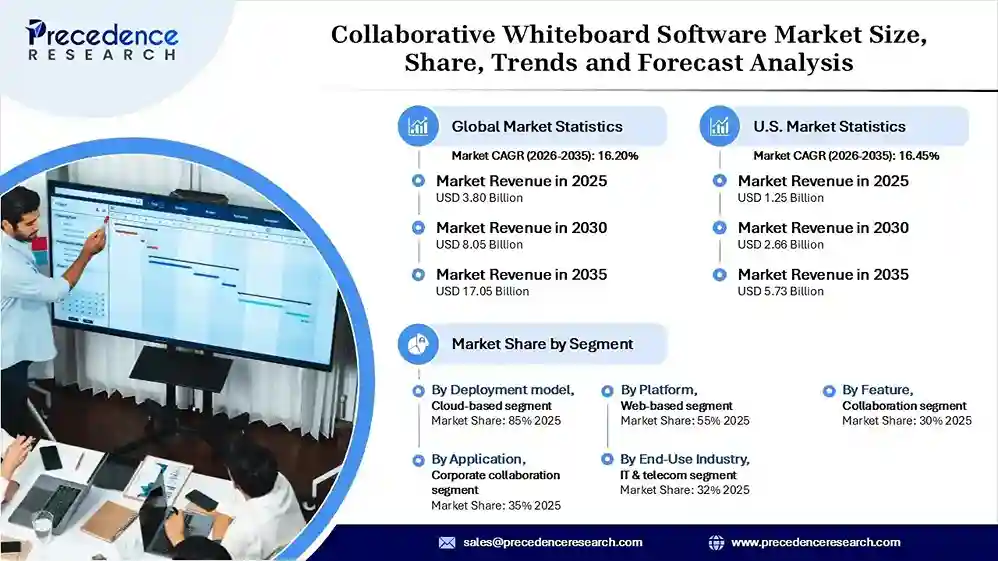
Market at a Glance
The collaborative whiteboard software market consists of digital platforms that enable multiple users to collaborate in real time through brainstorming, workflow visualization, project planning, and instant feedback sharing on a shared virtual workspace. These solutions commonly include features such as templates, sticky notes, diagramming tools, file sharing, and integration with workplace productivity applications.
Demand for collaborative whiteboard software is increasing across businesses, educational institutions, healthcare organizations, consulting firms, and government agencies that require efficient communication and visual collaboration tools. The market includes both cloud-based and on-premise solutions designed to support remote, hybrid, and in-office collaboration across various industries.
What are the Major Trends Impacting the Collaborative Whiteboard Software Market?
AI-Powered Whiteboards Driving Market Innovation
Collaborative whiteboard platforms are evolving from basic digital drawing tools into intelligent collaboration workspaces powered by artificial intelligence. Companies such as Zoom have introduced AI-powered features that can automatically generate sticky notes, tables, text blocks, and mind maps based on user prompts, significantly reducing planning time and improving productivity. As a result, whiteboards are increasingly becoming active productivity and ideation platforms rather than passive meeting tools.
Rising Demand for Hybrid Work Solutions
The continued adoption of hybrid work models is creating strong demand for tools that provide equal collaboration experiences for both in-office and remote employees. Organizations are increasingly investing in integrated digital collaboration environments that seamlessly connect communication, project management, and brainstorming workflows. Platforms such as Microsoft Teams continue to expand collaboration capabilities to support evolving workplace requirements through 2025 and beyond.
Market Segmentation Overview
- By deployment model, the cloud-based segment dominated the collaborative whiteboard software market with a 85.0% share in 2025 and is expected to maintain its leading position with a CAGR of 18.5% in the coming years. This is because of growing interest among organizations in Software as a Service (SaaS) models. Cloud platforms provide continuous updates, flexible subscription plans, and high scalability, making them ideal for businesses, educational institutions, and distributed teams.
- By platform, the web-based segment accounted for a significant revenue share of 55.0% in the market in 2025, due to its easy browser accessibility and minimal installation requirements. These platforms allow users to collaborate seamlessly across multiple devices without requiring specialized hardware or software.
- By platform, the mobile-based segment is expected to grow at the fastest CAGR of 18.5% in the market between 2026 and 2035, driven by the rising importance of mobile workforces and remote accessibility. Field teams, traveling professionals, and remote employees increasingly rely on smartphones and tablets for real-time collaboration, updates, and participation while on the move.
- By feature, the real-time collaboration segment held a major revenue share of 30.0% in the market in 2025, as it remains the core functionality of collaborative whiteboard platforms. This feature enables cross-functional teams in different geographic locations to brainstorm, plan, and communicate efficiently in real time.
- By feature, the AI-enabled collaboration segment is expected to grow at the fastest CAGR of 22.5% in the market in 2025, driven by growing demand for automation in ideation, summarization, workflow mapping, and task generation. AI-powered whiteboards are transforming these platforms from static collaboration tools into intelligent decision-making and productivity solutions.
- By application, the corporate collaboration segment accounted for a considerable revenue share of 35.0% in the collaborative whiteboard software market in 2025, due to the widespread adoption of hybrid work models. Organizations increasingly shifted from traditional meeting-room solutions to digital collaboration platforms for agile workflows, brainstorming sessions, project reviews, and strategic planning across distributed teams.
- By application, the education & e-learning segment is expected to expand rapidly in the market with a CAGR of 17.5% in the coming years, supported by the rapid adoption of digital classrooms worldwide. Schools, universities, tutors, and training organizations are increasingly using collaborative whiteboards for live teaching, visual learning, and interactive student engagement.
- By end-use industry, the IT & telecom segment accounted for a considerable revenue share of 32.0% in the collaborative whiteboard software market in 2025 due to the strong integration of digital collaboration into software development, agile project management, network planning, and technical support operations. These industries rely heavily on whiteboard platforms to manage distributed teams and visualize complex workflows effectively.
- By end-use industry, the education segment is expected to grow at the fastest CAGR of 18.5% in the market between 2026 and 2035, driven by the increasing acceptance of online and hybrid learning models. Educational institutions are investing in interactive technologies that replicate classroom collaboration, support group learning, and improve remote learning experiences.
Regional Analysis
North America dominated the global collaborative whiteboard software market with a major share of 44.0% in 2025, driven by strong remote work adoption and sustained demand for digital collaboration tools. The region’s mature SaaS ecosystem and widespread cloud adoption accelerated enterprise deployment of whiteboard platforms. The U.S. remained the largest revenue contributor due to the strong presence of companies such as Microsoft, Google, and Zoom. Canada also supported regional growth through increasing workplace digitization, education technology investments, and flexible work culture adoption.
Asia Pacific held a market share of 20.0% in 2025 and is expected to grow at the fastest CAGR of 21.5% during the forecast period. This growth is driven by expanding remote education infrastructure, rapid SME digitization, and increasing adoption of cost-effective cloud collaboration tools. India is expected to emerge as a major growth market due to its expanding startup ecosystem, rising hybrid work culture, and growing edtech sector. Meanwhile, China continues to benefit from large-scale enterprise digitization initiatives, mobile-first work habits, and rapid adoption of collaborative tools across educational and corporate environments.
Collaborative Whiteboard Software Market Coverage
| Report Attribute | Key Statistics |
| Market Revenue in 2025 | USD 3.80 Billion |
| Market Revenue by 2035 | USD 17.05 Billion |
| CAGR from 2026 to 2035 | 16.20% |
| Quantitative Units | Revenue in USD million/billion, Volume in units |
| Largest Market | North America |
| Base Year | 2025 |
| Regions Covered | North America, Europe, Asia-Pacific, Latin America, and the Middle East & Africa |
Top Companies in the Collaborative Whiteboard Software Market
Microsoft remains a powerful force through Whiteboard’s integration with Teams and Microsoft 365, while Google leverages Workspace to embed collaboration into everyday productivity flows. Miro and Mural continue to shape the category with enterprise-grade visual planning, brainstorming, and workshop tools widely used by distributed teams. Zoom Video Communications and Cisco Systems extend whiteboarding through meeting ecosystems, making visual collaboration a natural part of virtual communication. Stormboard, Conceptboard, and AWW App focus on structured brainstorming, project mapping, and easy-to-use online whiteboards for business and education users.
Segments Covered in the Report
By Deployment Model
- Cloud-based
- On-premise
By Component
- Software
- Services
By Platform
- Web-based
- Mobile-based
- Desktop-based
By Feature
- Real-time Collaboration
- Visual Planning & Brainstorming
- Diagramming & Flowcharting
- Integration with Productivity Tools
- AI-enabled Collaboration
By Organization Size
- Large Enterprises
- Small & Medium Enterprises (SMEs)
By Application
- Corporate Collaboration
- Education & E-learning
- Design & Product Development
- Project Management
By End-Use Industry
- IT & Telecom
- Education
- BFSI
- Healthcare
- Media & Entertainment
- Government
By Region
- North America
- Latin America
- Europe
- Asia-pacific
- Middle and East Africa
Get this report to explore global market size, share, CAGR, and trends, featuring detailed segmental analysis and an insightful competitive landscape overview @ https://www.precedenceresearch.com/sample/8402
You can place an order or ask any questions. Please feel free to contact us at sales@precedenceresearch.com |+1 804 441 9344