



Dementia Care Market Revenue to Attain USD 46.97 Bn by 2035
Published: 09 Jun 2026
Author: Precedence Research



Dementia Care Market Revenue and Trends 2026 to 2035
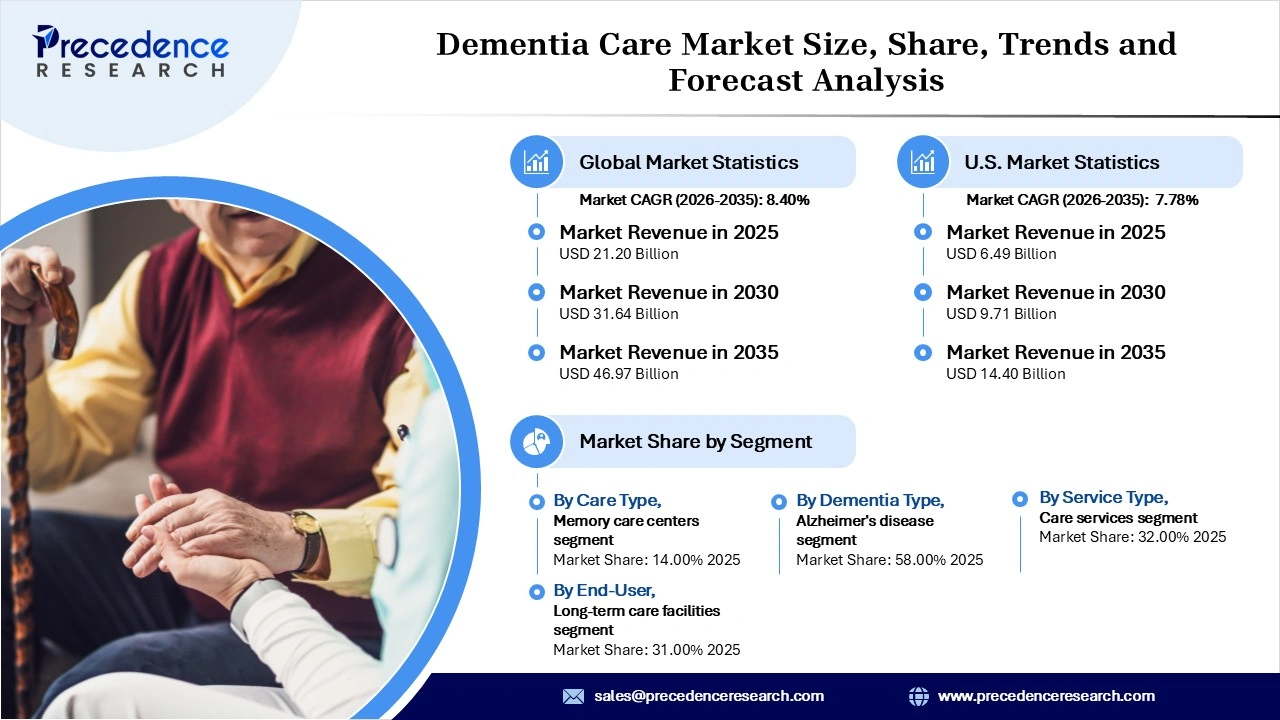
The global dementia care market revenue was valued at USD 21.20 billion in 2025 and is expected to attain around USD 46.97 billion by 2035, growing at a CAGR of 8.40% during forecast period. The market is driven by the growing aging population around the globe, the increasing incidence of Alzheimer’s disease and other neurodegenerative diseases, as well as the rising need for home care services.
Dementia Care: Market Overview
The dementia care market includes a wide range of products, services, and technologies designed to support individuals living with dementia, including vascular dementia, Lewy body dementia, and frontotemporal dementia. It covers medications for symptom management, alternative therapies such as cognitive stimulation, and supportive care approaches to improve quality of life.
The market also encompasses long-term care services such as nursing homes, assisted living facilities, memory care units, and home care solutions. In addition, the market includes assistive technologies, digital health tools, and caregiver support services and is utilized by hospitals, clinics, professional caregivers, and respite care providers.
What are the Major Trends Influencing the Market?
Development of Non-Invasive Neuromodulation Devices
The dementia care market is undergoing a major transformation with the development of non-invasive neuromodulation devices that aim to address underlying disease pathology rather than only managing symptoms. These innovations use approaches such as low-intensity pulsed ultrasound, gamma-frequency light and sound stimulation, and vagal nerve stimulation to enhance brain clearance of neurotoxins and improve cognitive function.
- In 2026, Sound Wave Innovation (SWI), a Tohoku University spin-off, raised USD 240 million in Series C funding to advance Phase 3 clinical trials of its LIPUS-Brain headset, designed to treat early-stage Alzheimer’s disease. This reflects growing investor confidence in device-based therapeutic solutions within dementia care.
Early Detection of Cognitive Impairment Through AI-Driven Wearables
People are increasingly relying on wearables as a way of continuously detecting the first signs of brain diseases, well before the onset of actual clinical symptoms. This technology analyzes changes in digital biomarkers like gait, verbal flow rate, and sleep pattern stability to predict potential risks for people living at home without any medical equipment or consultations.
- In 2026, Samsung introduced Brain Health, an AI-based solution built into the Samsung Health platform, which detects digital biomarkers, like dementia and Alzheimer’s, potentially up to a decade before the onset of symptoms.
Government Strategies and Funding for Dementia Patients’ Care
Governments across the world are undertaking initiatives aimed at accelerating dementia research and increasing the availability of healthcare services to both patients and caregivers. Governments intend to create national standards for diagnosis and treatment, which ultimately boosts the market for medical devices, diagnostics, and community healthcare. In 2026, the Government of Canada announced a USD 3.38 million investment initiative under its Dementia Community Investment program, investing in six new projects aimed at benefiting community organizations.
Survey Indicates Low Usage and Coverage Shortcomings of Digital Dementia Solutions
A survey conducted by COMFORTage and Frailty Solutions in October 2025 involving 8 European countries revealed that merely 20% of respondents had ever used digital dementia interventions, whereas nearly all healthcare providers regarded high emotional burden on carers as a key issue. Moreover, 50% of providers were not sure whether they could receive compensation for AI-based dementia interventions, and only 1 in 20 had full public insurance.
Market Segmentation Overview
- By care type, the home-based care segment led the dementia care market with a 34% share in 2025 and is expected to expand at the highest CAGR of 9.6% during the forecast period, since most dementia patients prefer a comfortable place. Home-based care is more economical compared to facility-based care and also allows for creating customized and comfortable settings that limit agitated behavior.
- By care type, the assisted living facilities segment held the second-largest market share of 21% in 2025 and is expected to grow at a 7.9% CAGR over the forecast period. This is because these facilities offer an ideal balance between home care and nursing home services for dementia sufferers in need of greater assistance than what could be provided at home, but not as serious as to warrant nursing homes.
- By dementia type, the Alzheimer’s disease segment dominated the market with a 58% share in 2025 and is expected to grow at the fastest CAGR of 8.9% from 2026 to 2035. This is primarily due to the fact that it is one of the most prevalent forms of dementia, contributing to 60 to 80% of all dementia diagnoses worldwide, resulting in the highest need for advanced treatments.
- By dementia type, the vascular dementia segment held the second-largest market share of 16% in 2025 owing to the fact that it can be caused by strokes and cerebrovascular diseases; hence, there exists a sizeable number of patients suffering from this disorder.
- By service type, the medical care services segment led the dementia care market with a 32% share in 2025 because patients suffering from dementia need constant monitoring, which involves the diagnosis, prescription of medications, and treatment of other diseases they might have, alongside checking the progress of the illness.
- By service type, the remote monitoring & digital care segment is expected to expand at the highest CAGR of 11.3% during the forecast period. This is because these services help to monitor the safety, compliance, and cognition of patients digitally, which reduces caregiver strain and prevents premature institutionalization.
- By end-use, the hospitals segment dominated the dementia care market with a 28% share in 2025, driven by their key role in early diagnosis, acute care management, and handling complications such as infections, falls, and behavioral disturbances. Hospitals remain central to dementia care delivery due to their access to specialized medical expertise and emergency care infrastructure.
- By end-use, the homecare settings segment is expected to grow at the fastest CAGR of 10.2% from 2026 to 2035, supported by a growing preference among patients to age in place rather than in institutional facilities. This shift is further enabled by advancements in remote monitoring, telehealth services, and digital caregiving solutions that enhance care quality at home.
Regional Analysis
North America led the dementia care market with a 39% share in 2025 due to the high prevalence of Alzheimer’s disease, the early adoption of new diagnostic and memory care technologies, as well as efficient reimbursement schemes that cover the expenses of pricey care options. The U.S. dominated the market in North America because of significant government healthcare spending, for example, the National Plan to Address Alzheimer’s disease, and well-developed infrastructure for memory care facilities. Canada is a significant contributor to the market owing to its favorable healthcare policies that provide universal access to the diagnosis, treatment, home and assisted care for people with dementia.
Asia Pacific is expected to expand at the highest CAGR of 10.5% during the forecast period, driven by the region’s large and rapidly aging population, which is increasing the prevalence of dementia and boosting demand for caregiving services, diagnostics, and caregiver support. China leads the regional market due to its significant elderly population and the expansion of long-term care insurance, which is transitioning from pilot programs to full-scale implementation. India is also witnessing strong growth, supported by a rising geriatric population, limited availability of specialized dementia care facilities, and increasing government initiatives alongside rapid development of geriatric healthcare infrastructure.
Dementia Care Market Coverage
| Report Attribute | Key Statistics |
| Market Revenue in 2025 | USD 21.20 Billion |
| Market Revenue by 2035 | USD 46.97 Billion |
| CAGR from 2026 to 2035 | 8.40% |
| Quantitative Units | Revenue in USD million/billion, Volume in units |
| Largest Market | North America |
| Base Year | 2025 |
| Regions Covered | North America, Europe, Asia-Pacific, Latin America, and the Middle East & Africa |
Top Companies in the Dementia Care Market
Eli Lilly and Company, Eisai, Biogen, and Roche are some of the key players that produce FDA-approved anti-amyloid antibodies. Novartis, AbbVie, and Otsuka Pharmaceutical offer symptomatic treatments as well as non-amyloid drugs. TauRx Pharmaceuticals, BioArctic, and AC Immune are working with tau targets, developing antibodies and vaccines. Alzheon and Anavex Life Sciences focus on small oral molecules aimed at treating neuroinflammation, protein aggregation, and synaptic dysfunction.
Segments Covered in the Report
By Care Type
- Home-based Care
- Adult Day Care
- Assisted Living Facilities
- Nursing Home Care
- Memory Care Centers
By Dementia Type
- Alzheimer's Disease
- Vascular Dementia
- Lewy Body Dementia
- Frontotemporal Dementia
- Mixed Dementia
- Others
By Service Type
- Medical Care Services
- Cognitive Therapy Services
- Rehabilitation Services
- Palliative & Supportive Care
- Remote Monitoring & Digital Care
By End-Use
- Hospitals
- Specialty Neurology Clinics
- Long-term Care Facilities
- Homecare Settings
By Therapy & Support
- Pharmacological Care
- Non-pharmacological Care
By Region
- North America
- Latin America
- Europe
- Asia-pacific
- Middle and East Africa
Get this report to explore global market size, share, CAGR, and trends, featuring detailed segmental analysis and an insightful competitive landscape overview @ https://www.precedenceresearch.com/sample/8461
You can place an order or ask any questions. Please feel free to contact us at sales@precedenceresearch.com |+1 804 441 9344