



Digital Accessibility Software Market Revenue to Attain USD 2,330.57 Mn by 2035
Published: 01 Jul 2026
Author: Precedence Research



Digital Accessibility Software Market Revenue and Trends 2026 to 2035
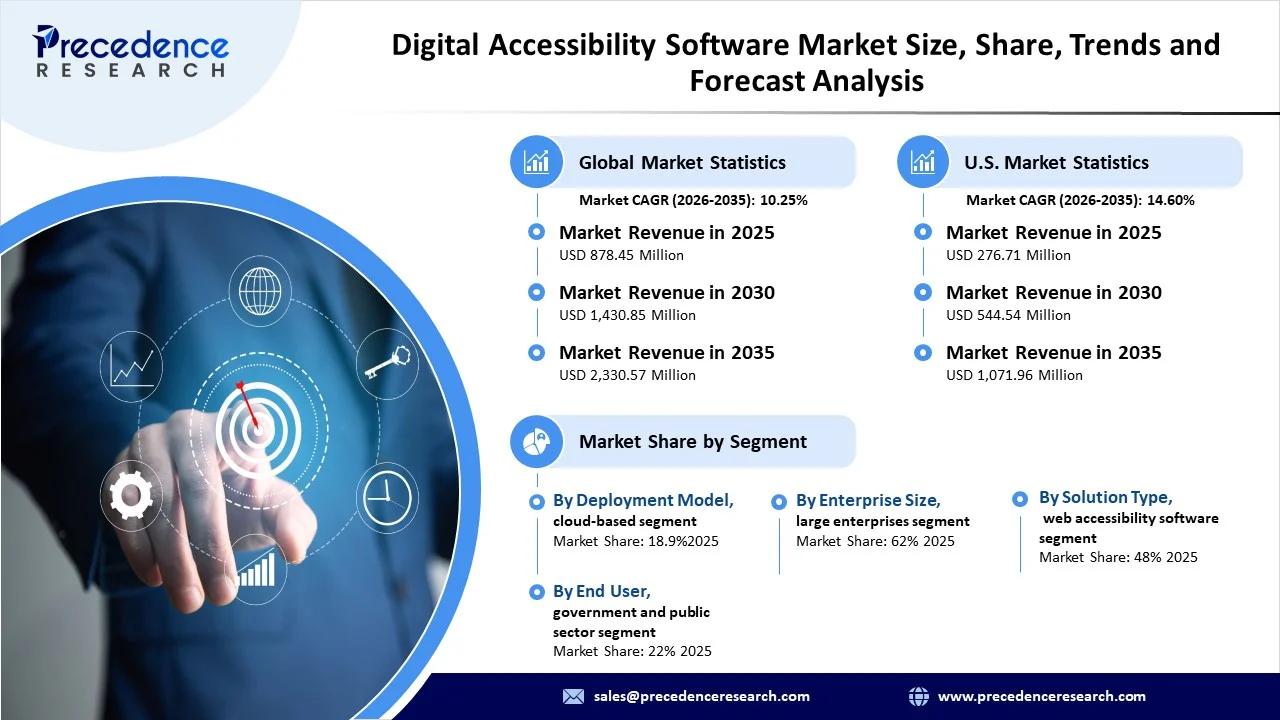
The global digital accessibility software market revenue surpassed USD 878.45 million in 2025 and is predicted to attain around USD 2,330.57 million by 2035, growing at a CAGR of 10.25%. The market is driven by increasing regulations, including the ADA (Americans with Disabilities Act), the European Accessibility Act, and WCAG compliance, along with organizations’ realization of the need to be inclusive in digital content and the liabilities associated with failing to do so.
Making Digital Technologies More Inclusive
The digital accessibility software market consists of software, platforms, and services that are intended to ensure that digital content, apps, and websites are made accessible to individuals suffering from various disabilities, whether visual, auditory, physical, cognitive, or speech-related. This market involves accessibility overlays and other assistive technologies, such as speech-to-text software, alternative input devices, and built-in features of the platform, including captioning, keyboard navigation, and high-contrast mode. The market is experiencing rapid adoption of machine learning algorithms that predict access violations before deployment, natural language processing algorithms that provide accurate alt-text for images, and computer vision models that detect color contrast.
This market encompasses desktop, mobile, and web applications, including those used in government, education, healthcare, the financial sector, e-commerce, and media. This market includes AI-powered accessibility tools for automatic remediation and user-specific personalization. Enterprises, governmental organizations, small businesses, and individuals primarily adopt digital accessibility software. The market is moving away from the overlay approach to proactive and integrated approaches in testing and remediation processes because of the legal enforcement of compliance with the Americans with Disabilities Act (ADA) and Section 508.
Agentic AI and Automated Remediation Revolutionize the Market
The market is evolving through the incorporation of agentic AI solutions that automate the scanning and certification of any potential accessibility problems on digital assets. They automatically detect and fix simple violations, and alert users about more complicated cases that need further analysis. This development helps reduce the costs related to compliance with various standards such as WCAG, ADA, and Section 508. SHI International, along with HPE, NVIDIA, and Kamiwaza, unveiled a complete solution for Section 508 compliance in 2025. The solution employs Kamizawa’s agentic AI “ARIA” (Accessibility Remediation Intelligence Agent) to automatically scan and fix potential accessibility problems. It is powered by NVIDIA GPUs and HPE private cloud in order to help government agencies become WCAG compliant in weeks rather than years with conventional methods.
AI-Driven Digital Accessibility Software Gains More Enterprise Adoption
The digital accessibility software market is being increasingly adopted by organizations integrating AI-powered digital accessibility tools right into their development and compliance operations. Organizations need to comply with various regulations and make scalability possible across their large digital asset base. These needs prompt them to adopt automated solutions that help them fix the problems of accessibility and scalability. In 2025, Level Access rolled out new AI accessibility agents aimed at helping organizations identify problems earlier, resolve them more quickly, and validate their performance against development cycles and regulation requirements. The agents are meant to be embedded directly into existing DevOps processes, audit cadences, and reporting procedures to cut down efforts and show return on investment.
Regulatory Requirements Drive Digital Accessibility Solutions Adoption
Governments across the globe have passed or revised regulations to mandate that businesses provide digital accessibility for their websites, applications, and services. Such laws stipulate that firms must make their digital products and services accessible to users with disabilities, who use screen readers, voice command systems, and other assistive technologies. The European Accessibility Act (EAA), which was enforced in 2025, mandates businesses to design and offer digital products and services such as e-commerce websites, banking applications, and online platforms that are easily accessible to users with disabilities. It applies to any digital product or service offered in the EU market, and violations attract penalties from regulators.
DevAlly Secures USD 2.3 Million Pre-Seed Investment to Scale its AI Accessibility Solution
DevAlly, an Irish technology company located in Dublin, raised USD 2.3 million in a pre-seed round to develop its AI-enabled platform designed to help enterprises identify and resolve accessibility problems and comply with the European Accessibility Act. This act has sparked a huge demand for compliance solutions, prompting companies to make their digital platforms compliant with the regulations. DevAlly intends to increase its staff from 5 to 15 people, mainly in Dublin, to enter the US market faster.
Market Segmentation Overview
- By deployment model, the cloud-based segment led the digital accessibility software market with 68% share in 2025 and is expected to expand at the highest CAGR of 18.9% during the forecast period, because the software that makes websites accessible requires frequent updates to keep pace with changes in the guidelines provided by WCAG and other regulatory bodies. This segment facilitates automatic instant updates without the need for patching and upgrading the software manually.
- By deployment model, the on-premise segment held the second-largest market share of 32% in 2025, owing to the fact that government bodies, defense companies, and finance firms need total control over their user data and internal documents, which means that they cannot outsource the accessibility testing and remediating process.
- By enterprise size, the large enterprises segment dominated the market with 62% share in 2025, due to their massive digital estate, facing greater regulatory scrutiny and litigation exposure, and requiring an end-to-end accessibility solution. Large enterprises have separate compliance departments along with enough IT manpower to make investments in AI-based continuous monitoring systems.
- By enterprise size, the SMEs segment is expected to grow at the fastest CAGR of 19.6% from 2026 to 2035, because of the confluence of relatively inexpensive, subscription-based accessibility platforms, which help to cut down the need for a specialized compliance team. The growing regulatory pressure is prompting many small businesses to adopt sophisticated digital accessibility solutions to ensure adherence to laws.
- By solution type, the web accessibility software segment led the digital accessibility software market with 48% share in 2025, since websites and web applications are the main touchpoints where customers engage, conduct business transactions, and receive services. This segment is easy to audit and remediate using automated scanning and AI technology.
- By solution type, the mobile accessibility software segment is expected to expand at the highest CAGR of 22.4% during the forecast period, due to the fact that mobile applications have emerged as the main interface for banking, e-commerce, healthcare, and governmental agencies. Regulations such as the European Accessibility Act directly mention mobile applications as being included in the scope of regulations.
- By end user, the government and public sector segment dominated the market with 22% share in 2025, because these institutions are legally required to abide by accessibility legislation. Public sector organizations have large digital assets as well as the greatest liability risk of litigation and public scrutiny. This promotes continuous investment in enterprise-grade digital accessibility solutions.
- By end user, the retail and e-commerce segment is expected to grow at the fastest CAGR of 18.9% from 2026 to 2035, since online shopping is rapidly growing in popularity, and there is an increasing need to contend with an explosion of ADA lawsuits. There is a quick transition to digital platforms, where retailers are rapidly adopting headless commerce and AI-powered personalization.
Regional Analysis
North America led the digital accessibility software market with 42% share in 2025, due to its early and vigorous implementation of accessibility laws, a large number of accessibility lawsuits filed, and a developed enterprise technology industry where compliance is important. The U.S. dominated the market in North America because thousands of website accessibility lawsuits are filed every year, which has made organizations implement digital accessibility scanning and remediation software solutions. Canada is a significant contributor to the market owing to the implementation of accessibility legislation and initiatives launched by the government to boost digital accessibility, together with an increasing number of organizations using digital accessibility software solutions.
Asia-Pacific is expected to expand at the highest CAGR of 21.2% during the forecast period, because of the presence of the largest number of internet users in the world, a rapidly digitizing economy, which is concerned about digital accessibility issues in accordance with both internal regulations and external trade pressures. China led the market in Asia Pacific due to its huge population of internet users, significant government support to organizations to become more digitally inclusive, and growth in e-commerce and mobile platforms that need to be widely accessible to comply with international trade requirements. India witnessed notable market growth owing to its rapidly growing digital infrastructure, a high number of internet users, and rising awareness regarding digital inclusivity due to the Rights of Persons with Disabilities Act.
Europe held the second-largest market share of 29% in 2025, due to its early implementation of extensive legislation with respect to accessibility laws such as the European Accessibility Act (EAA), which established an all-inclusive mechanism among 27 member countries, generating huge demand for accessibility testing and software. Germany dominated the market in Europe owing to its flourishing manufacturing, automobile, and financial service industries, which are rapidly adopting accessibility platforms to ensure compliance with the EAA and save themselves from hefty fines. France is a significant contributor to the market because of its progressive government measures related to digital inclusion and the renovation of public sector websites as per the Referentiel General d’Amelioration de l’Accessibilité (RGAA).
Digital Accessibility Software Market Coverage
| Report Attribute | Key Statistics |
| Market Revenue in 2025 | USD 878.45 Million |
| Market Revenue by 2035 | 2,330.57 Million |
| CAGR from 2026 to 2035 | 10.25% |
| Quantitative Units | Revenue in USD million/billion, Volume in units |
| Largest Market | North America |
| Base Year | 2025 |
| Regions Covered | North America, Europe, Asia-Pacific, Latin America, and the Middle East & Africa |
Top Companies in the Digital Accessibility Software Market
UserWay, accessible, and EqualWeb are some of the key players that offer AI-based automation tools for accessible websites. Level Access and Crownpeak are enterprise-level digital accessibility platform providers featuring testing, monitoring, and remediation capabilities. Siteimprove, Monsido, and DubBot provide web governance and quality assurance platforms that include scanning and monitoring capabilities for website accessibility compliance. Deque Systems and TPGI specialize in accessibility testing and consulting with features like manual testing, training, and audits. AudioEye is a hybrid accessibility platform provider with both automation testing and expert human remediation.
Segments Covered in This Report
By Deployment Model
- Cloud-Based
- On-Premise
By Enterprise Size
- Large Enterprises
- SMEs
By Solution Type
- Web Accessibility Software
- Accessibility Testing & Monitoring
- Document Accessibility Software
- Mobile Accessibility Software
- Other Accessibility Solutions
By End User
- BFSI
- Government and Public Sector
- Retail and E-Commerce
- Healthcare
- Education
- IT and Telecom
- Others
By Region
- North America
- Latin America
- Europe
- Asia-pacific
- Middle and East Africa
Get this report to explore global market size, share, CAGR, and trends, featuring detailed segmental analysis and an insightful competitive landscape overview @ https://www.precedenceresearch.com/sample/8529
You can place an order or ask any questions. Please feel free to contact us at sales@precedenceresearch.com |+1 804 441 9344