



Electronic Control Access Systems Market Revenue to Attain USD 155.59 Bn by 2035
Published: 02 Apr 2026
Author: Precedence Research



Electronic Control Access Systems Market Revenue and Trends 2026 to 2035
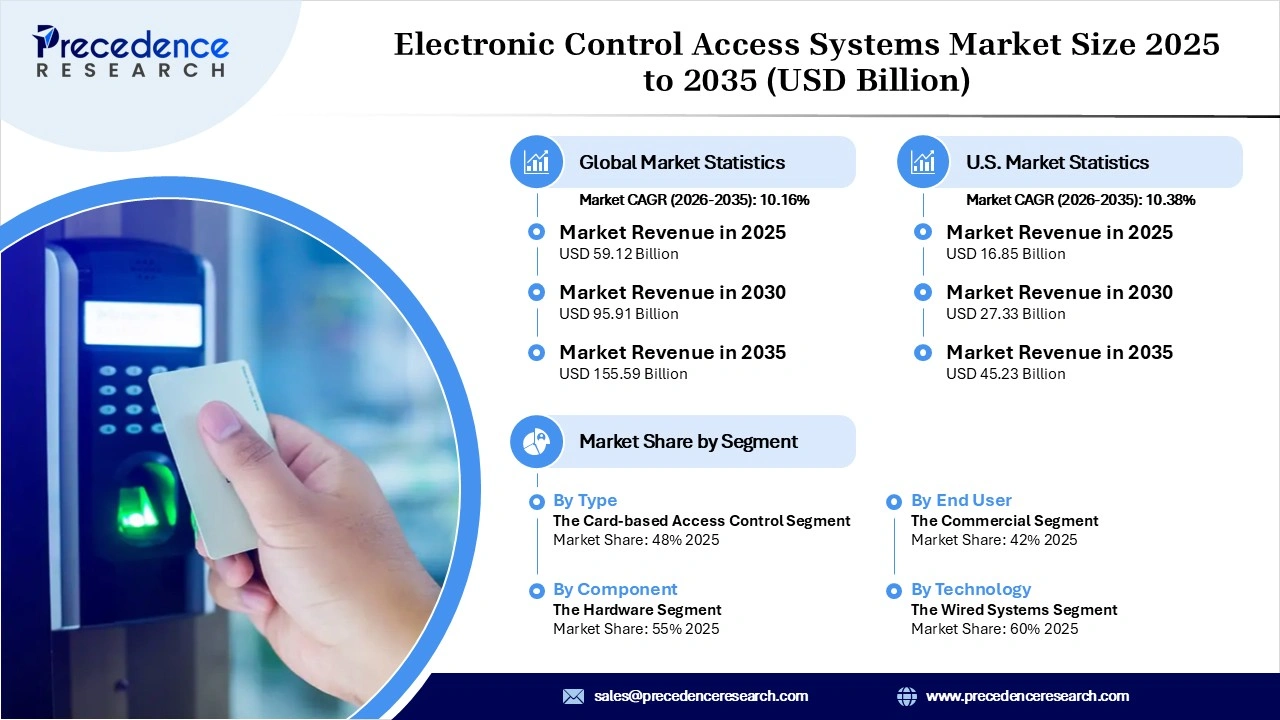
The global electronic control access systems market revenue was valued at USD 59.12 billion in 2025 and is expected to attain around USD 155.59 billion by 2035, growing at a CAGR of 10.16% during forecast period. The electronic access control systems market is quietly redefining how spaces are secured, shifting from keys and cards to intelligent, identity-driven systems that decide who gets in and when in real time.
Market at a Glance
Electronic access control systems are employed to control and restrict access to both physical and digital spaces, utilizing electronic credentials rather than locks. It consists of hardware devices such as card readers and biometric scanners, which monitor and authenticate the entrances and log them in real time. These systems are used in offices, hospitals, factories, and residential complexes, and they are also becoming increasingly linked to wider security ecosystems that offer not just management options but better visibility and accountability.
The electronic access control systems market encompasses everything from standalone door controllers to advanced cloud-based security platforms. The growth of the market is driven by the rise of intelligent buildings, which integrate IoT networks, communication technologies, and surveillance systems. Additionally, data-centric management, real-time environmental monitoring, and cybersecurity optimization are becoming critical for both virtual and physical infrastructure.
What Drives the Electronic Control Access Systems Market?
The electronic access control systems market is primarily driven by the rise of smart and connected buildings, where integrated IoT networks enable real-time monitoring, data sharing, and centralized management of security. Growing concerns over cybersecurity and physical security are prompting organizations to adopt advanced access solutions, including cloud-based systems and mobile credentials. Additionally, the convenience, scalability, and cost-efficiency of these technologies are encouraging widespread deployment across commercial, industrial, and institutional sectors. The increasing use of biometrics and intelligent authentication methods further supports market growth by enhancing security and reducing operational bottlenecks.
Market Dynamics: Adoption Trends and Technological Advances in Access Control
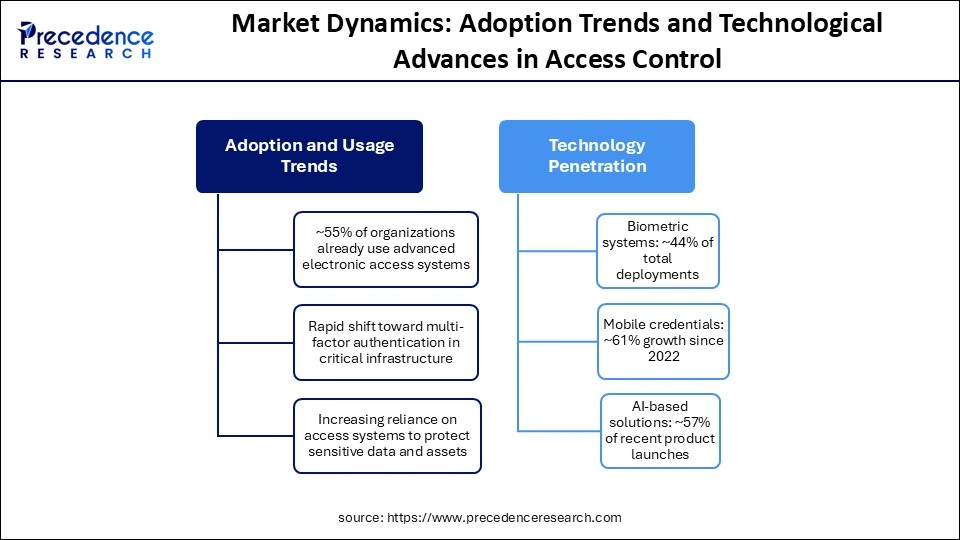
The diagram illustrates the current landscape of the electronic access control systems market, highlighting significant shifts in both organizational adoption and technological integration.
Market Segmentation Overview
- By type, the card-based access control segment held a major market share of 48% in 2025, due to its dependability, cost-effectiveness, and ease of deployment. Its compatibility with existing security systems made it especially popular in commercial settings, where scalability and simplicity often take precedence over advanced features.
- By type, the biometric access control segment is expected to grow at the highest CAGR in the market during the studied years, owing to the increasing demand for robust identity verification. Advances in facial and fingerprint recognition technologies, combined with concerns over unauthorized access, are encouraging organizations to adopt biometric solutions that verify individual identities rather than relying on easily transferable credentials.
- By component, the hardware segment led the global electronic control access systems market with a major share of 55% in 2025. This is because hardware solutions like readers, controllers, and locking mechanisms are key components of the electronic control access systems. Despite advances in software, these hardware components remain crucial for securing both new installations and existing facilities.
- By component, the software segment is expected to grow at the fastest CAGR in the market between 2026 and 2035 due to the rising adoption of cloud-based platforms and AI-driven analytics, which enable centralized management, remote monitoring, and real-time decision-making. Organizations are increasingly valuing data insights, predictive security, and integration with IoT networks, which make software-driven solutions more flexible, scalable, and efficient compared to traditional hardware-only systems.
- By end user, the commercial segment held a major market share of 42% in 2025, driven by widespread adoption of control access systems in offices, retail spaces, and the hospitality industry. These systems allow organizations to efficiently monitor employee and visitor movements while maintaining seamless operations, which is especially important in high-traffic environments. Their ease of integration, scalability, and ability to enhance operational security make them highly attractive for commercial applications.
- By end user, the residential segment is expected to gain the highest share of the market between 2026 and 2035, driven by the rising adoption of smart home technologies and heightened concerns for personal safety. Homeowners increasingly seek solutions that offer remote management, instant alerts, and seamless integration with other connected devices. These features not only provide convenience but also enhance security, making advanced access control an attractive addition to modern homes.
- By technology, the wired systems segment held a major revenue share of 60.0% in the market in 2025, largely due to its reliability in critical environments. Their stable connectivity and resistance to interference made them the preferred choice for legacy infrastructure and high-security facilities. In such settings, consistent performance was valued more than the flexibility offered by newer, wireless technologies.
- By technology, the wireless systems segment is expected to expand rapidly in the market in the coming years, driven by increasing demand for flexible and scalable solutions. These systems provide reliable connectivity and strong interference resistance, making them suitable for secure environments and legacy infrastructure. Their versatility allows easier integration and expansion compared to traditional wired setups, supporting modern, dynamic security requirements.
Regional Analysis
North America dominated the global electronic control access systems market with the largest share in 2025, driven by early adoption of advanced security technologies in commercial and institutional buildings. Major industry players, widespread smart building integration, and strict security regulations contributed to making digital access systems standard rather than optional. The U.S. spearheaded market growth with extensive enterprise implementation, while Canada showed steady expansion in commercial infrastructure and public facilities, boosting the demand for security solutions.
Asia Pacific is expected to grow at the fastest CAGR in the market during the forecast period. This is mainly due to rapid urbanization, increasing security concerns, and the shift toward smart, digitally integrated buildings. Governments and businesses are upgrading legacy systems, while the adoption of advanced, intelligent access solutions accelerates deployment. Additionally, countries like China, India, and Japan are investing heavily in large-scale urban projects, commercial infrastructure, and high-efficiency, technology-driven systems, further fueling market growth.
Electronic Control Access Systems Market Coverage
| Report Attribute | Key Statistics |
| Market Revenue in 2025 | USD 59.12 Billion |
| Market Revenue by 2035 | USD 155.59 Billion |
| CAGR from 2026 to 2035 | 10.16% |
| Quantitative Units | Revenue in USD million/billion, Volume in units |
| Largest Market | North America |
| Base Year | 2025 |
| Regions Covered | North America, Europe, Asia-Pacific, Latin America, and the Middle East & Africa |
Top Companies in the Electronic Control Access Systems Market
Several companies are leveraging their expertise to compete in the market. Johnson Controls International plc and Honeywell International Inc. integrate access control into large smart buildings and infrastructure projects, enhancing automation and connectivity. ASSA ABLOY AB and Allegion plc maintain leadership in physical access solutions through comprehensive offerings of locks, readers, and identity management systems. Meanwhile, Axis Communications AB is innovating by combining access control with IP-based surveillance, creating more integrated security ecosystems.
Segments Covered in the Report
By Type
- Card-Based Access Control
- Biometric Access Control
- Keypad-Based Access Control
- Mobile-Based Access Control
By Component
- Hardware
- Controllers
- Readers
- Locks
- Software
- Services
By End User
- Commercial
- Government & Defense
- Residential
- Industrial
By Technology
- Wired Systems
- Wireless Systems
By Region
- North America
- South America
- Asia Pacific
- Europe
- MEA
Get this report to explore global market size, share, CAGR, and trends, featuring detailed segmental analysis and an insightful competitive landscape overview @ https://www.precedenceresearch.com/sample/8265
You can place an order or ask any questions, please feel free to contact us at sales@precedenceresearch.com |+1 804 441 9344