



Emotion AI Market Revenue to Attain USD 311.99 Bn by 2035
Published: 08 Apr 2026
Author: Precedence Research



Emotion AI Market Revenue and Trends 2026 to 2035
The global emotion AI market revenue was valued at USD 9.10 billion in 2025 and is expected to attain around USD 311.99 billion by 2035, growing at a CAGR of 42.40% during forecast period. The growth of the market is primarily driven by the rising demand for AI-based sentiment analysis, focus on enhancing customer experiences, and demand for emotion-sensitive systems across healthcare, retail, automotive, and entertainment industries.
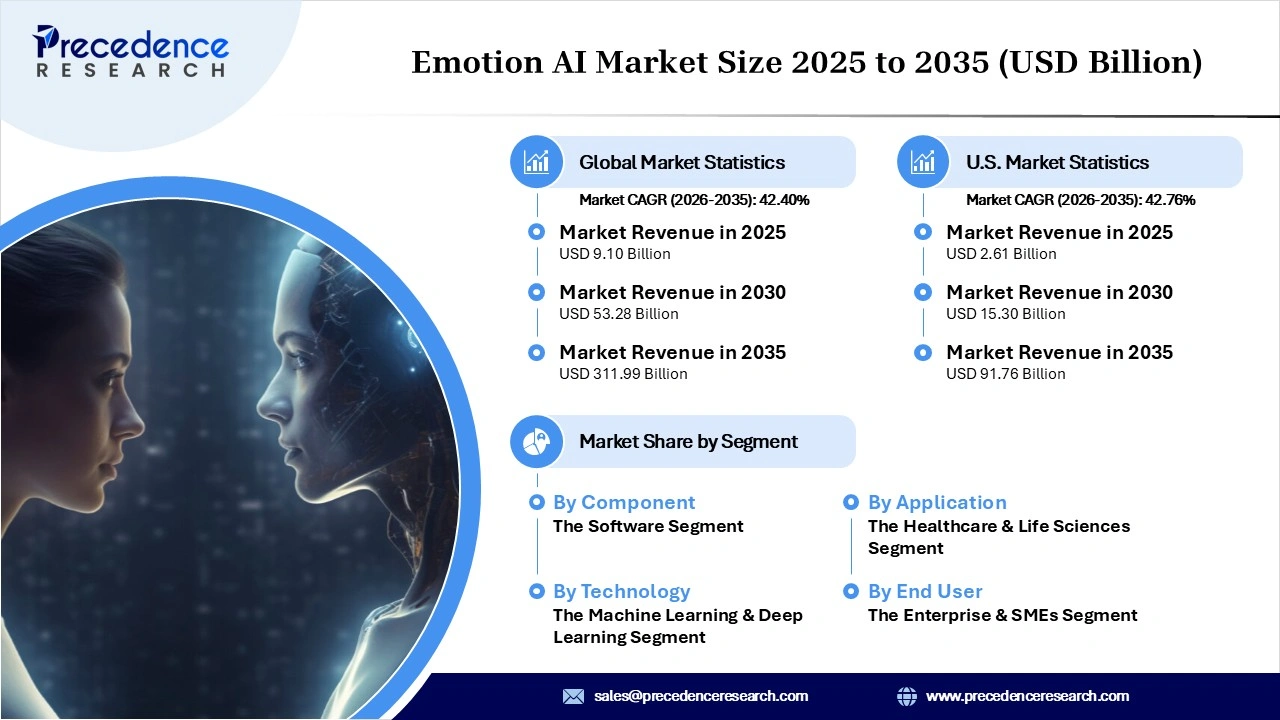
Market at a Glance
Emotion AI, also known as affective computing, is the fusion of data science and human psychology. It requires algorithms to analyze subtle cues like facial expressions, tone, and pauses. This technology involves techniques that perceive, interpret, and respond to emotional signals, allowing machines to function less like rigid machinery and more like attentive devices that actively adapt to the emotional cues of interactions.
Emotion AI extends beyond research fields and finds applications in call centers, vehicles, classrooms, and medical facilities. Their service offerings include voice intonation processing, written text interpretations, and interpreting facial signals, which are crucial for customer analytics, mental health assessments, and responsive interfaces.
What are the Major Trends Influencing the Emotion AI Market?
- Demand for Personalized AI Solutions: There is a rising demand for personalized and tailored emotion AI solutions across industries, which is likely to drive market growth. Recent global statistics indicate that two-thirds of frequent AI users now engage with platforms for emotional support or personalized guidance, highlighting growing demand for emotionally intelligent systems.
- Integration into Wearables & IoT: By integrating into IoT devices and wearable technology, emotion AI is creating systems capable of continuously monitoring users’ emotional states. This advancement opens new opportunities in healthcare monitoring, enhancing workplace efficiency, and developing adaptable environments that respond dynamically to human emotions.
Big Tech Companies are Integrating Emotion AI into Core Offerings
Large technology companies, including Microsoft and Google, are embedding emotion recognition into their core cloud-based AI services. This includes speech APIs that detect tone variations and visual tools designed to interpret facial expressions, reflecting a strategic move beyond ad hoc development toward mainstream adoption of Emotion AI capabilities.
Market Segmentation Overview
- By component, the software segment accounted for the highest market share of 72% in 2025. This is primarily due to its high scalability, ease of deployment, and minimal reliance on physical infrastructure. Software solutions offer greater flexibility, allowing companies to implement updates seamlessly and integrate with existing systems with minimal disruption, making them the preferred choice over hardware-centric alternatives.
- By component, the hardware segment held the second-largest position in the emotion AI market, holding a share of 16% in 2025, and is expected to grow at a significant rate in the upcoming period. This growth is driven by the essential role of hardware in data acquisition, including devices such as cameras, sensors, and microphones that capture emotional cues. Although less flexible than software, hardware remains a critical component, as it provides the foundational data required for accurate emotion analysis and interpretation.
- By technology, the machine learning & deep learning segment held a major revenue share of 55% in the market in 2025. This is primarily due to the complex and nuanced nature of human emotions, which often develop in subtle and dynamic patterns. These models are capable of continuously learning and improving with increased data exposure, enabling them to accurately detect tones, facial expressions, and behavioral cues that traditional rule-based systems may fail to capture.
- By technology, the natural language processing segment is the second-largest shareholder, holding a 22% share in 2025. Its importance lies in its ability to interpret human language as a natural and accessible means of expressing emotions. NLP effectively converts tone, phrasing, and intent into measurable insights; however, its reliance on verbal communication places it slightly behind more advanced multimodal approaches that combine voice, facial, and behavioral data for deeper emotional analysis.
- By application, the healthcare & life sciences segment accounted for a revenue share of 30% in the emotion AI market in 2025. This dominance is driven by its strong focus on human well-being rather than purely operational efficiency. The increasing need for early detection of mental health indicators, patient distress, and behavioral changes has accelerated the adoption of Emotion AI, enabling continuous and non-intrusive monitoring that complements traditional medical approaches.
- By application, the automotive segment is the second-largest shareholder, holding a 22% share in 2025, driven by the growing emphasis on driver safety. Driver monitoring systems have made emotion detection an essential feature for both safety and enhanced user experience. However, reliance on hardware development cycles and stringent regulatory requirements has limited its growth compared to more agile industries.
- By end user, the enterprise & SMEs segment dominated the emotion AI market with a major revenue share of 58% in 2025, driven by their need for real-time customer insights, employee feedback, and data-driven decision-making. Emotion AI supports these requirements by delivering actionable insights that can quickly influence outcomes, making it a critical tool for maintaining competitive advantage.
- By end user, the academia & research institutes segment is the second-largest shareholder, holding a 30% share in 2025, and is expected to grow at the fastest rate during the projection period. This is because these institutes play a pivotal role in advancing Emotion AI through foundational research, development of new frameworks, and innovation. By establishing baseline knowledge and pushing technological boundaries, academic institutions continue to shape the direction of commercial applications in the market.
Regional Insights
North America dominated the global emotion AI market with a share of 38.30% in 2025. This leadership is driven by early adoption of AI, substantial investments in R&D, and a strong pace of technological innovation. The region is home to major players such as Microsoft Corporation and IBM Corporation, who have played a key role in advancing emotion AI applications across sectors like call centers and healthcare analytics. Continuous investment and innovation have enabled businesses in the region not only to meet demand but also to shape the overall direction of market development.
Europe is the second-largest shareholder, holding a 28.70% share of the emotion AI market in 2025. The region’s strength is supported by robust regulatory frameworks and a strong emphasis on the ethical use of artificial intelligence. Countries across Europe are actively implementing emotion AI in sectors such as automotive and advertising, with companies like Realeyes Ltd. contributing to advancements in emotion measurement accuracy. This growth reflects a mature and policy-driven approach, characterized by steady and controlled expansion rather than rapid, unregulated adoption.
Emotion AI Market Coverage
| Report Attribute | Key Statistics |
| Market Revenue in 2025 | USD 9.10 Billion |
| Market Revenue by 2035 | USD 311.99 Billion |
| CAGR from 2026 to 2035 | 42.40% |
| Quantitative Units | Revenue in USD million/billion, Volume in units |
| Largest Market | North America |
| Base Year | 2025 |
| Regions Covered | North America, Europe, Asia-Pacific, Latin America, and the Middle East & Africa |
Top Companies in the Emotion AI Market
Major players in the emotion AI market include Microsoft Corporation, IBM Corporation, Google LLC, NVIDIA Corporation, and Affectiva, Inc., along with emerging firms such as Sightengine, Inc., and Eyeris, Inc. These companies contribute by developing advanced AI frameworks, emotion recognition software, and hardware infrastructure, while enabling applications across sectors such as healthcare, automotive, security, and customer experience analytics.
Segments Covered in the Report
By Component
- Software
- Emotion Recognition Software
- Speech Recognition Software
- Facial Expression Recognition Software
- Gesture Recognition Software
- Hardware
- Cameras & Sensors
- Microphones
- Services
- Integration Services
- Consulting Services
- Support & Maintenance
By Technology
- Machine Learning & Deep Learning
- Natural Language Processing (NLP)
- Computer Vision
- Speech & Voice Recognition
By Application
- Healthcare & Life Sciences
- Patient Monitoring
- Mental Health Assessment
- Automotive
- In-Vehicle Emotion Monitoring
- Driver Monitoring Systems
- Retail & Marketing
- Customer Experience & Behavior Analytics
- Advertisement Targeting
- Education
- Classroom Emotion Monitoring
- Adaptive Learning Systems
- Consumer Electronics
- Virtual Assistants
- Smart Home Devices
By End User
- Enterprise & SMEs
- Healthcare Providers
- Automotive Manufacturers
- Retailers
- Government
- Academia & Research Institutes
By Region
- North America
- Latin America
- Europe
- Asia-pacific
- Middle and East Africa
Get this report to explore global market size, share, CAGR, and trends, featuring detailed segmental analysis and an insightful competitive landscape overview @ https://www.precedenceresearch.com/sample/8282
You can place an order or ask any questions, please feel free to contact us at sales@precedenceresearch.com |+1 804 441 9344