



Endourology Instruments and Consumables Market Revenue to Attain USD 3.10 Bn by 2035
Published: 22 Apr 2026
Author: Precedence Research



Endourology Instruments and Consumables Market Revenue and Trends 2026 to 2035
The global endourology instruments and consumables market revenue reached USD 1.45 billion in 2025 and is predicted to attain around USD 3.10 billion by 2035 with a CAGR of 7.90%. The endourology instruments & consumables market is growing rapidly due to the rising demand for minimally invasive urological procedures. The rising demand for single-use instruments and rising kidney stone cases are also contributing to market growth.
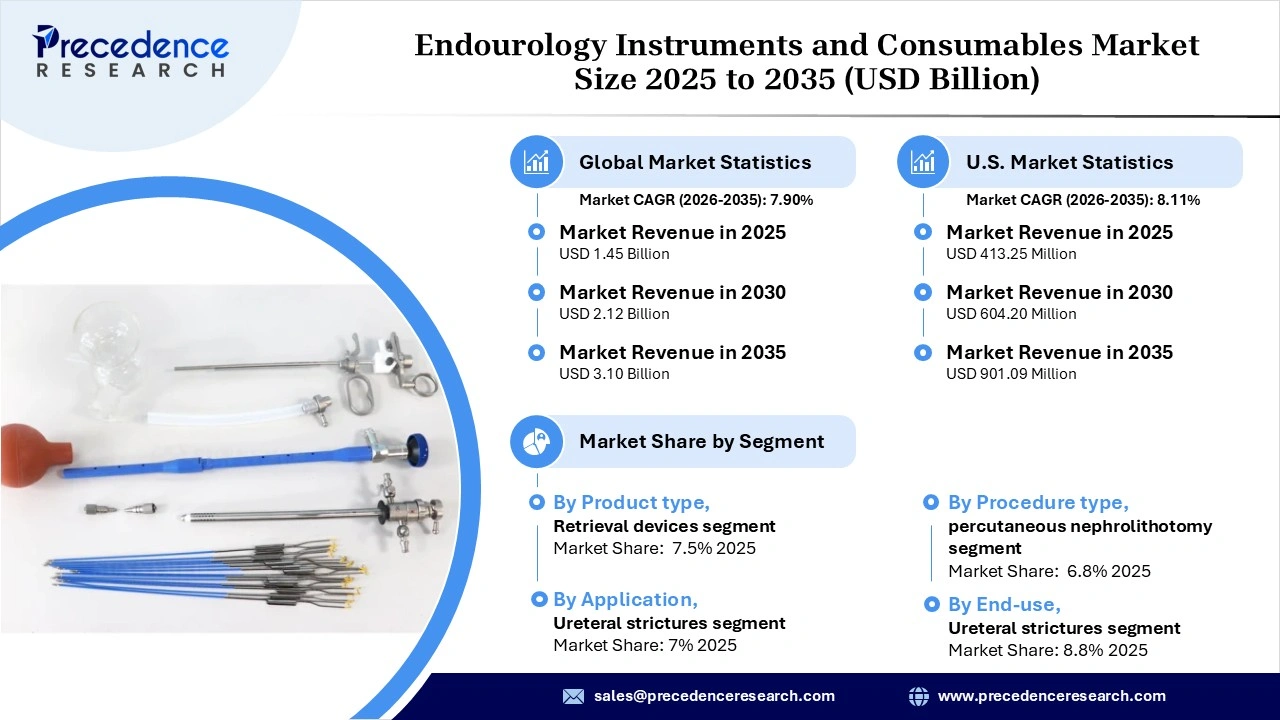
Market at a Glance
The endourology instruments & consumables market comprises disposable or limited-use products used in minimally invasive urological procedures. This includes guidewires, access sheaths, stone retrieval baskets, dilation balloons, and irrigation accessories commonly used during urinary tract interventions. Serving hospitals, ambulatory surgical centers, and specialty clinics, the market is primarily driven by procedural volumes and clinician preferences rather than technological innovation alone.
The market covers both diagnostic and therapeutic urological procedures, ranging from routine stone management to complex intrarenal interventions. It includes not only single-use products but also disposable instruments used alongside endoscopic systems in hospitals, outpatient surgical centers, and specialized urology clinics. The scope of the market is driven by increasing procedural frequency and clinician preference for minimally invasive techniques.
What Drives the Endourology Instruments & Consumables Market?
- Rising Prevalence of Urological Disorders: The increasing incidence of kidney stones, urinary tract infections, and prostate-related conditions is a major driver of the market. An aging global population and lifestyle factors such as poor diet and obesity are further accelerating the need for frequent urological interventions.
- Growing Adoption of Minimally Invasive Procedures: Minimally invasive endourological techniques are preferred due to reduced patient trauma, shorter hospital stays, and faster recovery times. This shift is increasing the use of specialized consumables such as guidewires, baskets, and access sheaths in routine procedures.
- Increasing Shift Toward Disposable and Single-Use Devices: Hospitals are increasingly adopting single-use endourology instruments to reduce infection risks and eliminate cross-contamination. Concerns over the high maintenance cost and limited lifespan of reusable devices are further supporting this transition. Reusable ureteroscopes often require repairs after fewer than 12 uses, with each repair costing over $6,000. Additionally, procedure delays associated with maintenance can add approximately $830 per case, prompting hospitals to increasingly consider disposable consumables.
Impact of Diagnostic and Interventional Costs on Endourology Consumables Demand
- Endourology consumables are significantly influenced by price variations, prompting the European Association of Urology to compile a multi-country dataset highlighting cost differences across regions. This reflects ongoing disparities in procedural economics and healthcare spending patterns.
- Imaging costs remain relatively moderate but vary by modality, with ultrasound averaging €51.3, X-ray KUB €27.1, CT KUB €105.8, and CTU €171.5 per case. These differences highlight variability in diagnostic pathways depending on clinical requirements and healthcare settings.
- In contrast, interventional procedures account for a substantial share of total expenses, particularly endoscopic laser lithotripsy, which requires higher volumes of consumables per procedure. This makes therapeutic interventions a key revenue driver for consumables demand.
- Even routine procedures such as stent placement and diagnostic ureteroscopy demonstrate recurring dependency on consumables, reinforcing steady procedural demand.
Market Segmentation Overview
- By product type, the ureteral stents segment led the endourology instruments & consumables market by holding a share of 25% in 2025. This is because of their widespread use in post-procedural drainage and for maintaining patency of the ureter after medical procedures. Their essential role after procedures has made their use standard practice rather than optional.
- By product type, the ureteral access sheaths segment is expected to grow at the fastest CAGR of 8.5% in the market between 2026 and 2035. This is because these devices allow repeated instrument entry and reduce intrarenal pressure. These advantages improve procedural efficiency and workflow, leading to higher and sustained utilization by surgeons.
- By procedure type, the ureteroscopy segment held a major revenue share of 40% in the endourology instruments & consumables market in 2025 due to its minimally invasive nature and widespread use in treating kidney stones and ureteral disorders. The high procedural frequency also supports consistent demand for consumables per intervention.
- By procedure type, the retrograde intrarenal surgery segment is expected to grow at the highest CAGR of 9.2% in the market between 2026 and 2035, supported by advancements in flexible ureteroscopes and laser lithotripsy technologies, enabling deeper renal access with minimal tissue disruption. As a result, RIRS is increasingly preferred for managing complex kidney stone cases.
- By application, the kidney stones segment accounted for the largest revenue share of 55% in the market in 2025 because of the rising global incidence of kidney stone cases. The increasing preference for minimally invasive treatment options has further strengthened demand, with each procedure generating consistent use of specialized consumables, turning episodic care into a continuous consumption cycle.
- By application, the benign prostatic hyperplasia segment is expected to expand rapidly with a CAGR of 7.5% in the coming years. This growth is driven by the growing aging population and the increasing preference for minimally invasive treatment approaches. As more patients opt for these procedures, demand for endourological consumables that enhance precision, control, and faster recovery continues to rise.
- By end-use, the hospitals segment held the largest share of 60% in the market in 2025, supported by advanced surgical infrastructure and high patient volumes for complex urological procedures. Their capability to manage high-risk and advanced interventions leads to greater per-patient consumption of consumables, reinforcing their dominant market position.
- By end-use, the ambulatory surgical centers segment is expected to grow at the fastest CAGR of 8.8% in the market between 2026 and 2035, owing to their cost-effectiveness, reduced hospital stays, and the increasing shift toward outpatient procedures. As more urological treatments move outside traditional hospital settings, ASCs are becoming key adopters of single-use instruments and related consumables.
Regional Insights
North America dominated the global endourology instruments & consumables market with a major share of 38% in 2025. This is mainly due to its healthcare system's readiness to embrace minimally invasive methods. High procedural volumes, particularly in kidney stone management, ensured consistent demand for consumables across the region. The presence of well-equipped hospitals enabled reliable access to advanced endourological technologies. In addition, procedural intensity, supportive reimbursement frameworks, well-defined care pathways, and steady adoption in Canada further reinforced regional market growth.
Asia Pacific held around 25% share of the market in 2025 and is projected to grow at the fastest CAGR of 9.5% during the forecast period. The regional market growth is driven by a large patient population, increasing healthcare expenditure, and improved access to minimally invasive treatments. Key countries such as China and India are playing a major role due to expanding healthcare infrastructure, while Japan continues to contribute through technological advancement. Rising awareness of urological disorders across the region is encouraging earlier diagnosis and intervention, supporting sustained demand for consumables.
Endourology Instruments and Consumables Market Coverage
| Report Attribute | Key Statistics |
| Market Revenue in 2025 | USD 1.45 Billion |
| Market Revenue by 2035 | USD 3.10 Billion |
| CAGR from 2026 to 2035 | 7.90% |
| Quantitative Units | Revenue in USD million/billion, Volume in units |
| Largest Market | North America |
| Base Year | 2025 |
| Regions Covered | North America, Europe, Asia-Pacific, Latin America, and the Middle East & Africa |
Top Companies in the Endourology Instruments & Consumables Market
Boston Scientific Corporation is known for maintaining a strict focus on stone management and disposable ureteroscopy systems, consistently investing in minimally invasive urological technology. Olympus Corporation, in contrast, leads in endoscopy, providing the essential visualization framework relied upon by consumables and maintaining a substantial share of the global endoscopic market. Concurrently, Karl Storz SE & Co. KG and Richard Wolf GmbH offer precision-engineered tools that shape the tactile aspects of endourology within surgical environments. Cook Medical and Coloplast A/S focus on consumable products such as guidewires, stents, and drainage solutions; their repeated utilization gradually accumulates volume in this sector.
Segments Covered in the Report
By Product Type
- Guidewires
- Ureteral Access Sheaths
- Stone Retrieval Devices (Baskets and Graspers)
- Ureteral Stents
- Dilators and Catheters
By Procedure Type
- Ureteroscopy (Flexible and Rigid)
- Percutaneous Nephrolithotomy (PCNL)
- Retrograde Intrarenal Surgery (RIRS)
- Cystoscopy-based Procedures
By Application
- Kidney Stones (Urolithiasis Management)
- Ureteral Strictures
- Urinary Tract Tumors
- Benign Prostatic Hyperplasia (BPH)
By End-Use
- Hospitals
- Ambulatory Surgical Centers (ASCs)
- Specialty Urology Clinics
By Region
- North America
- Latin America
- Europe
- Asia-pacific
- Middle and East Africa
Get this report to explore global market size, share, CAGR, and trends, featuring detailed segmental analysis and an insightful competitive landscape overview @ https://www.precedenceresearch.com/sample/8324
You can place an order or ask any questions, please feel free to contact us at sales@precedenceresearch.com |+1 804 441 9344