



Endourology Instruments and Consumables Market Size, Companies, Share, Patient Volume, Treatment Adoption Rates, Pricing Analysis, Regulatory Landscape, Competitive Positioning, and Demand Forecast
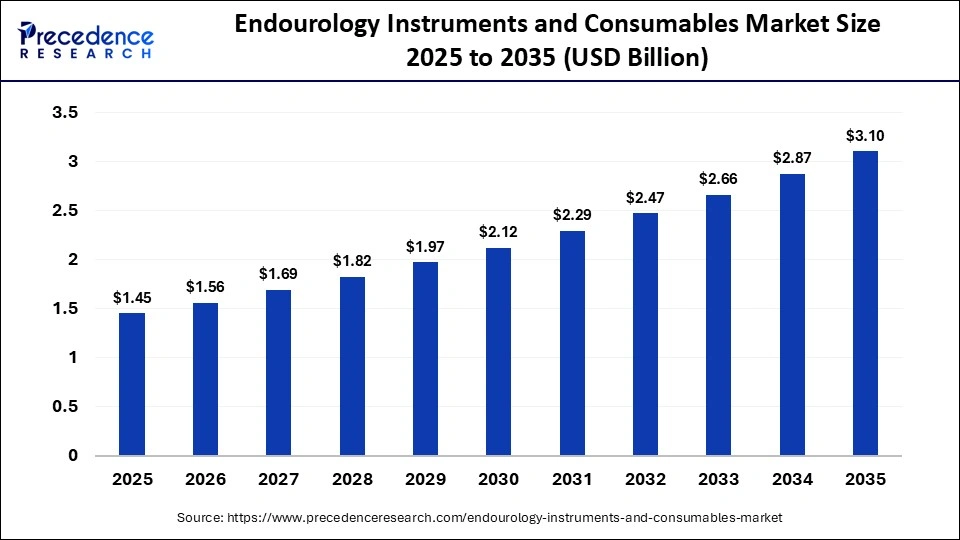
Deepa Pandey, a Healthcare Industry Expert, highlights that the endourology instruments and consumables market has reached USD 1.56 billion in 2026 and is on track to reach USD 3.10 billion by 2035, advancing at a CAGR of 7.90%. Key endourology instruments and consumables market companies shaping the market include Boston Scientific Corporation, Olympus Corporation, Karl Storz SE and Co. KG, Cook Medical, Coloplast A/S, while major growth segments span By Product Type, By Procedure Type, By Application.
Source: https://www.precedenceresearch.com/endourology-instruments-and-consumables-market
 Get a Sample
 Table Of Content


What is the Endourology Instruments and Consumables Market Size in 2026?
The global endourology instruments and consumables market size accounted for USD 1.45 billion in 2025 and is predicted to increase from USD 1.56 billion in 2026 to approximately USD 3.10 billion by 2035, expanding at a CAGR of 7.90% from 2026 to 2035. The endourology instruments and consumables market is driven by the rising incidence of kidney stones and the growing adoption of disposable surgical devices.
Key Takeaways
- North America dominated the endourology instruments and consumables market with a share of 38% in 2025.
- The Asia Pacific is expected to grow at the fastest CAGR of 9.5% during the forecast period.
- By product type, the ureteral stents segment held a dominant position in the market, accounting for 25% share in 2025.
- By product type, the stone retrieval devices segment is the second-largest shareholder and is expected to grow at a 7.5% CAGR between 2026 and 2035.
- By procedure type, the ureteroscopy segment accounted for a major revenue share of 40% in the market in 2025.
- By procedure type, the percutaneous nephrolithotomy segment is the second-largest shareholder and is expected to grow at a CAGR of 6.8% between 2026 and 2035.
- By application, the kidney stones segment held a 55% share of the market in 2025.
- By application, the ureteral strictures segment is the second-largest shareholder and is expected to grow at a significant CAGR of 7% between 2026 and 2035.
- By end-use, the hospitals segment led the global market with a share of 60% in 2025.
- By end-use, the ambulatory surgical centers segment is the second-largest shareholder and is expected to grow at the fastest CAGR of 8.8% between 2026 and 2035.
Market Overview
The endourology instruments and consumables market comprises single-use or replaceable instruments used in minimally invasive urology procedures to treat conditions such as kidney stones and other ureteral strictures and prostate conditions. These consumables include products such as guidewires, catheters, ureteral stents, baskets, and dilators, which are essential in providing quality, sterile, and safe practices in endourological procedures. The market is driven by the increasing worldwide prevalence of urological diseases and an aging population more prone to urinary tract complications. Additionally, technological advances in imaging devices and laser lithotripsy, as well as the development of more biocompatible materials, are also driving the market.
How is AI Impacting the Endourology Instruments and Consumables Market?
Artificial intelligence (AI) is significantly impacting the market by improving the accuracy of the diagnosis, precision of the procedure, and efficiency of the operation in urology. AI-based imaging systems interpret CT scans, ultrasounds, and endoscopic images and recognize conditions such as kidney stones, tumors, and strictures at earlier stages in a more accurate manner. AI-assisted radiography and robotic technologies enable real-time guidance and precise control of endourological instruments during surgery. This enhances procedural accuracy, improves navigation within complex anatomies, and reduces surgical risks in minimally invasive procedures.
Endourology Instruments and Consumables Market Trends
- The growing preference for minimally invasive endourological procedures is strongly associated with reduced patient trauma, shorter hospital stays, and faster recovery times. This trend is significantly driving demand for both disposable and high-precision consumable instruments.
- Single-use ureteroscopes, along with accessories such as catheters and guidewires, are gaining popularity in hospitals due to their ability to minimize infection risks and prevent cross-contamination. This shift is further supported by increasingly stringent sterilization requirements, which make reusable instruments less cost-effective in comparison.
- The increase in the number of cases of kidney stones, urinary tract disorders, and enlarged prostate conditions, particularly among the aging population, has led to an increase in procedural volumes. This, in turn, is accelerating the demand for endourology consumables used in both diagnostic and therapeutic applications.
Market Scope
| Report Coverage | Details |
| Market Size in 2025 | USD 1.45 Billion |
| Market Size in 2026 | USD 1.56 Billion |
| Market Size by 2035 | USD 3.10 Billion |
| Market Growth Rate from 2026 to 2035 | CAGR of 7.90% |
| Dominating Region | North America |
| Fastest Growing Region | Asia Pacific |
| Base Year | 2025 |
| Forecast Period | 2026 to 2035 |
| Segments Covered | Product Type, Procedure Type, Application, End-Use, and Region |
| Regions Covered | North America, Europe, Asia-Pacific, Latin America, and Middle East & Africa |
Market Dynamics
Drivers
Rising Prevalence of Urological Disorders
The endourology instruments and consumables market is being driven by the rising prevalence of urological conditions such as kidney stones, urinary incontinence, and prostate-related problems. Factors such as changing lifestyles, poor dietary habits, increasing obesity rates, and growing aging populations are all contributing to the high prevalence of these diseases worldwide. This significantly boosts the demand for accurate diagnosis and minimally invasive treatment procedures, which in turn is driving the adoption of endourology consumables such as guidewires, stents, baskets, and catheters.
Restraint
Regulatory Hurdles
Regulatory challenges restrain the endourology instruments and consumables market, since medical devices must undergo stringent approval procedures before commercialization. Trial activities, safety tests, and documentation are all cumbersome and mandated by the regulatory bodies in order to determine the effectiveness of the product and the safety of the patients. The presence of multiple regulatory bodies in different regions, such as the U.S. FDA, European CE marking, and other national bodies, complicates market entry and creates challenges for medical device manufacturers.
Opportunity
Technological Innovation
Product innovation represents a major opportunity in the endourology instruments and consumables market, as manufacturers focus on enhancing surgical efficiency and improving patient outcomes. Increased investment in RandD is enabling the creation of advanced consumables, such as biodegradable stents, which can reduce the need for follow-up procedures. Additionally, the integration of intelligent technologies, including embedded sensors and data-driven monitoring systems, is emerging as a key trend, enabling real-time feedback during endourological procedures and supporting more precise, outcome-driven care.
Segment Insights
Product Type Insights
Endourology Instruments and Consumables Market Share, By Product Type, 2025-2035 (%)
| Product Type | 2025 | 2035 | CAGR (%) |
| Guidewires | 20.00% | 19.50% | 7.00% |
| Ureteral Access Sheaths | 18.00% | 19.50% | 8.50% |
| Stone Retrieval Devices (Baskets and Graspers) | 22.00% | 21.00% | 7.50% |
| Ureteral Stents | 25.00% | 24.00% | 7.20% |
| Dilators and Catheters | 15.00% | 16.00% | 8.00% |
The Ureteral Stents Segment Held a 25% Market Share in 2025
In 2025, the ureteral stents segment dominated the endourology instruments and consumables market with a share of 25%. This is mainly due to the increased incidence of kidney stones and ureteral strictures, which created the need for ureteral stents. These stents play a crucial role in stone extraction procedures. Advancements in biocompatible materials and patient-centric designs have improved device tolerability and significantly reduced patient discomfort during use.
The stone retrieval devices segment held the second-largest market share of 22% in 2025 and is expected to grow at a CAGR of 7.5% during the projection period, driven by their proven effectiveness in stone removal in minimally invasive surgery. The increasing cases of kidney stones are boosting the demand for these devices, as they are routinely used in post-procedure drainage and maintain ureteral patency after interventions. Technological advances have improved the flexibility of these devices and enhanced the success of the procedure.
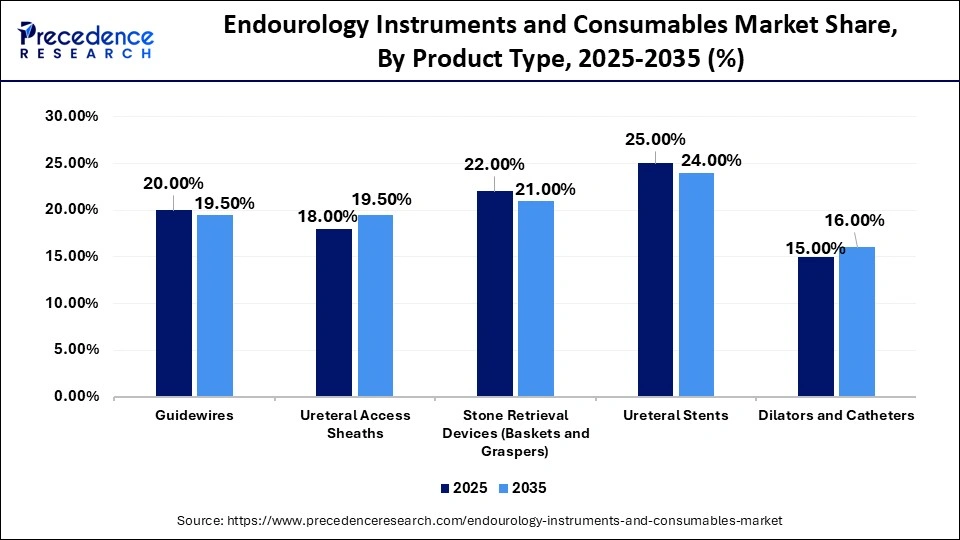
The guidewires segment held a 20% share of the market in 2025 and is expected to grow at a CAGR of 7% during the forecast period. This is primarily due to their significant role in all processes of endourology. Guidewires are preferred due to their ease of insertion of catheters, stents, and other devices, making the procedure efficient and reducing complications. There is high demand for guidewires with the increasing volumes of procedures for kidney stones, strictures, and urinary obstructions.
The ureteral access sheaths segment held a 18% share of the market in 2025 and is expected to grow at the fastest CAGR of 8.5% in the upcoming period, driven by their increasing use in complicated and monotonous endourological procedures. These devices enable controlled access and the sequential introduction of instruments into the kidney while minimizing ureteral trauma. They are widely adopted due to their ability to reduce intrarenal pressure, improve irrigation efficiency, and shorten overall procedural time.
Procedure Type Insights
Endourology Instruments and Consumables Market Share, By Procedure Type, 2025-2035 (%)
| Procedure Type | 2025 | 2035 | CAGR (%) |
| Ureteroscopy (Flexible and Rigid) | 40.00% | 42.00% | 8.50% |
| Percutaneous Nephrolithotomy (PCNL) | 25.00% | 23.50% | 6.80% |
| Retrograde Intrarenal Surgery (RIRS) | 20.00% | 22.00% | 9.20% |
| Cystoscopy-based Procedures | 15.00% | 12.50% | 6.00% |
The Ureteroscopy Segment Held a 40% Share of the Market in 2025
The ureteroscopy segment dominated the endourology instruments and consumables market with a major share of 40% in 2025, driven by its minimally invasive nature. This procedure is widely used in the treatment of kidney stones and ureteral diseases. It is the most preferred procedure because it is possible to visualize and treat stones in the UTI in an instant manner. Increased frequency of urolithiasis and the increased volume of outpatient procedures further reinforced the segment's dominance.
The percutaneous nephrolithotomy segment held a 25% share of the market in 2025 and is expected to grow at a notable CAGR of 6.8% during the projection period, driven by its use in the treatment of large, complicated, and difficult kidney stones. The growing cases of complicated urolithiasis and the development of stones due to obesity also boost the demand for this procedure.
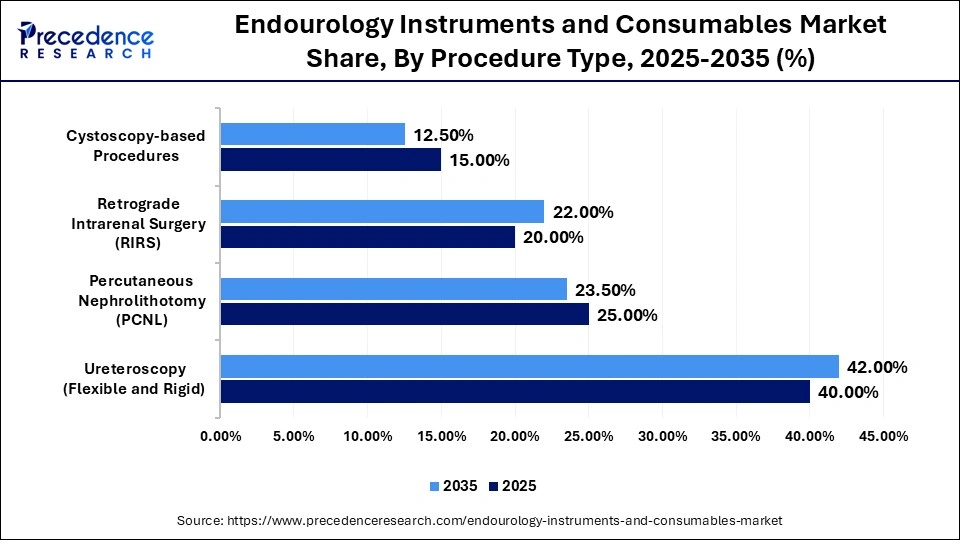
The retrograde intrarenal surgery segment held a 20% market share in 2025 and is expected to grow at the fastest CAGR of 9.2% during the studied period. This is because of technological advances in flexible ureteroscopes and laser lithotripsy, which have enhanced the effectiveness of this procedure. The minimally invasive nature, accuracy, and capability of this procedure to cure kidney stones, even without external cuts, have made it the preferred choice among both patients and healthcare professionals. RIRS is popular as it allows for shorter hospitalization stay, faster recovery, and reduced occurrence of post-operative complications.
The cystoscopy-based procedures segment held a 15% share of the market in 2025 and is expected to grow at a CAGR of 6% during the projection period, driven by its use in diagnostic evaluation and other adjunctive treatment. The increasing prevalence of urinary tract diseases is boosting the demand for this procedure. Improvements in imaging, flexible cystoscopes, and comfort have also enhanced their clinical value.
Application Insights
Why Did the Kidney Stones Segment Led the Market in 2025?
The kidney stones segment led the endourology instruments and consumables market with the largest share of 55% in 2025. This is mainly due to the rising incidence of urolithiasis worldwide and the rising trend toward less invasive treatments. Lifestyle changes, dehydration, and obesity have raised the world's kidney stone rate. This significantly created the need for endourology instrument and consumables.
The ureteral strictures segment held a 15% share of the market in 2025 and is expected to grow at a CAGR of 7% in the upcoming period, driven by the increase in the need for effective management of ureteral narrowing diseases. The practice of minimally invasive procedures, which has improved the outcome of the treatment and reduced the rate of recovery, has contributed to segmental growth. Innovation of novel stents and biocompatible substances has also enhanced the comfort of the patients and reduced the complications in the treatment of ureteral strictures.
Endourology Instruments and Consumables Market Share, By Application, 2025-2035 (%)
| Application | 2025 | 2035 | CAGR (%) |
| Kidney Stones (Urolithiasis Management) | 55.00% | 57.00% | 8.50% |
| Ureteral Strictures | 15.00% | 14.50% | 7.00% |
| Urinary Tract Tumors | 15.00% | 14.00% | 6.80% |
| Benign Prostatic Hyperplasia (BPH) | 15.00% | 14.50% | 7.50% |
The urinary tract tumors segment held a 15% share of the market in 2025 and is expected to grow at a CAGR of 6.8% during the projection period, supported by the increasing cases of urology malignancies that involve bladder and tumors of the upper urinary tract. The rising cases of urological cancer and the need for early disease diagnostics and minimally invasive surgeries are driving the demand for interventional endourology consumables.
The benign prostatic hyperplasia segment held a 15% share of the market in 2025 and is expected to grow at the fastest CAGR of 7.5% during the projection period, driven by the increasing number of cases of prostate enlargement, especially among elderly men. The demographic groups where old men are more susceptible to urinary flow blockage and the complications associated with it are growing. The development of minimally invasive surgeries has improved patient outcomes and reduced the number of hospital days.
End-Use Insights
Hospitals Held a 60% Share of the Market in 2025
The hospitals segment registered its dominance in the endourology instruments and consumables market by holding a share of 60% in 2025. This is mainly due to their well-developed surgical facilities, high patient inflow for complex urological procedures, and the availability of skilled professionals and advanced endourological equipment. Hospitals remain the preferred setting as they cater to both emergency and elective procedures, ensuring consistent demand for consumables.
Endourology Instruments and Consumables Market Share, By End-Use, 2025-2035 (%)
| End-Use | 2025 | 2035 | CAGR (%) |
| Hospitals | 60.00% | 57.00% | 7.00% |
| Ambulatory Surgical Centers (ASCs) | 25.00% | 28.00% | 8.80% |
| Specialty Urology Clinics | 15.00% | 15.00% | 7.50% |
The ambulatory surgical centers segment held a 25% share of the market in 2025 and is expected to grow at the fastest CAGR of 8.8% during the projection period. This growth is driven by their cost-effectiveness and the increasing adoption of outpatient procedures. The rising preference for minimally invasive, same-day surgeries that allow quicker recovery and reduced hospital stays is further boosting demand. ASCs are increasingly favored for their ability to lower hospitalization rates, reduce treatment costs, and enhance patient convenience.
The specialty urology clinics segment held a 15% share of the market in 2025 and is expected to grow at a significant CAGR of 7.5% during the projection period. The growth of this segment is supported by increasing demand for specialized, minimally invasive urological care. The expansion of dedicated urology centers offering advanced diagnostics and personalized treatment for conditions such as kidney stones, urinary tract infections, and prostate disorders is contributing to this trend.
Regional Insights
North America Endourology Instruments and Consumables Market Size and Growth 2026 to 2035
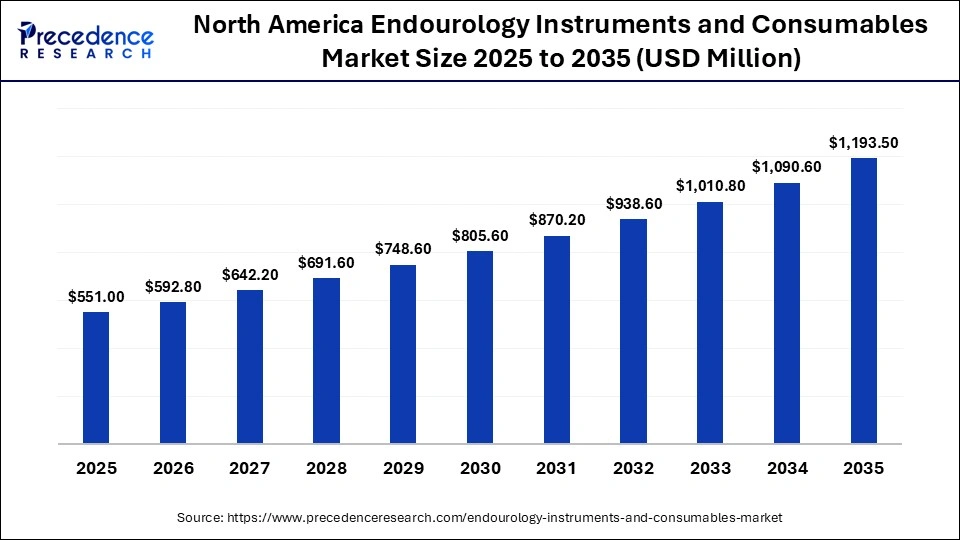
The North America endourology instruments and consumables market size is estimated at USD 551.00 million in 2025 and is projected to reach approximately USD 1,193.50 million by 2035, with a 8.04% CAGR from 2026 to 2035.
North America Led the Global Endourology Instruments and Consumables Market in 2025
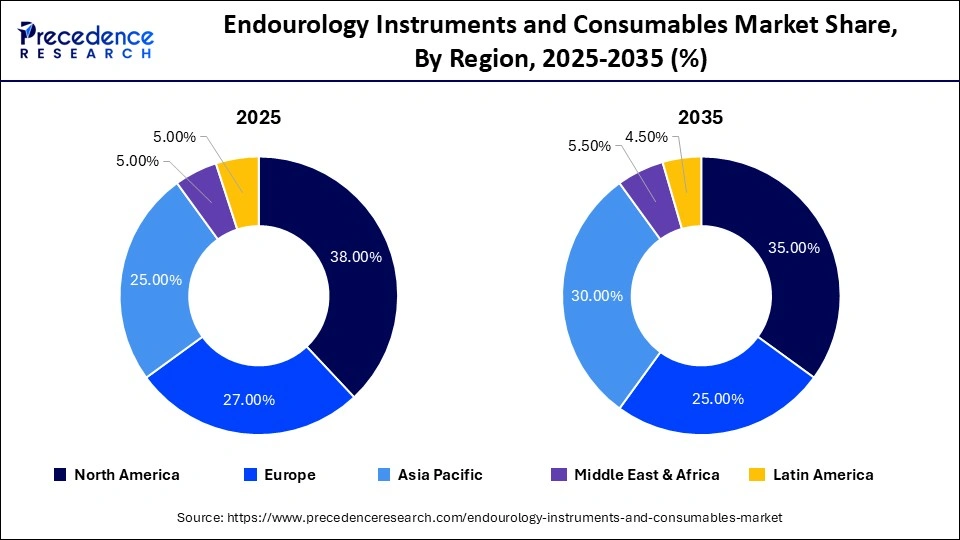
In 2025, North America registered dominance in the endourology instruments and consumables market by holding a 38% share. This is mainly due to the established network of well-developed healthcare facilities, the growing volume of procedures related to kidney stones, and the widespread adoption of minimally invasive surgeries. The region benefits from its well-developed healthcare system, specialty urology centers, and access to novel medical devices. Additionally, high healthcare expenditure and favorable reimbursement frameworks continue to support market growth by enabling the adoption of advanced endourological procedures. Government initiatives, such as the Affordable Care Act, have further improved access to healthcare services, contributing to increased procedural volumes and overall market expansion.
U.S. Endourology Instruments and Consumables Market Size and Growth 2026 to 2035
The U.S. endourology instruments and consumables market size is calculated at USD 413.25 million in 2025 and is expected to reach nearly USD 901.09 million in 2035, accelerating at a strong CAGR of 8.11% between 2026 and 2035.
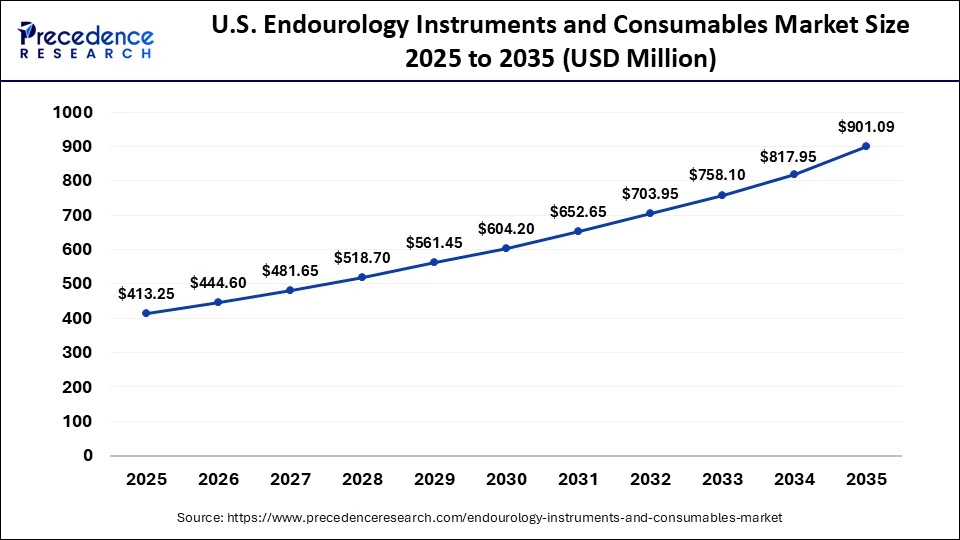
U.S. Endourology Instruments and Consumables Market Analysis
The U.S. is a major contributor to the North American endourology instruments and consumables market, driven by its sophisticated healthcare system and high adoption of minimally invasive urological procedures. Its huge patient base, the increase in prevalence of kidney stones and prostate disorders, and a growing geriatric population also contribute to market growth. Also, the country is home to leading medical device manufacturing companies, which contribute to the innovation of consumables like stents, guidewires, and retrieval devices.
Europe: The Second-Largest Market
Europe is the second largest market for endourology instruments and consumables, holding a 27% share in 2025, and is expected to grow at a notable CAGR of 6.8% during the projection period. The regional growth is driven by the increasing incidence of urological ailments and the rapid development of advanced surgical technologies. An increase in the number of cases of kidney stones, urinary tract infections, and prostate diseases in the aging population leads to market growth. The region benefits from the well-established healthcare sector, a robust regulatory environment, and the adoption of minimally invasive surgery. Favorable government policies such as the Horizon programs of the European Union are stimulating research and development in the medical equipment and enhancing clinical outcomes.
UK Endourology Instruments and Consumables Market Analysis
The UK is a major player in the European market due to the growing adoption of minimally invasive urological procedures and a well-structured public healthcare system. The rising incidence of kidney stones, prostate disorders, and UTIs, especially among the elderly, is boosting market growth. The National Health Service (NHS) plays a significant role in ensuring that endourological treatments are made available to a large number of people, thereby sustaining demand for endourology instruments and consumables.
What Makes Asia Pacific the Fastest-Growing Region in the Endourology Instruments Consumables Market?
Asia Pacific is expected to grow at the fastest CAGR of 9.5% during the projection period, driven by a large patient population, rising healthcare expenditure, and increasing awareness of urological disorders. The growing prevalence of conditions such as kidney stones, urinary tract infections, and prostate-related diseases, particularly in densely populated countries, continues to contribute significantly to market growth. Expansion of healthcare infrastructure, improved access to medical services, and supportive government initiatives are further accelerating market development in the region. The growth is primarily led by rapidly developing economies such as China and India, where substantial investments are being made in hospitals and specialty care facilities.
China Endourology Instruments and Consumables Market Analysis
The market in China is expanding due to the rapid healthcare modernization and a rising burden of urological diseases. The country is making substantial investments in hospital infrastructure and expanding access to advanced surgical technologies. Moreover, ongoing healthcare reforms and the expansion of insurance coverage are improving treatment affordability and increasing patient access to endourological procedures, thereby supporting overall market growth.
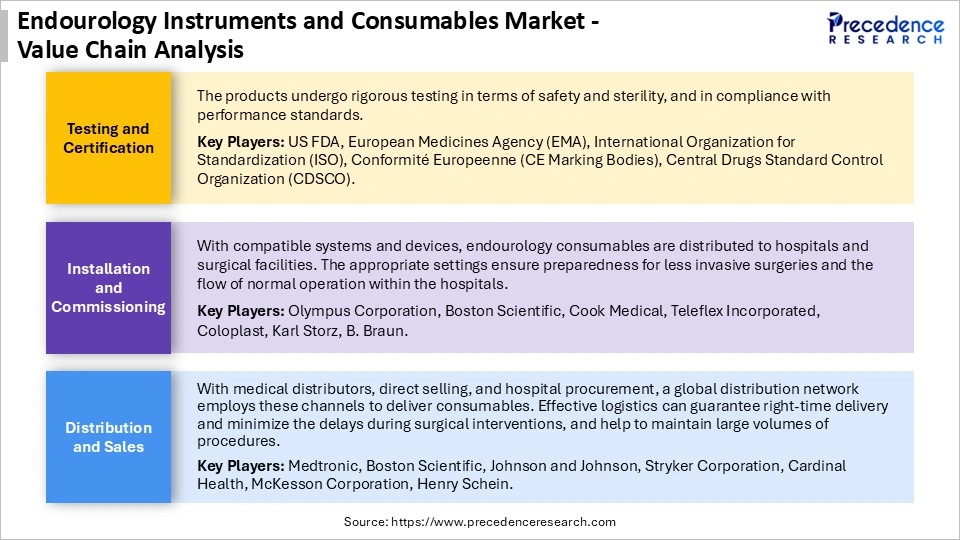
Endourology Instruments and Consumables Market Value Chain Analysis
Endourology Instruments and Consumables Market Companies
- Boston Scientific Corporation
- Olympus Corporation
- Karl Storz SE and Co. KG
- Cook Medical
- Coloplast A/S
- Richard Wolf GmbH
- Stryker Corporation
- Medtronic plc
- Teleflex Incorporated
- B. Braun Melsungen AG
- Conmed Corporation
- Urotech GmbH
- PUSEN Medical
- EndoMed Systems GmbH
- Vimex Sp. z o.o.
Recent Developments
- In March 2026, Cook Medical introduced the Syfonix Suction Ureteral Access Sheath and 7.5 Fr Ascend Single-Use Flexible Ureteroscope in the U.S. and Canada. The objective of these developments is to enhance the efficiency of endourology in terms of stone removal and the flexibility of the procedure.(Source: https://www.cookmedical.com)
- In June 2025, Ambu received FDA 510(k) clearance for its aScope 5 Cysto HD to include percutaneous nephrolithotomy (PCNL) surgical procedures. It is the first single-use flexible cysto-nephroscope to be approved for this advanced use in the U.S.(Source: https://www.massdevice.com)
- In September 2024, Olympus introduced the CH-S700-08-LB 4K endoscopic camera head in Europe, designed to be used in urology and gynecological surgeries. It can be used with the VISERA ELITE III system, which expands the imaging quality and surgical accuracy of minimally invasive surgery.(Source: https://www.olympus-global.com)
Segments Covered in the Report
By Product Type
- Guidewires
- Ureteral Access Sheaths
- Stone Retrieval Devices (Baskets and Graspers)
- Ureteral Stents
- Dilators and Catheters
By Procedure Type
- Ureteroscopy (Flexible and Rigid)
- Percutaneous Nephrolithotomy (PCNL)
- Retrograde Intrarenal Surgery (RIRS)
- Cystoscopy-based Procedures
By Application
- Kidney Stones (Urolithiasis Management)
- Ureteral Strictures
- Urinary Tract Tumors
- Benign Prostatic Hyperplasia (BPH)
By End-Use
- Hospitals
- Ambulatory Surgical Centers (ASCs)
- Specialty Urology Clinics
By Region
- North America
- Latin America
- Europe
- Asia-pacific
- Middle and East Africa
For inquiries regarding discounts, bulk purchases, or customization requests, please contact us at sales@precedenceresearch.com
Frequently Asked Questions





Ask For Sample
No cookie-cutter, only authentic analysis – take the 1st step to become a Precedence Research client
 Get a Sample
.webp)



 sales@precedenceresearch.com
 Schedule a Meeting
