



Eyewear Market Revenue to Attain USD 297.53 Bn by 2035
Published: 18 May 2026
Author: Precedence Research



Eyewear Market Revenue and Trends 2026 to 2035
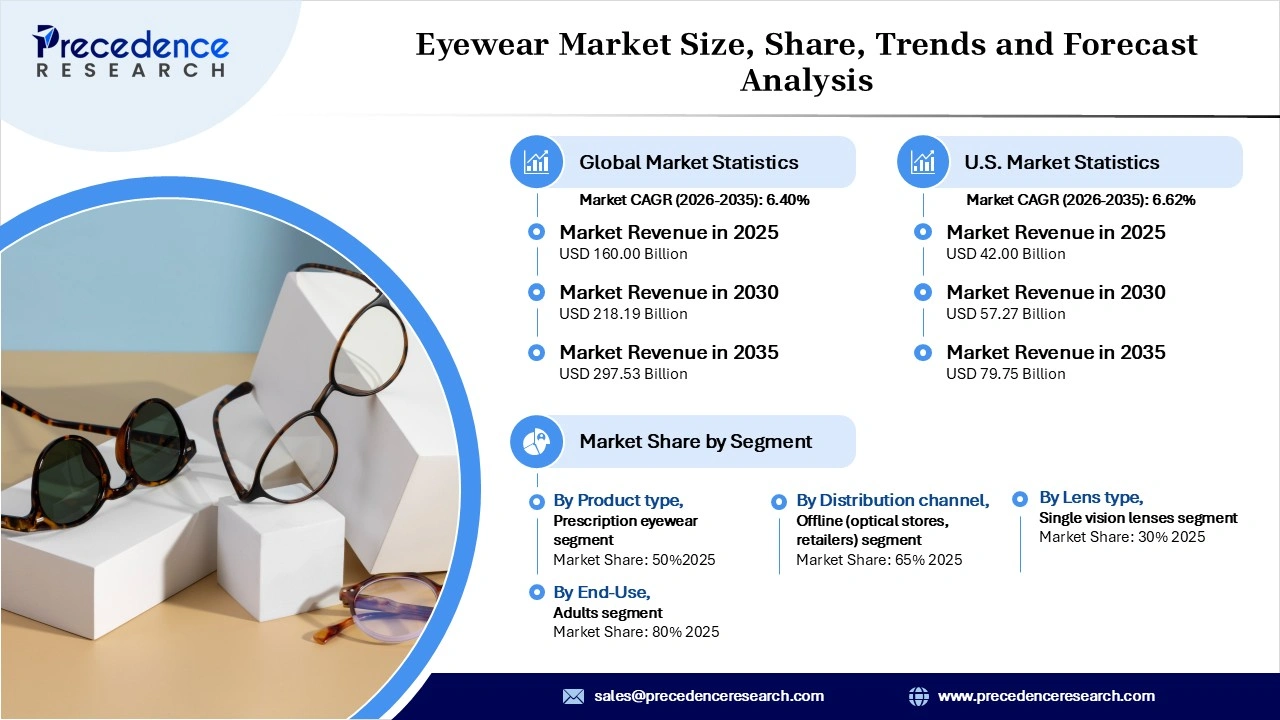
The global eyewear market revenue surpassed USD 160.00 billion in 2025 and is predicted to attain around USD 297.53 billion by 2035, growing at a CAGR of 6.40%. The market is driven by the increasing incidences of vision problems like myopia and presbyopia because of demographic aging, rising exposure time to screens, and growing use of blue light protection, photochromic, and polarized lenses.
Vision Correction, Fashion, and Eye Protection
The eyewear market involves products used to improve eyesight, shield eyes against environmental hazards, and as fashion accessories, and comprises spectacles, contact lenses, reading glasses, sunglasses, sports eyewear, and safety eyewear. Frames are made from various materials, such as metals (stainless steel, titanium, monel), acetates, TR-90, nylon, and environmentally friendly frames such as bio-based plastic.
This market also includes contact lenses ranging from daily disposable lenses, biweekly lenses, monthly lenses, rigid gas permeable lenses, and ortho-k lenses for slowing down the progression of myopia in children. There are various categories of reading glasses available in pharmacies and supermarkets, polarized sunglasses that block glares wen driving, and ANSI/EN166 prescription safety glasses for industrial usage.
Contact Lenses for Myopia Control Featuring Enhanced Oxygen Permeability
The emerging trend in the market is the use of specialized contact lenses used to decelerate the rate at which myopia progresses in young patients, especially amid an increasing incidence rate of myopia. These lenses rely on a concept called peripheral defocus, whereby special rings are incorporated into the lens design to slow down eyeball elongation without impacting the vision. In 2026, CooperVision introduced the MyDay MiSight 1 day, which are myopia control soft contact lenses that combine ActivControl Technology of CooperVision with a silicon hydrogel material featuring up to four times greater oxygen permeability than conventional hydrogels.
Adoption of AI Smart Glasses as the Next-Gen Wearable
The eyewear market is benefitting from the adoption of smart glasses based on AI technology, which includes multimodal large language models, allowing users to interact through voice commands, translation, object identification, photography, and hands-free calling. The AI architecture doesn’t add much weight, and such frames weigh less than 50 grams, which appear no different from regular eyewear. In 2025, Rokid, a Chinese firm focused on Augmented Reality (AR), introduced its AI+AR smart glasses, which weigh 49 grams and come with a dual Micro LED waveguide display and a 12MP camera.
Quality Certification of Optical Products by the Governments
Governments across the world have come up with mandatory orders regarding the quality certification of optical products as the demand increases at a very rapid pace. These orders have made it necessary for manufacturers to have a certification from national standards institutions in order to sell their products locally. In 2025, the British Standards Institution issued BS EN 16128:2025, which lays out the test method that should be used for determining nickel release from spectacle frames and sunglasses, where it is required to comply with the European Regulation limit value of 0.5 micrograms per square centimeter per week.
Synsam Makes 100,000 Eyewear Frames in Sweden as Reshoring Process Moves Faster
The eyewear manufacturing facility belonging to Synsam Group, located at Froson, Sweden, manufactured around 100,000 frames in 2025, and is anticipated to make more than 250,000 frames each year till 2028 while continuing to relocate its production process from Asia to Sweden. Synsam introduced a new Swedish-made eyewear collection named Isak V that includes 14 ophthalmic acetate frames and three sunglasses.
Market Segmentation Overview
- By product type, the prescription eyewear segment led the eyewear market with 50% share in 2025, since more than 4 billion people worldwide need vision correction for myopia, hyperopia, presbyopia, and astigmatism, and this segment offers a convenient form of treatment at an optimal budget.
- By product type, the sunglasses segment is expected to expand at the highest CAGR of 7.5% during the forecast period, because consumers’ increased knowledge about the adverse effects of UV rays on eyes, such as cataract, macular degeneration, and photokeratitis, has changed sunglasses from a fashion item into a constant requirement.
- By distribution channel, the offline (optical stores, retailers) segment dominated the market with 65% share in 2025, owing to the fact that glasses and contact lenses need professional fittings, measurements, and adjustments, therefore majority of customers preferred buying products by trying out different frames and discussing their options with optometrists.
- By distribution channel, the online (e-commerce) segment is expected to grow at the fastest CAGR of 10% from 2026 to 2035, due to the fact that direct-to-consumer companies have started adopting new technologies, such as virtual try-ons with the help of augmented reality and try-at-home schemes.
- By lens type, the single vision lenses segment led the eyewear market with 30% share in 2025, because they are the most common prescription lenses, the most affordable, and the most available ones on both the branded and budget eyewear industry, and make up for almost the whole stock of reading glasses.
- By lens type, the photochromic lenses segment is expected to expand at the highest CAGR of 7.2% during the forecast period, owing to its ability to automatically change color when they come into contact with UV rays, and become clear when not exposed, making it unnecessary for consumers to own both prescription and sun lenses.
- By end-use, the adults segment dominated the market with 80% share in 2025, due to an increase in the need for visual correction in relation to all the eye conditions with increasing age, especially presbyopia above the age of 40 years, meaning that their need for eyewear increases significantly.
- By end-use, the children segment is expected to grow at the fastest CAGR of 7.2% from 2026 to 2035, because of the rapid rise of myopia among children and teenagers across the world, attributed to rising screen usage for education, less outdoor time, and lifestyle changes.
Regional Analysis
North America held a major revenue share of 35% in the eyewear market in 2025, due to its mature vision care infrastructure, widespread insurance cover through vision insurance schemes such as VSP and EyeMed, and significant adoption of technologically advanced lenses, including blue-blocking, photochromic, and progressive lenses. The U.S dominated the market in North America because of its high per capita disposable income, dominance of eyewear retailers, including LensCrafters under the parentage of Luxottica, and the presence of the vertical integration model of EssilorLuxottica and innovative direct-to-consumer brands. Canada is a significant contributor to the market owing to its widespread insurance coverage and the awareness of UV protection because of the bright winter months and active outdoor lifestyles.
Asia-Pacific is expected to expand at the highest CAGR of 8% during the forecast period, because of its massive population, rapidly aging population, growing disposable incomes, and the world’s highest prevalence of myopia. China led the market in Asia-Pacific due to initiatives by the Chinese government to tackle the growing problem of myopia through regular eye tests for all students annually and limits on the use of electronic devices. India witnessed notable market growth owing to the increased use of smartphones and digital devices, resulting in vision problems, and the expansion of organized eyewear retail chains.
Eyewear Market Coverage
| Report Attribute | Key Statistics |
| Market Revenue in 2025 | USD 160.00 Billion |
| Market Revenue by 2035 | USD 297.53 Billion |
| CAGR from 2026 to 2035 | 6.40% |
| Quantitative Units | Revenue in USD million/billion, Volume in units |
| Largest Market | North America |
| Base Year | 2025 |
| Regions Covered | North America, Europe, Asia-Pacific, Latin America, and the Middle East & Africa |
Top Companies in the Eyewear Market
EssilorLuxottica, Johnson and Johnson Vision Care, CooperVision, and Bausch and Lomb are some of the key players that provide vision care and ophthalmic products. Ray-Ban, Oakley, Fossil Group, Marchon Eyewear, Safilo Group, Kering Eyewear, Warby Parker, Prada Eyewear, and Tom Ford Eyewear specialize in designer, premium, and lifestyle eyewear frames and sunglasses.
Segments Covered in This Report
By Product Type
- Prescription Eyewear
- Sunglasses
- Contact Lenses
- Sports Eyewear
By Distribution Channel
- Offline (Optical Stores, Retailers)
- Online (E-commerce)
By Lens Type
- Single Vision Lenses
- Bifocal Lenses
- Progressive Lenses
- Photochromic Lenses
- Anti-reflective Lenses
By End-Use
- Adults
- Children
By Region
- North America
- Latin America
- Europe
- Asia-pacific
- Middle and East Africa
Get this report to explore global market size, share, CAGR, and trends, featuring detailed segmental analysis and an insightful competitive landscape overview @ https://www.precedenceresearch.com/sample/8415
You can place an order or ask any questions. Please feel free to contact us at sales@precedenceresearch.com |+1 804 441 9344