



Gastrointestinal Bleeding Treatment Market Revenue to Attain USD 889.26 Mn by 2035
Published: 24 Feb 2026
Author: Precedence Research



Gastrointestinal Bleeding Treatment Market Revenue and Trends 2026 to 2035
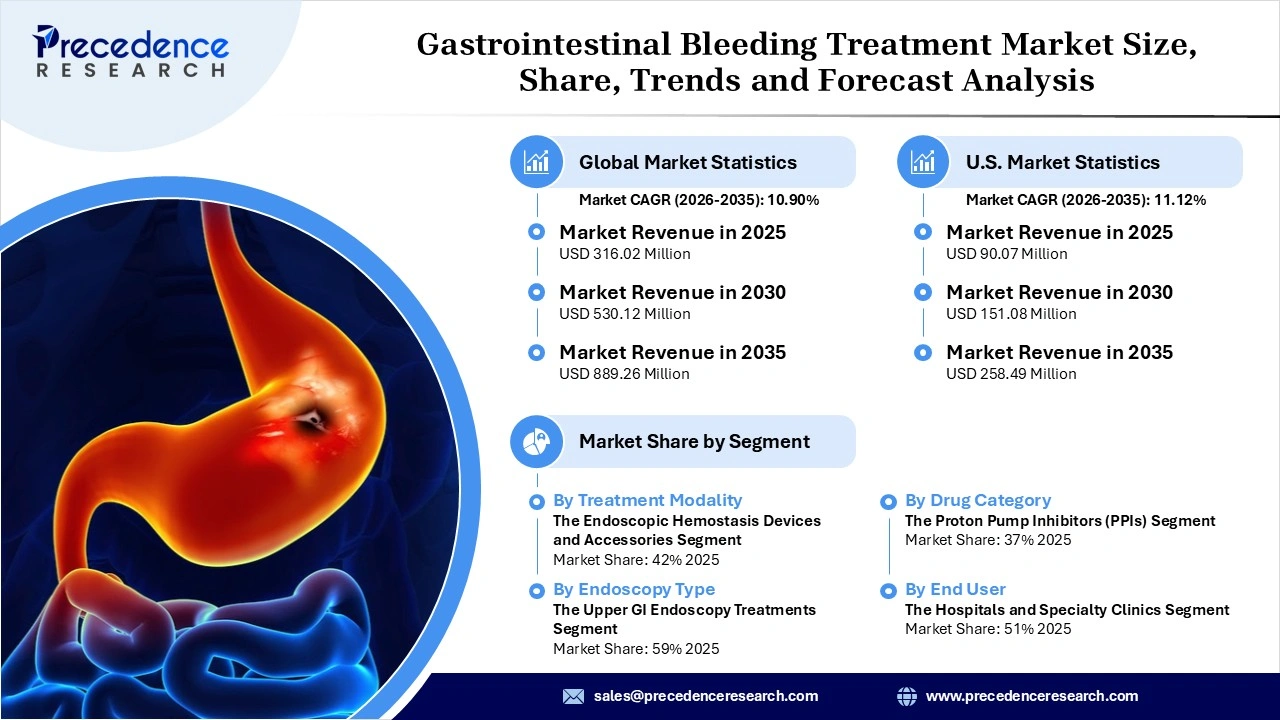
The global gastrointestinal bleeding treatment market revenue was valued at USD 316.02 million in 2025 and is expected to attain around USD 889.26 million by 2035, growing at a CAGR of 10.90% during forecast period.The gastrointestinal bleeding treatment market is experiencing unprecedented growth, driven by the growing demand for advanced endoscopic hemostasis, increasing use of NSAIDs, and the aging population.
What are the Factors Contributing to the Growth of the Gastrointestinal Bleeding Treatment Market?
The increasing prevalence of gastrointestinal disorders, such as peptic ulcers, gastroesophageal reflux disease (GERD), inflammatory bowel diseases (IBD), and colorectal cancer, is a major driver, accelerating the growth of the market in the coming years. Additionally, the rising need for effective endoscopic techniques, including next-generation clips, sprays, and hemostatic powders that improve treatment outcomes are expected to drive the growth of the gastrointestinal bleeding treatment market during the forecast period.
Segment Insights
- By treatment modality, the endoscopic hemostasis devices and accessories segment accounted for the highest revenue share of approximately 42% in 2025, owing to the increasing prevalence of GI disorders and the rising shift toward minimally invasive & non-surgical procedures.
- By endoscopy type, the upper GI endoscopy treatments segment contributed the biggest revenue share of approximately 59% in 2025. This is mainly due to the rising prevalence of upper GI conditions, such as peptic ulcers, gastric erosions, and esophageal varices, necessitates immediate endoscopic intervention.
- By drug category, the proton pump inhibitors (PPIs) segment accounted for the largest market share of approximately 37% in 2025, owing to their efficacy in suppressing gastric acid, which plays a crucial role in stabilizing clots, alleviating re-bleeding rates, and enhancing mucosal healing in patients with bleeding ulcers.
- By end user, the hospitals and specialty clinics segment held the largest revenue share of approximately 51% in 2025. Hospitals and specialty clinics have advanced infrastructure for endoscopic, robotic, and minimally invasive procedures. Hospitals and specialty clinics provide comprehensive care, including specialized gastroenterologists, 24/7 emergency services, and ICU support for severe bleeding cases.
Regional Insights
North America holds the dominant share in the global gastrointestinal bleeding treatment market. The region’s leadership is driven by the owing to its presence of sophisticated healthcare infrastructure, rising incidence of gastrointestinal disorders, surge in geriatric population, rising integration of AI-assisted endoscopy, the increasing preference for minimally invasive endoscopic hemostasis, and well-established reimbursement policies. Moreover, the rapid adoption of advanced technologies for endoscopic and interventional procedures, and the prioritization of preventative care.
On the other hand, Asia Pacific is anticipated to grow at the fastest rate in the market during the forecast period. The fastest growth of the region is attributed to the significant investment in healthcare infrastructure, the rising aging population, increasing prevalence of GI diseases, rising adoption of minimally invasive treatments, and rising access to advanced endoscopic procedures.
Gastrointestinal Bleeding Treatment Market Coverage
| Report Attribute | Key Statistics |
| Market Revenue in 2025 | USD 316.02 Million |
| Market Revenue by 2035 | USD 889.26 Million |
| CAGR from 2026 to 2035 | 10.90% |
| Quantitative Units | Revenue in USD million/billion, Volume in units |
| Largest Market | North America |
| Base Year | 2025 |
| Regions Covered | North America, Europe, Asia-Pacific, Latin America, and the Middle East & Africa |
Recent Development
- In March 2025, FUJIFILM Healthcare Americas Corp. announced the commercialization of its EN-840T Double Balloon Enteroscopy (DBE) scope, an endoscopic imaging technology that enables access to the entire small intestine for diagnosis and therapeutic intervention. The EN-840T DBE scope represents a major update to Fujifilm’s Double Balloon Enteroscopy technology.(Source: https://www.itnonline.com)
Get this report to explore global market size, share, CAGR, and trends, featuring detailed segmental analysis and an insightful competitive landscape overview @ https://www.precedenceresearch.com/sample/7765
You can place an order or ask any questions, please feel free to contact us at sales@precedenceresearch.com |+1 804 441 9344