



Green Hospitals Market Revenue to Attain USD 196.78 Bn by 2035
Published: 08 Apr 2026
Author: Precedence Research



Green Hospitals Market Revenue and Trends 2026 to 2035
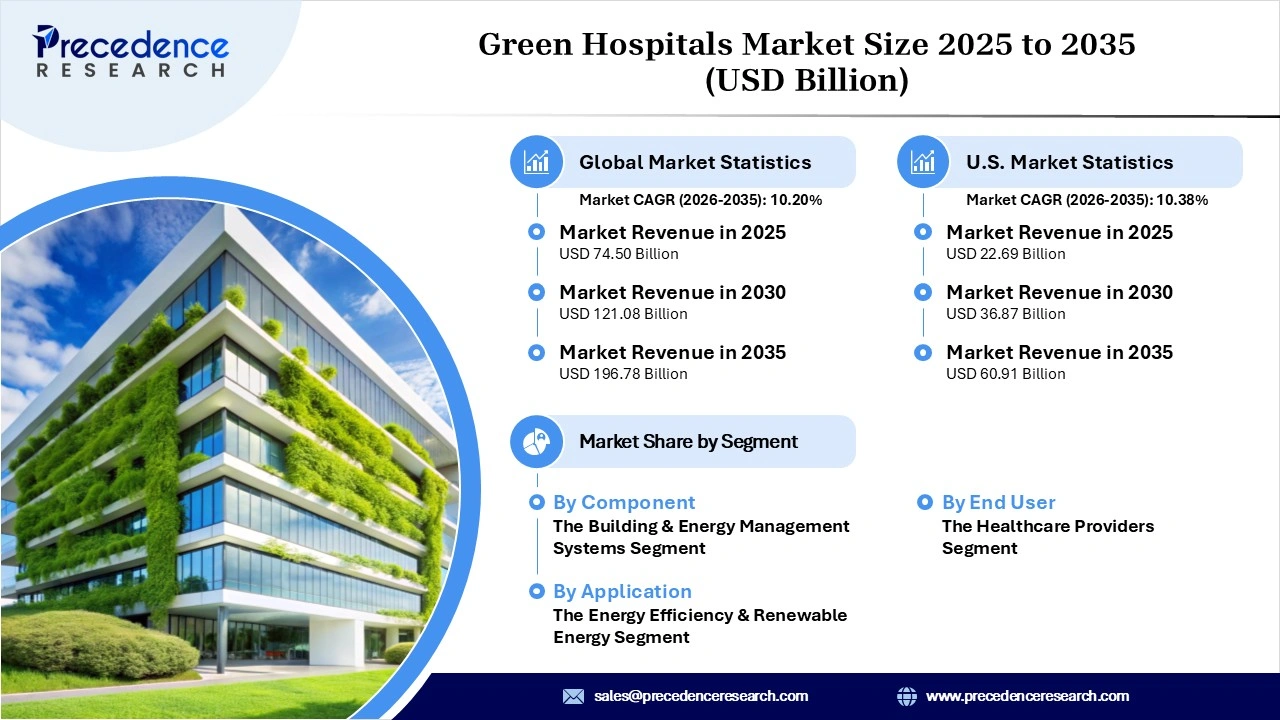
The global green hospitals market revenue surpassed USD 74.50 billion in 2025 and is predicted to attain around USD 196.78 billion by 2035, growing at a CAGR of 10.20%. The green hospitals market is growing rapidly due to increasing regulatory support, rising environmental awareness, adoption of energy-efficient technologies, and the need to reduce healthcare-related carbon emissions and operational costs.
Market at a Glance
The green hospitals market is an emerging segment of the healthcare industry that is transforming hospital design and operations to reduce environmental impact while maintaining high-quality patient care. It encompasses energy-efficient infrastructure, water conservation initiatives, renewable energy integration, and advanced waste management systems, often supported by digital monitoring technologies. Rather than a standalone solution, green hospitals represent a holistic approach that embeds sustainability as a core component of the healthcare lifecycle rather than an afterthought.
What are the Major Trends Impacting the Green Hospitals Market?
Building-Integrated Renewables Redefining Hospital Design
Building-integrated renewable energy systems are transforming hospital design by shifting facilities from passive energy consumers to active energy producers. For instance, a railway hospital project in India implemented building-integrated photovoltaics (BIPV) under government initiatives, enabling both on-site renewable energy generation and structural efficiency. With Indian Railways achieving a solar production capacity of approximately 11.5 million units annually, such initiatives highlight the potential for hospitals to evolve into micro-energy platforms.
Quantifiable Returns from Smart Infrastructure & Efficient Resources
Green hospitals are delivering measurable operational and financial benefits through sustainable infrastructure. Facilities adopting advanced design and resource-efficient technologies report energy savings of 30–50% and water conservation of 20-30%, while also enhancing patient environments. Additionally, solar initiatives at Tata Memorial Centre have resulted in substantial annual cost savings, demonstrating that sustainability not only supports environmental goals but also provides strong financial returns.
Transforming Hospitals: AIIMS’ Path to Sustainability and Efficiency
In March 2025, All India Institute of Medical Sciences, New Delhi (AIIMS) emerged as a leader in sustainable healthcare by adopting renewable energy and green infrastructure to reduce environmental impact and operational costs.
Key Initiatives:
- Solar Power: Installed 1.5 MW solar capacity, reducing energy costs by 30%.
- Energy Efficiency: LED lighting and smart HVAC systems cut electricity use by 25%.
- Waste Management: Partnered with authorized facilities for safe biomedical waste disposal.
- Water Conservation: Rainwater harvesting and recycling reduced water waste by 40%.
Impact:
AIIMS achieved annual energy savings of approximately ₹50 crore, significantly lowered its carbon footprint, and improved patient comfort and operational efficiency, demonstrating the financial and environmental benefits of green hospital practices.
Market Segmentation Overview
- By component, the building & energy management systems segment accounted for a major market share of 45.20% in 2025, as more hospitals have been implementing integrated control layers to optimize energy use. HVAC systems, lighting, and centralized energy management work together as essential components, embedding efficiency into daily operations rather than treating it as occasional upgrades. With the growing awareness about environmental conservation, the demand for these systems has been increasing.
- By component, the sustainable infrastructure segment held the second-largest position in the market with a share of 30.60% in 2025 as hospitals increasingly adopt eco-friendly construction materials and implement advanced waste and water management systems, reflecting a broader shift toward environmentally responsible facility design. This growth is driven by the recognition that sustainability extends beyond energy efficiency to include the materials used and the management of resources throughout the hospital’s lifecycle.
- By application, the energy efficiency & renewable energy segment held a major share of 34.40% in the green hospitals market in 2025, supported by the rising adoption of solar and wind energy solutions among hospitals, enabling them to generate a portion of their own electricity. This shift transforms energy from a fixed operational cost into a flexible, partially self-sustaining resource, improving both sustainability and cost efficiency.
- By application, the waste management & recycling segment is the second-largest shareholder, holding a 25.70% share in 2025. This is due to stricter regulatory requirements and rising environmental awareness. Hospitals are implementing advanced waste segregation and disposal systems, improving compliance, reducing environmental impact, and sometimes enabling partial recovery of waste materials.
- By end user, the healthcare providers segment held the largest share of 54.70% in the green hospitals market in 2025, as they are the primary adopters of sustainable initiatives. Their large scale makes them both major resource consumers and the most immediate beneficiaries of efficiency improvements, driving faster and more structured implementation of green systems.
- By end user, the government institutions segment was the second-largest shareholder, holding a 25.10% share in 2025. This is because public healthcare facilities are increasingly adopting sustainability measures driven by policies, regulations, and funding programs.
Regional Insights
North America dominated the global green hospitals market with a share of 40.60% in 2025, driven by strong policy support, technological adoption, and financial investment. Hospitals in the U.S. and Canada integrated sustainability into operations by upgrading infrastructure, implementing intelligent energy solutions, and following green building standards, making sustainability a core factor in procurement and long-term strategic planning rather than just an experimental initiative.
Europe is the second-largest shareholder, holding a 29.10% share of the market in 2025. Regulatory directives and climate commitments encouraged hospitals across the region to adopt circular systems, linking waste management, water use, and energy consumption rather than treating them separately. Several European Union countries incorporated sustainability into healthcare laws, helping green initiatives transition from innovative projects to standard practices in hospital operations.
Green Hospitals Market Coverage
| Report Attribute | Key Statistics |
| Market Revenue in 2025 | USD 74.50 Billion |
| Market Revenue by 2035 | USD 196.78 Billion |
| CAGR from 2026 to 2035 | 10.20% |
| Quantitative Units | Revenue in USD million/billion, Volume in units |
| Largest Market | North America |
| Base Year | 2025 |
| Regions Covered | North America, Europe, Asia-Pacific, Latin America, and the Middle East & Africa |
Top Companies in the Green Hospitals Market
Companies like Johnson Controls International plc and Schneider Electric SE enhance hospital energy systems and building intelligence, enabling consumption reductions often without active intervention. Siemens Healthineers AG and GE Healthcare integrate efficiency with clinical accuracy, embedding sustainability directly into healthcare operations. Meanwhile, Philips Healthcare and Honeywell International Inc. combine environmental management with healthcare delivery through advanced digital monitoring and energy optimization. At the infrastructure level, Trane Technologies, Carrier Global Corporation, and Daikin Industries Ltd. are redefining hospital air circulation a critical yet often overlooked aspect of sustainability.
Segments Covered in the Report
By Component
- Building & Energy Management Systems (BEMS)
- HVAC Systems
- Lighting Systems
- Energy Management Systems
- Sustainable Infrastructure
- Green Building Materials
- Waste Management Systems
- Water Management Systems
- Services
- Consulting Services
- Installation & Integration
- Maintenance & Support
By Application
- Energy Efficiency & Renewable Energy
- Solar Energy Solutions
- Wind Power Systems
- Waste Management & Recycling
- Waste Segregation & Disposal
- Recycled Materials for Construction
- Water Conservation
- Water Recycling Systems
- Water Efficient Fixtures
- Air Quality Management
- Ventilation Systems
- Air Filtration Systems
By End User
- Healthcare Providers
- Hospitals
- Healthcare Institutions
- Government Institutions
- Public Healthcare Facilities
- Others
- Corporate Healthcare Offices
- Clinics and Outpatient Centers
By Region
- North America
- Latin America
- Europe
- Asia-pacific
- Middle and East Africa
Get this report to explore global market size, share, CAGR, and trends, featuring detailed segmental analysis and an insightful competitive landscape overview @ https://www.precedenceresearch.com/sample/8281
You can place an order or ask any questions, please feel free to contact us at sales@precedenceresearch.com |+1 804 441 9344