



Green Hospitals Market Size, Companies, Share, Patient Volume, Treatment Adoption Rates, Pricing Analysis, Regulatory Landscape, Competitive Positioning, and Demand Forecast
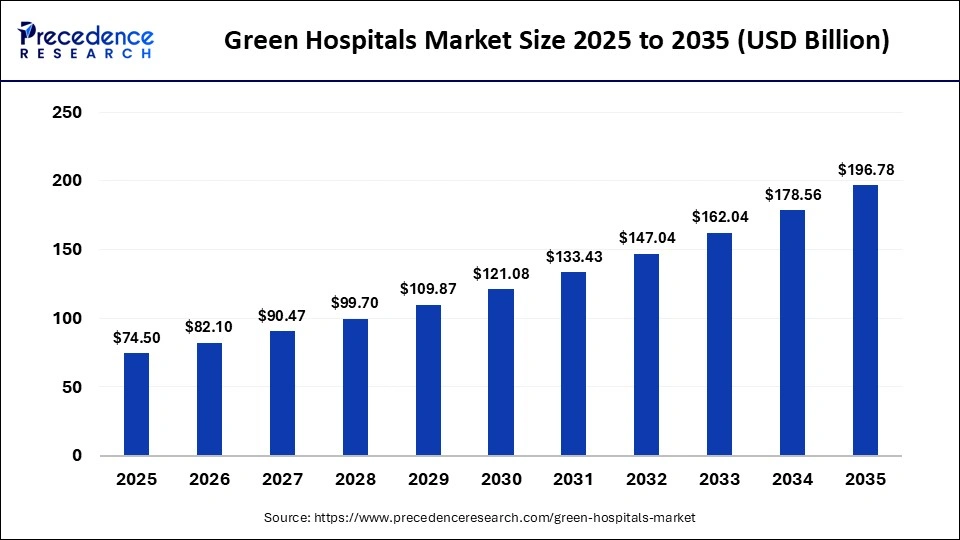
Deepa Pandey, a Healthcare Industry Expert, highlights that the green hospitals market has reached USD 82.10 billion in 2026 and is on track to reach USD 196.78 billion by 2035, advancing at a CAGR of 10.20%. Key green hospitals market companies shaping the market include Johnson Controls International plc, Siemens Healthineers AG, Schneider Electric SE, Honeywell International Inc, GE Healthcare, Philips Healthcare, while major growth segments span By Component, By Application, By End User.
Source: https://www.precedenceresearch.com/green-hospitals-market
 Get a Sample
 Table Of Content


What is the Green Hospitals Market Size in 2026?
The global green hospitals market size accounted for USD 74.50 billion in 2025 and is predicted to increase from USD 82.10 billion in 2026 to approximately USD 196.78 billion by 2035, expanding at a CAGR of 10.20% from 2026 to 2035. The market is driven by the growing demand for sustainable, energy-efficient, and eco-friendly healthcare infrastructure.
Key Takeaways
- North America dominated the market with a share of 40.60% in 2025.
- The Asia Pacific is expected to grow at the fastest rate between 2026 and 2035.
- By component, the building & energy management systems segment held a dominant position in the market with a share of 45.20% in 2025.
- By component, the sustainable infrastructure segment is the second-largest shareholder and is expected to grow at a significant rate between 2026 and 2035.
- By application, the energy efficiency & renewable energy segment accounted for a major revenue share of 34.40% in 2025.
- By application, the waste management & recycling segment is the second-largest shareholder and is expected to grow at a significant rate between 2026 and 2035.
- By end-user, the healthcare providers segment led the global market with a share of 54.70% in 2025.
- By end-user, the government institutions segment is the second-largest shareholder and is expected to grow at a significant rate between 2026 and 2035.
Green Hospitals: The Future of Sustainable Healthcare
Green hospitals refers to healthcare facilities that incorporate environmentally sustainable practices into their operations to reduce their ecological footprint while maintaining high standards of patient care. These hospitals focus on energy efficiency, waste reduction, water conservation, and the use of eco-friendly materials and advanced technologies. The market is experiencing significant growth, driven by increasing global awareness of sustainability and environmental responsibility. The healthcare sector is a major contributor to carbon emissions, waste generation, and energy consumption, making the transition to greener practices essential. Furthermore, stringent regulations and policies imposed by governments and environmental agencies are accelerating the shift from conventional systems to sustainable healthcare solutions.
How is AI Influencing the Green Hospitals Market?
Artificial intelligence (AI) is transforming the green hospitals market by enabling smarter, more efficient, and sustainable healthcare operations. AI optimizes the consumption of energy by analyzing infrastructure (lighting, heating, and ventilation) in real time to reduce waste and provide the patient with comfort. AI can be used to identify, categorize, and track hazardous materials, get rid of them in a safe manner, and minimize environmental risks. Also, administrative automation through AI minimizes the use of paper and enhances the efficiency of workflow. AI has been used to attain sustainable procurement by evaluating the supply chains and suggesting environmentally friendly alternatives.
Green Hospitals Market Trends
- Increasing regulatory requirements and government policies are driving hospitals to adopt environmentally sustainable practices. These initiatives encourage healthcare providers to align with sustainability goals and invest in green technologies, enabling both ecological and long-term economic benefits.
- Healthcare institutions are transitioning toward energy-efficient infrastructure, incorporating smart lighting systems, optimized air conditioning controls, and renewable energy sources such as solar power. These measures help reduce operational costs, lower carbon footprints, and minimize overall environmental impact.
Market Scope
| Report Coverage | Details |
| Market Size in 2025 | USD 74.50 Billion |
| Market Size in 2026 | USD 82.10 Billion |
| Market Size by 2035 | USD 196.78 Billion |
| Market Growth Rate from 2026 to 2035 | CAGR of 10.20% |
| Dominating Region | North America |
| Fastest Growing Region | Asia-Pacific |
| Base Year | 2025 |
| Forecast Period | 2026 to 2035 |
| Segments Covered | Component, Application, End User, and Region |
| Regions Covered | North America, Europe, Asia-Pacific, Latin America, and Middle East & Africa |
Market Dynamics
Drivers
Rising Environmental Awareness and Renewable Energy Adoption
Growing concern over climate change and environmental degradation is driving the healthcare sector toward more sustainable practices. Hospitals are increasingly recognizing their significant contribution to carbon emissions and are actively working to reduce their environmental impact. The adoption of energy-efficient systems and renewable energy sources is playing a crucial role in enhancing sustainability performance. Furthermore, supportive policies and incentives from governments and environmental organizations are accelerating this transition and encouraging wider adoption across the sector.
Expanding Waste Minimization and Recycling Initiatives
A large amount of toxic and non-toxic waste is produced by healthcare facilities, making waste management a critical concern. Hospitals are increasingly adopting structured waste management programs to reduce environmental impact and improve operational efficiency. These initiatives include waste segregation at the source, recycling of materials such as plastics and paper, and the safe disposal of biomedical waste. Additionally, the adoption of innovative technologies and reusable resources is supporting the transition toward a circular economy within the healthcare sector.
Restraint
Financial Constraints and High Capital Requirements
Although green hospitals have long-term advantages, the high initial investment remains a major barrier to their widespread adoption. Implementing sustainable practices in healthcare facilities often requires substantial capital for infrastructure redesign, installation of energy-efficient systems, integration of renewable energy sources, and development of comprehensive waste management programs. These upfront costs can place a considerable financial burden on healthcare providers, particularly in developing countries. Additionally, retrofitting existing infrastructure with green technologies can be complex, further increasing both the cost and time required for implementation.
Opportunity
Emergence of Sustainable and Green Supply Chains
Green supply chain development is emerging as a significant opportunity in the green hospitals market. Healthcare organizations are increasingly collaborating with suppliers to ensure that the products, materials, and services used in their operations meet environmental sustainability standards. Integrating sustainability into the supply chain enables hospitals to reduce their overall environmental impact beyond their direct operations, contributing to a more comprehensive and responsible approach to healthcare delivery.
Segment Insights
Component Insights
Green Hospitals Market Share, By Component, 2025-2035 (%)
| Component | 2025 | 2035 |
| Building & Energy Management Systems (BEMS) | 45.20% | 42.00% |
| Sustainable Infrastructure | 30.60% | 32.50% |
| Services | 24.20% | 25.50% |
The Building & Energy Management Systems Segment Held a 45.20% Market Share in 2025
The building & energy management systems segment held a dominant position in the green hospitals market with a share of 45.20% in 2025. This is because these systems play a crucial role in optimizing energy efficiency and lowering the cost of operation. Hospitals consume a significant amount of power that is allocated to HVAC systems, lighting, and medical devices, and therefore, energy control is crucial. Real-time monitoring, predictive maintenance, and efficient consumption of resources are also made possible by the energy management systems. The growing focus on reducing environmental impact is also driving the adoption of these systems.
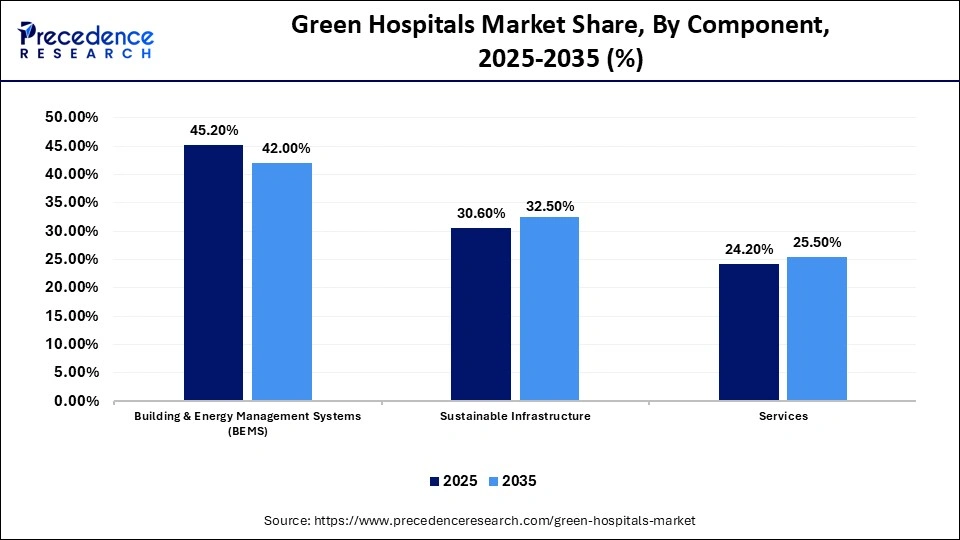
The sustainable infrastructure systems segment held a 30.60% share of the market in 2025, driven by increasing demand for energy- and resource-efficient buildings and systems. Sustainable infrastructure systems, including green building materials, waste management solutions, and water management systems, are designed to reduce the environmental impact of healthcare facilities. Waste management systems enable the safe handling and disposal of both hazardous and non-hazardous waste, while water management solutions promote conservation through recycling and efficient usage practices.
The services segment held a 24.20% share of the market in 2025, driven by the increasing demand for professional services in deploying and handling sustainable healthcare solutions. The consulting services help healthcare providers to build and adopt custom green solutions that are aligned with the regulatory requirements and sustainability goals. There is a heightened demand for integration and installation services, which enable the smooth execution of modern systems, including energy management and waste treatment systems.
Application Insights
The Energy Efficiency & Renewable Energy Segment Held a 34.40% Market Share in 2025
The energy efficiency & renewable energy segment dominated the green hospitals market while holding a 34.40% share in 2025. This is mainly due to the urgent need to reduce energy consumption and carbon emissions in healthcare buildings. Hospitals have been rapidly shifting toward solar and wind power systems to reduce dependence on fossil fuels and lower operational costs. Additionally, the implementation of advanced energy-efficient systems enables better monitoring and control of energy usage across hospital operations.
The waste management & recycling segment was the second-largest shareholder, holding a 25.70% share in 2025, supported by the growing emphasis on safe and sustainable waste handling practices. Healthcare facilities generate massive amounts of both hazardous and non-hazardous waste, which necessitate proper segregation, treatment, and recycling to prevent environmental pollution and health risks. Furthermore, the increasing use of recycled materials in construction and operations is promoting the adoption of circular economy principles.
Green Hospitals Market Share, By Application, 2025-2035 (%)
| Application | 2025 | 2035 |
| Energy Efficiency & Renewable Energy | 34.40% | 33.50% |
| Waste Management & Recycling | 25.70% | 27.40% |
| Water Conservation | 20.80% | 22.10% |
| Air Quality Management | 19.10% | 17.00% |
The water conservation segment held a 20.80% share of the market in 2025, driven by the need to determine how water resources are effectively utilized in the medical facilities. Water conservation in hospitals is very important as potable water is required in large quantities to ensure the facilitation of sanitation, medical practice, and the day-to-day running of the hospital. With the use of water recycling structures, hospital facilities can treat and reuse wastewater, hence reducing the overall consumption.
The air quality management segment held a 19.10% share of the market in 2025, as maintaining clean and safe indoor air is critical in healthcare environments. Hospitals are increasingly deploying advanced ventilation systems and air purification technologies to control airborne contaminants, improve infection prevention, and enhance patient outcomes. Additionally, optimized air management systems contribute to energy savings by ensuring efficient airflow and reducing unnecessary energy consumption.
End-User Insights
Green Hospitals Market Share, By End User, 2025-2035 (%)
| End User | 2025 | 2035 |
| Healthcare Providers | 54.70% | 52.80% |
| Government Institutions | 25.10% | 23.80% |
| Others | 20.20% | 23.40% |
Why Did the Healthcare Providers Segment Lead the Green Hospitals Market?
The healthcare providers segment led the market with a major revenue share of 54.70% in 2025. This leadership is primarily due to the high operational intensity of hospitals and healthcare organizations, which consume substantial resources. As a result, sustainability has become essential for reducing environmental impact and operational costs. Hospitals are increasingly adopting green building designs, efficient waste management systems, and energy-saving technologies to enhance overall efficiency and ensure compliance with environmental regulations.
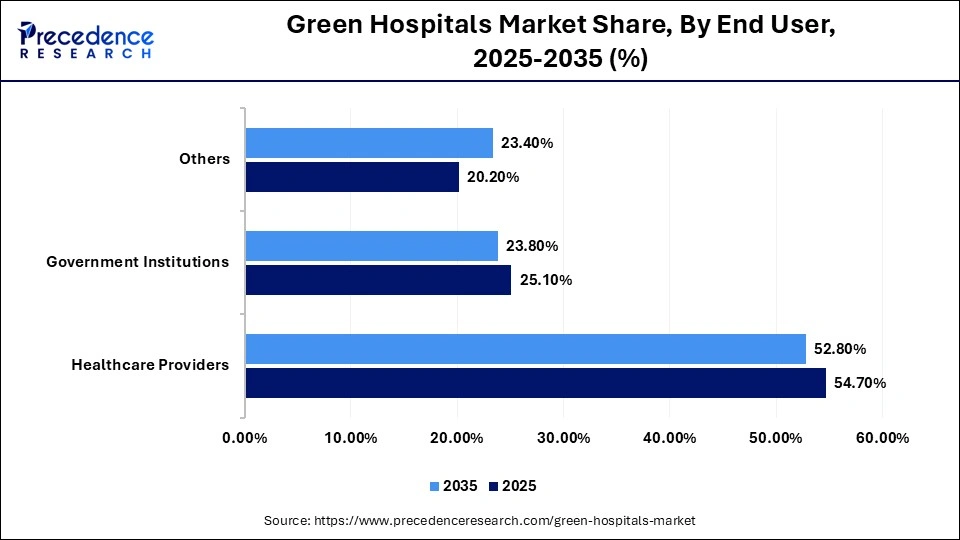
The government institutions segment held a 25.10% share of the market in 2025, driven by strong policy support and public-sector initiatives aimed at developing sustainable healthcare infrastructure. Governments are investing in green public healthcare facilities to minimize environmental impact and improve energy efficiency. Additionally, regulatory frameworks and sustainability mandates are encouraging the adoption of renewable energy, effective waste management practices, and environmentally friendly construction standards.
The others segment held a 20.20% share of the market in 2025, including other private organizations in the market. These entities are increasingly focusing on enhancing brand image, attracting environmentally conscious patients, and reducing operational costs. Many are adopting renewable energy solutions, eco-friendly materials, and digital technologies in healthcare offices and outpatient facilities to improve efficiency and minimize environmental impact.
Regional Insights
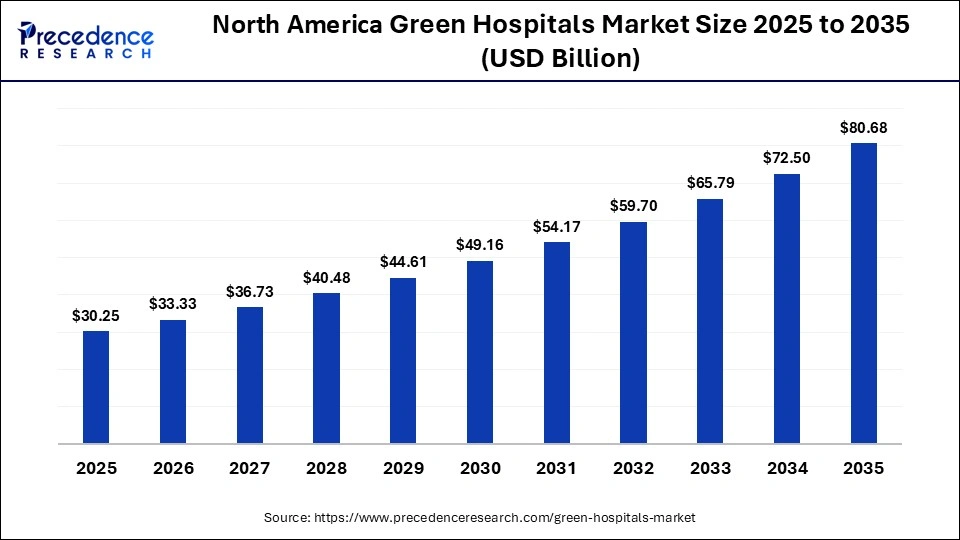
North America Green Hospitals Market Size and Growth 2026 to 2035
The North America green hospitals market size is estimated at USD 30.25 billion in 2025 and is projected to reach approximately USD 80.68 billion by 2035, with a 10.31% CAGR from 2026 to 2035.
Why Did North America Lead the Green Hospitals Market?
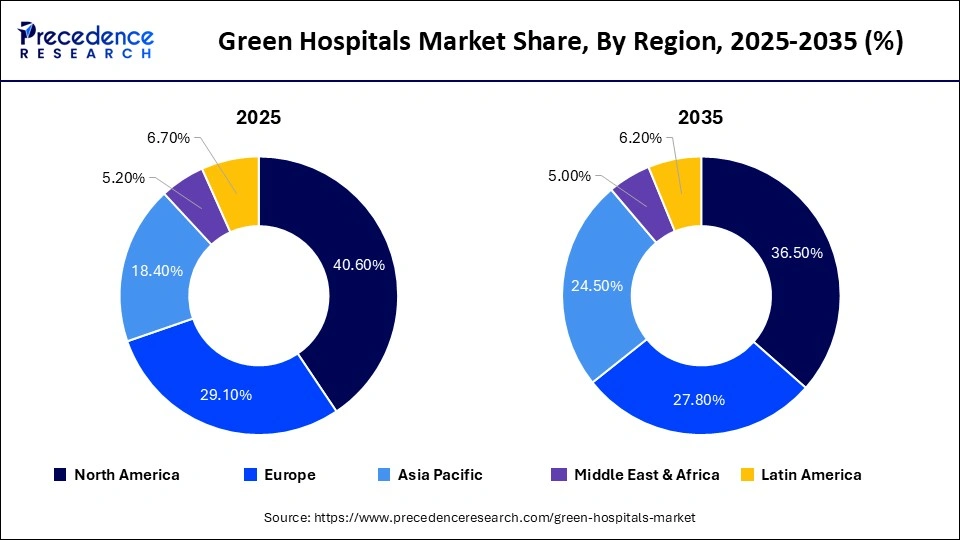
North America dominated the green hospitals market by capturing a major share of 40.60% in 2025. This is mainly due to a high adoption rate of sustainable healthcare practices, advanced technological infrastructure, and a positive regulatory regime. Hospitals and healthcare organizations in the region have been focusing on energy-efficient building designs, the incorporation of renewable energy, and the reduction of waste. Hospitals in the region are at the forefront of implementing advanced HVAC systems, smart lighting, and water conservation technologies. In addition, government policies, environmental regulations, and incentive programs are promoting the adoption of green solutions. Growing environmental awareness among both healthcare providers and patients further reinforces the demand for eco-friendly hospitals.
U.S. Green Hospitals Market Size and Growth 2026 to 2035
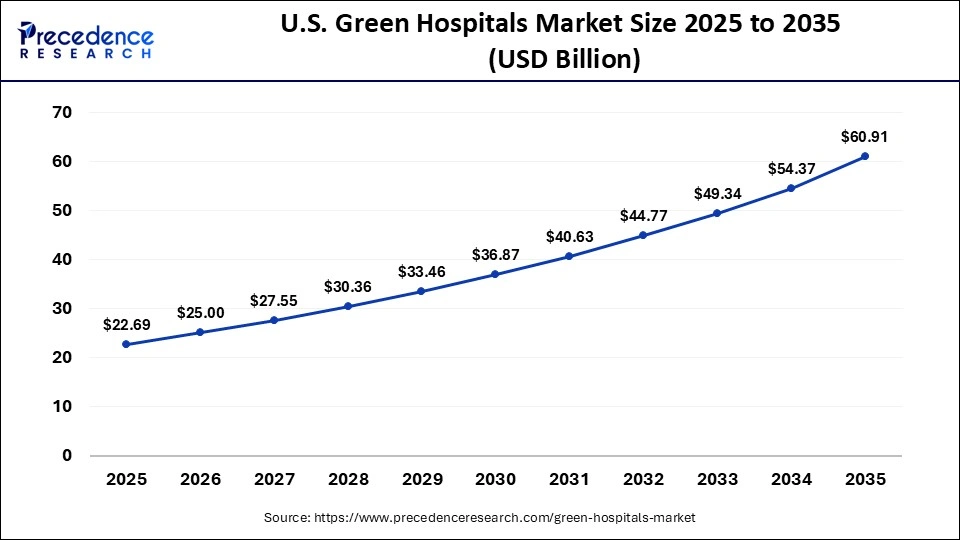
The U.S. green hospitals market size is calculated at USD 22.69 billion in 2025 and is expected to reach nearly USD 60.91 billion in 2035, accelerating at a strong CAGR of 10.38% between 2026 and 2035.
U.S. Green Hospitals Market Analysis
The U.S. is a major contributor to the North American market, driven by a well-developed healthcare infrastructure, favorable regulatory frameworks, and a growing focus on sustainability. Hospitals in the country are installing renewable energy, such as solar and wind energy, and adopting environmentally friendly building materials to reduce carbon emissions as well as the cost of operation. The incentives, environmental laws, and sustainability programs by the government help to motivate healthcare providers to adopt green practices, such as waste minimization, water savings, and intelligent energy utilization.
Why is Asia Pacific Experiencing the Fastest Growth in the Green Hospitals Market?
Asia Pacific held a 18.40% share of the market in 2025 and is expected to grow at the fastest rate in the coming years, driven by the growing urbanization, the maturing medical infrastructure, and the growing environmental awareness. The need to reduce the ecological impact is forcing governments and private healthcare providers to implement sustainable hospital practices. Countries such as China, India, and Japan are also incurring huge investments in energy-efficient buildings, renewable energy sources, and waste management systems within their hospitals.
China Green Hospitals Market Analysis
The market in China is primarily driven by rapid urbanization, the expansion of the healthcare sector, and rising environmental awareness. The government is actively promoting sustainable healthcare through supportive policies, financing, and incentives focused on energy conservation, renewable energy adoption, and environmentally friendly infrastructure. Additionally, growing public awareness of pollution and environmental health is compelling healthcare providers to implement green practices, enhancing both sustainability and operational performance.
Europe: The Second Largest Market
Europe is the second-largest market for green hospitals, holding a 29.10% share in 2025, driven by high environmental awareness and stringent regulations in the healthcare sector. European healthcare systems are increasingly focused on energy efficiency, renewable energy integration, and eco-friendly building designs. Additionally, governments are promoting green initiatives in hospitals through supportive legislation, funding, and incentive programs. Policies encouraging green hospital infrastructure include green building certifications, sustainable waste management, and water conservation measures, further accelerating market growth.
Germany Green Hospitals Market Analysis
In Germany, the market is driven by the increasing adoption of environmentally friendly practices and stringent regulations. The country is advancing the use of renewable energy, low-energy buildings, and sustainable construction materials to reduce carbon footprints and operational costs. Hospitals in Germany are implementing advanced waste management programs, water conservation initiatives, and smart technologies to monitor and optimize energy consumption, supporting both sustainability and operational efficiency.
Green Hospitals Market Companies
- Johnson Controls International plc
- Siemens Healthineers AG
- Schneider Electric SE
- Honeywell International Inc
- GE Healthcare
- Philips Healthcare
- United Technologies Corporation
- Interface Inc.
- Kingspan Group
- Armstrong World Industries
- Trane Technologies
- Carrier Global Corporation
- Eaton Corporation
- Daikin Industries Ltd.
- Rockwell Automation, Inc.
Recent Developments
- In July 2025, Indira Gandhi National Open University (IGNOU) unveiled a certificate of healthcare waste management (CHCWM) in association with the World Health Organization (WHO) and region-specific to South-East Asia. The program will assist the health infrastructure of the general population and educate medical workers on ways of managing biomedical waste efficiently.(Source: https://www.indiatoday.in)
- In June 2025, e-waste in Karo Sambhav collaborated with Ujala Cygnus Healthcare Services to handle e-waste in its network of hospitals in India. The model will implement the concept of a circular economy by establishing an IT-related waste and biomedical equipment recycling technology.(Source: https://www.karosambhav.com)
- In February 2025, Dr. Jitendra Singh, one of the Union Ministers, inaugurated the first indigenous automated biomedical waste treatment plant in AIIMS New Delhi. This facility will improve the management of bio-medical waste, besides promoting sustainable and eco-friendly practices in the hospitals.
Segments Covered in the Report
By Component
- Building & Energy Management Systems (BEMS)
- HVAC Systems
- Lighting Systems
- Energy Management Systems
- Sustainable Infrastructure
- Green Building Materials
- Waste Management Systems
- Water Management Systems
- Services
- Consulting Services
- Installation & Integration
- Maintenance & Support
By Application
- Energy Efficiency & Renewable Energy
- Solar Energy Solutions
- Wind Power Systems
- Waste Management & Recycling
- Waste Segregation & Disposal
- Recycled Materials for Construction
- Water Conservation
- Water Recycling Systems
- Water Efficient Fixtures
- Air Quality Management
- Ventilation Systems
- Air Filtration Systems
By End User
- Healthcare Providers
- Hospitals
- Healthcare Institutions
- Government Institutions
- Public Healthcare Facilities
- Others
- Corporate Healthcare Offices
- Clinics and Outpatient Centers
By Region
- North America
- Latin America
- Europe
- Asia-pacific
- Middle and East Africa
For inquiries regarding discounts, bulk purchases, or customization requests, please contact us at sales@precedenceresearch.com
Frequently Asked Questions
Tags





Ask For Sample
No cookie-cutter, only authentic analysis – take the 1st step to become a Precedence Research client
 Get a Sample
.webp)



 sales@precedenceresearch.com
 Schedule a Meeting
