



Immunochemistry Instruments and Reagents Market Revenue to Attain USD 53.50 Bn by 2035
Published: 14 May 2026
Author: Precedence Research



Immunochemistry Instruments and Reagents Market Revenue and Trends 2026 to 2035
The global immunochemistry & instruments reagents market revenue surpassed USD 26.20 billion in 2025 and is predicted to attain around USD 55.30 billion by 2035, growing at a CAGR of 7.40%. The market is steadily expanding as hospitals and diagnostic laboratories pursue both faster and more efficient disease testing, driven by rising rates of cancer, infectious diseases, hormonal disorders, and a significant trend towards automated, precision-driven diagnostics.
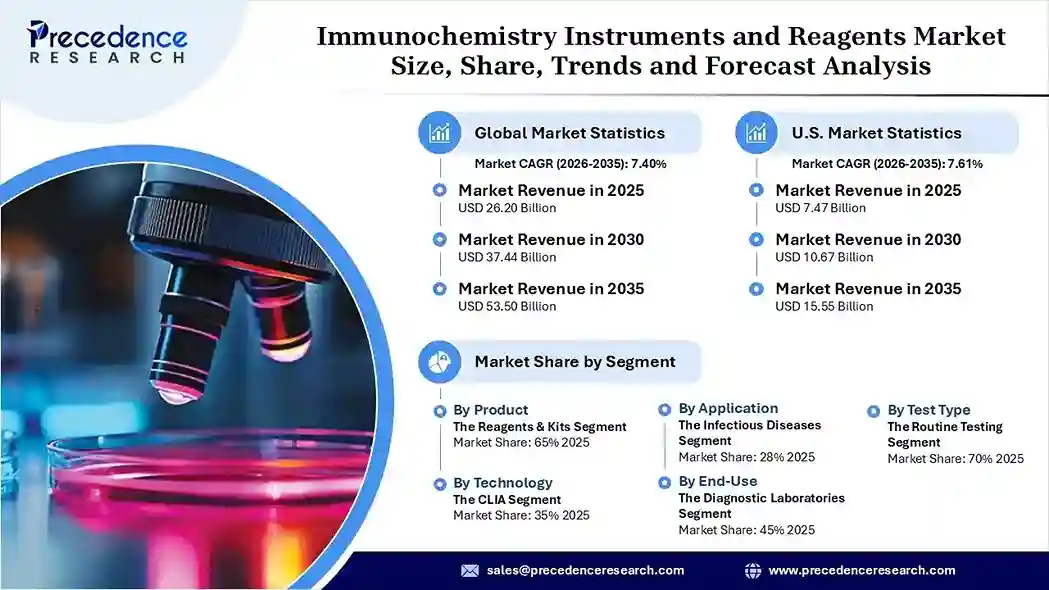
Market at a Glance
The immunochemistry & instruments reagents market comprises various components, including diagnostic systems, assay analyzers, antibodies, calibrators, and chemical reagents used to identify diseases based on the interaction between antigen and antibody in clinical samples. The technologies are key to detecting infections, cancers, cardiac diseases, hormonal imbalances, and autoimmune diseases in the healthcare delivery landscape. This market is becoming mature, with standard testing no longer enough; automation and high-throughput screening methods drive purchasing decisions by caregivers eager for faster and more reliable lab results.
This market represents a broad range that encompasses clinical diagnostics in hospital laboratories, blood screening centers, and research facilities. It combines a variety of applications from the diagnosis of infectious diseases, oncology detection, to endocrine assessment. The increasing employment of automated analyzers, specialized assay kits, and highly sensitive reagents is increasing the importance of this area in routine diagnostics and high-fidelity precision medicine.
Market Forecast for the Immunochemistry Instruments & Reagents Market
Chemiluminescence Immunoassay System is Driving the Market
Chemiluminescence immunoassay systems are becoming increasingly popular because of their ability to deliver high sensitivity, reduced processing errors, and faster sample throughput. Manufacturers are investing heavily in integrated analyzer-reagent ecosystems designed to support multiplex testing and precision diagnostics. This is gradually shifting laboratories away from conventional manual immunoassay workflows toward digitally connected diagnostic platforms.
Rising Demand for Automated Immunoassay Systems
Clinical laboratories are increasingly prioritizing high-throughput diagnostic infrastructure as testing demand spreads across infectious diseases, endocrinology, cardiology, and oncology. Automated immunoassay systems capable of delivering faster turnaround times with minimal technician involvement are gaining stronger procurement preference.
Immunochemistry Reagents Market Trends and Data
- The U.S. top ten health systems performed >2.3 billion immunoassay tests in 2024, representing >600 million more than estimates from 2019. Automated immunochemistry systems are becoming increasingly necessary as the need for diagnostics for such diseases as cardiac, thyroid, or respiratory conditions continues to rise.
- Last fiscal year (2023), India’s National Health Mission reimbursed nearly 370 million immunoassay tests. This is reflective of progress on the level of public diagnostics infrastructure and access to laboratory testing in emerging healthcare networks.
- Germany recorded nearly 11 million additional troponin-I test orders between 2022 and 2023 as hospitals intensified rapid cardiac emergency diagnostics and high-sensitivity biomarker testing protocols.
- At present, more than two-thirds (65%) of the world's laboratories also use automated high-throughput testing systems. Meanwhile, approximately 67% of hospitals are turning to integrated immunoassay platforms that enable round-the-clock laboratory workflows.
Market Segmentation Overview
- By product, the reagents and kits segment dominated the market with a 65% market share in 2025 and is expected to maintain its leading position with a CAGR of 8.5% in the coming years, due to their recurring testing demand across routine disease testing, oncology screening, hormone analysis, and infectious disease diagnostics. Hospitals and laboratories required continuous replenishment of assay reagents, calibrators, and controls, making this segment a steady revenue contributor compared to one-time analyzer installations.
- By technology, the chemiluminescence immunoassay (CLIA) segment dominated the market with a 35% market share in 2025 and is expected to maintain its leading position with a CAGR of 9.5% in the coming years, because of its high sensitivity, automation with the ability to process large sample volumes, and improved accuracy. Clinical laboratories increasingly preferred CLIA systems for cardiac markers, infectious disease testing, endocrine analysis, and oncology diagnostics, where reliable low-level biomarker detection remained critical.
- By application, the infectious diseases segment accounted for a considerable revenue share of 28% in the market in 2025, because of high testing volumes. Continuous demand for screenings, monitoring, and comprehensive public health surveillance initiatives has resulted in a rise in the global demand for immunochemistry reagents, assay kits, and automated testing platforms.
- By application, the oncology segment is expected to grow at the fastest CAGR of 9% in the immunochemistry instruments & reagents market between 2026 and 2035. As healthcare providers invest in dedicated infrastructure for cancer diagnostics, there will be a gradual increase in demand for tumor marker assays, companion diagnostics, and precision medicine workflows.
- By end-use, the diagnostic laboratories segment dominated the market with a 45% market share in 2025 and is expected to maintain its leading position with a CAGR of 8.5% in the coming years, because of high test volumes across infectious diseases, endocrinology, cardiology, and autoimmune disorders. Centralized laboratory networks consistently utilize high-throughput analyzers, leading to high continuing demand for reagents, consumables, calibration products, and automated testing systems.
- By test type, the routine testing segment held a major revenue share of 70% in the market in 2025, due to the frequent testing on chronic disease control, preventive examinations, and health needs for diagnosing all major health statuses. The use of hormone panels, cardiac markers, thyroid tests, and infectious disease assays kept the use of reagents at a level, and the continuous use of analyzers in labs.
- By test type, the specialized testing segment is steadily growing with a CAGR of 9.5% in the market between 2026 and 2035, as advanced diagnostics are gaining traction. Increasing use of advanced oncology panels, autoimmune disease assays, fertility diagnostics, and therapeutic drug monitoring is expected to create stronger demand for sophisticated immunochemistry platforms and high-sensitivity reagents.
Regional Analysis
North America dominated the global immunochemistry instruments & reagents market with a market share of 38% in 2025, due to its advanced diagnostic infrastructure, strong reimbursement framework, and exceptionally high laboratory testing volumes across hospitals and reference laboratories. The U.S. accounted for a significant share as large diagnostic chains and healthcare networks continuously invested in automated immunochemistry systems for oncology, cardiology, and infectious disease testing. Canada also contributed steadily through expanding public healthcare diagnostics and rising chronic disease screening programs.
Asia-Pacific held a market share of 22% in 2025 and is expected to grow at the fastest CAGR of 10.5% in the market during the forecast period, due to rapid population expansion, improving healthcare access, and aggressive development of diagnostic laboratory infrastructure. As hospitals have adopted more automated analyzers to diagnose high volumes of cancer and infectious disease tests, China will also likely remain the top contributor to this growth. India is also expected to show promising progress, given the proliferation of private diagnostic networks and government initiatives aimed at upgrading healthcare systems.
Immunochemistry & Instruments Reagents Market Coverage
| Report Attribute | Key Statistics |
| Market Revenue in 2025 | USD 26.20 Billion |
| Market Revenue by 2035 | USD 53.50 Billion |
| CAGR from 2026 to 2035 | 7.40% |
| Quantitative Units | Revenue in USD million/billion, Volume in units |
| Largest Market | North America |
| Base Year | 2025 |
| Regions Covered | North America, Europe, Asia-Pacific, Latin America, and the Middle East & Africa |
Top Companies in the Immunochemistry & Instruments Reagents Market
Roche Diagnostics retained a strong market share via cobas immunochemistry platforms and a wide-ranging Elecsys assay portfolio for oncology, cardiac, infectious disease, and endocrine evaluations. Equally, Abbott Laboratories expands the market presence with the simultaneous introduction of ARCHITECT and Alinity immunoassay systems. Danaher Corporation later ventured into automated laboratory diagnostics using resources from its Beckman Coulter division. Siemens Healthineers also kept on innovating integrated Atellica immunoassay solutions that fit within centralized laboratory networks. Thermo Fisher Scientific was working on specialty diagnostics as well to advance clinical laboratory technologies. Bio-Rad Laboratories has also improved quality control and enhanced immunodiagnostic testing capabilities.
Segments Covered in the Report
By Product
- Instruments
- Reagents & Kits
By Technology
- Chemiluminescence Immunoassay (CLIA)
- Enzyme-linked Immunosorbent Assay (ELISA)
- Radioimmunoassay (RIA)
- Fluorescence Immunoassay
By Application
- Infectious Diseases
- Oncology
- Endocrinology
- Cardiology
- Autoimmune Diseases
By End-Use
- Hospitals
- Diagnostic Laboratories
- Academic & Research Institutes
- Blood Banks
By Test Type
- Routine Testing
- Specialized Testing
By Region
- North America
- Latin America
- Europe
- Asia-pacific
- Middle and East Africa
Get this report to explore global market size, share, CAGR, and trends, featuring detailed segmental analysis and an insightful competitive landscape overview @ https://www.precedenceresearch.com/sample/8404
You can place an order or ask any questions. Please feel free to contact us at sales@precedenceresearch.com |+1 804 441 9344