



Indoor Positioning and Indoor Navigation Market Revenue to Attain USD 82.73 Bn by 2035
Published: 30 Apr 2026
Author: Precedence Research



Indoor Positioning and Indoor Navigation Market Revenue and Trends 2026 to 2035
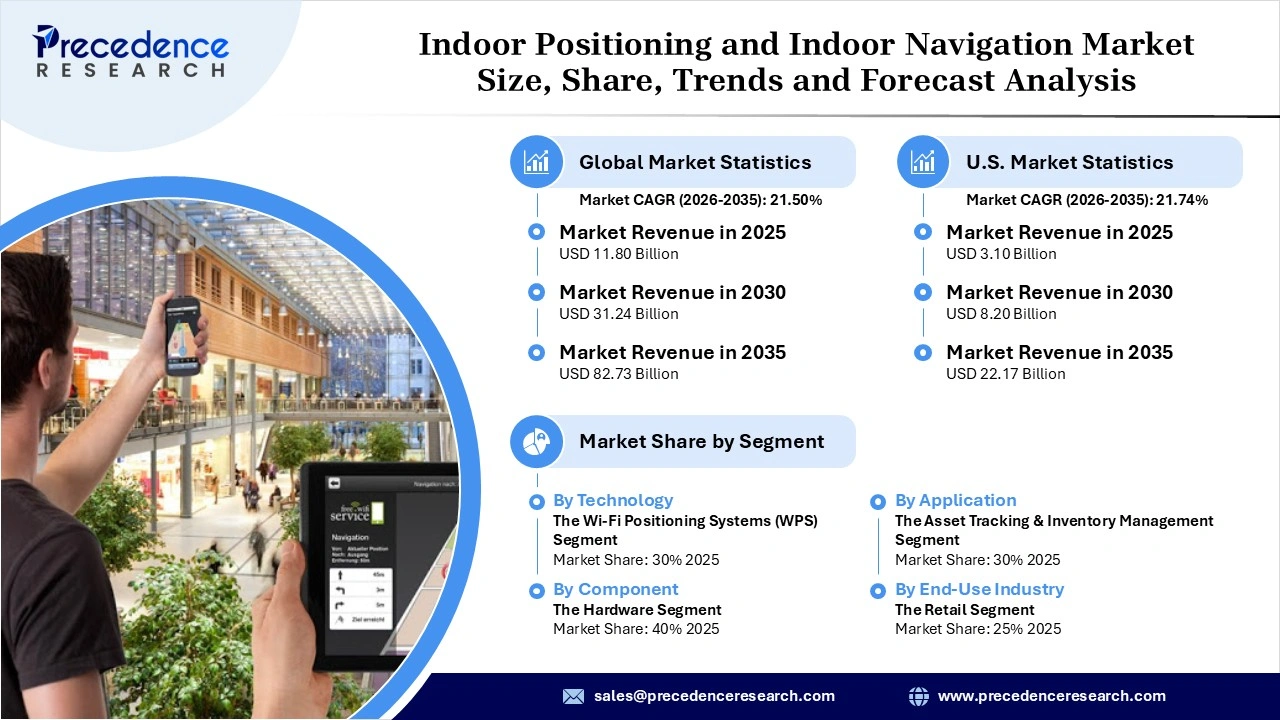
The global indoor positioning and indoor navigation market revenue was valued at USD 11.80 billion in 2025 and is expected to attain around USD 82.73 billion by 2035, growing at a CAGR of 21.50% during forecast period. The indoor positioning and navigation market is driven by the increasing adoption of smart building technologies and the growing need for real-time location intelligence in indoor environments where GPS signals are ineffective. Applications across malls, hospitals, warehouses, and airports are accelerating demand for accurate indoor navigation and positioning solutions.
Market at a Glance
The indoor positioning and navigation market encompasses a range of technologies designed to enable precise location tracking within enclosed environments. These technologies include Bluetooth Low Energy (BLE), Wi-Fi, ultra-wideband (UWB), and other sensor-based systems that provide real-time positioning capabilities beyond the limitations of GPS. The market includes a full ecosystem of hardware, software, and services that transform physical spaces into location-aware environments. Solutions support applications such as wayfinding in large facilities, asset tracking in healthcare settings, and workflow optimization in logistics and warehousing.
What Drives the Indoor Positioning and Indoor Navigation Market?
- Growing Adoption in Healthcare Facilities: Healthcare institutions, including those under the National Health Service, are increasingly deploying indoor navigation systems to improve patient and visitor experience. These solutions help reduce missed appointments, streamline navigation within complex hospital layouts, and enhance operational efficiency.
- Integration of Indoor Mapping Technologies: Google is expanding indoor mapping capabilities within Google Maps, enhancing user navigation inside large facilities such as shopping centers and airports. These advancements enable businesses to better understand customer movement patterns, transforming navigation data into actionable insights for store layout optimization, customer engagement, and sales strategies.
Market Segmentation Overview
- By technology, the Wi-Fi positioning systems segment accounted for a major revenue share of 30.0% in 2025, driven by the widespread availability of Wi-Fi infrastructure across commercial and public environments such as offices, shopping malls, and airports. Its cost-effectiveness and compatibility with existing networks have made it a preferred deployment option.
- By technology, the ultra-wideband segment is expected to grow at the fastest CAGR of 26.5% in the market between 2026 and 2035, supported by its ability to deliver highly accurate real-time location tracking. This precision is increasingly critical in sectors such as healthcare and industrial operations, where even minor positional inaccuracies can impact efficiency and safety.
- By component, the hardware segment led the indoor positioning and indoor navigation market by holding a share of 40.0% in 2025, as indoor positioning systems rely on physical infrastructure such as beacons, sensors, and access points. These components remain essential for ensuring accuracy and reliability, particularly in early-stage deployments.
- By component, the software platforms segment is expected to grow at a CAGR of 23.0% in the market between 2026 and 2035, driven by rising demand for real-time analytics and AI-powered insights. The market is shifting from basic location tracking to advanced data interpretation, enabling smarter decision-making through mapping and navigation intelligence.
- By application, the asset tracking & inventory management segment accounted for a revenue share of 30.0% of the indoor positioning and indoor navigation market in 2025, as industries such as logistics, healthcare, and manufacturing require continuous visibility of equipment and inventory. Real-time tracking has become essential for improving asset utilization and reducing operational losses.
- By application, the proximity marketing & customer engagement segment is expected to expand rapidly in the market with a CAGR of 23.5% in the coming years, driven by increasing adoption of location-based marketing strategies. Businesses are leveraging indoor positioning to deliver personalized offers and recommendations based on real-time customer location.
- By end-use industry, the retail segment accounted for a considerable revenue share of 25.0% in the indoor positioning and indoor navigation market in 2025, supported by the use of indoor navigation, in-store analytics, and proximity-based marketing to enhance customer experience and influence purchasing behavior.
- By end-use industry, the healthcare segment is expected to grow at the fastest CAGR of 23.0% between 2026 and 2035, as hospitals increasingly adopt indoor positioning systems for patient tracking, asset management, and workflow optimization. These systems help improve efficiency and coordination in time-sensitive environments.
Regional Insights
North America dominated the global indoor positioning and indoor navigation market with a major share of 35.0% in 2025, driven by early adoption of indoor location technologies and the presence of key ecosystem players such as Apple Inc., Google LLC, and Cisco Systems, Inc. Strong investments in smart infrastructure have enabled widespread deployment across airports, hospitals, and retail environments. The U.S. leads the region in adoption, while Canada continues to expand usage across healthcare and public infrastructure.
Asia Pacific held a market share of 30.0% in 2025 and is expected to grow at the fastest CAGR of 24.5% in the upcoming period. This growth is driven by rapid urbanization, expanding digital infrastructure, and increasing smart city initiatives. Countries such as China and India are witnessing strong adoption across transportation hubs, retail spaces, and healthcare facilities. Moreover, Japan and South Korea continue to advance high-precision applications in dense urban environments.
Indoor Positioning and Indoor Navigation Market Coverage
| Report Attribute | Key Statistics |
| Market Revenue in 2025 | USD 11.80 Billion |
| Market Revenue by 2035 | USD 82.73 Billion |
| CAGR from 2026 to 2035 | 21.50% |
| Quantitative Units | Revenue in USD million/billion, Volume in units |
| Largest Market | North America |
| Base Year | 2025 |
| Regions Covered | North America, Europe, Asia-Pacific, Latin America, and the Middle East & Africa |
Top Companies in the Indoor Positioning and Indoor Navigation Market
Major players such as Cisco Systems, Inc., Google LLC, Apple Inc., and Microsoft Corporation are central to the market, offering integrated solutions that combine connectivity, mapping, and cloud services. HERE Technologies enhances the ecosystem with advanced mapping capabilities, while Zebra Technologies Corporation focuses on real-time asset visibility solutions for logistics and healthcare. On the hardware side, STMicroelectronics N.V. provides essential sensors and chipsets. Meanwhile, companies such as Infsoft GmbH, IndoorAtlas Ltd., and Navigine Corporation specialize in software platforms and SDKs that convert signals into actionable location data.
Segments Covered in the Report
By Technology
- Wi-Fi Positioning Systems (WPS)
- Bluetooth Low Energy (BLE) Beacons
- Ultra-Wideband (UWB)
- Radio Frequency Identification (RFID)
- Magnetic Positioning
- Others (Infrared, Ultrasound)
By Component
- Hardware (Beacons, Sensors, Tags, Access Points)
- Software Platforms (Location Analytics, Mapping, Navigation Software)
- Services (Consulting, Integration, Maintenance)
By Application
- Asset Tracking & Inventory Management
- Indoor Navigation & Wayfinding
- Proximity Marketing & Customer Engagement
- Workforce Management & Safety Monitoring
- Emergency Response & Security Management
By End-Use Industry
- Retail
- Healthcare
- Transportation & Logistics (Airports, Warehouses)
- Manufacturing
- Hospitality
- Public Infrastructure (Smart Buildings, Smart Cities)
- Others
By Region
- North America
- Latin America
- Europe
- Asia-pacific
- Middle and East Africa
Get this report to explore global market size, share, CAGR, and trends, featuring detailed segmental analysis and an insightful competitive landscape overview @ https://www.precedenceresearch.com/sample/8355
You can place an order or ask any questions, please feel free to contact us at sales@precedenceresearch.com |+1 804 441 9344