



Industrial Vacuum Cleaner Market Revenue to Attain USD 5.56 Bn by 2035
Published: 20 Apr 2026
Author: Precedence Research



Industrial Vacuum Cleaner Market Revenue and Trends 2026 to 2035
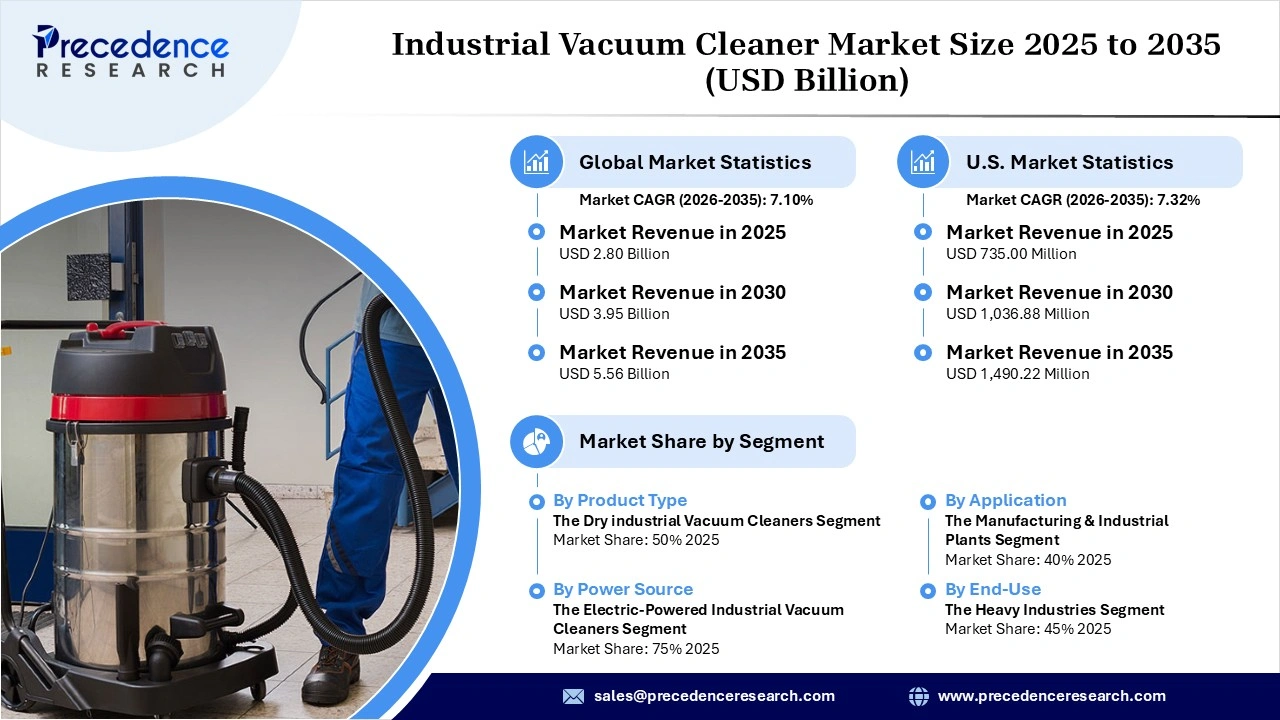
The global industrial vacuum cleaner market revenue was valued at USD 2.80 billion in 2025 and is expected to attain around USD 5.56 billion by 2035, growing at a CAGR of 7.10% during forecast period. Since dust, debris, and contamination present serious hazards, the market for industrial vacuum cleaners is expanding. Strict safety and hygiene standards and compliance demands also drive the market.
Market at a Glance
Industrial vacuum cleaners are heavy-duty cleaning systems designed for environments where conventional equipment is insufficient, such as factory floors, processing zones, and high-risk areas involving fine dust or hazardous materials. These systems help reduce worker exposure, recover valuable materials, and maintain required cleanliness and safety standards. They are available in a wide range of configurations, from portable mobile units to large centralized and application-specific systems, allowing them to meet diverse industrial needs and regulatory compliance requirements. These cleaners find a range of applications, from routine dust removal to the handling of toxic substances and fine particulate matter across industries such as manufacturing, pharmaceuticals, and construction.
What are the Major Trends in the Industrial Vacuum Cleaner Market?
- Stringent Workplace Safety Standards: Industrial cleaning is increasingly becoming a mandatory operational requirement rather than an optional activity, as regulatory pressures convert it into a fixed cost center. Stricter workplace safety standards across regions are compelling industries to invest in certified dust extraction systems to minimize airborne hazards and enhance air quality. This compliance-driven demand is emerging as one of the most consistent growth drivers in the market.
- Adoption of Automated Cleaning Systems: The transition toward smart and automated manufacturing environments is creating new demand opportunities for industrial cleaning solutions. Industrial facilities are increasingly integrating cleaning systems into automated workflows, shifting from manual cleaning to embedded, continuous cleaning processes. This trend is particularly strong in sectors such as electronics and pharmaceuticals, where tolerance for contamination is extremely low.
- Demand for Portable and Flexible Systems: Alongside central vacuum systems, there is a rising use of portable, mobile, and versatile vacuum units that can handle multiple materials, such as dust, liquids, and debris, in dynamic industrial settings such as construction and logistics.
Market Segmentation Overview
- By product type, the dry industrial vacuum cleaners segment held the largest share of 50% in the industrial vacuum cleaner market in 2025, as industries heavily rely on systems capable of handling fine dust, powders, and dry debris without operational interruption. Their capability to maintain high efficiency in various facilities makes them essential tools that facilitate processes within high-volume settings.
- By product type, the wet industrial vacuum cleaners segment held the second-largest market share of 30% in 2025, due to their ability to handle liquid spills and moist waste materials. They became particularly important in the food & beverage sector, where cleaning is a never-ending necessity.
- By power source, the electric-powered industrial vacuum cleaners segment led the industrial vacuum cleaner market, holding the highest share of 75% in 2025. This is primarily due to their high efficiency, operational reliability, and compatibility with a wide range of industrial setups. Their widespread adoption reflected a preference for stable, high-efficiency solutions that could integrate easily into daily operations without requiring complex infrastructure adjustments.
- By power source, the pneumatic-powered industrial vacuum cleaners segment is the second-largest shareholder, holding a 25% market share in 2025, because of their intrinsic safety in volatile environments. Their explosion-proof construction has made them indispensable products that can operate under hazardous or dusty environments.
- By application, the manufacturing & industrial plants segment accounted for a revenue share of 40% in the market in 2025, driven by high levels of dust and particulate generation in production environments. This necessitates continuous cleaning and dust management rather than periodic maintenance. The use of industrial vacuum systems supports machinery longevity, uninterrupted operations, and compliance with increasingly stringent workplace safety regulations.
- By application, the automotive segment is the second-largest shareholder, holding a 15% market share in 2025, owing to its strong emphasis on precision cleaning rather than surface-level maintenance. Industrial vacuum cleaners are widely used for cleaning vehicle components, maintaining production machinery, and servicing paint booths, all of which contribute significantly to market growth.
- By end-use, the heavy industries segment held a share of 45% in the industrial vacuum cleaner market in 2025, driven by their extensive reliance on industrial vacuum systems to support large-scale machinery and production lines. In these environments, cleaning is closely tied to operational safety and efficiency, making vacuum systems an essential component of daily operations rather than a supplementary tool.
- By end-use, the light industries segment held the second-largest market share of 25% in 2025, as the focus increasingly shifted from production scale to precision and quality control. In sectors such as electronics and assembly, industrial vacuum cleaners play a critical role in maintaining contamination-free environments, ensuring accuracy, consistency, and reliability at even microscopic levels.
Regional Analysis
North America dominated the global industrial vacuum cleaner market with a share of 35% in 2025, due to its strong industrial base and the growing shift toward high-efficiency cleaning systems that prioritize operational discipline over basic maintenance. In the U.S., demand for advanced manufacturing and stringent regulatory requirements significantly boosted demand for industrial vacuum solutions beyond conventional cleaning practices. Canada recorded steady growth driven by the energy and food processing sectors, while Mexico contributed through the expansion of manufacturing hubs, particularly in automotive and assembly industries.
Asia Pacific held a share of 25% in the industrial vacuum cleaner market in 2025 and is expected to grow at the fastest CAGR during the forecast period. This growth is driven by rapid industrialization and the increasing need for structured and efficient cleaning systems. China remains a central player driving demand through its extensive manufacturing sector, while India is seeing increased adoption driven by infrastructure advancements and stricter regulations.
Industrial Vacuum Cleaner Market Coverage
| Report Attribute | Key Statistics |
| Market Revenue in 2025 | USD 2.80 Billion |
| Market Revenue by 2035 | USD 5.56 Billion |
| CAGR from 2026 to 2035 | 7.10% |
| Quantitative Units | Revenue in USD million/billion, Volume in units |
| Largest Market | North America |
| Base Year | 2025 |
| Regions Covered | North America, Europe, Asia-Pacific, Latin America, and the Middle East & Africa |
Top Companies in the Industrial Vacuum Cleaner Market
Companies such as Nilfisk Group and Kärcher GmbH are globally recognized leaders in the industrial vacuum cleaner market, offering a broad portfolio ranging from standard industrial vacuum systems to highly specialized dust extraction solutions. With decades of manufacturing expertise and a strong international presence, these companies continue to strengthen their position across multiple industrial segments.
On the other hand, companies like VAC-U-MAX and Dustcontrol AB focus more on niche applications, particularly systems designed for combustible dust, fine powders, and continuous-duty operations where safety considerations are critical alongside performance. Meanwhile, firms such as Pentair plc and Comac Corporation are expanding their footprint in vacuum technologies by diversifying use cases and applications. In addition, advanced vacuum systems are increasingly being utilized in broader industrial cleaning and fluid handling applications, further extending their market relevance.
Segments Covered in the Report
By Product Type
- Wet Industrial Vacuum Cleaners
- Dry Industrial Vacuum Cleaners
- Combined Wet and Dry Industrial Vacuum Cleaners
By Power Source
- Electric-powered Industrial Vacuum Cleaners
- Pneumatic-powered Industrial Vacuum Cleaners
By Application
- Manufacturing & Industrial Plants
- Automotive
- Food Processing
- Pharmaceuticals
- Chemicals
- Others
By End-Use
- Heavy Industries
- Light Industries
- Food & Beverage
- Pharmaceutical
- Chemical & Petrochemical
- Others
By Region
- North America
- Latin America
- Europe
- Asia-pacific
- Middle and East Africa
Get this report to explore global market size, share, CAGR, and trends, featuring detailed segmental analysis and an insightful competitive landscape overview @ https://www.precedenceresearch.com/sample/8314
You can place an order or ask any questions, please feel free to contact us at sales@precedenceresearch.com |+1 804 441 9344