



Life Science Imaging Market Revenue and Forecast by 2035
Published: 17 Dec 2025
Author: Precedence Research



Life Science Imaging Market Revenue and Trends 2026 to 2035
The global life science imaging market focuses on advanced imaging technologies used in biological research, drug discovery, and clinical diagnostics to visualize cells, tissues, and molecular processes. The market is largely driven by the rising, unprecedented disease burden globally, technological innovations in the biotech and pharma sectors, AI/ML integration for precise treatment options, and substantial R&D spending in the healthcare sector.
What are the Key Driving Factors of the Life Science Imaging Market?
The leading drivers of the life science imaging market's expansion are the adoption of advanced imaging techniques, the growing burden of chronic disease due to an aging population, and a well-established healthcare infrastructure that supports 24/7 care delivered by highly skilled professionals.
The increasing investment in the healthcare sector, including the expansion of diagnostic centres and hospitals, further supports the adoption of advanced imaging modalities. Additionally, imaging technologies, including AI-powered analysis, 3D imaging, and portable diagnostic equipment, are key drivers of the market's expansion.
Segments Insights
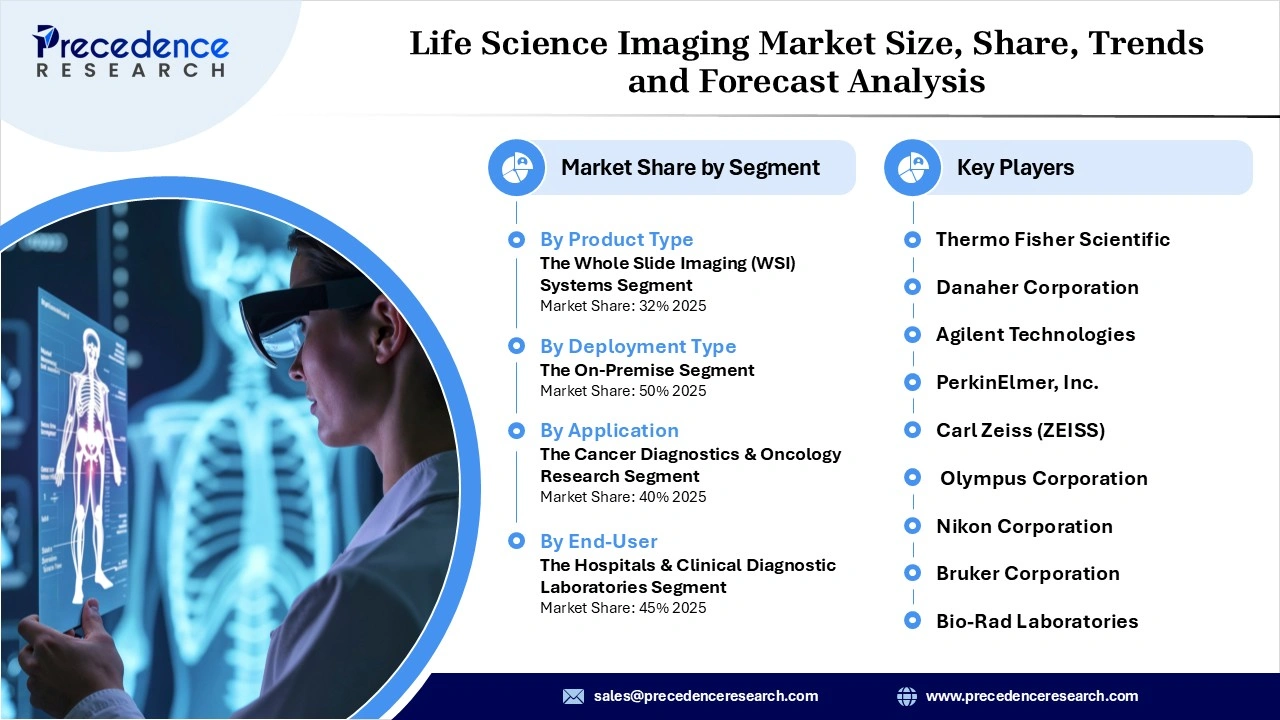
- By product type, the whole-sliding imaging segment held the largest market share in 2025. The dominance is attributed to its precise digitalization of whole tissue slides and its high speed, which drive broad clinical adoption.
- By deployment type, the on-premises segment held the largest market share in 2025. This growth is driven by the widespread adoption of cloud-based systems in healthcare institutions to ensure data privacy and stringent security compliance.
- By application, the cancer diagnostics and oncology research segment held the largest market share in 2025. As the imaging method plays a critical role in tumour detection, biomarker discovery, and therapy monitoring, as well as in its characterization.
- By end-user, the hospitals and clinical laboratories held the largest market share in 2025. The segment is dominating due to the substantial number of diagnostic tastings performed in this area, using digital microscopy and whole-slide imaging tools, preferably.
Regional Insights
North America held the largest market share in 2025, supported by its highly developed research ecosystem, early adoption of AI-powered imaging technologies, and widespread use of digital microscopy and multimodal diagnostic platforms across major clinical settings. Hospitals, academic medical centers, and reference laboratories in the region increasingly rely on whole-slide imaging, AI-assisted image analysis, and integrated pathology platforms to improve diagnostic accuracy, reduce turnaround times, and support precision medicine workflows. The region’s strong adoption is reinforced by established reimbursement pathways for advanced diagnostics and consistent investment in digital health infrastructure.
At the country level, the United States is the primary contributor to regional growth. The U.S. benefits from robust healthcare regulations, clear regulatory guidance for digital pathology tools, and strong adoption of AI-enabled diagnostic systems in oncology, hematopathology, and infectious disease diagnostics. Programs supported by institutions such as the National Institutes of Health and the National Cancer Institute encourage the integration of digital pathology and AI-driven imaging into clinical research and routine diagnostics. These factors collectively position North America as the leading market for advanced imaging and digital pathology solutions.
Asia Pacific is projected to grow at the fastest CAGR during the foreseeable period, driven by rapidly expanding biotechnology research, increasing integration of AI across imaging workflows, and rising adoption of multi-omics-enabled diagnostic platforms. Research institutes, hospitals, and biotechnology firms across the region are investing in advanced imaging systems that combine histopathology, genomics, proteomics, and spatial biology to support translational research and personalized medicine. This convergence of imaging and omics data is accelerating demand for scalable, AI-ready diagnostic infrastructure.
At the country level, China represents a major growth frontier due to substantial government-backed investment in advanced medical imaging and digital healthcare infrastructure. National initiatives supporting hospital modernization, AI-based medical technologies, and domestic development of imaging platforms are driving rapid adoption in large public hospitals and research centers. Expansion of precision oncology programs and population-scale health research further increases demand for high-throughput digital microscopy and AI-assisted image analysis. These developments position the Asia-Pacific region as the fastest-growing in the market.
Life Science Imaging Market Coverage
| Report Attribute | Key Statistics |
| Quantitative Units | Revenue in USD million/billion, Volume in units |
| Largest Market | North America |
| Base Year | 2025 |
| Regions Covered | North America, Europe, Asia-Pacific, Latin America, and the Middle East & Africa |
Recent Developments
- In September 2025, a UK-based CRO, Concept Life Science, and ZEISS Microscopy collaborated to find robust solutions for workflow automation and scalable image analysis in spatial biology, aiming to enhance seamless image analysis with AI.(Source: https://www.zeiss.com)
Get this report to explore global market size, share, CAGR, and trends, featuring detailed segmental analysis and an insightful competitive landscape overview @ https://www.precedenceresearch.com/sample/7205
You can place an order or ask any questions, please feel free to contact us at sales@precedenceresearch.com |+1 804 441 9344