



Life Science Laboratory Automation Market Revenue and Forecast by 2035
Published: 05 Dec 2025
Author: Precedence Research



Life Science Laboratory Automation Market Revenue and Trends 2026 to 2035
The global life science laboratory automation market accelerates with automation solutions that streamline diagnostics, drug discovery, and sample handling. The market is rising because laboratories worldwide are under mounting pressure to deliver faster, more accurate results at scale, and automation addresses these needs by streamlining workflows, minimizing human error, and accelerating research and diagnostic throughput.
What Are the Key Drivers Enabling the Growth of the Life Science Laboratory Automation Market?
The growing use of automation is being driven largely by the rising level of investment in research and development (R&D) by pharmaceutical and biotechnology companies; this growth in R&D investment has increased the demand for the development of methods for high-throughput screening and the requirement that companies reduce the potential for human error by increasing workflow efficiency through the use of automated processes. Automation systems allow laboratories to streamline workflows by building facilities that support handling large samples at high throughput, thereby offering greater consistency across laboratories.
The ability of artificial intelligence (AI) and machine learning to improve automation has led to the introduction of smarter systems that better predict maintenance issues and help labs optimize workflows, thus allowing them to be more productive. The trend toward modular, scalable, and cloud-based laboratory environments enables smaller laboratories to adopt the same technologies. It provides laboratories with flexibility and accessibility to automation that may not otherwise be able to implement automated processes. The increasing demand for regulation of clinical diagnostic and drug discovery efforts is prompting laboratories worldwide to adopt automation as an additional means to improve performance and achieve high levels of reliability and reproducibility.
Segment Insights
- By Product/Component, the hardware segment dominated the market in 2024, given the broad use of robotic workstations, liquid-handling platforms and automated sample-storage units as Integral to Laboratory Automation Workflows.
- By Technology/Instrument Type, Liquid-handling and pipetting robots were the dominant segment of the market, due to the critical role they play in high-throughput sample preparation, accurate reagent dispensing, and time-saving workflows in drug-discovery and molecular biology applications.
- By Application, the demand for drug discovery and High-Throughput Screening (HTS) dominated Laboratory Automation, as laboratories have a strong need to Improve Time-to-Lead identification through more efficient Compound-Screening Processes, Assay Workflows, and Rapid Data Generation.
- By End User, pharmaceutical and biotechnology companies held the largest share, as they leverage automation to Improve R&D efficiency and Reduce time to develop compounds by improving consistency and scalability.
- By Deployment/Integration Model, integrated/walk-away automation systems represent the majority of market share for commercially available turnkey automated solutions that incorporate robotics and liquid handlers.
Regional Insights
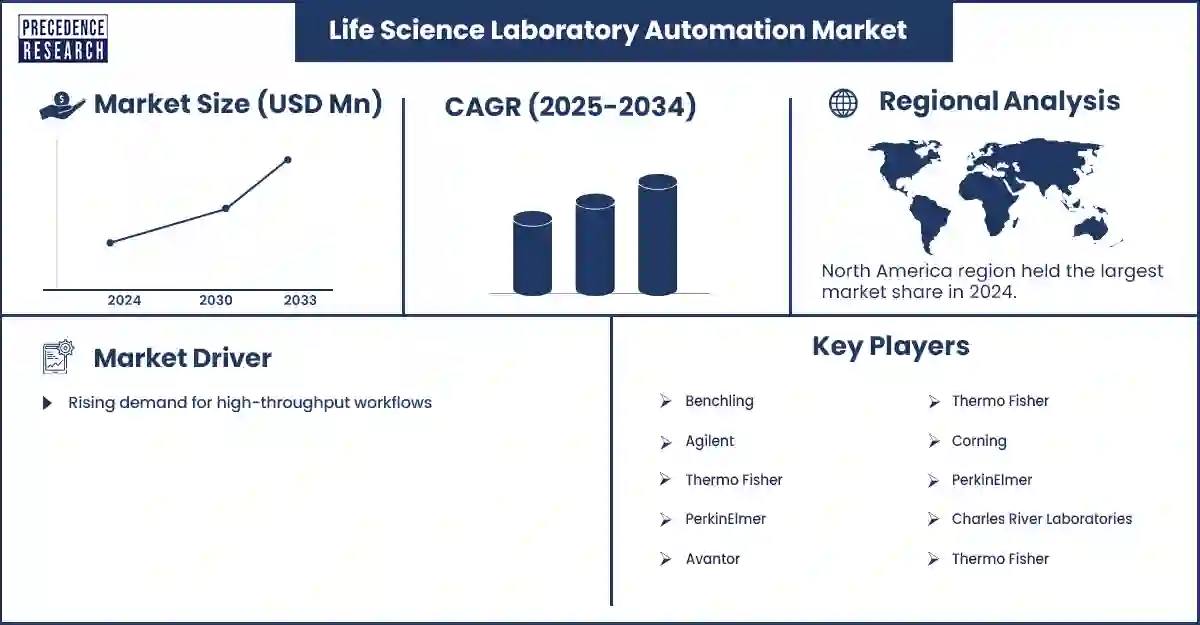
North America is currently the largest market for automated Life Science laboratories, and that trend is expected to continue. North America is also adopting AI-enabled robotics and integrated automation platforms into laboratories at an accelerated rate. Supportive regulatory frameworks, along with a high level of R&D funding, further support market penetration. The growing emphasis on precision, productivity, and the industry's digital transformation supports North America's position.
Asia-Pacific is currently the fastest-growing region in the global automated Life Science laboratories market, primarily due to extensive investments by emerging economies in the biopharmaceutical and academic research infrastructure sectors. The continual modernization of laboratories, the increase in clinical studies, and the growing number of robotic and digital automation options available in the current marketplace have led to rising demand for laboratory automation. Additionally, the combination of government-backed innovation initiatives and the region's rapidly increasing availability of talented professionals with lower-cost research capabilities creates an environment highly conducive to the adoption of automated laboratory systems.
Life Science Laboratory Automation Market Coverage
| Report Attribute | Key Statistics |
| Quantitative Units | Revenue in USD million/billion, Volume in units |
| Largest Market | Asia Pacific |
| Base Year | 2025 |
| Regions Covered | North America, Europe, Asia-Pacific, Latin America, and the Middle East & Africa |
Recent Development
- In July 2024, Inpeco launched its FlexLab X total lab automation system at the ADLM 2024 conference, offering enhanced flexibility and improved workflow integration by enabling laboratories to connect analyzers from multiple vendors under a unified interface, thereby streamlining operations and boosting efficiency.(Source: https://www.pharmiweb.com)
Get this report to explore global market size, share, CAGR, and trends, featuring detailed segmental analysis and an insightful competitive landscape overview @ https://www.precedenceresearch.com/sample/7176
You can place an order or ask any questions, please feel free to contact us at sales@precedenceresearch.com |+1 804 441 9344