



Life Science Robotics Market Revenue and Forecast by 2035
Published: 12 Dec 2025
Author: Precedence Research



Life Science Robotics Market Revenue and Trends 2026 to 2035
The global life science robotics market is transforming research and biopharma operations with automated platforms that enhance productivity, streamline workflows, and support advanced therapeutic development. This market is experiencing unprecedented growth, driven by the growing need for innovative robotic solutions in the life sciences sector.
What Are the Factors That Have a Significant Contribution to the Growth of the Life Science Robotics Market?
The growing demand for high-throughput screening (HTS) and personalized medicine is the major driver, accelerating the growth of the life science robotics market during the forecast period. The shortage of skilled workers and the surge in labor costs have significantly increased the adoption of robots to automate tasks and reduce the risk of human error. Additionally, the increasing need for increasing operational efficiency, precision, and scalability in research and manufacturing for advanced cell therapies, along with the rapid technological advancements such as Artificial Intelligence (AI), Machine Learning (ML), and Internet of Things (IoT), are expected to fuel the expansion of the life science robotics market.
In May 2025, Life Science Robotics announced the launch of ARUS, a robotic solution for ultrasound scanning in pregnancy. ARUS is a robot-assisted ultrasound solution developed to support sonographers in performing scans while addressing one of the most important challenges in sonography, like work-related musculoskeletal disorders (WRMSDs).
Segment Insights
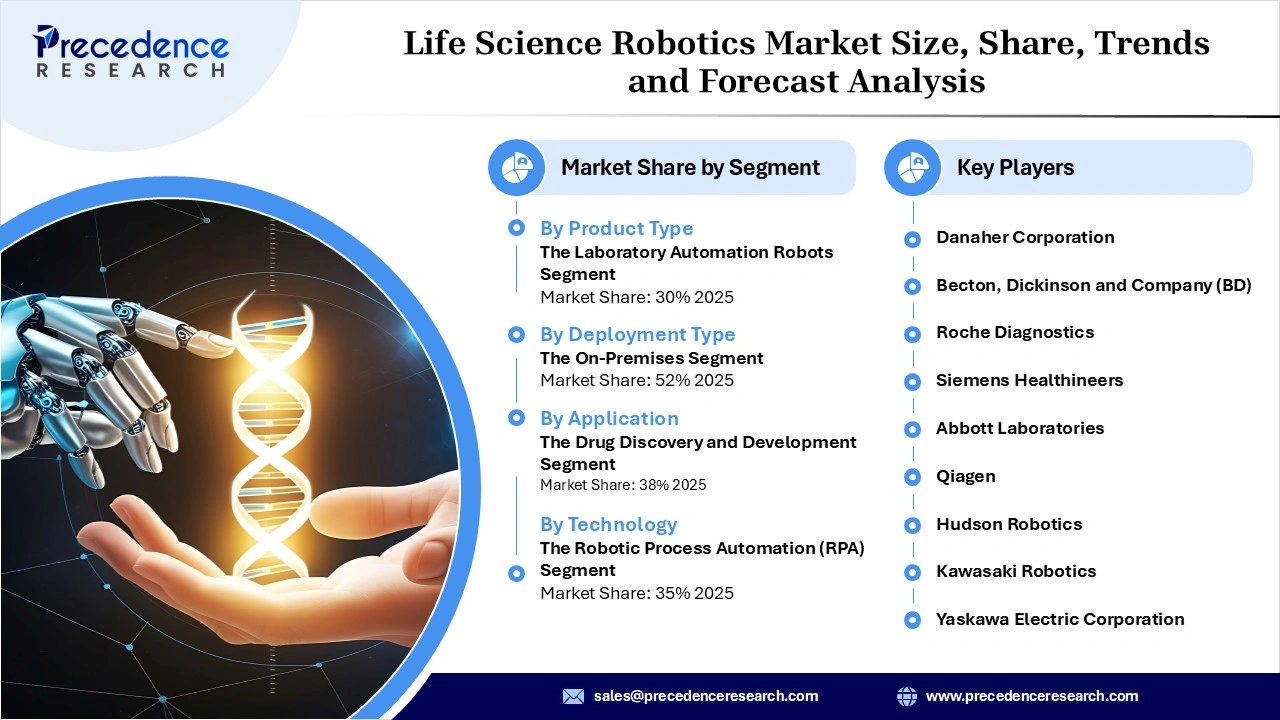
- By product type, the laboratory automation robots segment held the largest market share, at 30%, in 2025. owing to the increasing need for enhancing efficiency, precision, and high-throughput screening in clinical diagnostics, genomics and proteomics, and drug discovery.
- By deployment type, the on-premises segment accounted for the majority share of 52% in the life science robotics market in 2025, underscoring the need to address data security concerns and the rising focus on aligning with strict regulatory requirements. On-premise solutions allow organizations to manage security protocols and protect sensitive information in compliance with regulations.
- By application, the drug discovery & development segment led the market with a 38% share in 2025. The growing need for high efficiency, precision, and cost-effectiveness in the development of innovative therapeutics drives the segment’s growth. The adoption of robotics minimizes error risk and ensures consistency in repetitive tasks such as high-throughput screening, sample handling, and data analysis, which are crucial in the early stages of the drug discovery process.
- By technology/mode of action, the robotic process automation (RPA) segment dominated the market in 2025, with a 35% share, driven by the growing need to streamline data-heavy, regulated, and repetitive digital administrative tasks. Robotic Process Automation (RPA) is a software-based automation technology that automates high-volume, repetitive, rule-based tasks.
Regional Insights
North America holds the dominant share in the global life science robotics market. The presence of sophisticated healthcare infrastructure drives the region’s leadership, the growing need for automation to address labor shortages, the rise in biologics and personalized medicine, the increasing geriatric population, and the surge in chronic diseases. Moreover, the rising demand for cell therapy & regenerative medicine and the increasing shift toward AI-driven research and automated manufacturing systems are expected to drive growth in life science robots during the forecast period.
On the other hand, the Asia Pacific region is anticipated to grow at the fastest rate in the market during the forecast period. The region's fastest growth is attributed to strong demand for automation to improve efficiency in the healthcare sector, rapid technological progress, a supportive government framework, an increasing patient population with chronic diseases, an aging population, and rising demand for minimally invasive surgeries. Additionally, the rising integration of Artificial Intelligence (AI), machine learning, and advanced sensors, and increasing investments in automated solutions, are driving the regional market’s growth. Such a combination of factors is likely to fuel the region's expansion in the coming years.
Life Science Robotics Market Coverage
| Report Attribute | Key Statistics |
| Quantitative Units | Revenue in USD million/billion, Volume in units |
| Largest Market | North America |
| Base Year | 2025 |
| Regions Covered | North America, Europe, Asia-Pacific, Latin America, and the Middle East & Africa |
Recent Developments
- In July 2025, Merck launched the AAW Automated Assay Workstation, a solution powered by Opentrons, a leader in lab automation and accessible robotics. The workstation automates routine laboratory experiments previously performed manually, reducing hands-on time and ensuring consistency in results across diverse experimental settings. This launch follows the earlier announcement of a multi-year partnership with Opentrons Labworks, Inc. to enhance laboratory workflows through automation.(Source: https://www.merckgroup.com)
Get this report to explore global market size, share, CAGR, and trends, featuring detailed segmental analysis and an insightful competitive landscape overview @ https://www.precedenceresearch.com/sample/7197
You can place an order or ask any questions, please feel free to contact us at sales@precedenceresearch.com |+1 804 441 9344