



Metabolic Testing Equipment Market Revenue to Attain USD 4.38 Bn by 2035
Published: 24 Apr 2026
Author: Precedence Research



Metabolic Testing Equipment Market Revenue and Trends 2026 to 2035
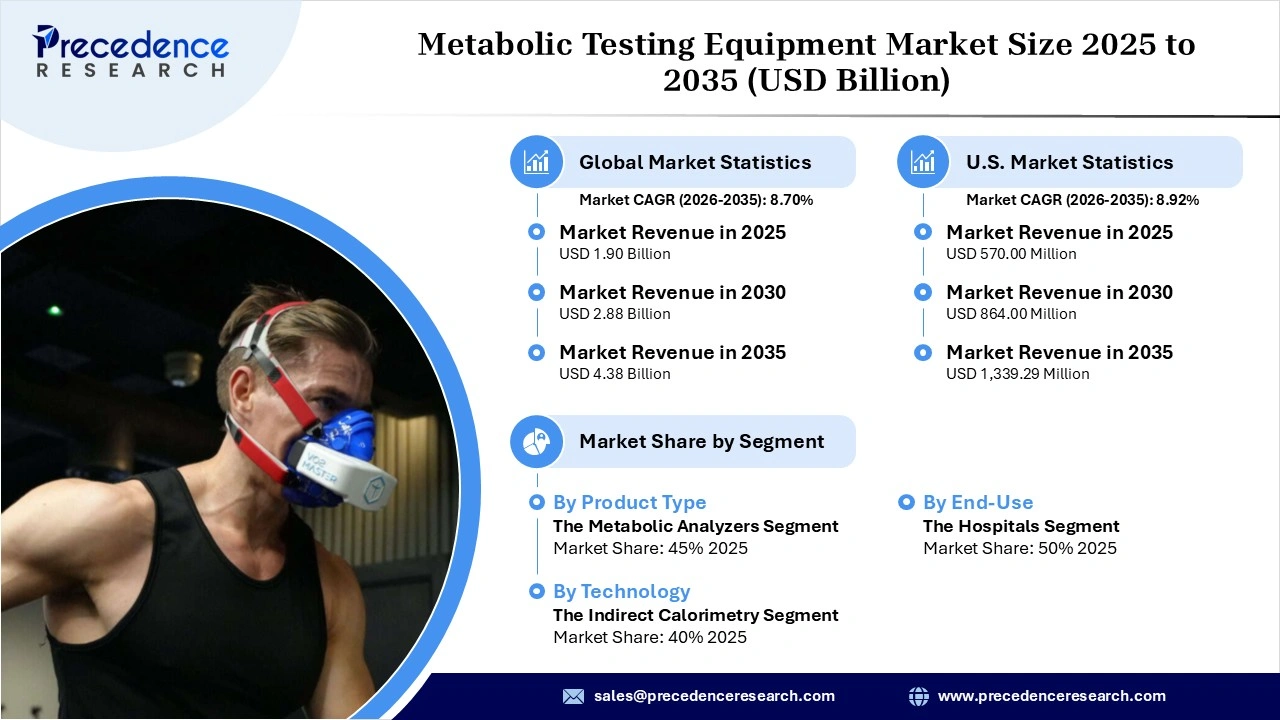
The global metabolic testing equipment market revenue surpassed USD 1.90 billion in 2025 and is predicted to attain around USD 4.38 billion by 2035, growing at a CAGR of 8.70%. The market is driven by the increasing need for accurate diagnosis of metabolic issues, growing consciousness about fitness, and the increased application of metabolism testing in diagnostic procedures and athletic performance.
Market Overview
The metabolic testing equipment market involves devices that measure the body’s intake of oxygen and output of carbon dioxide in order to assess the amount of energy used, metabolic rate, and physical efficiency. This technique is commonly utilized to test the resting metabolic rate, endurance, and caloric needs, thus becoming valuable for hospitals, health clubs, sports performance centers, and research laboratories.
This market covers all types of metabolic testing equipment, analysis software, and associated hardware components for assessing respiration and metabolism rates. These tools are vital in assisting medical practitioners in designing proper diets and rehabilitation programs for their clients. Trainers and scientists make use of these tools in evaluating the physiological reactions to various physical exercises.
What Drives the Metabolic Testing Equipment Market?
Rise of Cordless Wearable Metabolic Testing Systems
The market is witnessing innovations that include metabolic testing systems that enable the observation of the digestive system while the user engages in natural movements during physical activities. Such systems utilize lightweight masks that track consumption of oxygen and production of carbon dioxide, thereby helping establish metrics like energy expenditure, endurance capabilities, and metabolic efficiency. Portable wearable systems ensure precise testing while the user remains active on treadmills, rowing machines, and other workout equipment.
- In 2026, Life Time introduced the national expansion of its new SpiroFit metabolic testing system, an innovative cordless wearable solution for obtaining VO2 max and metabolic measurement results during exercise routines.
Adoption of Metabolic Tests in Sports Medicine and Performance Labs
There is increasing adoption of metabolic test systems in sports medicine and performance labs, which use metabolic tests to analyze athletes’ fitness and recovery. Sports organizations are progressively implementing techniques that allow for monitoring oxygen consumption and stamina in structured tests. These techniques enable specialists to develop individual training and rehabilitation strategies.
- In 2025, the players of Omonia Football Club underwent a series of metabolic and cardiopulmonary tests utilizing the Quark CPET system before beginning their preseason training for the 2025/26 season.
Government Investment in Sports Science Centers
Governments across the world are investing in the development of high-performance sports science centers. These centers have advanced lab facilities for physiological and metabolic testing of athletes. Governments are allocating resources to develop comprehensive performance testing facilities, including injury management and athlete assessment. These initiatives help to increase awareness among practitioners regarding the implementation of evidence-based training methods.
- In 2026, the Directorate of Sports and Youth Affairs, Meghalaya, India, launched an official tender to build a high-performance Sports Science Center in Shillong.
Rising Prevalence of Metabolic Diseases
Over 15 million people in the U.S, U.K, Germany, and France suffer from the metabolic dysfunction-associated steatohepatitis (MASH) without even being aware of it. The rate of diagnosis is still under 18%, and hence, a majority of patients go undiagnosed. According to experts, there are a total 20 million cases, out of which approximately 2.5 million people have gotten their condition diagnosed.
Metabolic Testing: Key Insights and Developments
- The American College of Sports Medicine released a study reporting that more than 7 in 10 fitness professionals and sports practitioners around the world would use physiological and metabolic-linear information to determine athlete training and recovery interventions in the years 2024-2025.
- As 2024-2026 research on VO 2 max practices in sports environments with high performance, these results suggest that metabolic measurement systems are important tools during metabolic testing in high-performance sports settings, which often display VO 2 max values of more than 80 ml/kg/min.
- In 2024-2025, nearly 537-550 million adults worldwide lived with diabetes, and it is expected to keep rising, meaning that there will be high demand for metabolic monitoring and assessment tools in clinical environments.
- Global innovation. According to global innovation updates, published in 2024, metabolic health startup funding is robust, with companies such as Ultrahuman raising around USD 35 million in their Series B to increase metabolic tracking technology and expand manufacturing capacities.
Market Segmentation Overview
- By Product Type: The metabolic analyzers segment led the market with a 45% share in 2025, since they provide accurate measurements of important metabolic indicators that are necessary for identifying and assessing various diseases. Metabolic analyzers are used in hospitals, diagnostic laboratories, and research facilities owing to their effectiveness and flexibility.
- By Product Type: The body composition analyzers segment is expected to expand at the highest CAGR of 10.5% during the forecast period, owing to rising health consciousness, an increase in obesity cases, and the increasing importance being accorded to preventative and fitness-oriented healthcare facilities. These analyzers are rapidly adopted in fitness centers and wellness clinics.
- By Technology: The indirect calorimetry segment dominated the metabolic testing equipment market with a 40% share in 2025, due to its reliability and popularity. Its effectiveness in measuring energy expenditure based on the analysis of oxygen uptake and carbon dioxide exhalation makes it the preferred choice. This technology has been efficiently incorporated in hospital settings and has versatile applications in numerous types of medical problems.
- By Technology: The respiratory gas exchange measurement segment held the second-largest market share of 25% in 2025, because it is useful in providing important information about lung operation by measuring the intake of oxygen and release of carbon dioxide. This segment has wide-ranging applications in the diagnosis of pulmonary diseases, cardiac conditions, and other forms of critical care.
- By End-Use: The hospitals segment led the metabolic testing equipment market with a 50% share in 2025, since they host a high number of metabolic tests as part of the diagnosis, management, and monitoring of various acute and chronic diseases due to their well-established infrastructure and highly trained medical professionals.
- By End-Use: The clinics & diagnostic centers segment held the second-largest market share of 20% in 2025, owing to their provision of affordable and easily available testing equipment for metabolism during regular health screening, early diagnosis of diseases, and monitoring of patients outside hospital premises.
Regional Analysis
North America dominated the metabolic testing equipment market with a 40% share in 2025, owing to its highly advanced healthcare infrastructure, widespread adoption of the latest diagnostic tools, and a significant prevalence of metabolic disorders. This region has a robust research ecosystem, effective reimbursement policies, and the adoption of innovative medical equipment in hospitals and diagnostic centers. The U.S. leads the market in North America due to significant investment in healthcare, a significant presence of hospitals and research institutes, and the use of advanced technologies in metabolic and respiratory diagnosis. Canada contributes significantly to market growth because of its efficient healthcare sector and increased emphasis on preventative medicine and management of chronic diseases.
Asia Pacific is expected to grow at the fastest rate from 2026 to 2035, owing to increased awareness about healthcare, rising prevalence of metabolic and lifestyle-related disorders, and the rapid development of healthcare infrastructure. This region is witnessing the rapid adoption of low-cost diagnostic solutions and investments in hospitals, gyms, and preventive care. China led the market in Asia Pacific because of its vast population, fast urbanization rate, and substantial investment by the government towards upgrading healthcare infrastructure. India is a significant contributor to the market due to the increase in demand from the middle class for preventive tests and higher penetration of diagnostic facilities.
Metabolic Testing Equipment Market Coverage
| Report Attribute | Key Statistics |
| Market Revenue in 2025 | USD 1.90 Billion |
| Market Revenue by 2035 | USD 4.38 Billion |
| CAGR from 2026 to 2035 | 8.70% |
| Quantitative Units | Revenue in USD million/billion, Volume in units |
| Largest Market | North America |
| Base Year | 2025 |
| Regions Covered | North America, Europe, Asia-Pacific, Latin America, and the Middle East & Africa |
Top Companies in the Metabolic Testing Equipment Market
Cosmed Srl, MGC Diagnostics Corporation (including Medical Graphics Corporation), and ParvoMedics are key players specializing in the development of indirect calorimeters used for clinical and performance metabolic assessment. Companies such as Schiller AG, GE Healthcare, and Hitachi Medical Corporation offer metabolic testing modules as part of their broader cardiopulmonary diagnostic systems.
Meanwhile, KORR Medical Technologies, Vyair Medical Inc., and Beurer GmbH focus on compact metabolic testing devices designed for applications such as weight management, fitness training, and general health screening. At the high end of the market, Sable Systems International and Prometheus Group manufacture advanced research-grade metabolic chambers and gas exchange analyzers used in experimental studies involving both human and animal models.
Segments Covered in the Report
By Product Type
- Metabolic Analyzers
- Spirometers
- Cardiopulmonary Exercise Testing (CPET) Systems
- Body Composition Analyzers
- Other Testing Equipment (e.g., Indirect Calorimeters)
By Technology
- Indirect Calorimetry
- Respiratory Gas Exchange Measurement
- Bioelectrical Impedance Analysis (BIA)
- Dual-Energy X-ray Absorptiometry (DEXA)
- Others
By End-Use
- Hospitals
- Clinics & Diagnostic Centers
- Fitness Centers & Sports Organizations
- Research & Academic Institutions
- Home Care Settings
By Application
- Cardiometabolic Health Monitoring
- Obesity & Weight Loss Management
- Exercise Physiology & Performance
- Nutritional Assessment
- Clinical Diagnostics
By Region
- North America
- Latin America
- Europe
- Asia-pacific
- Middle and East Africa
Get this report to explore global market size, share, CAGR, and trends, featuring detailed segmental analysis and an insightful competitive landscape overview @ https://www.precedenceresearch.com/sample/8337
You can place an order or ask any questions, please feel free to contact us at sales@precedenceresearch.com |+1 804 441 9344