



Microscopy Software Market Revenue to Attain USD 5.24 Bn by 2035
Published: 14 Jul 2026
Author: Precedence Research



Microscopy Software Market Revenue and Trends 2026 to 2035
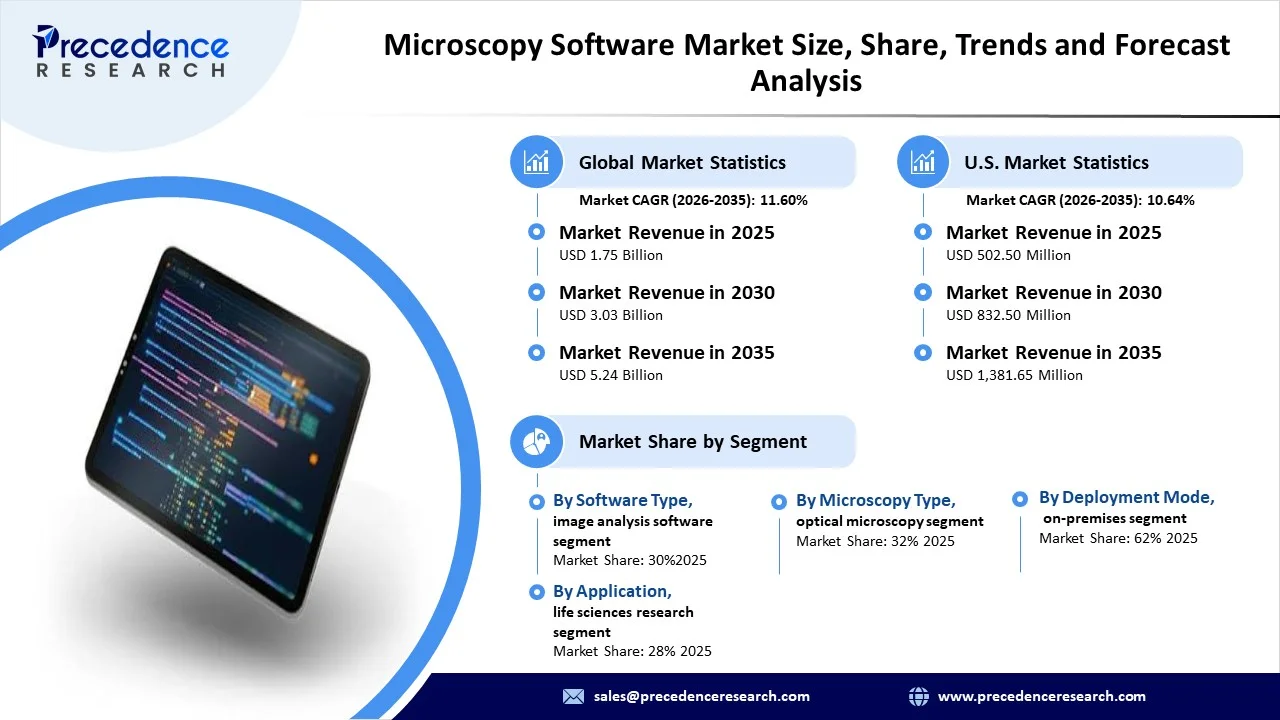
The global microscopy software market revenue was valued at USD 1.75 billion in 2025 and is expected to attain around USD 5.24 billion by 2035, growing at a CAGR of 11.60% during forecast period. The market is driven by the shift from basic image capture to integrated, AI-enabled analysis, workflow automation, and data-intensive interpretation. Advancements in scalable, integrated imaging software offer essential solutions for large-scale and high-throughput data processing in biological discovery.
The Dawn of AI-Enabled Microscopy Software
The microscopy software market is transitioning from basic image viewing and capture to integrated, AI-enabled analysis, workflow automation, and data-intensive interpretation. The market growth is mainly driven by the rapid adoption of AI and ML for automated cell classification and high-throughput screening. This expansion is further fostered by the demand to reduce inter-observer variability, rising biomedical research, and the demanding data-driven adaptive feedback during imaging.
Government initiatives, public health mandates, and research funding are reinforcing the modernization and adoption of digital microscopy software with a strong emphasis on the development of multidimensional imaging frameworks. Furthermore, public-private research partnerships are fostering open-source software to increase the accessibility of advanced quantitative imaging accessibility.
The Shift toward AI-Enabled and Automated Workflows
The market has a strong potential opportunity lying in the integration of AI and ML into digital microscopy, which transforms imaging by automating complex tasks such as cell detection, tissue classification, and real-time anomaly identification. This shift efficiently improves laboratory throughput and workflow efficiency, which uplifts healthcare providers and pharmaceutical companies to process large sample volumes with amplified speed and accuracy. In May 2025, Leica Microsystems launched the latest version of its AI-driven image analysis software, Aivia 15. It provides accurate detection and easy batch processing analysis by encouraging scientists to project and deploy spontaneous AI-powered analysis.
How Thermo Fisher’s EVOS M7000X is Reshaping Microscopy Software
Thermo Fisher Scientific unveiled the EVOS M7000X automated imaging platform, integrating deep learning algorithms for real-time image analysis to accelerate drug discovery workflows and deliver clean and accurate information. Thermo Fisher's elimination of time-consuming off-board processing is prompting competitors to develop similar on-instrument AI to remain relevant rapidly. It drives industry-wide shifts by setting a benchmark for high-throughput screening, enhancing time-to-market in therapeutics, and accelerating the adoption of AI-driven microscopy.
Market Segmentation Overview
- By software type, the image analysis software segment dominated with 30% market share in 2025, due to increasing demand for quantitative image interpretation, making automated image analysis software convert descriptive images into high-throughput data. Clinical workflow integration offers image analysis frameworks for personalizing treatments. Advancements in AI provide automated and pixel-level segmentation, enhancing measurement reproducibility.
- By software type, the AI-based microscopy software segment is expected to expand at the highest CAGR of 19.40% during the forecast period, due to expanding AI-driven automation, which accelerates image analysis and diagnostics as it shifts toward quantitative. AI-assisted software also improves personnel efficiency and diagnostic accuracy. AI algorithms detect specific cellular events and adjust microscope hardware, reducing timelines and avoiding phototoxicity.
- By microscopy type, the optical microscopy segment dominated with 32% market share in 2025, due to its wider deployment across academic and clinical laboratories, because of its cost-effectiveness, and the necessity for pharmaceutical research, life sciences, and nanotechnology. Laboratories modified with advanced imaging software, where the data-driven microscopy is transforming optical imaging and improving diagnostic throughput and speed.
- By microscopy type, the digital microscopy software segment is expected to expand at the highest CAGR of 15.10% during the forecast period, due to rapid adoption by digital pathology and remote collaboration, because it features built-in AI models. Digital pathology and workflows also lower review times and allow pathologists to view multiple slides simultaneously, improving productivity. Digital images accelerating phenotypic drug discovery and clinical diagnostics
- By deployment mode, the on-premises segment dominated with 62% market share in 2025, due to its high preference for high-security research environments and multidimensional imaging for safe and continuous workflow execution. Academic institutes and research centers depend on on-premises setups to protect sensitive research data. On-premises models also mitigate cybersecurity risks associated with cloud-based storage for fewer internet outage disruptions.
- By deployment mode, the cloud-based segment is expected to expand at the highest CAGR of 17.80% during the forecast period, due to increasing demand for scalable data storage and collaboration because of its remote accessibility, scalability, and affordability. Biotechnology information and cloud-based solutions drive growth in microscopy and digital pathology. Researchers and clinicians upload digitized slides to centralized cloud platforms to be reviewed and analyzed.
- By application, the life sciences research segment dominated with a 28% market share in 2025, due to expanding cell biology and genomics research. Advanced software efficiently tracks cell signaling pathways and structural changes across vast image datasets. Academic and research facilities depend on multi-user licensing and centralized software to coordinate large volumes of biomedical data across multiple imaging modalities.
- By application, the semiconductor and electronics segment is expected to expand at the highest CAGR of 13.70% during the forecast period, mainly stemming from the increasing chip inspection and failure analysis, along with the strong push for nanotechnology for high-resolution characterization and complex materials. Modern semiconductor fabrication leverages creating hidden defects, demanding non-contact imaging to lower dependence on manual review.
- By end user, the pharmaceutical and biotechnology segment dominated with 29% market share in 2025, due to its massive investment in drug discovery and biologics research. Advanced software is necessary to automate image acquisition, autofocus, and multi-well plate environmental control. Image-based cellular profiling acts as a crucial process to quantify complex disease phenotypes and assess treatment efficacy with more accurate interpretation.
- By end user, the semiconductor and electronics manufacturers segment is expected to expand at the highest CAGR of 14.50% during the forecast period, due to increasing semiconductor quality inspection requirements in academic and healthcare sectors. AI and automation are shifting microscopes into highly automated and high-throughput platforms. Semiconductor manufacturers deploy these AI-driven software tools for real-time sample screening.
Regional Analysis
North America dominated the microscopy software market with a 38% market share in 2025. This dominance stems from the strong infrastructure with the presence of life science research institutions and software vendors, along with rolling regulatory and technological developments. The U.S. led the market in North America by virtue of its institutional requirement for multi-user and advanced imaging software licenses and a sustained supply chain of domestic manufacturers and developers of AI-driven platforms. The U.S. government, through agencies like the National Institutes of Health, constantly encourages and supports biomedical research. Canada witnessed notable growth through its strong digital diagnostics and biotech healthcare innovations, government-backed grants, and private investments for a targeted software ecosystem.
Asia Pacific is expected to grow at the fastest CAGR of 14.80% from 2026 to 2035, due to the increasing research and development investments and semiconductor manufacturing expansion, along with biotechnology infrastructure development and global AI adoption. China led the market in Asia Pacific, through its AI-driven medical imaging and computer-aided pathology software and hardware-software integration with high-resolution hardware such as Atomic Force and Scanning Electron Microscopes, driving further expansion. India acts as a significant contributor within the region by virtue of its massive burden of non-communicable and infectious diseases, along with the Department of Science and Technology’s focus on solving chronic pathological limitations by automating manual microscopic reviews.
Europe held the second-largest market share of 28% in 2025, due to rising research in biotechnology and pharmaceuticals, regulatory support through the European Union's focus on active Post Market Clinical Follow-Up, and demands for computational tools and digital pathology. Germany led the market in Europe due to the presence of strong players like Carl Zeiss AG and Leica Microsystems GmbH, world-class academic centers, and stringent Health Technology Assessments with high productivity. The UK is a significant contributor to the market due to its large-scale funding, clinical digitization practices by the UK public health adopting robotic visualization systems and digital pathology software with improved diagnostic workflows.
Microscopy Software Market Coverage
| Report Attribute | Key Statistics |
| Market Revenue in 2025 | USD 1.75 Billion |
| Market Revenue by 2035 | USD 5.24 Billion |
| CAGR from 2026 to 2035 | 11.60% |
| Quantitative Units | Revenue in USD million/billion, Volume in units |
| Largest Market | North America |
| Base Year | 2025 |
| Regions Covered | North America, Europe, Asia-Pacific, Latin America, and the Middle East & Africa |
Top Companies in the Microscopy Software Market
Carl Zeiss AG, Thermo Fisher Scientific Inc., Leica Microsystems, Nikon Corporation, and Bruker Corporation are major companies with covering hardware-software ecosystem and offer foundational imaging platforms. Oxford Instruments, Media Cybernetics, Nanolive, Scientific Volume Imaging, and MIPAR are emerging players scaling by redefining innovation in point-of-care diagnostics and specialized post-acquisition analytics as an accessible microscopy. SigTuple, ONI, Biodock, Holloid, and Cancilico are bringing lower prices and highly specific diagnostic tools like cloud-native and AI-powered platforms.
Segments Covered in the Report
By Software Type
- Image Acquisition Software
- Image Analysis Software
- Image Processing and Enhancement Software
- 3D Visualization and Reconstruction Software
- Laboratory Information Management (LIMS) Integration Software
- AI-based Microscopy Software
By Microscopy Type
- Optical Microscopy
- Electron Microscopy
- Confocal Microscopy
- Fluorescence Microscopy
- Scanning Probe Microscopy
- Digital Microscopy
- Other Microscopy Types
By Deployment Mode
- On-premises
- Cloud-based
- Hybrid
By Application
- Life Sciences Research
- Clinical Diagnostics
- Material Science
- Semiconductor & Electronics
- Nanotechnology
- Pharmaceutical & Biotechnology Research
- Industrial Inspection
- Academic Research
- Others
By End User
- Pharmaceutical & Biotechnology Companies
- Hospitals & Diagnostic Laboratories
- Academic & Research Institutes
- Semiconductor & Electronics Manufacturers
- Contract Research Organizations (CROs)
- Industrial Manufacturing Companies
- Others
By Enterprise Size
- Large Enterprises
- Small & Medium Enterprises (SMEs)
By Licensing Model
- Perpetual License
- Subscription-based
- Open-source
By Region
- North America
- Latin America
- Europe
- Asia-pacific
- Middle and East Africa
Get this report to explore global market size, share, CAGR, and trends, featuring detailed segmental analysis and an insightful competitive landscape overview @ https://www.precedenceresearch.com/sample/8552
You can place an order or ask any questions. Please feel free to contact us at sales@precedenceresearch.com |+1 804 441 9344