



Microscopy Software Market Trends, Companies, Revenue / Sales Performance, Subscriber Growth, Pricing Strategies, Cloud Adoption, Infrastructure Expansion, Competitive Landscape, and Industry Outlook
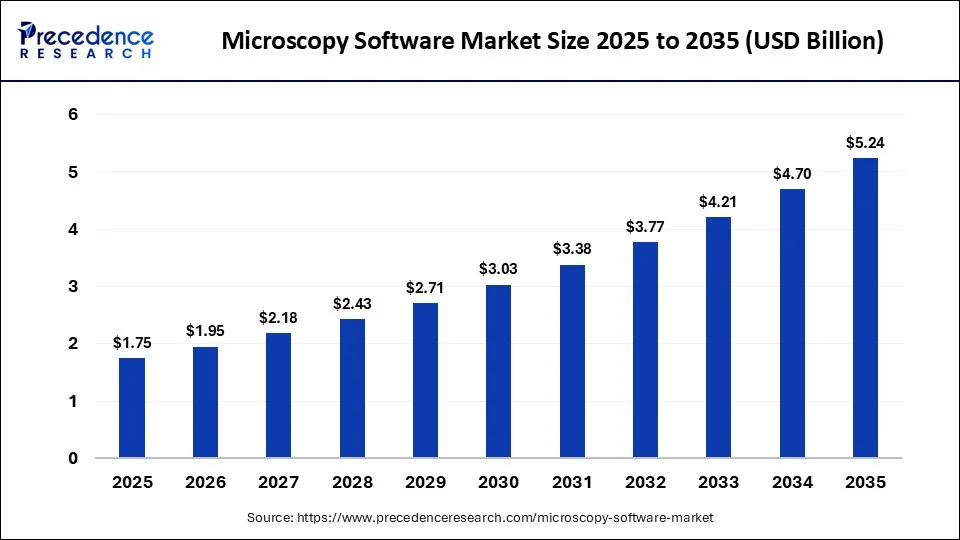
ICT industry specialist Shivani Zoting estimates the microscopy software market at USD 1.95 billion in 2026, with continued technology adoption expected to take the market to USD 5.24 billion by 2035 at a CAGR of 11.60%. Leading microscopy software market providers such as Thermo Fisher Scientific Inc, Hitachi High-Tech Corporation, JEOL Ltd are expanding their capabilities across segments including software type, microscopy type, deployment mode, application, end user, enterprise size, licensing model, region.
Source: https://www.precedenceresearch.com/microscopy-software-market
 Get a Sample
 Table Of Content


Microscopy Software Market Size and Forecast 2026 to 2035
The global microscopy software market size accounted for USD 1.75 billion in 2025 and is predicted to increase from USD 1.95 billion in 2026 to approximately USD 5.24 billion by 2035, expanding at a CAGR of 11.60% from 2026 to 2035. The market is driven by the integration of artificial intelligence (AI) and machine learning (ML).
Key Takeaways
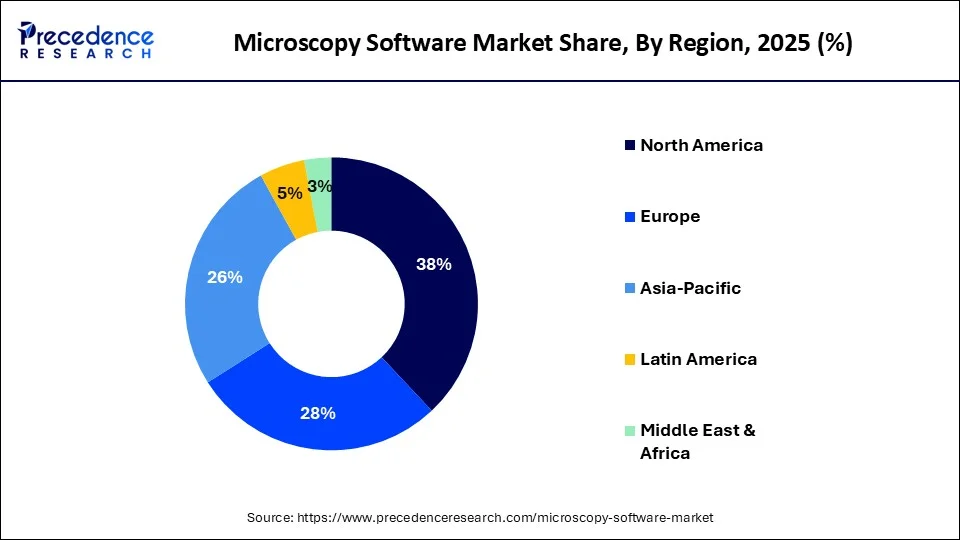
- North America dominated the microscopy software market by holding a major share of 38% in 2025.
- Asia-Pacific held a 26% share of the market in 2025 and is expected to grow at the fastest CAGR of 14.8% during the projection period.
- By software type, the image analysis software segment held a dominant position in the market, with a 30% share in 2025.
- By software type, the AI-based microscopy software segment held a 9% share of the market in 2025 and is expected to grow at the fastest CAGR of 19.4% during the projection period.
- By microscopy type, the optical microscopy segment held a dominant position in the microscopy software market, with a 32% share in 2025.
- By microscopy type, the digital microscopy segment held an 8% share of the market in 2025 and is expected to grow at the fastest CAGR of 15.1% during the projection period.
- By deployment mode, the on-premises segment held a dominant position in the market, with a 62% share in 2025.
- By deployment mode, the cloud-based segment held a 26% share of the microscopy software market in 2025 and is expected to grow at the fastest CAGR of 17.8% during the projection period.
- By application, the life sciences research segment held a dominant position in the market, with a 28% share in 2025.
- By application, the semiconductor and electronics segment held a 12% share of the market in 2025 and is expected to grow at the fastest CAGR of 13.7% during the projection period.
- By end user, the pharmaceutical and biotechnology companies segment held a dominant position in the market, with a 29% share in 2025.
- By end user, the semiconductor and electronics manufacturers segment held an 11% share of the market in 2025 and is expected to grow at the fastest CAGR of 14.5% during the projection period.
Market Overview
Microscopy software is a specialized computer program utilized to control digital microscopes, capture visual data, and even process magnified images. Instead of simply viewing via an eyepiece, it connects the microscope to a computer, enabling users to automate experiments, measure samples, and apply image-analysis tools. Moreover, the miniaturization of electronics demands high-resolution imaging for defect detection, wafer inspection, and metrology. Software is necessary for dimensional measurement alongside photolithography monitoring at the micro and nanoscale.
Microscopy Software Market Trends
Modern high-resolution experiments now generate terabytes of data, creating analytical bottlenecks. AI models, like convolutional neural networks, are thus built directly into software to automatically segment, track, and even score phenotypes on the fly.
Hospitals and diagnostic labs are considered the fastest-growing end-user segment. The change from traditional glass slides to high-quality digital images allows predictive diagnostics, remote collaboration, and rapid turnaround times.
Market Report Coverage and Key Metrics
| Report Coverage | Details |
| Market Size in 2025 | USD 1.75 Billion |
| Market Size in 2026 | USD 1.95 Billion |
| Market Size by 2035 | USD 5.24 Billion |
| Market Growth Rate from 2026 to 2035 | CAGR of 11.60% |
| Dominating Region | North America |
| Fastest Growing Region | Asia Paicfic |
| Base Year | 2025 |
| Forecast Period | 2026 to 2035 |
| Segments Covered | Software Type, Microscopy Type, Deployment Mode, Application, End User, Enterprise Size, Licensing Model, and Region |
| Regions Covered | North America, Europe, Asia-Pacific, Latin America, and Middle East & Africa |
Market Dynamics
Drivers
Rapid integration of Artificial Intelligence and Machine Learning
The rapid integration of artificial intelligence and machine learning drives the microscope imaging analysis software market as it transforms microscopes from passive observational tools into high-throughput, quantitative systems. Healthcare is changing heavily toward digital diagnostics and personalized medicine. Moreover, AI software automates tissue classification and decreases manual diagnostic variability, thus shortening the turnaround time for clinical results.
Restraint
High Licensing Costs
High licensing costs limit the market by pricing out smaller academic labs along with emerging-market clinics with limited budgets. Premium vendor licenses force facilities to depend on restricted software or free open-source tools, and thus this financial strain is further compounded by the demand to maintain expensive high-performance computing hardware. Advanced software suites command substantial price tags, thus putting them out of reach for universities, tier-two core facilities, and even clinics lacking massive grant funding.
Opportunity
Event-Driven Acquisition
Event-driven acquisition represents a major opportunity for microscopy software as it transitions imaging from rigid, manual time-lapse setups into smart and autonomous systems. Modern high-resolution microscopes generate terabytes of data. As only a fraction of this data contains usable information, storing everything is costly and inefficient. Capturing stochastic, rare biological processes manually demands constant human intervention. Autonomous software identifies target cells or behaviors and adjusts hardware to capture them instantly, thereby vastly shortening discovery timelines.
Market Segmentation Analysis
Software Type Insights
Why Did the Image Analysis Software Segment Lead the Microscopy Software Market in 2025?
The image analysis software segment held a dominant position in the market, with a 30% share in 2025, driven by increasing demand for quantitative image interpretation. The integration of advanced segmentation algorithms, such as Deep Learning and Vision Transformers, allows systems to automatically recognize complex cellular structures and even morphologies without tedious manual parameter adjustments. AI-based segmentation minimizes human observer bias and generates reproducible, compliant quantitative results.
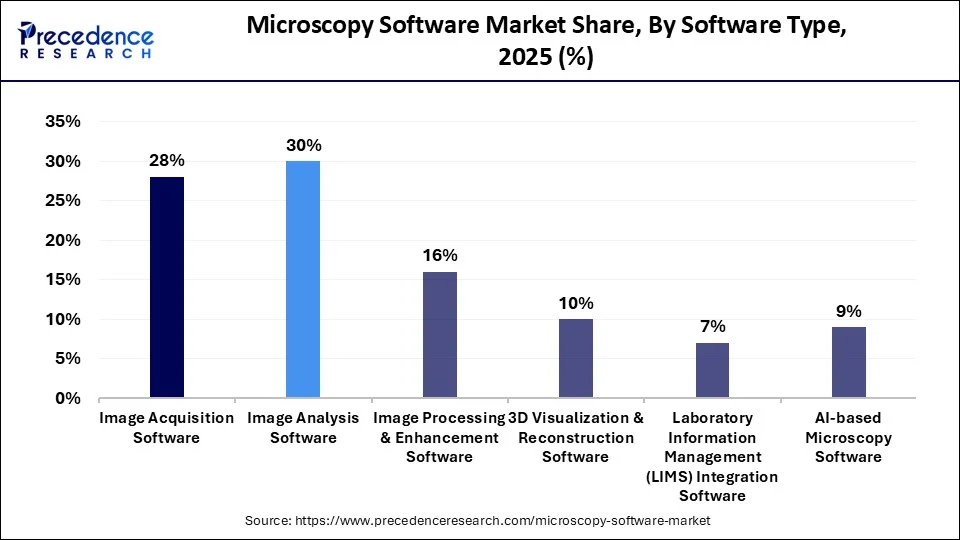
The AI-based microscopy software segment held a 9% share of the market in 2025 and is expected to grow at the fastest CAGR of 19.4% during the projection period. This is mainly because AI-driven automation accelerates image analysis and diagnostics. AI is increasingly thus moving upstream directly into data acquisition. Leading systems use AI segmentation in real time to determine rare events or features of interest autonomously, prompting the microscope to zoom in or scan only relevant sections. Moreover, this cuts high-resolution acquisition times and even saves on unnecessary data storage.
The image acquisition software segment held a 28% share of the market in 2025 and is expected to grow at a CAGR of 9.6% during the projection period. This is due to its essential for microscope control and high-throughput image capture. Living cells are fragile; thus, exposing them to laser light for prolonged periods can kill or damage them. EDA tracks and segments target cells on the fly, thus shutting off illumination as soon as a diagnostic threshold is reached. Advanced acquisition suites integrate AI-based tools, such as ZEISS ZEN Intellesis, to process immediate segmentation data alongside automatically adjusting device parameters for the next frame.
Microscopy Type Insights
Why Did the Optical Microscopy Segment Lead the Microscopy Software Market?
The optical microscopy segment held a dominant position in the market, with a 32% share in 2025, driven by its widespread deployment across academic and clinical laboratories. Modern optical microscopy, along with cell analysis core facilities, faces bottlenecks from large data volumes. Optical microscopy software effectively solves this via deep learning, artificial intelligence-based segmentation, and also high-throughput batch processing.
Microscopy Software Market Share, By Microscopy Type, 2025 (%)
| Microscopy Type | 2025 | 2035 | CAGR (%) |
| Optical Microscopy | 32 | 28 | 9.30% |
| Electron Microscopy | 21 | 22 | 11.80% |
| Confocal Microscopy | 15 | 16 | 12.70% |
| Fluorescence Microscopy | 14 | 15 | 12.90% |
| Scanning Probe Microscopy | 7 | 7 | 10.80% |
| Digital Microscopy | 8 | 10 | 15.10% |
| Other Microscopy Types | 3 | 2 | 9.80% |
The digital microscopy segment held an 8% share of the market in 2025 and is expected to grow at the fastest CAGR of 15.1% during the projection period. This is mainly due to digital pathology and remote collaboration driving adoption. Modern digital software systems can store and recall specific imaging parameters, allowing firms to automate repetitive tasks, reduce training times, and guarantee consistent results across users. Digital microscopy allows for soft-copy reading, network connectivity, alongside seamless data exchange, driving efficiency in pathology diagnostics, life sciences, and industrial inspection.
The electron microscopy segment held a 21% share of the market in 2025 and is expected to grow at a CAGR of 11.8% during the projection period. This is due to the increasing materials science and semiconductor applications. Electron microscopes, such as SEM and TEM, produce incredibly large volumes of data per scan, thus necessitating advanced software for machine learning, automation, and AI-guided 3D volume reconstruction. In life sciences, cryo-electron microscopy is thus heavily reliant on highly specialized processing software to work and average images of tiny proteins to near-atomic resolution.
Deployment Mode Insights
Why Did the On-premises Segment Dominate the Microscopy Software Market?
The on-premises segment held a dominant position in the market, with a 62% share in 2025, driven by the preference for high-security research environments. Academic core facilities, pharmaceutical firms, and hospitals handle sensitive intellectual property alongside confidential clinical data. On-premises software offers a secure, isolated environment without relying on the public internet. Research labs and hospitals usually need to tie their microscope workstations directly into their existing local servers, like their Laboratory Information Management Systems (LIMS) or Electronic Lab Notebooks.
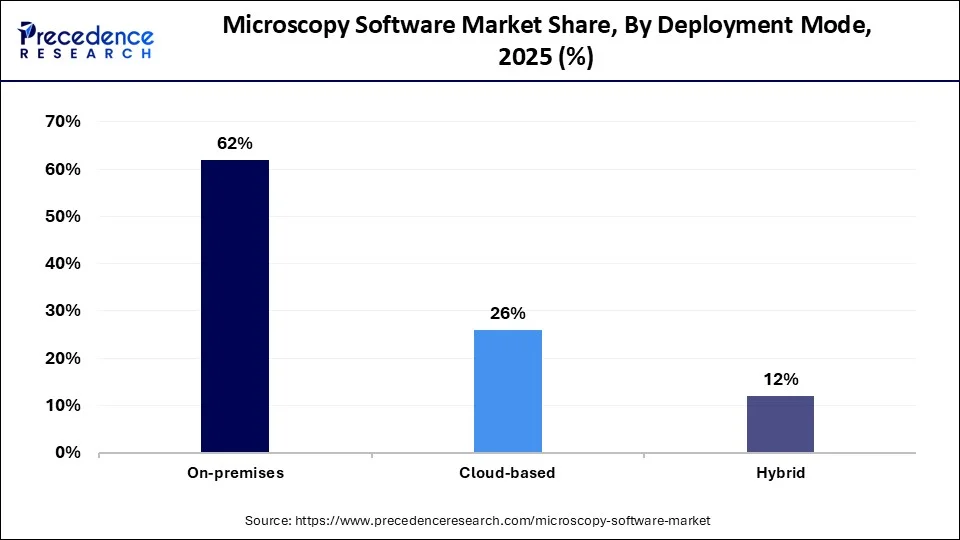
The cloud-based segment held a 26% share of the market in 2025 and is expected to grow at the fastest CAGR of 17.8% during the projection period. This is mainly due to growing demand for scalable data storage and collaboration. Modern imaging modalities such as Cryo-EM and multi-dimensional light-sheet microscopy analyze enormous datasets. Cloud platforms enable labs to rent parallel processing power to determine images in hours rather than weeks, and connected laboratory environments break down data silos, thus letting organizations synchronize data and even automate workflows directly from the microscope to centralized, indexed databases.
The hybrid segment held a 12% share of the market in 2025 and is expected to grow at a CAGR of 12.6% during the projection period. This is due to balancing security with cloud-enabled workflows. Continuous exposure to strong lasers during long time-lapse experiments damages living cells. Moreover, hybrid software solves this by using label-free methods, such as phase-contrast, for gentle surveillance and thus only triggers high-resolution fluorescence imaging when an event of interest occurs.
Application Insights
Why Did the Life Sciences Research Segment Lead the Microscopy Software Market?
The life sciences research segment held a dominant position in the market, with a 28% share in 2025, driven by expanding cell biology and genomics research. Modern fluorescence microscopes, along with confocal microscopes, generate thousands of time-lapse images, thus making manual measurement too time-consuming. Automated analysis now accelerates high-content screening, which is vital for pharmaceutical research and drug discovery.
The semiconductor & electronics segment held a 12% share of the market in 2025 and is expected to grow at the fastest CAGR of 13.7% during the projection period. This is mainly because of increasing chip inspection and failure analysis. Software-defined microscopy leverages machine learning and AI to automatically detect, classify, and even report faults. This decreases human error and speeds up quality control in fabrication facilities (fabs). Modern electron microscopes thus generate terabytes of raw image data during wafer testing and failure analysis. Advanced software is needed to process and visualize this data in real time without bottlenecking production lines.
The clinical diagnostics segment held a 17% share of the market in 2025 and is expected to grow at a CAGR of 12.4% during the projection period. This is due to digital pathology and AI-assisted diagnosis adoption. Whole slide imaging software allows pathologists to instantly share high-definition digital slides securely, thus facilitating real-time second opinions across different hospitals and geographies without physically shipping slides.
End User Insights
Why Did the Pharmaceutical & Biotechnology Companies Segment Lead the Microscopy Software Market?
The pharmaceutical and biotechnology companies segment held a dominant position in the market, with a 29% share in 2025, driven by strong investment in drug discovery and biologics research. Software allows high-content screening to continuously track cellular reactions to assess efficacy, novel drug compounds, and identify toxicity. Researchers can quantify complex cell phenotypes as well as behaviors to profile potential drugs. Pharma environments have strict data tracking requirements. Moreover, specialized software provides compliant environments to guarantee data integrity, reliable documentation, and even traceability across research sites.
Microscopy Software Market Share, By End User, 2025 (%)
| End User | 2025 | 2035 | CAGR (%) |
| Pharmaceutical & Biotechnology Companies | 29 | 30 | 12.80% |
| Academic & Research Institutes | 27 | 24 | 10.20% |
| Hospitals & Diagnostic Laboratories | 18 | 20 | 13.80% |
| Semiconductor & Electronics Manufacturers | 11 | 13 | 14.50% |
| Contract Research Organizations (CROs) | 7 | 7 | 11.90% |
| Industrial Manufacturing Companies | 5 | 4 | 9.90% |
| Others | 3 | 2 | 10.60% |
The semiconductor and electronics manufacturers segment held an 11% share of the market in 2025 and is expected to grow at the fastest CAGR of 14.5% during the projection period. This is mainly because of rising semiconductor quality inspection requirements. AI and machine learning algorithms now scan wafers to identify, classify, and map microscopic faults instantly. This automation prevents costly cascading errors early in the production line. Moreover, specialized programs enable engineers to reconstruct 3D models of internal circuit structures non-destructively, and also locate elusive electrical faults, and analyse root causes with precision.
The academic and research institutes segment held a 27% share of the market in 2025 and is expected to grow at a CAGR of 10.2% during the projection period. This is due to extensive use in fundamental scientific research. Manual image evaluation is a vast analytical bottleneck. Institutes have broadly adopted integrated software packages to remove this bottleneck, utilizing tools such as deep-learning segmentation and cell tracking for impartial and reproducible results.
Market Regional Analysis: North America, Europe, Asia-Pacific
What Led the Global North America Microscopy Software Market to Grow in 2025?
North America led the market by holding a major share of 38% in 2025. This is due to the strong presence of life science research institutions and software vendors. Manual evaluation thus creates analytical bottlenecks. North American labs prioritize hybrid software that utilizes built-in AI models to segment and then track phenotypes on the fly, vastly cutting down discovery timelines.
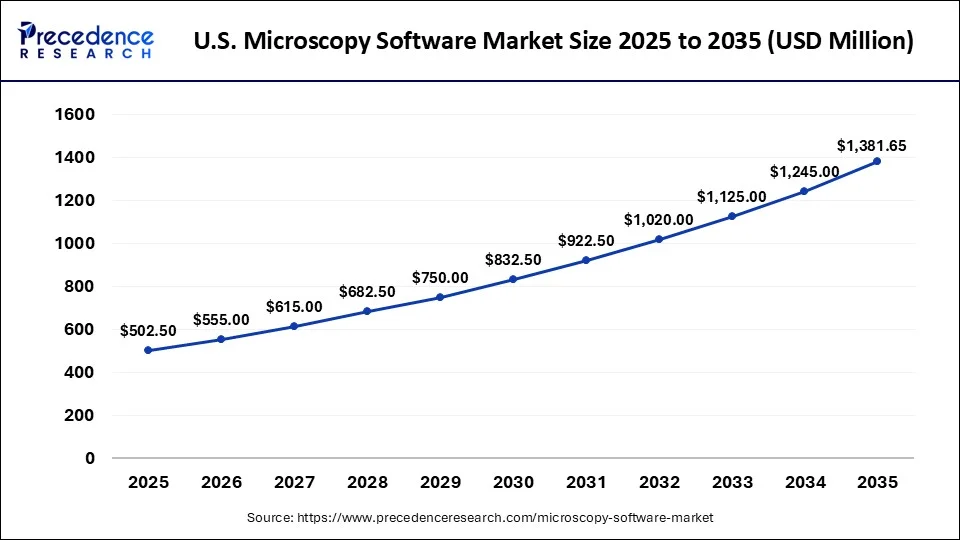
U.S. Microscopy Software Pumps Market Size and Growth 2026 to 2035
The U.S. microscopy software market size was evaluated at USD 502.50 million in 2025 and is projected to reach around USD 1,381.65 million by 2035, growing at a CAGR of 10.64% from 2026 to 2035.
U.S. Market Analysis
The U.S. popularized microscopy software as modern high-resolution imaging creates terabytes of data, which causes analytical bottlenecks. Software adoption removes this by using AI and automation to determine cell phenotypes and semiconductor defects, drastically reducing discovery and inspection timelines. As chip architecture becomes smaller, software offers Automated Defect Recognition (ADR) and then critical measurement metrology without slowing down the production line.
Europe: The Second-Largest Market
Europe held the second-largest share at 28% in 2025 and is expected to grow at a notable CAGR of 10.8% during the projection period, driven mainly by extensive academic research and advanced healthcare infrastructure. Europe is home to optical and microscopy giants such as Carl Zeiss and Leica Microsystems, whose integrated software platforms thus drive advanced materials and life sciences research. Moreover, heavy reliance on microscopy software for failure detection in the region's automotive and aerospace sectors, along with nanotechnology and semiconductor fabrication.
UK Market Analysis
The UK has a strong history of popularizing and developing microscopy software because of its robust life sciences sector, major academic breakthroughs, and emphasis on accessible technology. UK research facilities have engineered specialized tools such as FLIMfit, developed at Imperial College London, for complex fluorescent lifetime analysis.
Asia Pacific: The Fastest-Growing Region
Asia Pacific held a 26% share of the market in 2025 and is expected to grow at the fastest CAGR of 14.8% during the projection period, driven by rising R&D investments and semiconductor manufacturing expansion. As the global centre for microelectronics, countries such as Taiwan, China, and Japan depend heavily on advanced microscopy software to maintain nanometer-scale chip yields, conduct wafer defect detection, and perform failure analysis. Increasing digitization of regional hospitals and diagnostic centres has spurred the need for AI-driven software, enabling clinical labs to determine diseases accurately and speed up drug discovery.
China Market Analysis
China's rapid embrace and popularization of advanced microscopy software is boosted by massive government investments in biotechnology alongside semiconductor manufacturing. As the world's manufacturing and research centres, China depends on AI-powered, automated imaging to boost productivity, drive medical innovation, and achieve self-reliance in high-end scientific equipment.
What Drives the Microscopy Software Market in Latin America?
Latin America held a 5% share of the market in 2025 and is expected to grow at a significant CAGR of 11.4% during the projection period, driven by growing laboratory modernization initiatives. Digital microscopy software thus solves access issues to pathology expertise. Software platforms allow virtual microscopy, which cuts down analysis time and enhances patient care by enabling remote specialist consultations.
Brazil Market Analysis
Brazil's scientific and medical sectors increasingly depend on advanced microscopy software to improve research and education. This includes the demand to digitize healthcare for widespread medical training, improve major agricultural pathology research, and determine high-resolution data from digital and 3D microscopes.
How is the Opportunistic Rise of the Middle East and Africa in the Microscopy Software Market?
Middle East and Africa held a 3% share of the market in 2025 and are expected to grow at a notable CAGR of 11.2% during the projection period, driven by increasing investment in healthcare and scientific research. The acceptance of artificial intelligence and digital imaging within software is increasing remote collaboration along with telemedicine capabilities across the Middle East and African laboratories. AI-driven software reduces human error and standardizes data interpretation without demanding an expert to be physically present.
Saudi Arabia Market Analysis
Saudi Arabia's expansion into advanced microscopy software is driven by its Vision 2030 initiative. By heavily investing in artificial intelligence along with biotechnology, the Kingdom aims to become a global centre for scientific research and precision healthcare, demanding sophisticated, automated software for cellular, molecular, and atomic-level analysis.
Market Competitive Landscape: Leading Companies and Strategies
The microscopy software market is highly competitive, with established imaging and life science firms competing alongside specialized software developers and emerging AI-driven firms. Major players aim on integrating artificial intelligence, automated image analysis, cloud-based image management, and workflow optimization to strengthen their offerings.
Strategic initiatives like product launches, partnerships, and acquisitions, along with continuous software upgrades, are common to expand capabilities and market reach. Demand from life sciences, materials science, clinical diagnostics, and semiconductor industries encourages innovation in quantitative analysis, data visualization, and remote collaboration. As digital pathology and automated microscopy gain traction, vendors increasingly differentiate through interoperability, cybersecurity, scalability, and user-friendly interfaces.
Microscopy Software Market Companies
- Thermo Fisher Scientific Inc
- Hitachi High-Tech Corporation
- JEOL Ltd.
- Evident Scientific
- Bruker Corporation
- Oxford Instruments
- Biodock
- INSCOPER
- Clemex
Recent Developments Microscopy Software Market (2025-2026)
- In August 2025, Evident declared that it completed the acquisition of Pramana, Inc., a leading producer of digital pathology solutions. Pramana's latest autonomous whole slide imaging technologies, combined with Evident's longstanding leadership in clinical microscopy alongside superior optics, will revolutionize the market for digital pathology solutions and even usher in a new era, digital pathology 2.0.(Source: https://evidentscientific.com)
Segments Covered in the Report
By Software Type
- Image Acquisition Software
- Image Analysis Software
- Image Processing and Enhancement Software
- 3D Visualization and Reconstruction Software
- Laboratory Information Management (LIMS) Integration Software
- AI-based Microscopy Software
By Microscopy Type
- Optical Microscopy
- Electron Microscopy
- Confocal Microscopy
- Fluorescence Microscopy
- Scanning Probe Microscopy
- Digital Microscopy
- Other Microscopy Types
By Deployment Mode
- On-premises
- Cloud-based
- Hybrid
By Application
- Life Sciences Research
- Clinical Diagnostics
- Material Science
- Semiconductor & Electronics
- Nanotechnology
- Pharmaceutical & Biotechnology Research
- Industrial Inspection
- Academic Research
- Others
By End User
- Pharmaceutical & Biotechnology Companies
- Hospitals & Diagnostic Laboratories
- Academic & Research Institutes
- Semiconductor & Electronics Manufacturers
- Contract Research Organizations (CROs)
- Industrial Manufacturing Companies
- Others
By Enterprise Size
- Large Enterprises
- Small & Medium Enterprises (SMEs)
By Licensing Model
- Perpetual License
- Subscription-based
- Open-source
By Region
- North America
- Latin America
- Europe
- Asia-pacific
- Middle and East Africa
For inquiries regarding discounts, bulk purchases, or customization requests, please contact us at sales@precedenceresearch.com
Frequently Asked Questions





Ask For Sample
No cookie-cutter, only authentic analysis – take the 1st step to become a Precedence Research client
 Get a Sample




 sales@precedenceresearch.com
 Schedule a Meeting
