



Model Inference Optimization Tools Market Revenue and Trends 2026 to 2035
Published: 08 May 2026
Author: Precedence Research



Model Inference Optimization Tools Market Revenue to Attain USD 48.82 Bn by 2035
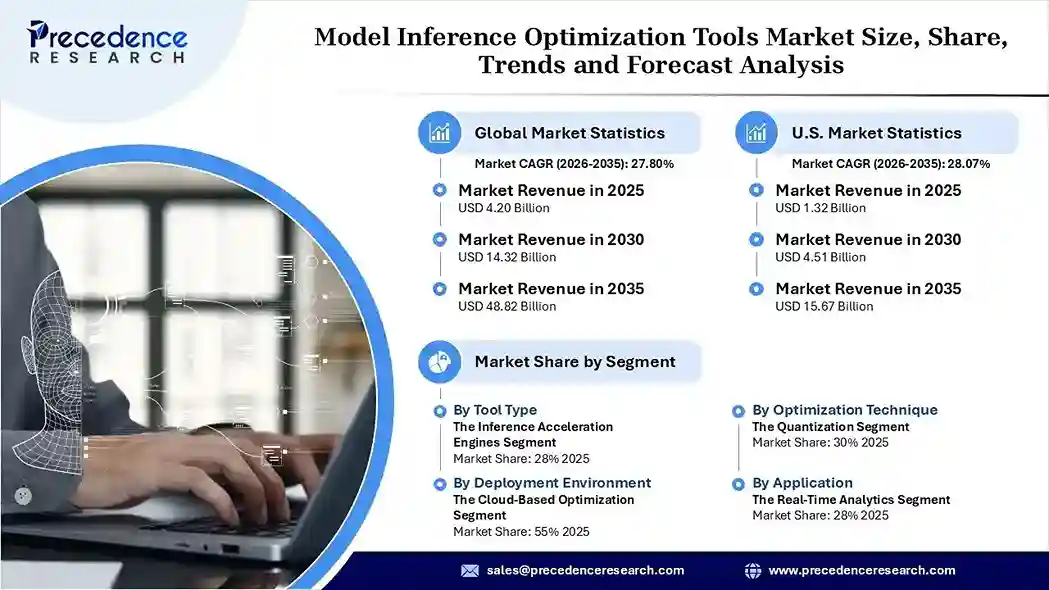
The global model inference optimization tools market revenue surpassed USD 4.20 billion in 2025 and is predicted to attain around USD 48.82 billion by 2035, growing at a CAGR of 27.80%. The model inference optimization tools market is gaining momentum as AI shifts from experimentation to deployment, where shrinking latency, cutting compute costs, and taming oversized models have become less of a technical choice and more of an operational necessity.
Market at a Glance
The model inference optimization tools market comprises a range of software frameworks, compilers, and runtime engines designed to enhance the efficiency of trained AI models during deployment. Rather than improving model intelligence, these tools focus on making AI systems practical and scalable by reducing latency, compressing model size, and aligning performance with hardware constraints, from cloud GPUs to edge and on-device processors.
These tools are deployed in environments including cloud, edge, and on-device systems, where techniques such as quantization, pruning, and hardware-aware tuning are widely applied. The market serves industries like healthcare, automotive, BFSI, retail, and others where real-time AI responsiveness is critical, and is increasingly extending beyond software into chip design, highlighting the growing importance of end-to-end efficiency across the AI stack.
What Influences the Model Inference Optimization Tools Market?
- Rising Need for Optimized Inference Efficiency: Optimized inference stacks have demonstrated performance improvements of up to 50× and cost reductions of up to 35×, significantly enhancing the commercial viability of AI deployments. Additionally, hardware–software co-optimization platforms are delivering up to 15× gains in energy efficiency, strengthening return on investment for enterprises operating at scale.
- Shift Toward Inference-Centric Architectures: The industry is transitioning from training-focused systems to inference-heavy infrastructure, with increasing server demand and CPU–GPU ratios approaching 1:1 to support higher inference workloads. This shift is driving demand for tools capable of dynamically optimizing performance across heterogeneous hardware environments, including GPUs, CPUs, and specialized accelerators such as NPUs.
Market Segmentation Overview
- By tool type, the inference acceleration engines segment held a revenue share of 28.0% in the market in 2025 because of their low latency and high throughput. As AI workloads scaled, these engines became critical in preventing performance bottlenecks and ensuring responsive, production-grade inference systems.
- By tool type, the edge AI optimization tools segment is expected to grow at the fastest CAGR in the market between 2026 and 2035, supported by the rapid expansion of edge devices and IoT ecosystems. As intelligence shifts closer to data sources, demand for localized processing increases to reduce latency and minimize bandwidth constraints.
- By deployment environment, the cloud-based optimization segment held a major revenue share of 55.0% in the model inference optimization tools market in 2025, driven by demand for scalable infrastructure and seamless system integration. Organizations continue to rely on cloud environments for elastic compute resources and centralized management of large-scale inference workloads.
- By deployment environment, the edge/on-device optimization segment is expected to grow at the highest CAGR in the market between 2026 and 2035, driven by the need for real-time processing and ultra-low latency. Increasingly, AI systems are required to operate directly at the point of data generation, eliminating reliance on cloud round-trips.
- By optimization technique, the quantization segment dominated the market with a 30.0% share in 2025 and is expected to maintain its leading position with a CAGR of 30.5% in the coming years. Its popularity is driven by significant reductions in compute and memory requirements, directly translating into lower operational costs while maintaining acceptable model accuracy.
- By application, the real-time analytics segment accounted for a revenue share of 28.0% in the market in 2025, as enterprises increasingly rely on immediate insights for decision-making. Even minor reductions in inference latency can create measurable competitive advantages in time-sensitive environments.
- By application, the customer experience segment is expected to expand rapidly in the market in the coming years, driven by increasing demand for chatbots, recommendation engines, and personalization systems. Users now expect instantaneous, context-aware responses with minimal or no perceptible delay.
- By end-use industry, the IT & cloud providers segment dominated the market with a 40.0% market share in 2025 and is expected to maintain its leading position with a CAGR of 29.5% in the coming years. Hyperscale AI deployment has made inference optimization a core requirement for sustaining performance across massive concurrent workloads.
Regional Analysis
North America dominated the global model inference optimization tools market with a share of 42.0% in 2025, supported by strong hyperscaler ecosystems and deep integration between AI infrastructure and software development. In the U.S., leading cloud providers and AI research institutions treat inference efficiency as a strategic advantage rather than a technical afterthought. Canada complements this ecosystem through advanced research programs and government-backed innovation initiatives that accelerate the commercialization of AI optimization technologies.
Asia Pacific held a market share of 25.0% in 2025 and is expected to grow at the fastest CAGR during the forecast period. This growth is driven by aggressive AI adoption and parallel advancements in semiconductor innovation. In China, expansion of domestic AI infrastructure and chip manufacturing is accelerating inference optimization capabilities, while India is rapidly scaling enterprise and public-sector AI deployments. Meanwhile, Japan and South Korea are advancing high-performance chip architectures that increasingly underpin next-generation inference optimization systems.
Model Inference Optimization Tools Market Coverage
| Report Attribute | Key Statistics |
| Market Revenue in 2025 | USD 4.20 Billion |
| Market Revenue by 2035 | USD 48.82 Billion |
| CAGR from 2026 to 2035 | 27.80% |
| Quantitative Units | Revenue in USD million/billion, Volume in units |
| Largest Market | North America |
| Base Year | 2025 |
| Regions Covered | North America, Europe, Asia-Pacific, Latin America, and the Middle East & Africa |
Top Companies in the Model Inference Optimization Tools Market
NVIDIA Corp., Intel Corp., and Advanced Micro Devices Inc. continue to anchor the hardware-software interplay, while Amazon Web Services Inc., Microsoft Corp., and Google LLC embed optimization directly into cloud-native stacks. Meanwhile, Alibaba Group Holding Ltd. and Scaleway SAS extend this capability across regional cloud ecosystems. A different cadence comes from Graphcore Ltd., Groq Inc., Cerebras Systems Inc., and Tenstorrent Inc., where architecture itself is redesigned for inference-heavy workloads. On the software and tooling side, Hugging Face Inc., IBM Corp., and Modular Inc. reshape how models are compiled, compressed, and deployed.
Segments Covered in the Report
By Tool Type
- Model Compression Tools (Quantization, Pruning, Distillation)
- Inference Acceleration Engines (Runtime, Compilers, Tensor Optimization)
- Hardware-aware Optimization Tools
- Edge AI Optimization Tools
- AutoML & Optimization Platforms
By Deployment Environment
- Cloud-based Optimization
- On-device/Edge Optimization
- Hybrid Deployment
By Model Type
- Large Language Models (LLMs)
- Computer Vision Models
- Speech & Audio Models
- Recommendation & Ranking Models
- Multimodal Models
By Optimization Technique
- Quantization
- Pruning & Sparsity Optimization
- Knowledge Distillation
- Graph Optimization & Compilation
- Kernel & Runtime Optimization
By Application
- Real-time Analytics & Decision Making
- Autonomous Systems (AVs, Robotics, Drones)
- Customer Experience (Chatbots, Personalization)
- Fraud Detection & Risk Analytics
- Industrial AI & Predictive Maintenance
By End-Use Industry
- IT & Cloud Providers
- Automotive
- Healthcare
- BFSI
- Retail & E-commerce
- Telecommunications
- Manufacturing
By Region
- North America
- Latin America
- Europe
- Asia-pacific
- Middle and East Africa
Get this report to explore global market size, share, CAGR, and trends, featuring detailed segmental analysis and an insightful competitive landscape overview @ https://www.precedenceresearch.com/sample/8383
You can place an order or ask any questions, please feel free to contact us at sales@precedenceresearch.com |+1 804 441 9344