



Multilingual LLM Market Revenue to Attain USD 57.00 Bn by 2035
Published: 14 May 2026
Author: Precedence Research



Multilingual LLM Market Revenue and Trends 2026 to 2035
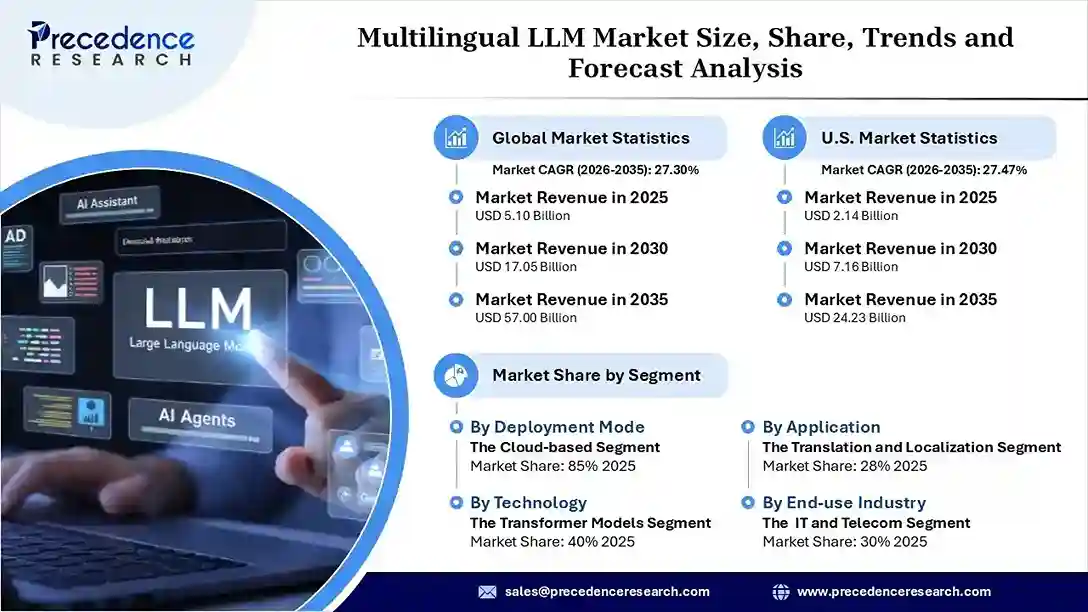
The global multilingual LLM market revenue surpassed USD 5.10 billion in 2025 and is predicted to attain around USD 57.00 billion by 2035 with a CAGR of 27.30%. The market is driven by the growing need for organizations to communicate, translate text, perform sentiment analysis, and handle customer service across multiple languages using a single model.
Market Overview
The multilingual LLM market comprises large language models (LLMs) that have been trained and fine-tuned to handle more than a single human language. Such languages range from English, German, Chinese, Spanish, Swahili, Urdu, and Quechua. The market comprises models for translating languages using neural machine translation, which can translate language pairs without the need for bilingual dictionaries.
The multi-language LLMs are equipped with cross-lingual information retrieval, allowing users to search for documents in one language using queries in another. They are also capable of performing multilingual sentiment analysis to detect emotions from social media content in different languages. multilingual LLM enables representing words and sentences from multiple languages in a common vector space and facilitates zero-shot transfer (when a model trained in English is able to perform the tasks in other languages it was not previously exposed to).
What Drives the Growth of the Market?
Adaptive Scaling and Dynamic Mixing for Enhanced Multilingual Model Training
A major emerging trend in the market is the adoption of adaptive scaling laws and dynamic language-mixing techniques that improve multilingual AI model performance through cross-language transfer learning. These approaches analyze how different language combinations enhance or negatively affect model accuracy, enabling developers to optimize multilingual training strategies more effectively.
- In 2026, Google Research announced ATLAS, which stands for Adaptive Transfer Scaling Laws for Multilingual Pretraining, Finetuning, and Decoding the Curse of Multilinguality. ATLAS is built on the results of 774 experiments with models ranging from 10 million to 8 billion parameters trained in more than 400 languages.
Adoption of Fine-Tuned Multilingual AI Models
The market is driven by the rising adoption of fine-tuning for AI models, where companies are now using region-specific language models tailored to their native languages and dialects. Sovereign AI models that respect privacy will be able to support enterprise applications involving voice assistants, customer service automation, and documentation in regional languages.
- In 2026, Tech Mahindra received the endorsement of the World Economic Forum’s MINDS initiative for its multi-lingual AI models in citizen services, banking, and healthcare that can handle 3.8 million queries per month from more than 10,000 active users.
Government Investments to Develop Sovereign Multilingual AI Ecosystems
Governments across the globe have made significant investments and strategic plans for developing sovereign multilingual AI models due to their concerns about vulnerabilities resulting from their dependency on foreign language models. Governments have formulated plans to create a national database for linguistic resources, which enables AI data in multiple languages, including ethnic minority and ancient languages.
- In 2025, Germany’s Federal Ministry for Economic Affairs and Energy announced the SOOFI (Sovereign Open Source Foundation Models) projects, allocating approximately USD 21.6 million for creating an open AI language model with around 100 billion parameters. This model is aligned with European regulations and includes six top research organizations to minimize dependence on AI companies outside Europe.
Market Segmentation Overview
- By Model Type: The text-based multilingual LLMs segment led the market with 45% share in 2025 due to text being the most common and fundamental type of digital communication in every language and industry sector, allowing use cases like machine translation, search, customer service chatbots, and document summarization.
- By Model Type: The multimodal multilingual LLMs segment is expected to expand at the highest CAGR during the forecast period, since businesses have begun to realize the need for AI systems capable of performing various tasks, such as translating text written on a product label taken through a camera, transcribing, and translating recorded audio calls.
- By Technology: The transformer models segment dominated the market with 40% share in 2025, since it is the core architecture that enables modern language models to work by providing opportunities to process an entire sequence of words and to detect long-range dependencies between them using self-attention techniques.
- By Technology: The RAG segment is expected to grow at the fastest rate from 2026 to 2035, due to its ability to link language models to real-time knowledge bases, documents, and databases in one language while responding in several other languages without the need for frequent model retraining.
- By Application: The translation & localization segment led the multilingual LLM market with 28% share in 2025 because companies operating in a global environment require content to be translated not only by translating the words but also by localizing them according to the regional culture.
- By Application: The content generation segment is expected to expand at the highest CAGR during the forecast period, owing to the increasing need to produce marketing content, product descriptions, social media content, and technical documents in multiple languages, which is facilitated by multi-language LLMs.
- By End-Use Industry: The IT & telecom segment dominated the market with 30% share in 2025 because the sector often deals with customers in multiple countries speaking different languages, hence needing multilingual support in their customer service booths, automatic routing in call centers, and software localization.
- By End-Use Industry: The retail & e-commerce segment is expected to grow at the fastest rate from 2026 to 2035, since the sector caters to consumers in numerous countries, which requires localization of product descriptions, customer reviews, emails, and checkout processes.
- By Organization Size: The large enterprises segment led the market with 68% share in 2025, since these enterprises operate in many countries and interact with many customers, employees, and associates in different languages and are financially as well as technically capable to integrate multi-language LLMs into their systems.
Regional Analysis
North America led the multilingual LLM market with 42% share in 2025 because it is home to some of the world’s leading technology organizations, like Google, Microsoft, Meta, and Amazon, which invest millions of dollars in developing and implementing multilingual LLMs to cater to their global customer base using hundreds of different languages. The U.S. dominated the market due to a significant presence of prominent AI research centers, powerful cloud computing capabilities, and the availability of funding from venture capital investors in LLM-based start-ups. Canada is a significant contributor to the market owing to extensive LLM-based research conducted in various institutions such as Vector Institute, Mila, and Amii, and a robust AI research environment in Toronto, Montreal, and Edmonton.
Asia Pacific is expected to expand at the highest CAGR during the forecast period because it is home to more than 2000 languages used by hundreds of millions of speakers, with many languages lacking sufficient digital representation. China led the market in Asia Pacific owing to the vast number of internet users, the AI policy, called the “Next Generation Artificial Intelligence Development Plan”, and the presence of leading technology firms. India witnessed notable market growth due to a large number of languages and dialects, along with government projects such as BHASHINI and IndiaAI Mission, which are dedicated to supporting the development of multilingual AI models among all scheduled languages.
Multilingual LLM Market Coverage
| Report Attribute | Key Statistics |
| Market Revenue in 2025 | USD 5.10 Billion |
| Market Revenue by 2035 | USD 57.00 Billion |
| CAGR from 2026 to 2035 | 27.30% |
| Quantitative Units | Revenue in USD million/billion, Volume in units |
| Largest Market | North America |
| Base Year | 2025 |
| Regions Covered | North America, Europe, Asia-Pacific, Latin America, and the Middle East & Africa |
Top Companies in the Multilingual LLM Market
Google, Meta, Microsoft, OpenAI, and Anthropic are some of the key players that provide foundational LLMs with robust multilingual skills. Baidu, Alibaba Cloud, Tencent, and Naver provide multi-language LLMs that are well-aligned with regional languages. SAP and IBM specialize in enterprise-focused multilingual LLMs to be used in business software applications.
Segments Covered in the Report
By Model Type
- Text-based Multilingual LLMs
- Multimodal Multilingual LLMs
- Domain-Specific Multilingual Models
By Technology
- Transformer-based Models
- Retrieval-Augmented Generation (RAG)
- Fine-tuned Multilingual Models
- Open-source LLM Frameworks
By Application
- Translation & Localization
- Customer Support & Chatbots
- Content Generation
- Knowledge Management
- Voice Assistants
By End-Use Industry
- IT & Telecom
- BFSI
- Retail & E-commerce
- Healthcare
- Media & Entertainment
- Government
By Organization Size
- Large Enterprises
- Small & Medium Enterprises
By Region
- North America
- Europe
- Asia Pacific
- Middle East & Africa
- Latin America
Get this report to explore global market size, share, CAGR, and trends, featuring detailed segmental analysis and an insightful competitive landscape overview @ https://www.precedenceresearch.com/sample/8407
You can place an order or ask any questions. Please feel free to contact us at sales@precedenceresearch.com |+1 804 441 9344