



Nursing Homes and Long-term Care Facilities Market Revenue to Attain USD 1,027.47 Bn by 2035
Published: 17 Apr 2026
Author: Precedence Research



Nursing Homes and Long-term Care Facilities Market Revenue and Trends 2026 to 2035
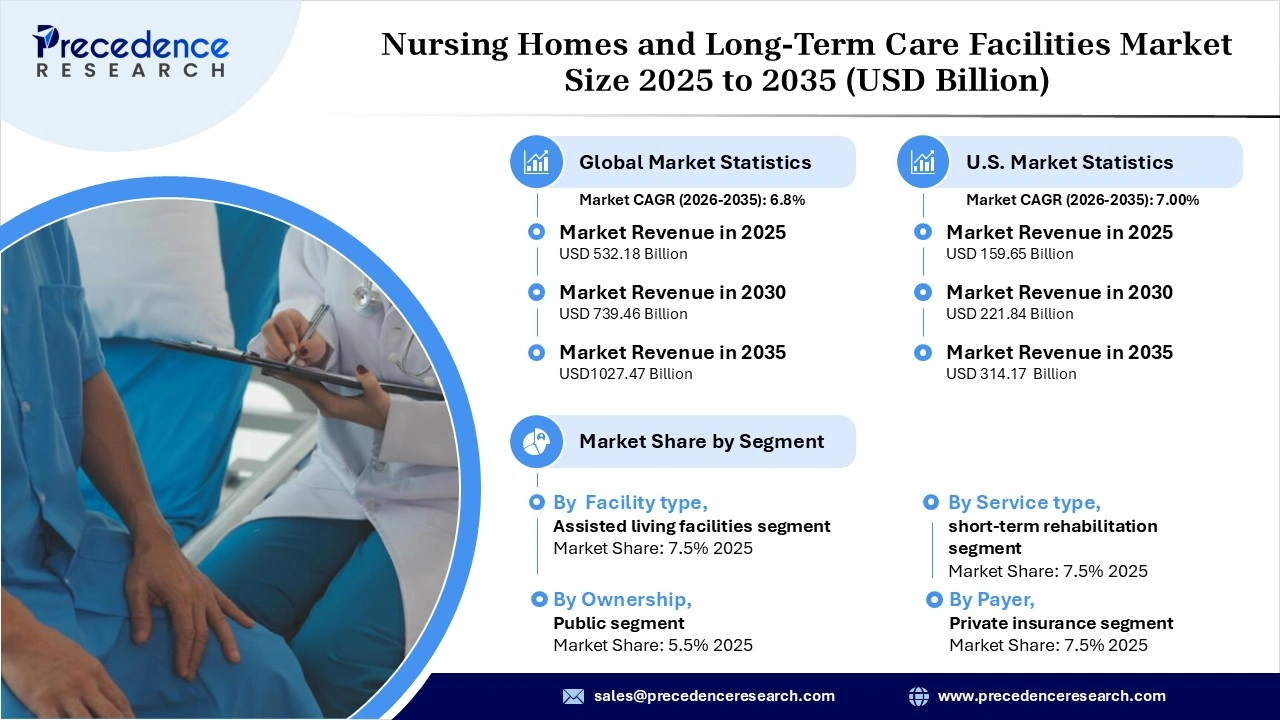
The nursing homes and long-term care facilities market revenue surpassed USD 532.18 billion in 2025 and is predicted to attain around USD 1,027.47 billion by 2035 with a CAGR of 6.80% during the forecast period. The market is driven by the growing proportion of senior citizens, the rising incidence of chronic diseases, and the need for assistance in living and rehabilitation.
Market Overview
The nursing homes and long-term care facilities market includes establishments that provide medical care, personal assistance, and supervised living for elderly individuals, patients with chronic conditions, and people with disabilities. These facilities support recovery and long-term well-being through services such as skilled nursing, rehabilitation, assisted living, dementia care, and palliative care for patients with serious illnesses. These services are crucial for ensuring patient safety and enhancing the quality of life for individuals needing reliable assistance.
What are the Major Trends in the Market?
Rise of AI-Based Intelligent Fall Detection Systems
One of the latest innovations in the market is the rise of AI-powered fall detection systems that detect any falls or abnormal movement in real-time. This technology uses devices such as wearable sensors, cameras, and motion detectors that not only detect abnormalities but also transmit immediate alert messages to the caregiver. This technology aids in reducing the time taken to respond and thus increases patient safety.
- In 2025, scientists introduced a smart IoT-based fall detection technology that relied on computer vision and immediate notifications in case of a fall in eldercare settings.
Large-Scale Senior Housing Expansion
The market scope is being broadened by the large-scale expansion of senior housing by means of acquisitions and development initiatives. This enables providers to expand bed availability, offer special services, and build their care network in several locations.
- In 2025, Welltower Inc., a real estate investment trust, invested USD 14 billion to grow its senior housing assets by making significant acquisitions of senior housing facilities and thus gained more capability to offer various levels of long-term care services.
Government Initiatives
Governments have a significant influence on building the foundation for developing nursing homes and long-term care facilities. With the increasing elderly population in many countries, governments are providing financial assistance for infrastructural development, improved quality of care delivery, and better access to care services.
- In 2025, the Indian Government increased its financial commitment towards senior care facilities under the Atal Vayo Abhyudaya Yojana (AVYAY) program, under which 696 senior citizen homes operated in 29 states till August 2025, while 84 more homes were approved to be developed in 2025-26.
Aging Wave and Care Capacity Crunch Transforming the Market
- According to Centers for Medicare and Medicaid Services data, the U.S. continues to be the biggest provider of institutional long-term care capacity and has more than 1.6 million certified nursing home beds in 2024-2025 that are supported by federal programs like Medicare and Medicaid.
- According to the Australian Institute of Health and Welfare, more than 220,000 residential aged care places have been reported in 2024-2025 in Australia, with ongoing reforms to increase bed capacity and enhance accessibility as part of the national policy frameworks.
- Japan nursing homes and long-term care facilities market is hit by massive labor shortages, as the Ministry of Health, Labor and Welfare, Japan estimates a future of a 570,000 shortage in caregivers by 2040, even with the current recruiting exercise.
- Due to rapid population aging and a falling availability of informal caregiving, the Organization for Economic Co-Operation and Development estimates that the demand for long-term care services will be more than one-third in 2050.
Market Segmentation Overview
- By Facility Type: The nursing homes segment led the market with a 35% share in 2025, owing to their ability to provide consistent medical care, together with the provision of living assistance, to an ever-increasing number of elderly persons, alongside other individuals with persistent illnesses that necessitate regular monitoring.
- By Facility Type: The assisted living facilities segment held the second-largest market share of 25% in 2025 and is expected to grow at the fastest rate in the coming years. This is because they provide a combination of freedom, along with support to elderly individuals who require continuous monitoring and help in performing certain routine chores.
- By Service Type: The long-term care segment dominated the nursing homes and long-term care facilities market with a 45% share in 2025, as it addresses the medical and personal care needs of a growing elderly population, as well as individuals with chronic illnesses and disabilities requiring prolonged support. The segment’s dominance is driven by the sustained demand for continuous care services over extended periods.
- By Service Type: The memory care segment is expected to grow at the fastest rate from 2026 to 2035, driven by the rising global prevalence of Alzheimer’s disease and dementia. The rapidly aging population is further increasing the need for specialized care environments tailored to cognitive and behavioral health management.
- By Ownership: The private segment led the nursing homes and long-term care facilities market with a 50% share in 2025 due to the fact that private organizations can fast-track investment in infrastructure and deliver better quality service. They are investing heavily in building new facilities to cater to the care requirements for senior citizens.
- By Ownership: The public segment held the second-largest market share of 30% in 2025, driven by government-provided long-term care services offered at affordable costs. These facilities are widely accessible, particularly benefiting low-income and elderly populations who rely on publicly funded care systems.
- By Payer: The public insurance segment dominated the nursing homes and long-term care facilities market with a 45% share in 2025, driven by extensive coverage of long-term care expenses under government-sponsored healthcare plans. This broad financial support has significantly increased the adoption of publicly funded long-term care services.
- By Payer: The private insurance segment is expected to expand at the highest CAGR during the forecast period, supported by rising income levels, increasing awareness of long-term care needs, and demand for higher-quality healthcare services. Faster access to care and reduced waiting times compared to public insurance are further encouraging the shift toward private coverage.
Regional Analysis
North America led the nursing homes and long-term care facilities market with a 40% share in 2025, owing to its advanced healthcare industry, well-established nursing homes infrastructure, and the adoption of systematic elderly care practices. This region has a significant proportion of an aging population, which is expected to further rise in the future. Robust financial support from the government as well as private insurance companies bolstered the market in the region.
The U.S. led the market in North America due to its mature nursing homes ecosystem and assisted living centers. This country has a high private insurance rate and significant government funding for elderly care programs. Canada is a notable contributor to the market because of its growing aging population and good public healthcare support.
Asia Pacific is expected to grow at the fastest rate from 2026 to 2035 due to the growing aging population and improvements in healthcare services. Rising disposable incomes and increasing urbanization are further supporting demand for nursing homes and long-term care facilities in the region. China leads the market due to its large elderly population and strong government-backed expansion of long-term care infrastructure. Japan contributes significantly due to its high aging population and well-established elderly care systems.
Nursing Homes and Long-term Care Facilities Market Coverage
| Report Attribute | Key Statistics |
| Market Revenue in 2025 | USD 532.18 Billion |
| Market Revenue by 2035 | USD 1,027.47 Billion |
| CAGR from 2026 to 2035 | 6.80% |
| Quantitative Units | Revenue in USD million/billion, Volume in units |
| Largest Market | North America |
| Base Year | 2025 |
| Regions Covered | North America, Europe, Asia-Pacific, Latin America, and the Middle East & Africa |
Top Companies in the Nursing Homes and Long-term Care Facilities Market
Brookdale Senior Living Inc., Sunrise Senior Living, LLC, and Sienna Senior Living Inc. primarily focus on private-pay senior living facilities, catering to individuals seeking premium assisted living and residential care services. Extendicare Inc., Genesis HealthCare Inc., and Diversicare Healthcare Services, Inc. operate skilled nursing facilities with a significant reliance on government reimbursement programs. Meanwhile, Amedisys Inc., Kindred Healthcare LLC, LHC Group Inc., and The Ensign Group Inc. bridge the gap between home healthcare and post-acute care services, supporting patient recovery and continuity of care after hospital discharge.
Segments Covered in the Report
By Facility Type
- Nursing Homes
- Assisted Living Facilities
- Continuing Care Retirement Communities (CCRCs)
- Skilled Nursing Facilities (SNFs)
By Service Type
- Long-term Care
- Short-term Rehabilitation
- Hospice & Palliative Care
- Memory Care (Alzheimer’s & Dementia Care)
By Ownership
- Publi
- Private
- Non-profit
By Payer
- Public Insurance
- Private Insurance
- Out-of-Pocket
By Region
- North America
- Latin America
- Europe
- Asia-pacific
- Middle and East Africa
Get this report to explore global market size, share, CAGR, and trends, featuring detailed segmental analysis and an insightful competitive landscape overview @ https://www.precedenceresearch.com/sample/8309
You can place an order or ask any questions, please feel free to contact us at sales@precedenceresearch.com |+1 804 441 9344