



Observability Tools and Platforms Market Revenue to Attain USD 49.60 Bn by 2035
Published: 12 May 2026
Author: Precedence Research



Observability Tools and Platforms Market Revenue and Trends 2026 to 2035
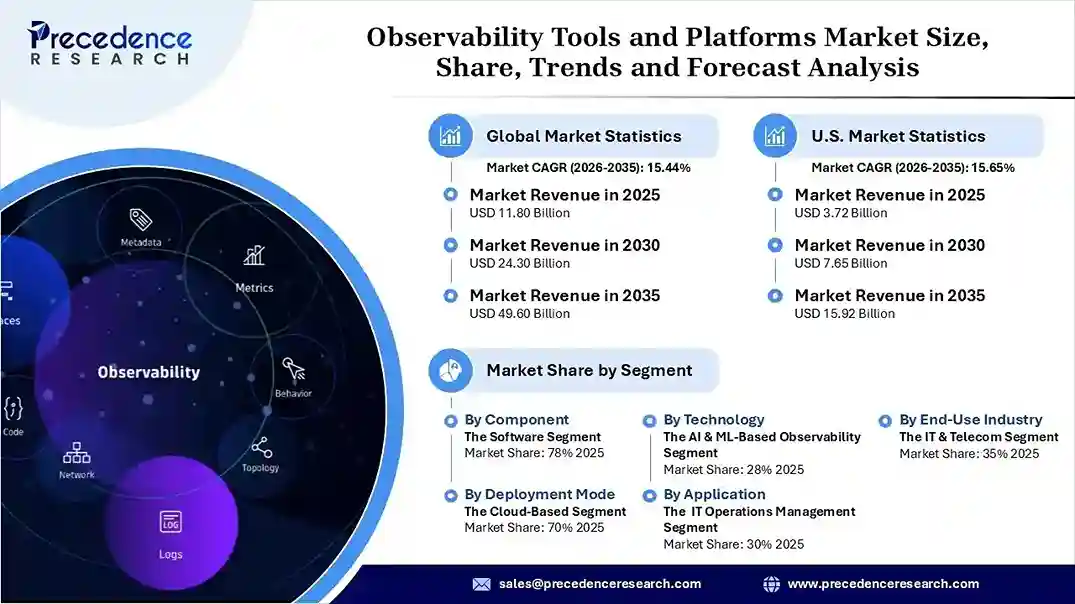
The global observability tools and platforms market revenue reached USD 11.80 billion in 2025 and is predicted to attain around USD 49.60 billion by 2035 with a CAGR of 15.44%. The market for observability tools and platforms is growing as organizations seek to navigate complex cloud, AI, and distributed infrastructures. Even minor outages, visibility gaps, performance slowdowns, or system issues are quickly noticed by these platforms.
Market at a Glance
Observability tools and platforms provide the enterprise with higher visibility into the health, performance, and behaviors of an entire system. These platforms collect and analyze telemetry data, including logs, metrics, traces, and events, to detect anomalies, troubleshoot issues, and optimize system performance more effectively.
The market spans solutions deployed across cloud-native, on-premises, and hybrid environments, along with associated services. It includes capabilities such as application performance monitoring, infrastructure visibility, cloud performance management, network diagnostics, user experience monitoring, and incident response automation. These tools are widely used by both large enterprises and SMEs across industries such as banking, healthcare, retail, manufacturing, and telecommunications, where maintaining digital reliability is critical to business continuity.
What Influences the Observability Tools and Platforms Market?
- AI Monitoring Complexity Creates Demand: The increasing adoption of AI workloads is adding complexity to IT environments. According to industry insights, a significant number of organizations report challenges in monitoring AI systems. This creates strong demand for advanced observability platforms that offer capabilities such as model tracing, inference monitoring, and automated root-cause analysis.
- Demand for Managed Observability: Mid-sized organizations often lack dedicated site reliability engineering (SRE) teams while operating complex cloud-native infrastructures. This gap is driving demand for managed observability solutions that offer turnkey deployment, automated alerting, and usage-based pricing models. Vendors targeting this segment are well-positioned to capture significant growth opportunities in the coming years.
Market Segmentation Overview
- By component, the software segment dominated the observability tools and platforms market with a 78% share in 2025 and is expected to maintain its leading position in the coming years, as enterprises leaned heavily on core observability platforms. Companies prefer software that reduces operational blind spots and improves infrastructure decision-making.
- By deployment mode, the cloud-based segment dominated the market with a 70% share in 2025 and is expected to maintain its leading position in the coming years because of the rapid adoption of SaaS solutions. Also, cloud-based platforms are favored for their enhanced ability to scale within growing digital environments.
- By technology, the AI & ML-based observability segment dominated the market with a 28% share in 2025 and is expected to maintain its leading position in the coming years because of its intelligent monitoring capabilities. Its ability to automate pattern recognition and predictive alerting makes it highly effective in managing complex, data-intensive systems.
- By application, the IT operations management segment accounted for a considerable revenue share of 30% in the observability tools and platforms market in 2025, driven by its essential role in monitoring infrastructure, ensuring service continuity, and supporting incident response and resource optimization.
- By application, the DevOps and CI/CD monitoring segment is expected to expand rapidly in the market with a CAGR of 21.5% in the coming years, due to the adoption of agile development practices and continuous delivery models requiring real-time visibility across development pipelines.
- By end-use industry, the IT & telecom segment dominated the observability tools and platforms market with a 35.0% market share in 2025 and is expected to maintain its leading position in the coming years. This is mainly due to the high adoption of observability platforms in this sector to manage dense digital ecosystems. High demand for uptime, increasing network complexity, and rising customer expectations continue to drive investment in observability solutions.
Regional Analysis
North America dominated the global observability tools and platforms market with a major share of 42.0% in 2025. The region’s dominance is driven by widespread adoption of cloud-native technologies such as containers, Kubernetes, microservices, and hybrid cloud architectures. The U.S. remains the dominant contributor due to a high concentration of hyperscalers and SaaS providers. Canada witnessed strong growth due to high adoption across banking, telecommunications, and government sectors.
Asia Pacific held a market share of 20% in 2025 and is expected to grow at the fastest CAGR of 22.5% during the forecast period. This growth is fueled by rapid IT modernization, increasing cloud adoption, and the expansion of digital ecosystems. China is advancing through large-scale digitization and smart infrastructure initiatives. Moreover, India is experiencing strong growth driven by its expanding IT services sector, startup ecosystem, and cloud-first strategies.
Observability Tools and Platforms Market Coverage
| Report Attribute | Key Statistics |
| Market Revenue in 2025 | USD 11.80 Billion |
| Market Revenue by 2035 | USD 49.60 Billion |
| CAGR from 2026 to 2035 | 15.44% |
| Quantitative Units | Revenue in USD million/billion, Volume in units |
| Largest Market | North America |
| Base Year | 2025 |
| Regions Covered | North America, Europe, Asia-Pacific, Latin America, and the Middle East & Africa |
Top Companies in the Observability Tools and Platforms Market
Datadog, Splunk, New Relic, and Dynatrace have established strong market positions by offering full-stack observability solutions, real-time telemetry insights, and AI-driven troubleshooting capabilities. In contrast, Elastic and Grafana Labs maintain competitive strength through open-source-driven approaches, attracting engineering-focused organizations seeking flexibility, customization, and cost efficiency.
At the same time, major technology providers such as Cisco Systems, IBM, Microsoft, Google Cloud, Amazon Web Services (AWS), and Oracle are increasingly integrating observability into their broader portfolios, including cloud computing, networking, cybersecurity, and infrastructure services. Additionally, VMware, ServiceNow, and BMC Software play a key role in supporting hybrid IT environments, workflow automation, and legacy system management, where comprehensive operational visibility is essential.
Segments Covered in the Report
By Component
- Software
- Services
By Deployment Mode
- Cloud-based
- On-premises
By Technology
- AI & Machine Learning-based Obsevability
- AIOps Platforms
- Big Data Analytics
- Open-source Observability Tools
By Application
- IT Operations Management
- DevOps & CI/CD Monitoring
- Network & Infrastructure Monitoring
- Security & Compliance Monitoring
By End-Use Industry
- IT & Telecom
- BFSI
- Healthcare
- Retail & E-commerce
- Manufacturing
- Government
By Region
- North America
- Latin America
- Europe
- Asia-pacific
- Middle and East Africa
Get this report to explore global market size, share, CAGR, and trends, featuring detailed segmental analysis and an insightful competitive landscape overview @ https://www.precedenceresearch.com/sample/8395
You can place an order or ask any questions, please feel free to contact us at sales@precedenceresearch.com |+1 804 441 9344