



Oilfield Communication Market Revenue to Attain USD 7.45 Bn by 2035
Published: 11 May 2026
Author: Precedence Research



Oilfield Communication Market Revenue and Trends 2026 to 2035
The global oilfield communication market revenue surpassed USD 3.40 billion in 2025 and is predicted to attain around USD 7.45 billion by 2035, growing at a CAGR of 8.16%. The oilfield communications market is growing due to increasing remote and offshore exploration activities and the need for secure, real-time connectivity to enhance operational efficiency and safety in harsh environments.
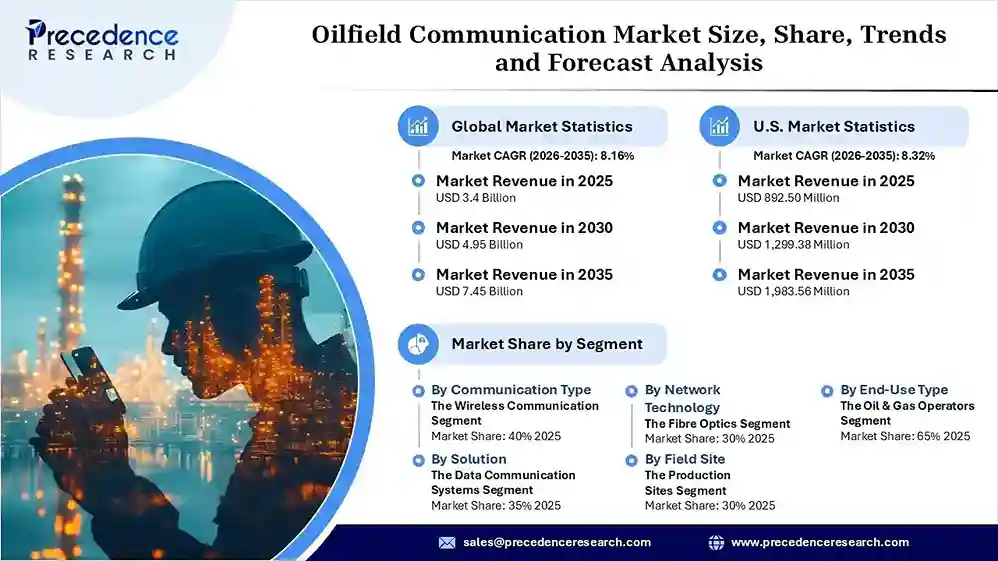
Market at a Glance
Oilfield communications integrate voice calling, video conferencing, and data-sharing solutions to maintain continuous connectivity between drilling sites, production wells, offshore platforms, pipelines, and control centers. The market includes satellite systems, fiber optic networks, radio communication devices, private LTE/5G technology, SCADA systems for monitoring and control, and cybersecurity measures designed for extreme environments. The demand for oilfield communication is driven by operators adopting real-time oversight, remote operations, automated maintenance, and secure data transmission, enabling safer, faster, and more efficient energy operations.
What are the Major Trends Driving the Oilfield Communication Market?
Increasing Investments
Oilfield operators are increasingly investing in communication systems that allow engineers to monitor wells, rigs, and field assets remotely. For example, Halliburton’s Integrated Virtual Remote Operations (iVRO) platform reportedly reduces organizational and operational costs by up to 40%, demonstrating that connectivity now directly impacts margins, not just convenience.
Expanding Offshore Activities
Offshore platforms require always-on, fail-safe networks for safety systems, surveillance, equipment health monitoring, and production control. BP’s deployment of its Plant Operations Advisor on Gulf of Mexico assets highlights the strategic importance of offshore communications, reinforcing that budgets for these networks are essential rather than optional.
Shift Toward Remote and Autonomous Operations
Oil and gas companies are increasingly adopting remote operations to monitor and control field assets without physical presence. This trend reduces operational costs, improves safety, and enables faster, data-driven decision-making across geographically dispersed sites.
Market Segmentation Overview
- By Communication Type: The wireless communication segment led the oilfield communication market with a 40.0% share in 2025 and is expected to maintain its dominance, driven by its flexibility in deployment across drilling sites, mobile crews, and remote assets. Its ability to provide connectivity without extensive physical infrastructure makes it ideal for rugged and hard-to-reach environments.
- By Solution: The data communication systems segment accounted for 35.0% of the market in 2025 and is projected to grow at a CAGR of 9.0%, supported by the increasing reliance on continuous data flows. These systems are critical for enabling real-time monitoring, minimizing downtime, and enhancing production visibility.
- By Network Technology: The fiber optics segment held a 30.0% share in 2025, as operators required high-speed, reliable data transmission from field locations to central control units. Its ability to handle large volumes of data supports surveillance, production analytics, and real-time process management.
- By Network Technology: The LTE/4G/5G networks segment is expected to grow at the fastest CAGR of 10.5% from 2026 to 2035, driven by the increasing adoption of private networks. These technologies enable low-latency communication, support connected equipment, and enhance mobility for field operations.
- By Field Site: The production sites segment led the oilfield communication market with a 30.0% share in 2025, as continuous monitoring of output, equipment health, and operational parameters remains critical. Communication systems ensure uninterrupted tracking of pressure, flow rates, and maintenance alerts.
- By Field Site: The pipeline & transportation segment is expected to grow at a CAGR of 8.5%, fueled by rising investments in pipeline monitoring. Increased focus on leak detection, route surveillance, and operational efficiency is driving demand for long-distance communication networks.
- By End-Use: The oil & gas operators segment dominated the oilfield communication market with a 65.0% share in 2025, as they are the primary adopters of communication technologies to support exploration, production, safety, and asset performance.
- By End-Use: The oilfield service companies segment is expected to grow at the fastest CAGR of 8.5%, driven by the shift toward technology-enabled service operations. Service providers are increasingly adopting advanced communication tools to improve coordination, efficiency, and response times in field activities.
Regional Analysis
North America dominated the global oilfield communication market with a share of 35.0% in 2025. The region’s dominance is supported by its mature oil and gas infrastructure and early adoption of digital technologies. Extensive use of SCADA systems, remote diagnostics, and real-time communication solutions has enhanced operational efficiency across established assets. The U.S. leads the market through shale-rich regions such as Texas and New Mexico, while Canada contributes through Alberta’s oil sands, where harsh environmental conditions necessitate robust and reliable communication systems.
The Middle East & Africa held a market share of 25.0% in 2025 and is expected to grow at the fastest CAGR of 9.5% during the forecast period. The region’s is driven by ongoing investments in upstream modernization, expansion into remote exploration areas, and national energy strategies. Additionally, countries such as China and India are accelerating investments in digital communication infrastructure, including connected pipelines, refinery integration, and advanced monitoring systems to support growing energy demands.
Oilfield Communication Market Coverage
| Report Attribute | Key Statistics |
| Market Revenue in 2025 | USD 3.40 Billion |
| Market Revenue by 2035 | USD 7.45 Billion |
| CAGR from 2026 to 2035 | 8.16% |
| Quantitative Units | Revenue in USD million/billion, Volume in units |
| Largest Market | North America |
| Base Year | 2025 |
| Regions Covered | North America, Europe, Asia-Pacific, Latin America, and the Middle East & Africa |
Top Companies in the Oilfield Communications Market
Huawei, Ericsson, Nokia, and Cisco Systems make significant contributions with their LTE, as well as the 5G network, with routers that cater to secure management of data related to assets that are out of proximity. ABB, Siemens, Honeywell, and Emerson Electric continue to dominate through their industrial automation platforms, integrating control systems into communication architectures through their industries as industry automation platforms. Parallel to this, Speedcast, RigNet, and Tait Communications focus on satellite communications, rugged wireless technologies on the one hand, and communication technology and mission-essential communications for deployment on offshore systems, mobile crews, and also at isolated oilfield sites for which silence is very costly.
Segments Covered in the Report
By Communication Type
- Wired Communication
- Wireless Communication
- Satellite Communication
By Solution
- Voice Communication Systems
- Data Communication Systems
- Video Communication Systems
- SCADA Communication Systems
By Network Technology
- Fiber Optics
- Microwave Communication
- VSAT (Very Small Aperture Terminal)
- LTE/4G/5G Networks
By Application
- Onshore Oilfields
- Offshore Oilfields
By Field Site
- Drilling Sites
- Production Sites
- Pipeline & Transportation
- Refinery & Processing
By End-Use
- Oil & Gas Operators
- Oilfield Service Companies
By Region
- North America
- Latin America
- Europe
- Asia-pacific
- Middle and East Africa
Get this report to explore global market size, share, CAGR, and trends, featuring detailed segmental analysis and an insightful competitive landscape overview @ https://www.precedenceresearch.com/sample/8391
You can place an order or ask any questions, please feel free to contact us at sales@precedenceresearch.com |+1 804 441 9344