



Oilfield Communication Market Trends, Companies, Revenue / Sales Performance, Subscriber Growth, Pricing Strategies, Cloud Adoption, Infrastructure Expansion, Competitive Landscape, and Industry Outlook
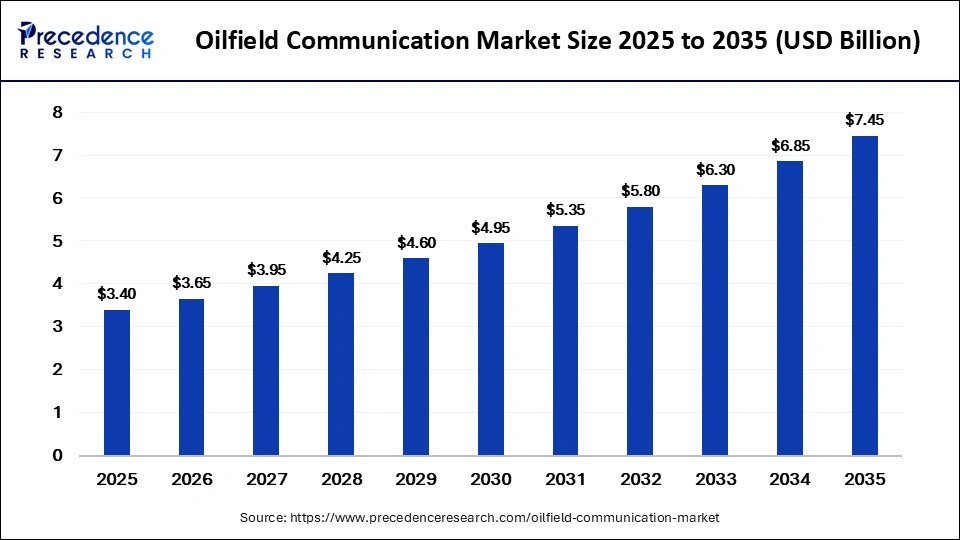
ICT industry specialist Shivani Zoting estimates the oilfield communication market at USD 3.65 billion in 2026, with continued technology adoption expected to take the market to USD 7.45 billion by 2035 at a CAGR of 8.16%. Leading oilfield communication market providers such as Schlumberger, Halliburton, Baker Hughes, Weatherford are expanding their capabilities across segments including By Communication Type, By Solution, By Network Technology, By Application, By Field Site, By End-Use.
Source: https://www.precedenceresearch.com/oilfield-communication-market
 Get a Sample
 Table Of Content


What is the Oilfield Communication Market Size in 2026?
The global oilfield communication market size accounted for USD 3.40 billion in 2025 and is predicted to increase from USD 3.65 billion in 2026 to approximately USD 7.45 billion by 2035, expanding at a CAGR of 8.16% from 2026 to 2035. The market is driven by rising offshore and onshore exploration activities, increasing adoption of IoT and digital oilfield technologies, and the need for reliable, real-time connectivity to improve operational efficiency and safety in remote and harsh environments.
Key Takeaways
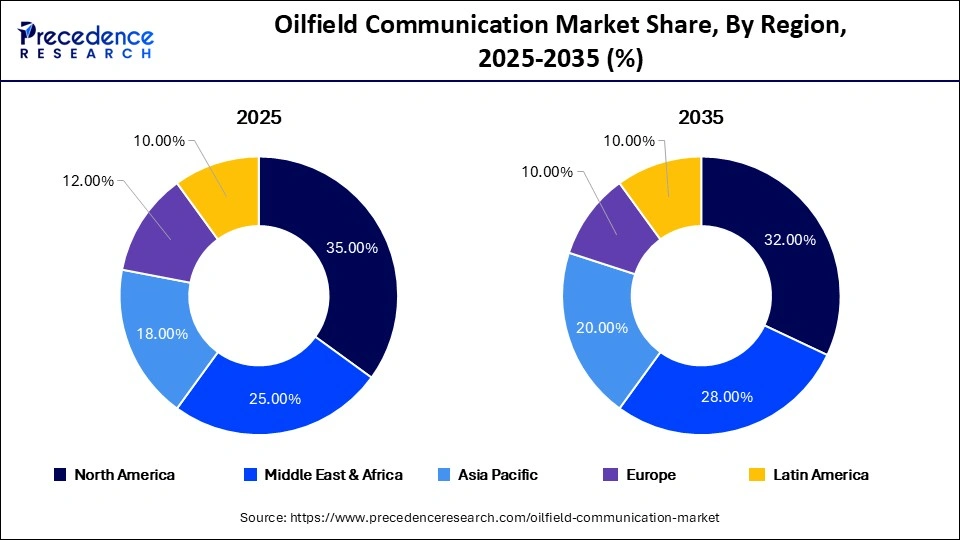
- North America led the oilfield communication market in 2025 with a 35% share.
- Middle East & Africa is observed to be the fastest-growing region, expanding at a CAGR of 9.5% during the forecast period.
- By communication type, the wireless communication segment led the market with a 40% share in 2025 and is expected to grow at the fastest CAGR of 9.5% in the upcoming period.
- By solution, the data communication systems segment led the global market in 2025 with a 35% share and is expected to grow at the fastest CAGR of 9% between 2026 and 2035.
- By network technology, the fibre optics segment led the global market in 2025 with a 30% share.
- By network technology, the LTE / 4G / 5G networks segment is expected to grow at the fastest CAGR of 10.5% in the coming years.
- By field site, the production sites segment led the global market in 2025 with a 30% share.
- By field site, the pipeline & transportation segment is expected to grow at the fastest CAGR of 8.5% during the projection period.
- By end-use type, the oil & gas operators segment led the global market in 2025 with 65% share.
- By end-use type, the oilfield service companies segment is expected to grow at the fastest CAGR of 8.5% in the upcoming period.
Oilfield Communication Market Overview
Oilfield communications serve as the key to ensuring seamless connectivity among offshore drilling rigs, production facilities, and onshore operations centres. As companies in the oilfield communication sector adopt digitalization and automation, they are leveraging advanced technologies to deliver comprehensive solutions tailored to each phase of the process, from exploration to refining. The rising demand for oil and gas resources is driving an increased need for effective oilfield communication systems.
Impact of Artificial Intelligence on the Oilfield Communication Market
Artificial intelligence is revolutionizing the oil and gas sector. Within the oilfield communication industry, AI employs sophisticated algorithms to analyse seismic data and accurately predict hydrocarbon locations. Furthermore, it leverages current data and analytics to monitor and enhance oilfield operations. Through advanced monitoring and predictive maintenance, potential issues can be identified before they develop into significant problems. Additionally, AI and machine learning enhance forecasting and decision-making processes, enabling the automation of oilfield communication operations. AI also plays a crucial role in predicting equipment failures and optimizing production parameters, thereby ensuring more efficient operations.
Oilfield Communication Market Trends
- Advanced Communication Technologies: Technologies such as satellite communication, microwave links, and cellular networks are essential for establishing seamless connectivity across oil field operations. These solutions enhance communication systems, enabling them to endure the harsh and extreme conditions of remote environments.
- Growth of Digital Tools and Applications: There has been a notable increase in the adoption of digital tools and applications aimed at streamlining communication processes in oil field operations. Industry-specific software solutions, including mobile applications for real-time data sharing, task management platforms for tracking progress, and incident reporting tools, are enhancing efficiency and ensuring compliance with safety standards.
- Impact on Environmental Regulations: Technological advancements are being propelled by stringent environmental regulations and carbon emission targets. These factors encourage companies to embrace advanced technologies for continuous monitoring and informed decision-making within production systems.
Market Scope
| Report Coverage | Details |
| Market Size in 2025 | USD 3.40 Billion |
| Market Size in 2026 | USD 3.65 Billion |
| Market Size by 2035 | USD 7.45 Billion |
| Market Growth Rate from 2026 to 2035 | CAGR of 8.16% |
| Dominating Region | North America |
| Fastest Growing Region | Middle East & Africa |
| Base Year | 2025 |
| Forecast Period | 2026 to 2035 |
| Segments Covered | Communication Type, Solution, Network Technology, Application, Field Site, End-Use, and Region |
| Regions Covered | North America, Europe, Asia-Pacific, Latin America, and Middle East & Africa |
Market Dynamics
Drivers
Integration of IoT and Growing Demand for Real-Time Data
The integration of Internet of Things (IoT) technology, coupled with the growing demand for real-time data and advancements in communication systems, is significantly propelling the growth of the oilfield communication market. The market growth is further fueled by the increasing trend of digitalization within the energy sector. Globally, the demand for oil and gas has surged, prompting companies to invest consistently in the exploration of new oil fields, thus supporting market growth.
Restraint
Lack of Skilled Professionals and Cybersecurity Challenges
A significant challenge in the oilfield communication market is a significant shortage of highly specialized professionals to address network-related issues. Furthermore, managing cybersecurity concerns and implementing new technologies to improve connectivity are crucial tasks. Ensuring safety and operational efficiency through reliable, real-time communication and data transfer is essential in oilfield environments.
Opportunity
Importance of Training and Workforce Development
Investing in training and education for personnel plays a crucial role in enhancing communication within oil field operations. A comprehensive training program that emphasizes communication protocols, equipment usage, and emergency procedures equips employees with essential skills. This approach facilitates effective communication during routine operations, emergencies, and crisis scenarios, while also promoting continuous learning and improvement in response to the evolving dynamics of the industry.
Segment Insights
Communication Type Insights
Oilfield Communication Market Share, By Communication Type, 2025-2035 (%)
| Communication Type | 2025 | 2035 | CAGR (%) |
| Wireless Communication | 40.00% | 45.00% | 9.5% |
| Wired Communication | 35.00% | 30.00% | 6.0% |
| Satellite Communication | 25.00% | 25.00% | 7.5% |
The Wireless Communication Segment Dominated the Market in 2025
The wireless communication emerged as the dominant segment in the oilfield communication market, holding a 40% share in 2025, and is expected to continue its dominance during the forecast period. This is mainly due to the rising demand for flexibility and remote connectivity. Wireless mesh solutions provide reliable broadband communications in oil fields, ensuring high reliability, robust capacity, and seamless scalability.
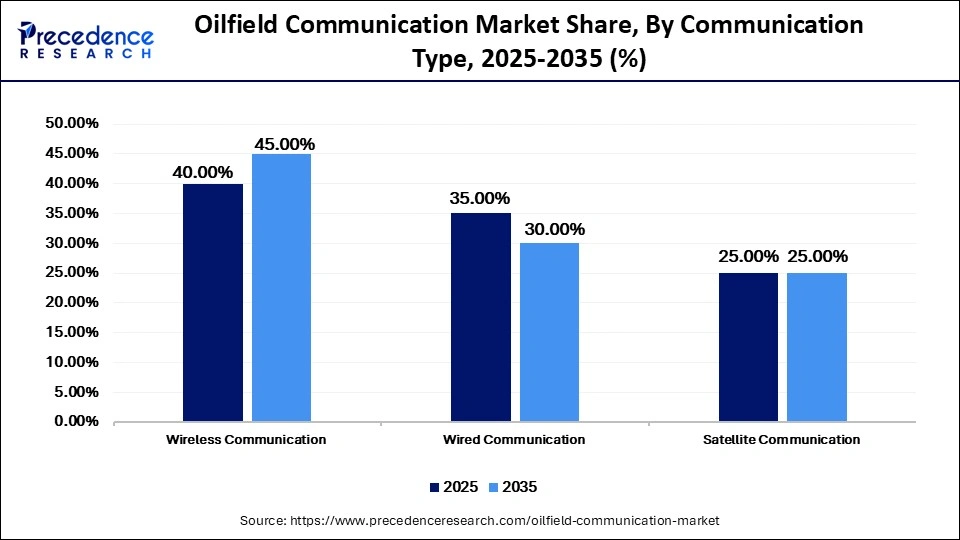
The wired communication segment held approximately 35% share of the market in 2025 and is expected to grow at a CAGR of 6% in the forthcoming years, thanks to its dependable infrastructure. For mission-critical systems that necessitate constant and uninterrupted connectivity, wired networks are frequently the preferred option. Wired networks deliver reliable, high-speed communication and superior security compared to wireless networks, making them particularly suitable for sensitive data transmission.
The satellite communication segment accounted for around 25% market share in 2025 and is projected to grow at a CAGR of 7.5% during the forecast period, driven by the increasing demand for remote offshore communication. Satellite communications enhance operational efficiency by enabling industries to leverage the Internet of Things (IoT). Furthermore, satellite connectivity facilitates a new level of digitalization within the industry by providing affordable and secure solutions to some of its most significant challenges.
Solution Insights
The Data Communication Systems Segment Held a 35% Market Share in 2025
The data communication systems segment led the oilfield communication market in 2025, capturing a 35% share, and is likely to grow at the fastest rate throughout the forecast period. This growth is fuelled by the increasing demand for dependable data communication solutions for oilfield crews operating in remote locations, alongside the rising trend towards data-driven operations. Data communication involves the transfer of digital and electronic information among multiple devices, systems, or locations via a transmission medium, facilitating seamless connectivity across networks.
The voice communication systems segment held a 25% market share in 2025 and is expected to grow at a CAGR of 6.5% in the upcoming years. This segment's growth is bolstered by the capacity of voice communication systems to integrate various communication channels into a unified platform. Voice Communication and Control Systems are essential for managing and connecting diverse communication tools utilized in Air Traffic Management, including VHF transmitters and receivers, telephones, and other air traffic control communication systems.
Oilfield Communication Market Share, By Solution, 2025-2035 (%)
| Solution | 2025 | 2035 | CAGR (%) |
| Data Communication Systems | 35.00% | 38.00% | 9.0% |
| Voice Communication Systems | 25.00% | 22.00% | 6.5% |
| Video Communication Systems | 20.00% | 22.00% | 8.5% |
| SCADA Systems | 20.00% | 18.00% | 7.0% |
The video communication systems segment held a 20% share of the oilfield communication market in 2025 and is expected to grow at a CAGR of 8.5% during the forecast period, driven by the increasing significance of video communication as a real-time visual link between two or more remote parties over the internet, effectively simulating face-to-face interaction. Video conferencing has become vital, enabling meaningful communication and collaboration among individuals who may not have the opportunity to meet in person.
The SCADA communication systems segment held a 20% market share in 2025 and is projected to grow at a CAGR of 7% in the forthcoming years. This segment's growth is attributed to the essential role that SCADA systems play in assisting industrial organizations to maintain operational efficiency, process data for informed decision-making, and identify system issues to reduce downtime. The SCADA communication network infrastructure is also a fundamental component of monitoring systems, ensuring reliable and continuous industrial operations.
Network Technology Insights
Oilfield Communication Market Share, By Network Technology, 2025-2035 (%)
| Network Technology | 2025 | 2035 | CAGR (%) |
| Fiber Optics | 30.00% | 32.00% | 8.0% |
| LTE / 4G / 5G Networks | 25.00% | 30.00% | 10.5% |
| VSAT | 25.00% | 22.00% | 6.5% |
| Microwave Communication | 20.00% | 16.00% | 6.0% |
The Fiber Optics Segment Dominated the Market with a 30% Share in 2025
The fiber optics segment led the oilfield communication market, accounting for a 30% share in 2025, fueled by an increasing demand for high-speed data transmission. Fiber optic solutions have become essential for establishing secure, scalable, and high-performance communication infrastructure within the sector. Their robustness and unparalleled efficiency have made fiber optic technologies a cornerstone of modern communication systems in industries such as oil and gas.
The LTE/4G/5G networks segment held approximately 25% share of the market in 2025 and is anticipated to grow at the fastest CAGR of 10.5% throughout the forecast period. This is mainly due to the rising adoption of private networks and their capability to support multiple communication protocols and interfaces. In smart oilfields, 5G LTE routers facilitate high-speed data transmission, effectively addressing real-time data requirements. Additionally, 4G and 5G networks allow for the flexible deployment of access points, ensuring comprehensive coverage across all oilfield locations necessitating data collection.
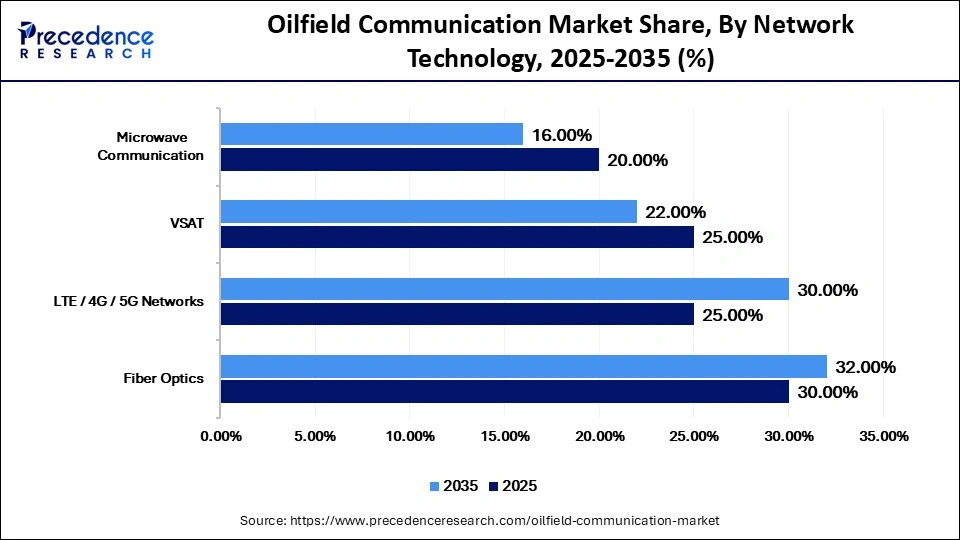
The VSAT (Very Small Aperture Terminal) segment held around 25% market share in 2025 and is projected to expand at a CAGR of 6.5% in the coming years, bolstered by its effectiveness in remote connectivity and compatibility with legacy infrastructure. VSAT enables two-way data transmission via geostationary satellites, linking remote sites to a central hub and providing internet, voice, and video services in areas lacking traditional infrastructure. Its adaptability and rapid deployment capabilities make it an asset in the oilfield communication market.
The microwave communication segment held nearly 20% share of the market in 2025 and is expected to grow at a CAGR of 6% in the coming years, driven by ongoing reliance on legacy infrastructure. Microwave radio transmission is often favored in regions where fiber optic infrastructure is absent, as well as for its relatively straightforward deployment. Microwave radio towers facilitate long-range communication across rural areas and provide last-mile, low-speed access through traditional interfaces.
Field Site Insights
Why Did the Production Sites Segment Led the Market in 2025?
The production sites segment led the oilfield communication market, holding around 30% share in 2025. This is mainly due to the necessity for continuous monitoring, the use of advanced and costly equipment, and the requirement for highly skilled labor. Most production facilities are strategically situated along coastal areas near offshore rigs. Furthermore, the design and operation of these facilities must adhere to safety and environmental regulations set forth by governing bodies.
The pipeline & transportation segment held approximately 25% share of the market in 2025 and is anticipated to grow at the fastest CAGR of 8.5% during the forecast period. Pipeline networks serve as essential transportation systems for moving oil and other materials over extensive distances, playing a critical role in the oil transportation process, as a substantial portion of oil is conveyed through pipelines for at least part of its journey. Variations in pipeline size, material, and function further underscore their significance within the broader oilfield infrastructure.
Oilfield Communication Market Share, By Field Site, 2025-2035 (%)
| Field Site | 2025 | 2035 | CAGR (%) |
| Production Sites | 30.00% | 32.00% | 8.0% |
| Drilling Sites | 25.00% | 24.00% | 7.5% |
| Pipeline & Transportation | 25.00% | 26.00% | 8.5% |
| Refinery & Processing | 20.00% | 18.00% | 6.5% |
The drilling sites segment held nearly 25% market share in 2025 and is expected to grow at a CAGR of 7.5% from 2026 to 2035. This is mainly due to the rising exploration activities. Vertical drilling remains the conventional technique for accessing reservoirs directly beneath the surface, and horizontal or directional drilling has gained traction, allowing for increased production volumes from a single wellbore by accessing a larger area of oil and gas reservoirs.
The refinery & processing segment accounted for approximately 20% market share in 2025 and is projected to grow at a CAGR of 6.5% throughout the forecast period. This is because these facilities rely on stable infrastructure to ensure efficient operations. The refining process is crucial for separating crude oil into various fractions, which can then be blended to meet specific product specifications. Consequently, refinery and processing facilities are integral components of the oilfield communication market.
End-Use Insights
The Oil & Gas Operators Segment Led the Market With a 65% Share in 2025
In 2025, the oil & gas operators segment led the oilfield communication market, capturing nearly 65% of the total market share. This is because these operators are responsible for overseeing exploration, production, and overall field operations, and they typically engage in drilling, completing, and maintaining wells. As key decision-makers in oilfield exploration, production, and marketing, they significantly influence the demand for communication solutions.
Oilfield Communication Market Share, By End-Use, 2025-2035 (%)
| End-Use | 2025 | 2035 | CAGR (%) |
| Oil & Gas Operators | 65.00% | 63.00% | 7.5% |
| Oilfield Service Companies | 35.00% | 37.00% | 8.5% |
The oilfield service companies segment held approximately 35% share of the market in 2025 and is expected to expand at the fastest CAGR of 8.5% from 2026 to 2035. This is mainly due to their increasing reliance on real-time data transmission for drilling, production, and well monitoring operations across remote sites. These companies are rapidly adopting advanced communication systems to improve operational efficiency, ensure worker safety, and enable predictive maintenance through continuous equipment and field data monitoring.
Regional Insights
North America Oilfield Communication Market Size and Growth 2026 to 2035
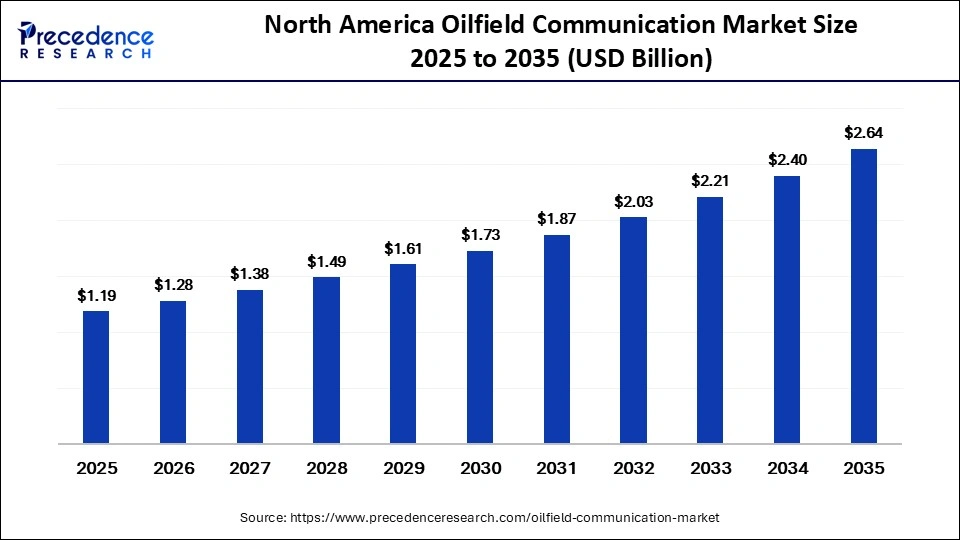
The North America oilfield communication market size is estimated at USD 1.19 billion in 2025 and is projected to reach approximately USD 2.64 billion by 2035, with a 8.29% CAGR from 2026 to 2035.
North America Dominated the Market With a 35% Share in 2025
North America dominated the oilfield communication market in 2025, accounting for 35% of the total share, driven by its mature oilfield infrastructure and ongoing digitalization. The region focuses on a robust industrial foundation, positioning it as a central hub for innovation and market expansion. A pivotal factor contributing to this leadership is the growing integration of digital technologies and automation within oil and gas operations. Furthermore, substantial investments in research and development (R&D) have bolstered the region's competitive standing.
U.S. Oilfield Communication Market Size and Growth 2026 to 2035
The U.S. oilfield communication market size is calculated at USD 892.50 million in 2025 and is expected to reach nearly USD 1,983.56 million in 2035, accelerating at a strong CAGR of 8.32% between 2026 and 2035.
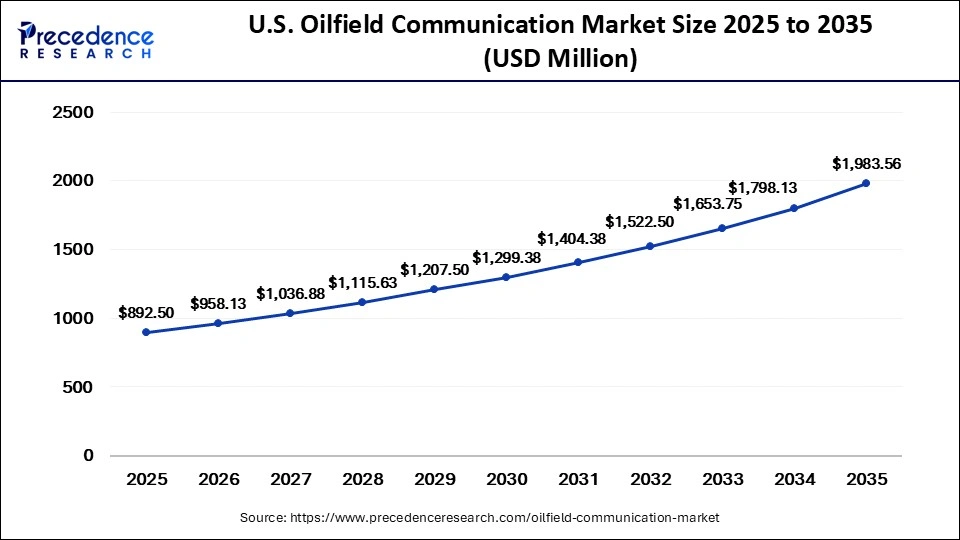
In North America, the U.S. holds a leading position, primarily due to its groundbreaking advancements in unconventional oil and gas resources, which have generated a significant demand for sophisticated oilfield communication services. Major industry players in the country are dedicated to creating and implementing customized communication solutions that enhance connectivity, optimize productivity, and elevate operational safety.
Middle East & Africa: The Fastest-Growing Region
The Middle East & Africa (MEA) held about 25% share of the oilfield communication market in 2025 and is expected to expand at the fastest CAGR of 9.5% during the forecast period. The region's growth is largely attributed to its abundant oil and gas reserves, alongside an increase in investments in communication infrastructure. The advent of satellite communication technology has been particularly revolutionary, providing dependable connectivity in remote areas and facilitating real-time data transfer in oilfield operations.
Saudi Arabia leads the oilfield communication market within the Middle East & Africa, bolstered by its strategic procurement agreements with both local and international oilfield service providers. As a key regional player, Saudi Arabia also stimulates demand from neighboring countries. The nation is well-regarded for its commitment to high standards of security, regulatory compliance, and industry certifications, which further enhances the development of the oilfield communication market.
Asia Pacific: The Fastest-Growing Region
Asia Pacific held a18% share of the market in 2025 and is expected to grow at a 8.5% CAGR in the coming years. This growth is propelled by an increase in exploration activities, a rise in energy consumption, and heightened investments in research and development. Furthermore, government initiatives aimed at fostering digital transformation within the energy sector are expediting market growth throughout the region.
China leads the Asia Pacific market, bolstered by significant investments in digital oilfield technologies. The region's growth is driven by an escalating demand for drilling, completion, and production optimization services in upstream oil and gas operations. Companies are increasingly channeling investments into automation, remote operations, and AI-driven optimization platforms to lower operational costs and enhance efficiency.
Oilfield Communication Market Companies
- Schlumberger
- Halliburton
- Baker Hughes
- Weatherford
- Huawei
- Ericsson
- Nokia
- Cisco Systems
- ABB
- Siemens
- Honeywell
- Emerson Electric
- Speedcast
- RigNet
- Tait Communications
Recent Developments
- In November 2025, COSL Drilling Europe, the Stavanger-based European drilling rig owner of Shanghai-listed China Oilfield Services Ltd. (COSL), deployed SpaceX's Starlink low Earth orbit (LEO) communications across four semi-submersible drilling rigs. The deployment supports remote operations by providing the predictable, high-quality connectivity such operations require.(Source: https://www.rivieramm.com)
- In August 2025, SuperMobile launched the first nationwide 5G-Advanced network slice for businesses, featuring built-in security and satellite-to-mobile connectivity. Early adopters, including Delta Air Lines and Axis Energy Services, are already using the solution to improve airline operations and support remote oilfield communications.(Source: https://www.rcrwireless.com)
Segment Covered in the Report
By Communication Type
- Wired Communication
- Wireless Communication
- Satellite Communication
By Solution
- Voice Communication Systems
- Data Communication Systems
- Video Communication Systems
- SCADA Communication Systems
By Network Technology
- Fiber Optics
- Microwave Communication
- VSAT (Very Small Aperture Terminal)
- LTE/4G/5G Networks
By Application
- Onshore Oilfields
- Offshore Oilfields
By Field Site
- Drilling Sites
- Production Sites
- Pipeline & Transportation
- Refinery & Processing
By End-Use
- Oil & Gas Operators
- Oilfield Service Companies
By Region
- North America
- Latin America
- Europe
- Asia-pacific
- Middle and East Africa
For inquiries regarding discounts, bulk purchases, or customization requests, please contact us at sales@precedenceresearch.com
Frequently Asked Questions





Ask For Sample
No cookie-cutter, only authentic analysis – take the 1st step to become a Precedence Research client
 Get a Sample




 sales@precedenceresearch.com
 Schedule a Meeting
