



Perovskite Photovoltaics Market Revenue to Attain USD 17.08 Bn by 2035
Published: 06 Jul 2026
Author: Precedence Research



Perovskite Photovoltaics Market Revenue and Trends 2026 to 2035
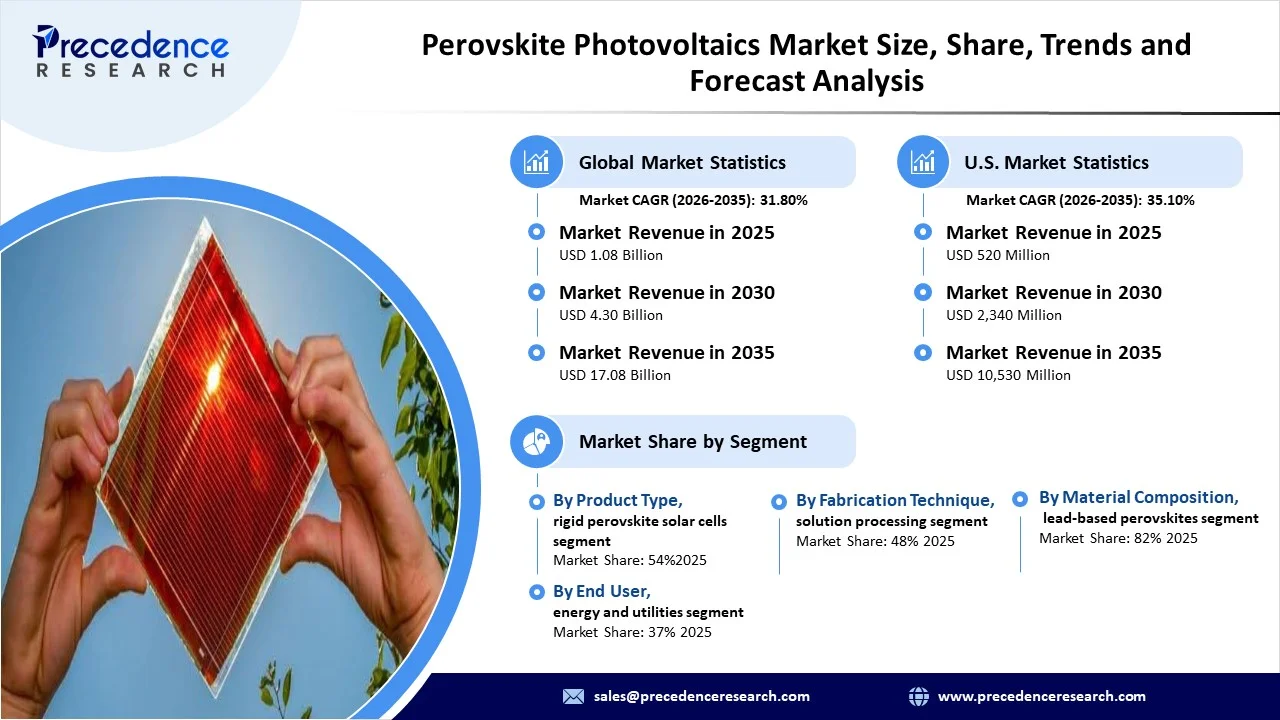
The global perovskite photovoltaics market revenue surpassed USD 1.08 billion in 2025 and is predicted to attain around USD 17.08 billion by 2035, growing at a CAGR of 31.80%. The market is driven by the revolutionary nature of this technology, offering highly efficient solar cells at considerably reduced production costs compared to traditional silicon, utilizing solution processability, light weight and flexibility, and stacking capability on top of silicon in tandem arrangements.
Next-Generation Solar Frontier
The perovskite photovoltaics market includes all aspects of activities involved in the research, development, manufacturing, and implementation of solar cells made using perovskite as the main light-absorbing component. Perovskite photovoltaics is a thin-film solar technology characterized by an innovative crystal structure featuring highly efficient optical and electrical properties such as a high absorption coefficient, long charge carrier diffusion length, and adjustable bandgap.
Perovskite photovoltaics have extremely high power conversion efficiency achieved at significantly lower material and processing costs compared to traditional silicon technology. The market includes single junction perovskite cells, perovskite-silicon tandem cells, all-perovskite tandem cells, and flexible and semi-transparent modules for integration in buildings and portable devices. The applications of this market include utility-scale solar plants, building-integrated photovoltaics (BIPV), portable electronics, and off-grid energy systems. This market has been adopted by solar farm developers, construction firms, electronics producers, and government authorities.
Commercial-Scale Efficiency Breakthroughs Drive Solar Technology Forward
The market is moving towards commercialization as manufacturers are recording unprecedented power and efficiency performance levels at an industrial scale. These are made possible through large-area tandem cells and indicate the possibility of a fast increase in efficiency at the commercially relevant scale. Trinasolar achieved a new world record for output of power in a tandem module in 2026, reaching up to 907W power in a perovskite/crystalline silicon tandem module with a full-area module efficiency of 29.2%, which has been verified by TUV SUD.
Early Shipments Signal Change from Laboratory to Utility-Scale
The perovskite photovoltaics market is progressing out of the laboratory prototype phase towards utility-scale applications with the emergence of commercial shipments and pilot production lines by manufacturers. Despite the skepticism about the long-term reliability of this technology versus traditional crystalline silicon, recent developments by various companies have signaled greater confidence in the viability of this technology. Caelux shipped its first commercial customer order of Active Glass technology for a utility-scale project from a major developer in 2025. According to the company, its tandem-based modules facilitate up to 30% more power density, 20% more energy generation, and reduce project costs by 20%.
National Funding Initiatives Drive Innovations in Commercial Solar Cells
Governments across the globe have initiated specific funding programs that facilitate the research, development, and commercialization of perovskite solar cell technology. Such initiatives enable countries to decrease the costs associated with making the leap from the lab to the commercial stage of this technology. In 2025, New Energy and Industrial Technology Development Organization (NEDO), Japan, chose EneCoat Technologies as a beneficiary of a Green Innovation Fund project during the final stage of the “Next-Generation Solar Cell Strategy” under the Ministry of Economy, Trade and Industry (METI). The project is aimed at developing mass production technology for thin-film perovskite solar cells.
GCL Optoelectronics Secures 1.2 MW Commercial Tender for Perovskite Tandem Modules
In 2026, GCL Optoelectronics signed a 1.2 MW commercial tender contract from China’s Huaneng Power for perovskite-silicon tandem photovoltaic modules. The contract calls for commercially available IEC-certified modules with more than 25% conversion efficiency, 25 years of performance guarantee, and delivery before the end of 2026. This is the first ever publicly announced commercial perovskite tandem modules project among China’s 5 largest state-owned power companies.
Market Segmentation Overview
- By product type, the rigid perovskite solar cells segment led the perovskite photovoltaics market with a 54% share in 2025 because of its compatibility with existing technology in the market and large-scale utility installations, which helps achieve rapid commercial success by using roll-to-roll or sheet-to-sheet processes in glass substrates that satisfy the needs of efficiency and durability for solar farms and building-integrated photovoltaics.
- By product type, the flexible perovskite solar cells segment is expected to expand at the highest CAGR of 36.7% during the forecast period, because it allows for the creation of brand new applications that cannot be met by any other technology. This segment facilitates portable electronics, BIPV on curved and lightweight substrates, and deployable applications that require flexibility.
- By fabrication technique, the solution processing segment dominated the market with a 48% share in 2025, owing to the fact that this process is the main feature of perovskite solar cells since it allows for obtaining films via low-cost manufacturing processes at room temperature using spin coating, slot-die coating, and inkjet printing. This segment optimizes capital investment and energy consumption.
- By fabrication technique, the roll-to-roll printing segment is expected to grow at the fastest CAGR of 38.5% from 2026 to 2035, because it represents the most realistic means for obtaining high-throughput and low-cost production, allowing for continuous manufacturing of lightweight, flexible perovskite modules that can be manufactured faster and cheaper than any other process.
- By material composition, the lead-based perovskites segment led the market with an 82% share in 2025 because it delivers the best power conversion efficiencies, along with being the main area of research for more than a decade thanks to its well-understood chemistry, effective deposition technique, and extensive literature providing fast development and improvement in performance and stability.
- By material composition, the lead-free perovskites segment is expected to expand at the highest CAGR of 39.8% during the forecast period, owing to the growing regulatory pressure and environmental concerns with regard to the toxicity of lead. This has led to rigorous development of tin-based, bismuth-based, and double perovskite substitutes that can offer similar efficiency levels to lead-based perovskites without posing any kind of toxicity risks.
- By application, the utility-scale solar power segment dominated the perovskite photovoltaics market with a 29% share in 2025, because it has a large addressable market and economic sense of introducing this technology, since switching from traditional silicon modules to perovskite-silicon tandem solar cells increases the power generation by 20 to 30 percent without altering the footprint of the project.
- By application, the consumer electronics segment is expected to grow at the fastest CAGR of 38.6% from 2026 to 2035, because flexible, lightweight, and even transparent perovskite solar cells can be incorporated into consumer electronics devices such as smartphones, wearable devices, IoT sensors, and portable chargers.
- By end user, the energy and utilities segment led the market with a 37% share in 2025, because it is the main provider of utility-scale solar farms, which account for the largest solar deployments worldwide and need high-efficiency modules to maximize and use the balance of system (BOS) costs.
- By end user, the consumer electronics manufacturers segment is expected to expand at the highest CAGR of 39.2% during the forecast period, since the flexible, lightweight, and semi-transparent solar perovskites can be embedded directly into electronic devices such as smartphones, wearable devices, IoT sensors, and portable chargers.
Regional Analysis
Asia-Pacific led the perovskite photovoltaics market with a 48% share in 2025 and is expected to expand at the highest CAGR of 35.1% during the forecast period, due to its status as the largest solar panel manufacturing base and having the largest solar deployment pipeline in the world. China dominated the market in Asia-Pacific because it manufactures more than 80% of all solar modules worldwide and is expanding perovskite-silicon tandem production to retain its cost advantage and technological lead. India witnessed notable market growth owing to its aggressive renewable energy goals, massive solar tender pipelines, and increasing manufacturing capabilities that make it a good early adopter for perovskites to reduce land footprint and increase energy efficiency.
Europe held the second-largest market share of 24% in 2025 because it is at the forefront of innovation in the area of sustainability, adhering to rigorous environmental policies, and undertaking cross-border collaborative research projects, which have become the benchmark for the responsible commercialization of perovskite photovoltaics globally. Germany led the market in Europe due to its well-developed research centers, mature solar industry, and significant work in tandem perovskites-silicon, boosted by government support through research initiatives. The UK is a significant contributor to the market owing to its thriving startup environment, significant number of perovskite intellectual property rights, and the commercial rollout of perovskite products by firms such as Oxford PV.
North America held the third-largest market share of 19% in 2025, due to the fact that it leads the way in terms of research and innovation, spearheaded by the top colleges and national institutions that have achieved improvements in efficiency, stability, and manufacturing. The U.S. dominated the market in North America owing to the significant investment from the Department of Energy for research in this field, the vibrant venture capital community that invests in perovskite technologies, and the early deployment of tandem technology in high-end applications. Canada witnessed notable market growth because of its excellent research facilities in the field of perovskites.
Perovskite Photovoltaics Market Coverage
| Report Attribute | Key Statistics |
| Market Revenue in 2025 | USD 1.08 Billion |
| Market Revenue by 2035 | USD 17.08 Billion |
| CAGR from 2026 to 2035 | 31.80% |
| Quantitative Units | Revenue in USD million/billion, Volume in units |
| Largest Market | North America |
| Base Year | 2025 |
| Regions Covered | North America, Europe, Asia-Pacific, Latin America, and the Middle East & Africa |
Top Companies in the Perovskite Photovoltaics Market
Oxford PV, Saule Technologies, Cubic PV, Swift Solar, and UtmoLight are some of the key players that focus on the development and commercialization of perovskite photovoltaics. Perovskia Solar AG and Microquanta Semiconductor focus on the development of digitally printed perovskite cells using smart manufacturing equipment. Solaires Enterprise, Inc. uses perovskite to develop next-generation solar technology that revolutionizes and accelerates the energy transition.
Segments Covered in this Report
By Product Type
- Rigid Perovskite Solar Cells
- Glass-based
- Silicon Tandem Modules
- Flexible Perovskite Solar Cells
- Plastic Substrate
- Metal Foil Substrate
- Semi-transparent Perovskite Solar Cells
- Architectural Glass
- Greenhouse Panels
By Device Architecture
- Planar Structure
- n-i-p
- p-i-n
- Mesoporous Structure
- Tandem Structure
- Perovskite-Silicon
- Perovskite-CIGS
- Perovskite-Perovskite
By Fabrication Technique
- Solution Processing
- Spin Coating
- Slot-Die Coating
- Blade Coating
- Vapor Deposition
- Inkjet Printing
- Roll-to-Roll Printing
By Material Composition
- Lead-based Perovskites
- Hybrid Organic-Inorganic
- All-Inorganic
- Lead-free Perovskites
- Tin-based
- Germanium-based
- Bismuth-based
By Application
- Utility-scale Solar Power
- Building Integrated Photovoltaics (BIPV)
- Facades
- Roofing
- Windows
- Consumer Electronics
- Wearables
- Portable Chargers
- IoT Devices
- Automotive
- Aerospace & Defense
- Indoor Energy Harvesting
By End User
- Energy and Utilities
- Residential
- Commercial
- Industrial
- Consumer Electronics Manufacturers
- Automotive Manufacturers
- Government and Research Institutions
By Distribution Channel
- Direct Sales
- EPC Contractors
- Distributors and Wholesalers
- Online Sales
By Region
- North America
- Latin America
- Europe
- Asia-pacific
- Middle and East Africa
Get this report to explore global market size, share, CAGR, and trends, featuring detailed segmental analysis and an insightful competitive landscape overview @ https://www.precedenceresearch.com/sample/8535
You can place an order or ask any questions. Please feel free to contact us at sales@precedenceresearch.com |+1 804 441 9344